
Forex Broker Commissions
Exness Commission Structure: Complete Breakdown by Account Type
Understand exactly what you pay per trade on every Exness account type.

Senior Forex Trader & Market Analyst
Daniel Chen is an experienced forex trader and financial market analyst with over 15 years of experience in currency trading. He specializes in technical analysis, risk management, and developing practical trading strategies to help traders make informed decisions.
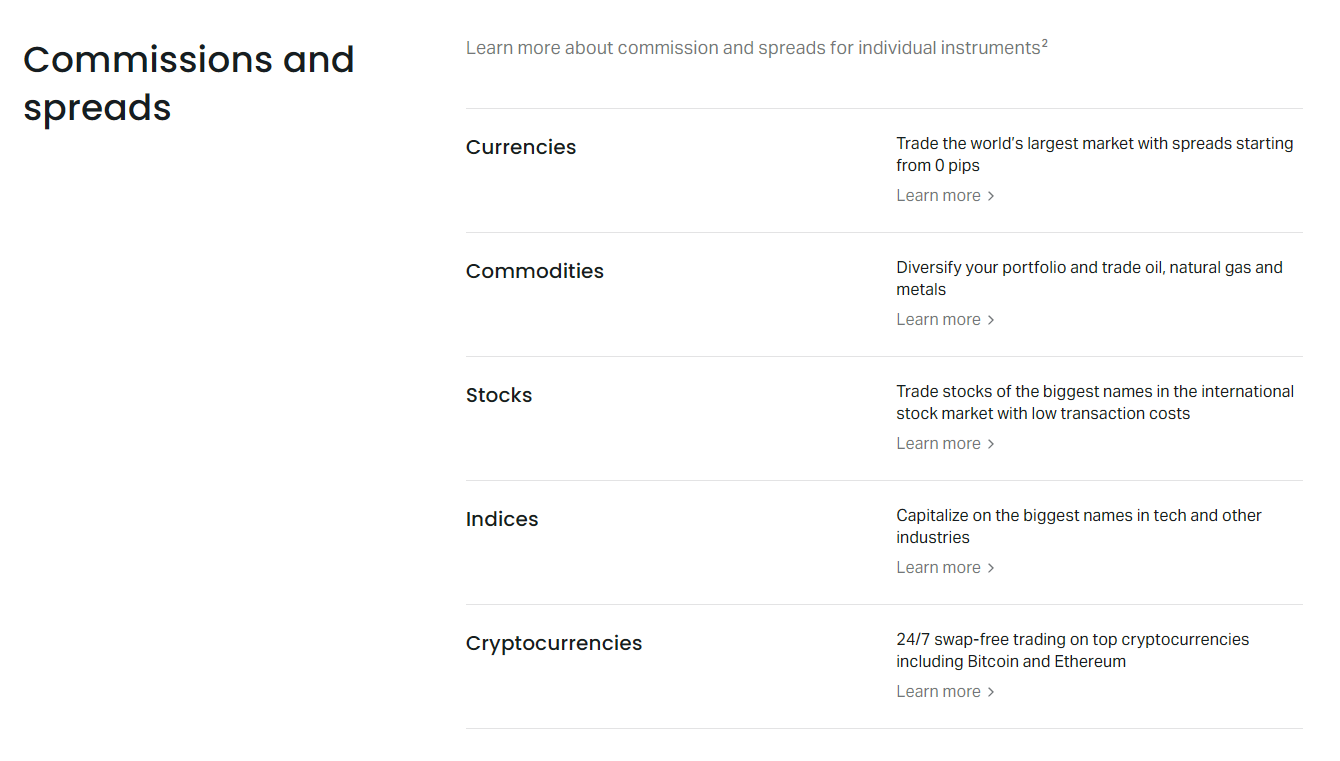
Exness offers several account types, each with a distinct commission structure. The broker does not charge a single flat fee across all products. Instead, commissions apply only to specific professional accounts, while standard accounts operate on a spread-only model. This article breaks down every commission rate, explains how they combine with spreads, and shows what different trading styles actually cost.
Contents
- 1. Exness Account Types and Their Cost Models
- 2. Standard and Standard Cent Accounts: Spread-Only Pricing
- 3. Pro Account: Low Spreads Without Commission
- 4. Raw Spread Account: Commission Rates by Instrument
- 5. Zero Account: Zero Spread Windows and Higher Commission
- 6. Comparing Total Cost: Spread Plus Commission
- 7. Commission Impact on Different Trading Styles
- 8. Swap Fees and Overnight Costs
- 9. Deposit and Withdrawal Fees
- 10. Hidden Costs to Watch For
- 11. Choosing the Right Account for Your Strategy
- 12. Final Assessment of Exness Commission Structure
Most traders focus on spreads first. That makes sense for standard accounts where the spread is the entire cost. But once you move to Raw Spread or Zero accounts, the commission becomes a separate line item that can exceed the spread on certain pairs. Knowing the exact per-lot rate for each instrument matters, especially for high-frequency strategies or large position sizes.
Exness publishes its commission schedule in the contract specifications for each account type. The rates differ by asset class: forex majors, minors, exotics, metals, energies, indices, stocks, and cryptocurrencies each have their own commission table. Some instruments carry a fixed commission per lot. Others use a percentage of notional value. The differences are not trivial.
This guide covers every account type Exness offers as of the current specification. It includes the Standard and Standard Cent accounts (zero commission), the Pro account (low spread, no commission), and the two commission-based professional accounts: Raw Spread and Zero. For each, you will find the exact commission per lot, how it is charged, and what it means for your bottom line.
Exness Account Types and Their Cost Models
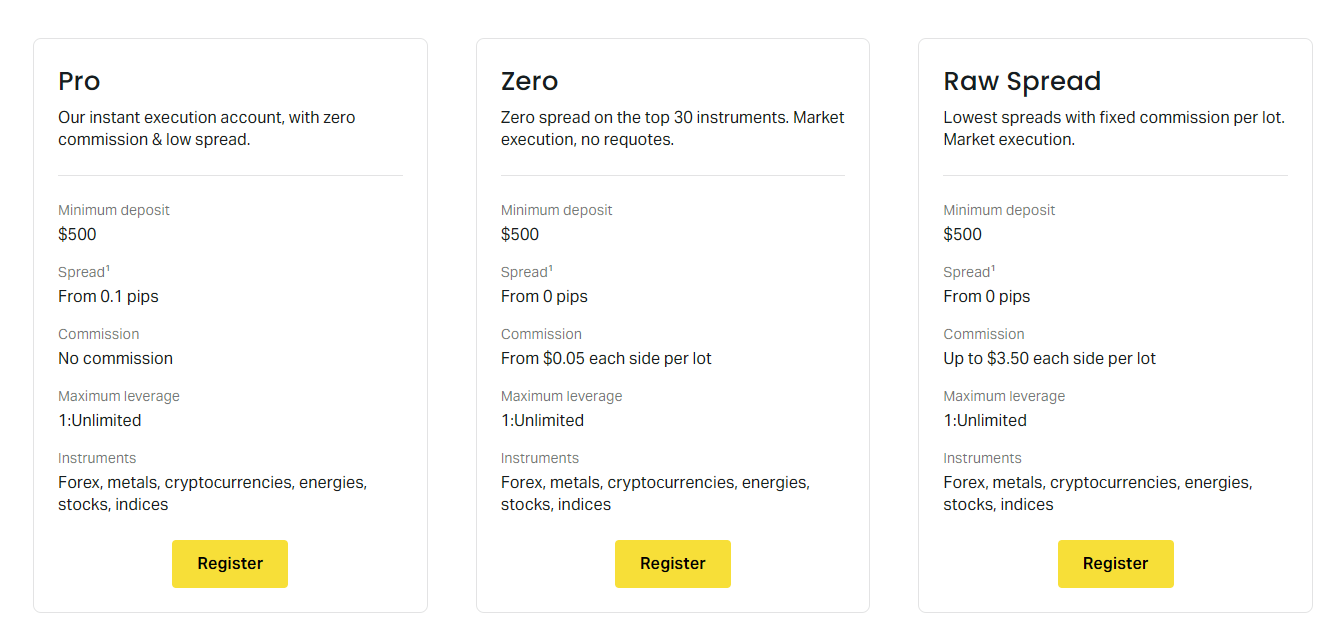
Exness currently provides five live account categories. Two are designed for beginners and casual traders. Three target professionals with different preferences for how trading costs are structured. The commission only appears on two of them.
- Standard — spread-only, no commission, minimum deposit $1
- Standard Cent — spread-only, no commission, denominated in cents
- Pro — low spread, no commission, minimum deposit $200
- Raw Spread — tight spreads plus fixed commission per lot
- Zero — zero spread on top pairs during peak hours, commission per lot
The Standard and Standard Cent accounts are straightforward. You pay the spread. That spread widens during volatile periods but never includes a separate commission charge. The Pro account also has no commission. Its spreads are tighter than Standard but wider than Raw Spread or Zero. The trade-off is simplicity: one cost component, no per-lot calculation needed.
Raw Spread and Zero accounts introduce a commission. On Raw Spread, you get spreads close to the interbank level and pay a fixed commission per round turn (open and close). On Zero, spreads can reach 0.0 pips on major forex pairs during peak liquidity, but the commission is higher. Both accounts require a $200 minimum deposit.
The commission on Raw Spread and Zero accounts is charged per lot per side. That means opening a 1-lot position incurs half the round-turn commission. Closing it incurs the other half. Some traders prefer to think in round-turn terms. A round turn on EURUSD Raw Spread costs $3.5 per lot ($1.75 per side). On Zero, the same pair costs $7 per lot round turn ($3.5 per side).
Standard and Standard Cent Accounts: Spread-Only Pricing
These two accounts share the same cost model. The broker makes money entirely from the spread markup. There is no commission, no ticket fee, no hidden per-trade charge. The spread you see on the platform is the total cost to enter and exit a position.
Standard account spreads start from 0.3 pips on EURUSD under normal conditions. Standard Cent spreads are identical in pip terms but the monetary value per pip is 100 times smaller because the account is denominated in cents. A 1-pip move on a 1-lot Standard Cent position equals $0.10, not $10.
Spreads on these accounts are floating. They widen during news events, rollover, and low-liquidity hours. Exness does not guarantee fixed spreads. During major releases like NFP or CPI, EURUSD spreads on Standard can exceed 3 pips temporarily. That is the only cost increase — no commission spike occurs.
Scroll horizontally to see all columns
| Instrument | Average Spread | Commission |
|---|---|---|
| EURUSD | 0.7 | 0 |
| GBPUSD | 1.1 | 0 |
| USDJPY | 0.8 | 0 |
| XAUUSD | 25 | 0 |
| USOIL | 4 | 0 |
| BTCUSD | 4500 | 0 |
The spread-only model suits traders who want predictable cost structure without calculating per-lot fees. It also works well for smaller accounts where a $3.5–$7 round-turn commission would represent a large percentage of the trade value. On a $100 account trading 0.01 lots, a $0.07 commission is negligible, but the spread cost scales linearly with position size.
Spread-only accounts remove the mental overhead of commission math. You see the cost on the chart. What you see is what you pay.
Pro Account: Low Spreads Without Commission
The Pro account sits between Standard and the commission-based accounts. It offers tighter spreads than Standard — typically 0.1–0.2 pips better on majors — but still charges zero commission. The minimum deposit is $200. This account targets traders who want better pricing than Standard but dislike the commission model.
Pro account spreads are floating like Standard. They do not reach the near-zero levels of Raw Spread or Zero during peak hours. But they also do not carry a per-lot fee. For a trader doing 10 lots per month on EURUSD, the spread saving versus Standard might be $10–$20, while avoiding $35–$70 in commissions on Raw Spread or Zero.
Exness does not charge swap fees on Pro accounts for forex majors and metals if the position is closed within the same trading day. Overnight swaps apply normally. This intraday swap-free feature is unique to Pro and can benefit day traders who occasionally hold past rollover by accident.
Raw Spread Account: Commission Rates by Instrument
Raw Spread is the first account where commission appears. The spreads are the tightest Exness offers outside of Zero's promotional zero-spread windows. The commission is fixed per lot per side and varies by asset class. Forex majors cost $3.5 per lot round turn. Crosses and minors cost more. Metals, energies, and indices have their own schedules.
The commission is deducted at the moment the position opens and again when it closes. It appears as a separate line in the trade history and account statement. It does not affect the spread displayed on the chart. The spread you see is the raw market spread. Your total cost equals that spread plus the commission.
Scroll horizontally to see all columns
| Asset Class | Commission (USD) | Notes |
|---|---|---|
| Forex majors (EURUSD, GBPUSD, USDJPY, etc.) | $3.5 | Per lot round turn |
| Forex minors and crosses | $5 – $10 | Varies by pair |
| Forex exotics | $15 – $50 | Higher due to liquidity |
| Gold (XAUUSD) | $5 | Per lot round turn |
| Silver (XAGUSD) | $10 | Per lot round turn |
| Energies (USOIL, UKOIL) | $10 | Per lot round turn |
| Indices (US30, US500, USTEC) | $5 – $15 | Per lot round turn |
| Stocks (US shares) | $0.02 per share | Minimum $1 per trade |
| Cryptocurrencies | 0.005% notional | Per side, percentage-based |
Note that stock commissions use a per-share model with a $1 minimum. Trading 10 shares of a $200 stock costs $1 (the minimum), not $0.20. Trading 100 shares costs $2. Cryptocurrency commissions are percentage-based on the notional value, which means they scale with price. A 1-lot BTCUSD position at $60,000 incurs $3 per side ($6 round turn). At $100,000, it becomes $5 per side.
The Raw Spread commission schedule is competitive with other ECN-style brokers. IC Markets Raw Spread charges $3.5 per lot round turn on majors. Pepperstone Razor charges $3.5. FP Markets Raw charges $3.0. Exness sits in the middle. Where Exness differs is the Zero account, which offers a zero-spread window on top pairs — a feature most competitors do not match.
Zero Account: Zero Spread Windows and Higher Commission
The Zero account is Exness's most distinctive offering. During peak liquidity hours (typically London/New York overlap), spreads on major forex pairs can reach 0.0 pips. The commission is double the Raw Spread rate: $7 per lot round turn on majors. Outside the zero-spread window, spreads widen to Raw Spread levels but the commission remains at the Zero rate.
This account suits scalpers and high-frequency traders who execute during the London/New York session and value zero spread over lower commission. For a scalper taking 5-pip targets on EURUSD, saving 0.5–0.8 pips of spread per trade can outweigh the extra $3.5 commission per lot. The math changes completely for swing traders holding positions for days.
Scroll horizontally to see all columns
| Asset Class | Commission (USD) | Zero Spread Window |
|---|---|---|
| Forex majors | $7 | Yes, 0.0 pips possible |
| Forex minors and crosses | $10 – $20 | No |
| Forex exotics | $30 – $100 | No |
| Gold (XAUUSD) | $10 | No |
| Silver (XAGUSD) | $20 | No |
| Energies | $20 | No |
| Indices | $10 – $30 | No |
| Stocks | $0.04 per share | Min $2 per trade |
| Cryptocurrencies | 0.01% notional | Per side |
The zero-spread window runs approximately 07:00–20:00 server time (GMT+2/GMT+3 depending on DST). This covers the London open through the US close. Outside these hours, spreads on majors typically range 0.1–0.3 pips. The commission does not decrease. Traders who operate mainly during Asian session hours pay the higher Zero commission without the zero-spread benefit.
Comparing Total Cost: Spread Plus Commission
To compare accounts fairly, you must add the spread cost to the commission cost. Spread cost equals spread in pips × pip value × lots. Commission cost equals commission per lot × lots. The account with the lowest combined total wins for your specific instrument and trade size.
On EURUSD with 1-lot positions: Standard might show 0.7 pip spread ($7 cost). Raw Spread shows 0.1 pip spread ($1) + $3.5 commission = $4.5 total. Zero shows 0.0 pip spread ($0) + $7 commission = $7 total. In this example, Raw Spread wins. But if Standard spread widens to 1.5 pips during news, its cost becomes $15, making Zero cheaper despite the higher commission.
Scroll horizontally to see all columns
| Account | Spread (pips) | Spread Cost | Commission | Total Cost |
|---|---|---|---|---|
| Standard | 0.7 | $7 | $0 | $7 |
| Pro | 0.5 | $5 | $0 | $5 |
| Raw Spread | 0.1 | $1 | $3.5 | $4.5 |
| Zero (peak) | 0.0 | $0 | $7 | $7 |
| Zero (off-peak) | 0.2 | $2 | $7 | $9 |
The table above uses typical spreads. Real spreads fluctuate. During high volatility, Standard and Pro spreads can widen significantly while Raw Spread and Zero spreads remain relatively stable. This stability is the main advantage of commission-based accounts: cost predictability. You know the commission. The spread varies less.
Commission accounts trade variable spread risk for fixed commission certainty. That trade-off favors high-volume traders who can amortize the commission.
Commission Impact on Different Trading Styles
Scalpers are most sensitive to commission. A scalper targeting 3–5 pips per trade on EURUSD executes dozens of trades daily. On Raw Spread, each round turn costs $3.5. On 20 trades of 1 lot each, that is $70 daily in commissions alone — $1,400 monthly. The spread saving versus Standard must exceed that amount to justify the account.
Day traders holding positions for hours face a similar calculation but with fewer trades. Five trades daily at 1 lot each: $17.5 commission on Raw Spread, $35 on Zero. If the tighter spread saves 0.5 pips per trade ($5), Raw Spread nets $2.5 saving per trade. Zero loses $2.5 per trade unless the spread hits 0.0 pips.
Swing and position traders barely notice commission. A trader holding 2 lots of EURUSD for two weeks pays $7 commission on Raw Spread once. The spread saving over that period — even 0.2 pips daily — accumulates to $28. Commission becomes a rounding error. For these traders, Standard or Pro often makes more sense due to zero commission and simpler accounting.
- Scalpers (10+ trades/day): Raw Spread usually optimal, Zero only during peak hours
- Day traders (3–8 trades/day): Raw Spread or Pro depending on volume
- Swing traders (1–5 trades/week): Standard or Pro, commission irrelevant
- Position traders (1–2 trades/month): Standard, simplest cost structure
Swap Fees and Overnight Costs
Commission is not the only recurring cost. Swap fees (rollover interest) apply to positions held past 23:59 server time. Exness charges swaps on all account types except for the Pro account's intraday swap-free feature on forex majors and metals. Swap rates vary by instrument and direction (long vs short). They can be positive (you receive) or negative (you pay).
On major forex pairs, swaps are typically small — often $0.50–$2 per lot per night. On exotics, they can exceed $20 per lot per night. Gold swaps are significant: roughly -$1.5 per lot per night long, +$0.5 short. Indices and stocks also carry swaps. Cryptocurrency swaps are high due to volatility and funding rates.
Exness offers swap-free (Islamic) accounts for clients who qualify. These accounts replace swaps with a fixed administration fee per lot per night after a grace period (usually 3–7 days). The fee is typically lower than the swap would be on major pairs but higher on exotics. Commission on Raw Spread and Zero swap-free accounts remains unchanged.
Deposit and Withdrawal Fees
Exness does not charge deposit fees for any payment method. The broker absorbs processor fees. Withdrawals are also free on most methods. The exception is bank wire withdrawals under $500, which incur a $10 fee. Crypto withdrawals carry the network fee (miner fee), which goes to the blockchain, not Exness.
This is more generous than many brokers who charge 1–2% on card deposits or fixed withdrawal fees. The lack of deposit fees means your full capital reaches the trading account. For a $10,000 deposit, saving $100–$200 in deposit fees equals 20–40 round turns on Raw Spread EURUSD.
Withdrawal speed varies by method. E-wallets and crypto are instant. Cards take 1–3 business days. Bank wires take 3–5 business days. Exness processes withdrawal requests 24/7, including weekends. The funds leave Exness instantly; the delay is on the payment provider side.
Hidden Costs to Watch For
Beyond commission, spread, and swap, three less obvious costs affect net profitability: slippage, requotes, and inactivity fees. Exness uses market execution on all accounts. Slippage occurs during high volatility. It is not a fee but a cost — you fill at a worse price than requested. Positive slippage also occurs and Exness passes it to the client.
Requotes do not happen on market execution accounts. The order fills at the best available price. This is standard on Raw Spread, Zero, and Pro. Standard and Standard Cent also use market execution. No dealing desk intervention means no artificial requotes.
Inactivity fees apply after 180 days of no trading activity. The fee is $10 per month deducted from the account balance until trading resumes or balance reaches zero. This only affects dormant accounts. Active traders never encounter it.
- Slippage: market execution, can be positive or negative
- No requotes on any account type
- Inactivity fee: $10/month after 180 days idle
- No deposit fees on any method
- Bank wire withdrawal fee: $10 if under $500
Choosing the Right Account for Your Strategy
The decision tree is straightforward. Start with your typical monthly volume in lots and your primary instruments. Then match to the account that minimizes total cost.
If you trade under 5 lots monthly on forex majors: Standard or Standard Cent. Commission accounts add cost without enough spread saving to compensate. If you trade 5–30 lots monthly on majors: Pro or Raw Spread. Pro if you dislike commission math; Raw Spread if you want the tightest spreads and accept the per-lot fee.
If you trade 30+ lots monthly on majors during London/NY hours: Zero account during peak hours, Raw Spread otherwise. The zero-spread window must align with your trading schedule. If you trade minors, exotics, metals, or indices heavily: Raw Spread. Zero commission on those instruments is too high.
Stock and crypto traders should compare the per-share and percentage commissions against other brokers. Exness stock commission ($0.02/share Raw, $0.04/share Zero) is competitive for US shares. Crypto commission (0.005% Raw, 0.01% Zero) is higher than dedicated crypto exchanges but typical for CFD brokers.
The best account is not the one with the lowest spread or lowest commission. It is the one where spread plus commission plus swap equals the lowest total for your actual trading pattern.
Final Assessment of Exness Commission Structure
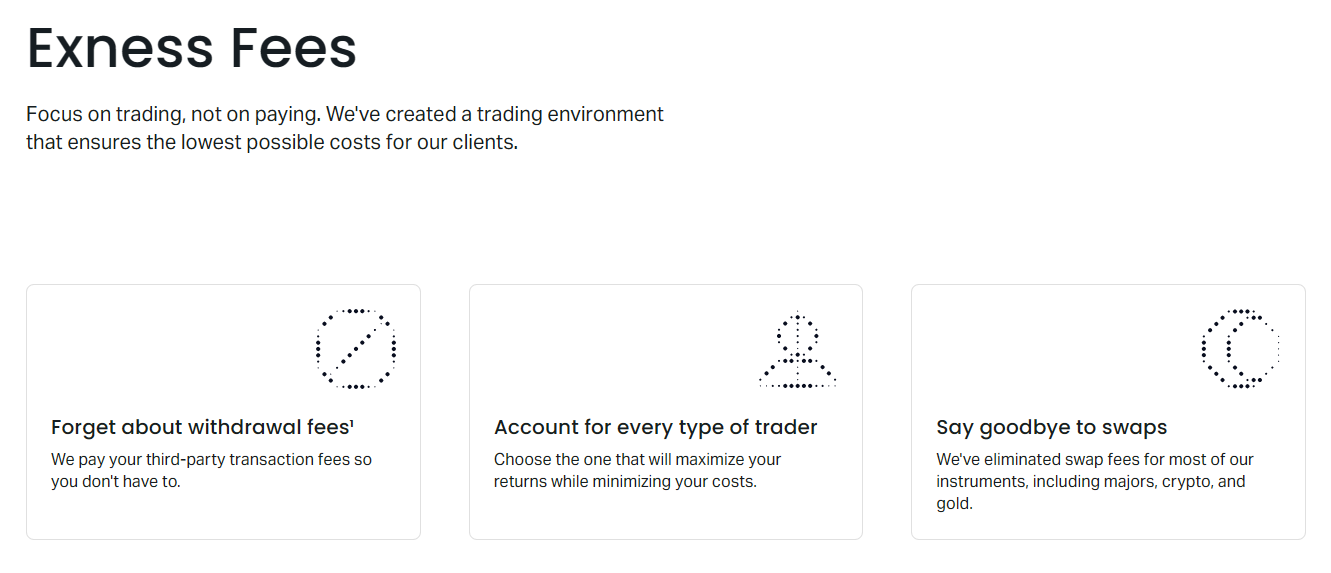
Exness commissions are transparent, published, and applied consistently. The broker does not hide fees in widened spreads on commission accounts — the spread is raw, the commission is separate. This clarity is valuable. Traders can calculate exact costs before entering a position.
The Raw Spread account at $3.5 per lot round turn on majors is industry-standard. The Zero account's $7 commission is high but buys access to genuine 0.0 pip spreads during the most liquid hours. For the right trader — a scalper executing 50+ lots monthly during London/NY overlap — that trade-off pays off. For everyone else, it is an expensive gimmick.
Standard and Pro accounts remain the most practical choices for the majority of retail traders. Zero commission, reasonable spreads, no per-lot math. The Pro account's intraday swap-free feature on majors and metals is a genuine differentiator for day traders. Exness's fee structure rewards self-awareness: know your volume, know your hours, pick the account that matches.
Frequently Asked Questions
Does Exness charge commission on Standard accounts?
No. Standard and Standard Cent accounts are spread-only. The spread you see is the total cost. There is no separate commission charge on any instrument.
What is the commission on Exness Raw Spread account for EURUSD?
$3.5 per lot round turn ($1.75 per side). This applies to all forex majors. Minors and exotics have higher rates.
How does Exness Zero account commission compare to Raw Spread?
Zero account commission is double: $7 per lot round turn on majors. In exchange, spreads can reach 0.0 pips during peak liquidity hours (approximately 07:00–20:00 server time).
Are there deposit or withdrawal fees at Exness?
Deposits are free on all methods. Withdrawals are free except bank wires under $500, which incur a $10 fee. Crypto withdrawals carry the network miner fee.
Does Exness charge inactivity fees?
Yes, $10 per month after 180 consecutive days of no trading activity. The fee stops when trading resumes or balance reaches zero.
How are stock commissions calculated on Exness?
Raw Spread: $0.02 per share, minimum $1 per trade. Zero: $0.04 per share, minimum $2 per trade. Commission applies per side (open and close).
Is the Pro account truly commission-free?
Yes. Pro account has zero commission on all instruments. Spreads are tighter than Standard but wider than Raw Spread. It also offers intraday swap-free on forex majors and metals.
Which Exness account has the lowest total cost for a swing trader?
Standard or Pro. For positions held days or weeks, commission is paid once but spread saving on Raw Spread/Zero is minimal. Zero commission accounts win for low-frequency trading.