

Forex Trading Guides
Exness Minimum Lot Sizes by Account Type
Learn the exact minimum lot sizes for each Exness account type and how they affect your trading strategy and risk management.

Senior Forex Trader & Market Analyst
Daniel Chen is an experienced forex trader and financial market analyst with over 15 years of experience in currency trading. He specializes in technical analysis, risk management, and developing practical trading strategies to help traders make informed decisions.
When you open a trade on Exness, the smallest position you can take is defined by the minimum lot size. This number varies depending on which account type you use, and it directly affects how much capital you need, how you manage risk, and which strategies are practical. Understanding these minimums is not just a technical detail — it shapes every trading decision you make on the platform.
Contents
- 1. What Is a Lot in Forex Trading
- 2. Exness Account Types and Their Minimum Lots
- 3. Standard Account Minimum Lot Details
- 4. Standard Cent Account Minimum Lot Details
- 5. Professional Account Minimum Lots
- 6. How Minimum Lot Affects Risk Management
- 7. Calculating Position Size with Exness Minimum Lots
- 8. Practical Examples for Different Account Sizes
- 9. Minimum Lot vs Leverage and Margin Requirements
- 10. Trading Different Instruments with Minimum Lots
- 11. Switching Account Types as You Grow
- 12. Common Mistakes with Minimum Lot Sizing
- 13. Exness Minimum Lot in the Trading Terminal
- 14. Final Assessment of Exness Minimum Lot
Exness offers several account categories: Standard, Standard Cent, and Professional accounts that include Raw Spread, Zero, and Pro. Each has its own minimum lot requirement, and the differences are significant. A Standard account lets you trade as little as 0.01 lots. A Standard Cent account goes down to 0.01 cent lots, which is effectively 0.0001 standard lots. Professional accounts also start at 0.01 lots but come with different cost structures that change how that minimum works in practice.
Many traders overlook minimum lot size when choosing an account. They focus on spreads, commissions, or leverage instead. But the minimum lot determines the smallest risk you can take per trade. If your account balance is small, a 0.01 lot minimum on a Standard account might force you to risk more per trade than you're comfortable with. That's where the Cent account becomes valuable — it lets you scale down risk to match a smaller balance.
This guide breaks down the exact minimum lot sizes for every Exness account type, explains how they translate to real monetary risk, and shows you how to calculate position sizes that fit your account balance and risk tolerance. We'll also cover how minimum lots interact with leverage, margin requirements, and different instrument classes like forex, metals, indices, and crypto.
What Is a Lot in Forex Trading
A lot is the standardized unit of measurement for a trading position. In forex, one standard lot equals 100,000 units of the base currency. If you buy one lot of EURUSD, you're buying 100,000 euros. A mini lot is 0.1 lots, or 10,000 units. A micro lot is 0.01 lots, or 1,000 units. Exness also supports cent lots on Cent accounts, where one cent lot equals 1,000 units of the base currency — but the account currency is cents, not dollars, so the monetary value is 100 times smaller.
The lot size determines your pip value. On a standard lot of EURUSD, one pip is worth $10. On a mini lot, it's $1. On a micro lot, it's $0.10. On a cent lot, it's $0.001. This scaling is why minimum lot size matters so much for risk management. If you can only trade 0.01 standard lots and your stop loss is 20 pips, your minimum risk per trade is $20. On a Cent account trading 0.01 cent lots with the same stop, your risk is $0.20.
Exness allows fractional lots beyond the minimum. You can trade 0.02, 0.03, 0.15, or any increment above the minimum. The platform supports lot sizes up to 200 lots per position on most instruments, though maximum position limits vary by instrument and account type. The key constraint for most traders is the minimum, not the maximum.
Exness Account Types and Their Minimum Lots
Exness groups accounts into three main categories. Standard accounts include Standard and Standard Cent. Professional accounts include Raw Spread, Zero, and Pro. Each category has distinct minimum lot requirements, and the differences reflect the intended user base — from beginners with small deposits to high-volume traders who need the tightest spreads.
The table below summarizes the minimum lot sizes across all Exness account types. Note that these minimums apply to forex pairs. Some instruments like crypto or indices may have different minimums, which we'll cover later.
Scroll horizontally to see all columns
| Account Type | Category | Minimum Lot | Lot Type | Pip Value (EURUSD) |
|---|---|---|---|---|
| Standard | Standard | 0.01 | Standard lot | $0.10 |
| Standard Cent | Standard | 0.01 | Cent lot | $0.001 |
| Raw Spread | Professional | 0.01 | Standard lot | $0.10 |
| Zero | Professional | 0.01 | Standard lot | $0.10 |
| Pro | Professional | 0.01 | Standard lot | $0.10 |
All Exness accounts share the same 0.01 minimum lot increment. The difference lies in what that 0.01 represents. On Standard, Raw Spread, Zero, and Pro accounts, 0.01 means 0.01 standard lots — 1,000 units of base currency. On Standard Cent, 0.01 means 0.01 cent lots — 1,000 units of base currency but denominated in cents, making the monetary exposure 100 times smaller.
Standard Account Minimum Lot Details
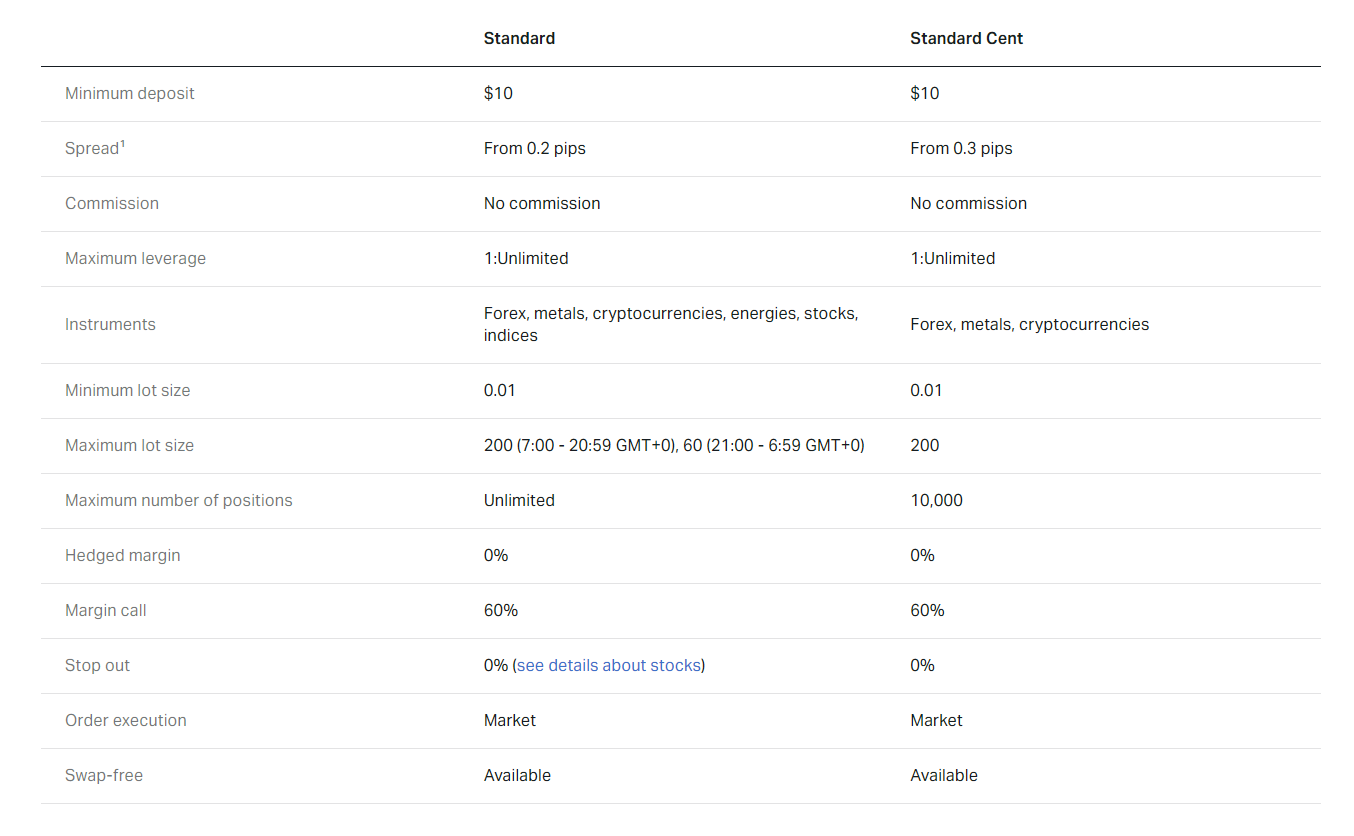
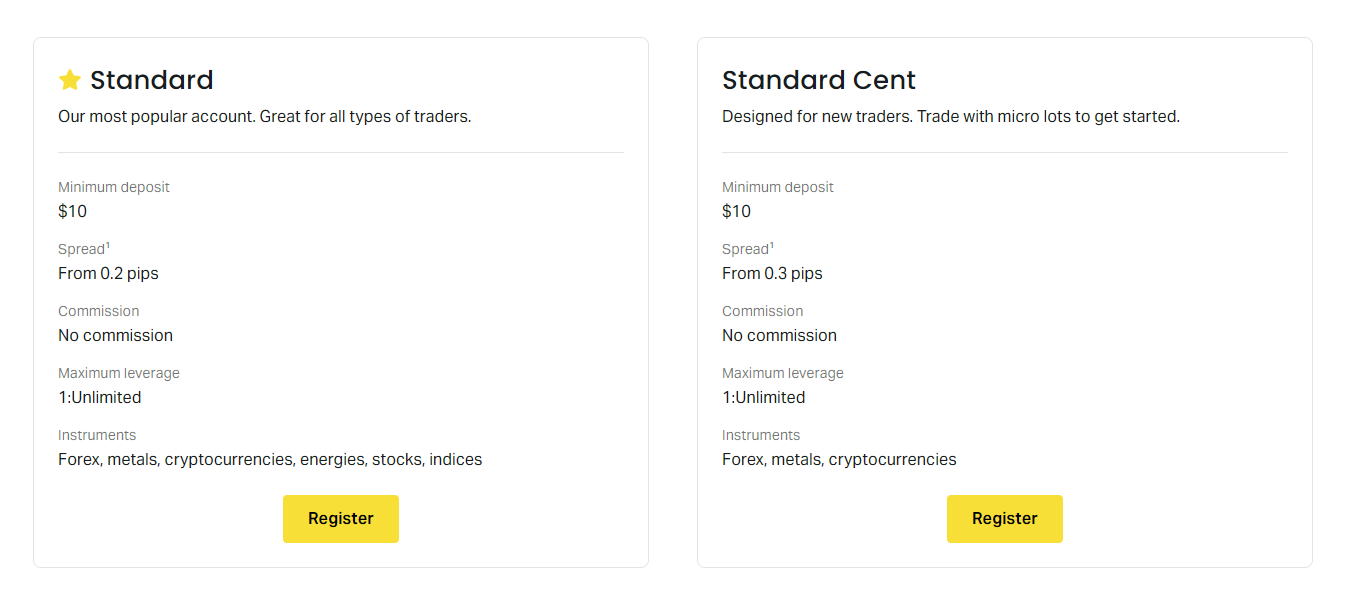
The Standard account is Exness's most popular offering for retail traders. It requires a minimum deposit of $1 (though practical minimums depend on your payment method), offers spreads from 0.3 pips with no commission, and allows a minimum trade size of 0.01 standard lots. This account suits traders with balances from roughly $100 to several thousand dollars who want straightforward pricing without commissions.
At 0.01 lots on EURUSD, each pip moves your account by $0.10. A 20-pip stop loss risks $2. A 50-pip stop risks $5. For a $500 account, risking 1% per trade means a $5 maximum risk, which aligns with a 50-pip stop at minimum lot size. If you need tighter stops or smaller risk, you either need a larger account or a Cent account. The Standard account also supports up to 1:2000 leverage (depending on equity), which reduces margin requirements but doesn't change the minimum lot size.
One practical consideration: the Standard account's spread starts at 0.3 pips on major pairs. On a 0.01 lot trade, that spread costs $0.03. It's negligible for swing trades but adds up for scalpers. If you're placing dozens of minimum-lot trades per day, the spread cost becomes a meaningful drag. That's where Professional accounts with raw spreads and commissions can make sense — but they require higher deposits.
The Standard account also applies to metals, energies, indices, and crypto. Minimum lot sizes for these instruments differ. Gold (XAUUSD) minimum is 0.01 lots, where one lot equals 100 ounces. So 0.01 lots is 1 ounce. Silver minimum is 0.01 lots (500 ounces per lot). Oil minimum is 0.01 lots (1,000 barrels per lot). Index minimums vary — US30 is 0.01 lots, US500 is 0.01 lots. Crypto minimums are typically 0.01 lots but check the contract specifications for each coin.
Standard Cent Account Minimum Lot Details
The Standard Cent account is unique. It's designed for traders who want to trade live with very small amounts — think $10 to $100 deposits. The minimum lot is 0.01 cent lots. Since the account currency is cents (USD cents, EUR cents, etc.), a 0.01 cent lot position on EURUSD has a pip value of $0.001. That's one-tenth of a cent per pip. You can risk literal pennies per trade.
This account type is ideal for transitioning from demo to live trading. The psychology of real money matters even at tiny stakes. It's also useful for testing strategies in live market conditions without meaningful financial risk. The spreads are the same as the Standard account — from 0.3 pips, no commission. Leverage goes up to 1:2000. The maximum position size is capped at 100 cent lots (equivalent to 1 standard lot), and maximum open orders are lower than Standard accounts.
There's a catch. Cent accounts are only available for forex and metals. You cannot trade indices, energies, or crypto on a Cent account. If you want to diversify across asset classes with small position sizes, you'll need a Standard account and accept the larger minimum lot, or deposit more to make 0.01 standard lots viable for your risk parameters.
Professional Account Minimum Lots
Exness offers three Professional account types: Raw Spread, Zero, and Pro. All three share a 0.01 standard lot minimum. The differences lie in pricing structure, minimum deposit, and target trading style. Raw Spread offers spreads from 0.0 pips with a commission of $3.5 per side per lot. Zero offers spreads from 0.0 pips on top 30 instruments with a fixed commission. Pro offers spreads from 0.1 pips with no commission.
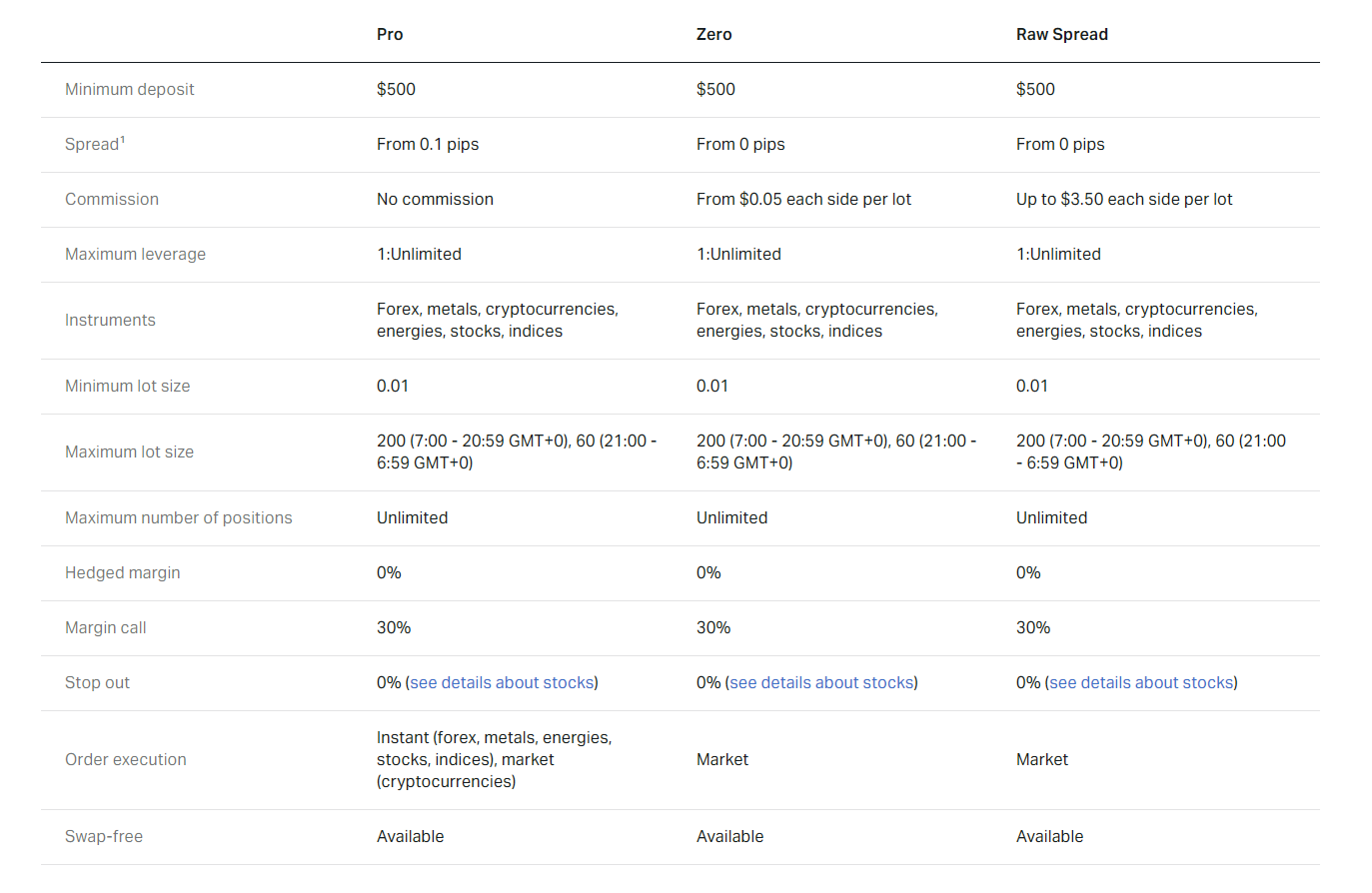
On a Raw Spread account, trading 0.01 lots of EURUSD incurs a $0.035 commission per side ($0.07 round trip) plus the raw spread. On a Zero account, the commission is fixed per lot — typically $0.2 per side per lot on forex, so $0.004 per side at 0.01 lots. On a Pro account, there's no commission but the spread starts at 0.1 pips, costing $0.01 per 0.01 lot trade. For minimum-lot traders, the Pro account often works out cheapest on majors, while Raw Spread and Zero shine at larger volumes.
Professional accounts require higher minimum deposits: $200 for Raw Spread and Zero, $500 for Pro (amounts vary by region). They also offer higher leverage tiers and priority support. The minimum lot remains 0.01 standard lots across all three, so the risk floor is the same as the Standard account — $0.10 per pip on EURUSD. If your balance is under $500, a Professional account's minimum lot may force larger risks than you want.
How Minimum Lot Affects Risk Management
Risk management starts with position sizing. The minimum lot sets a floor on how small your risk can be. If you follow the common rule of risking 1–2% of your account per trade, your account balance must be large enough that the minimum lot at your chosen stop distance doesn't exceed that percentage. Let's work through the math.
On a Standard account trading EURUSD at 0.01 lots: each pip = $0.10. With a 20-pip stop, risk = $2. To keep that at 1% of account, you need $200 minimum. With a 50-pip stop, risk = $5, requiring $500. With a 100-pip stop, risk = $10, requiring $1,000. If your account is $100 and you want a 50-pip stop, 0.01 lots risks 5% — too high. You'd need a Cent account where 0.01 cent lots at 50 pips risks $0.05, or 0.5% of a $10 account.
This is why account type selection should be driven by your balance and preferred stop distances, not just by spread comparisons. A trader with $200 who likes 30-pip stops can use a Standard account (0.01 lots = $3 risk = 1.5%). A trader with $50 who likes 30-pip stops needs a Cent account (0.01 cent lots = $0.03 risk = 0.06%). Forcing a Standard account with a small balance leads to either oversized risk or stops placed too tight for the strategy.
Calculating Position Size with Exness Minimum Lots
Position sizing formula: position size (lots) = account risk amount / (stop loss pips × pip value per lot). On Exness Standard accounts, pip value per standard lot is $10 for EURUSD. Per 0.01 lot, it's $0.10. On Cent accounts, pip value per cent lot is $0.01. Per 0.01 cent lot, it's $0.001. The formula works the same — just use the correct pip value for your account type.
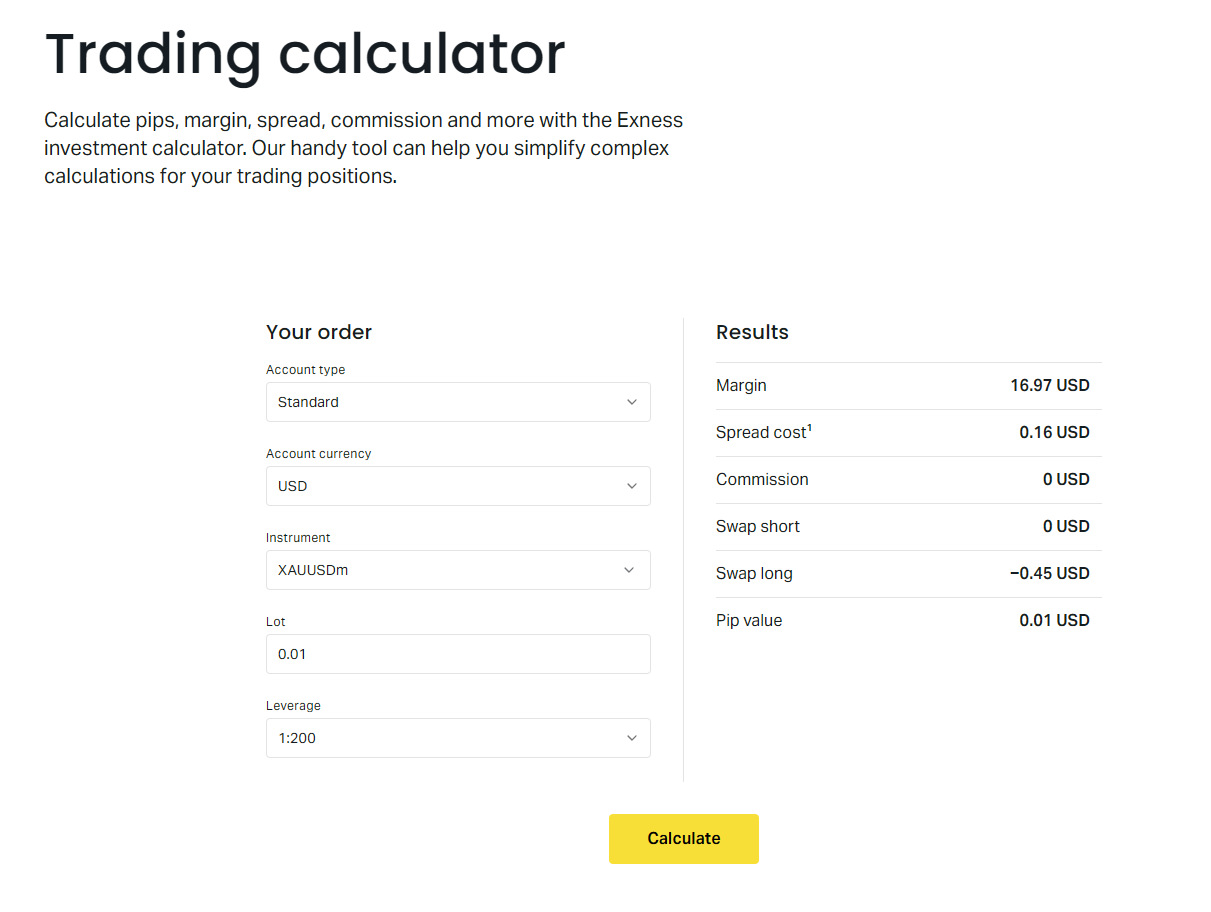
Exness provides a trading calculator in the Personal Area and on the website. You input your account currency, instrument, lot size, leverage, and it shows margin required, pip value, and swap. It's useful for verifying your manual calculations. For quick mental math: on Standard accounts, 1 lot = $10/pip, 0.1 lot = $1/pip, 0.01 lot = $0.10/pip. On Cent accounts, divide by 100.
Let's say you have a $1,000 Standard account, want to risk 1% ($10) on a EURUSD trade with a 25-pip stop. Position size = $10 / (25 × $0.10) = $10 / $2.5 = 4. So you'd trade 0.04 lots. That's above the 0.01 minimum, so it works. If the same trader had a $200 account risking 1% ($2) with a 25-pip stop: position size = $2 / $2.5 = 0.8. That's 0.008 lots — below the 0.01 minimum. The trader must either widen the stop, reduce risk percentage, switch to Cent, or deposit more.
Practical Examples for Different Account Sizes
Here are realistic scenarios showing how minimum lot constraints play out across account sizes and types. These assume EURUSD, 1% risk per trade, and typical stop distances for different trading styles.
Scroll horizontally to see all columns
| Account Balance | Account Type | Stop (pips) | Risk % | Calculated Lots | Viable? |
|---|---|---|---|---|---|
| $50 | Standard Cent | 20 | 1% | 0.025 cent lots | Yes |
| $50 | Standard | 20 | 1% | 0.0025 lots | No — below 0.01 min |
| $200 | Standard | 30 | 1% | 0.0067 lots | No — below 0.01 min |
| $200 | Standard Cent | 30 | 1% | 0.067 cent lots | Yes |
| $500 | Standard | 30 | 1% | 0.0167 lots | Yes |
| $1,000 | Standard | 50 | 1% | 0.02 lots | Yes |
| $2,000 | Raw Spread | 20 | 1% | 0.05 lots | Yes |
| $5,000 | Pro | 100 | 2% | 0.1 lots | Yes |
The pattern is clear. Standard accounts become viable around $300–$500 depending on stop distance. Below that, Cent accounts are the only way to maintain proper risk management without forcing stops tighter than your strategy allows. Professional accounts don't change the minimum lot math — they only make sense when your volume is high enough that commission savings outweigh the higher deposit requirement.
Minimum Lot vs Leverage and Margin Requirements
Leverage and minimum lot are separate settings. Leverage determines how much margin is required to open a position. Minimum lot determines the smallest position you can open. High leverage lets you open the minimum lot with less capital, but it doesn't reduce the risk of that position. A 0.01 lot EURUSD trade at 1:2000 leverage requires about $0.50 margin. At 1:100 leverage, it requires about $10 margin. The pip value and risk remain $0.10 per pip regardless.
Exness offers dynamic leverage that decreases as your account equity grows. Up to $999 equity, you can use 1:2000. From $1,000 to $4,999, max is 1:1000. Higher equity tiers have lower max leverage. This affects how many minimum lots you can hold simultaneously, not the minimum lot itself. Margin call and stop out levels (typically 60% and 0% on Exness) determine when positions are closed, but the minimum lot stays constant.
Trading Different Instruments with Minimum Lots
Minimum lot sizes vary by instrument class. Forex pairs are uniformly 0.01 lots (or 0.01 cent lots). Metals: Gold (XAUUSD) minimum 0.01 lots where 1 lot = 100 oz, so 0.01 = 1 oz. Silver minimum 0.01 lots (1 lot = 5,000 oz). Energies: USOil and UKOil minimum 0.01 lots (1 lot = 1,000 barrels). Indices: most major indices minimum 0.01 lots. Crypto: varies by coin, typically 0.01 lots but check specifications.
Pip values differ too. Gold at 0.01 lots: $0.10 per $0.01 price move (10 cents per tick). Silver at 0.01 lots: $0.50 per $0.01 move. USOil at 0.01 lots: $0.10 per $0.01 move. Index values depend on the contract specification — US30 at 0.01 lots might be $0.10 per point, US500 $0.50 per point. Always check the contract specification in the trading terminal or Exness website for exact pip values.
Cent accounts only support forex and metals. If you want to trade indices, energies, or crypto with small position sizes, you need a Standard or Professional account. The 0.01 lot minimum on these instruments may represent larger notional value than forex. For example, 0.01 lots of US30 (Dow Jones) at 35,000 points with $0.10 per point = $35 notional exposure per 0.01 lot. That's still small, but larger than a 0.01 lot EURUSD position (~$1,000 notional at 1.0000).
Switching Account Types as You Grow
Many traders start on a Cent account, graduate to Standard, and eventually move to Professional accounts as their balance grows and volume increases. Exness allows multiple accounts under one Personal Area. You can run a Cent account for testing new strategies, a Standard account for main trading, and a Raw Spread account for high-volume scalping — all simultaneously.
There's no automatic upgrade path. You open a new account type when it suits your needs. The minimum lot on the new account will feel larger at first. Moving from Cent (0.01 cent lots = $0.001/pip) to Standard (0.01 lots = $0.10/pip) is a 100x jump in minimum risk. Ensure your balance supports it. A common milestone: when your Cent account grows past $500–$1,000, the 100 cent lot maximum position limit becomes constraining, and the Standard account's higher limits and full instrument access make sense.
Common Mistakes with Minimum Lot Sizing
Traders often make three mistakes around minimum lots. First, they ignore the minimum and calculate a position size below 0.01 lots, then round up to 0.01 without adjusting their stop or risk percentage. This silently increases risk. If your calculation says 0.006 lots and you trade 0.01, you're taking 67% more risk than planned. Always recalculate your stop distance or risk percentage when rounding to the minimum.
Second, they confuse cent lots with standard lots. Seeing '0.01' on a Cent account and thinking it's the same as 0.01 on a Standard account leads to massive position sizing errors. A 0.01 cent lot is 100 times smaller. If you're used to Standard accounts and switch to Cent, divide your usual lot size by 100 to get equivalent exposure.
Third, they assume minimum lot is the recommended lot. It's not. The minimum is the floor, not the target. Most traders should trade well above the minimum once their account allows it. Trading at minimum lot on a $10,000 account with a 50-pip stop means risking $5 (0.05%) — unnecessarily conservative. Scale your position to your risk parameters, not to the minimum.
The minimum lot is a constraint, not a recommendation. Size your positions to your risk plan, then check if the result clears the minimum. If it doesn't, change your account type or your stop — don't just round up.
Exness Minimum Lot in the Trading Terminal
In MetaTrader 4, MetaTrader 5, and Exness Web Terminal, the minimum lot is enforced at the order entry level. If you type 0.005 in the volume field and try to place a market order on a Standard account, the platform will reject it with an 'Invalid volume' error. The minimum increment is also 0.01 — you can enter 0.01, 0.02, 0.03, but not 0.015 on most account types. Some Professional accounts may allow 0.001 increments for certain instruments, but 0.01 remains the practical minimum for forex.
The terminal shows contract specifications for each symbol. Right-click a symbol in Market Watch, select Specification, and you'll see 'Min Lot' and 'Lot Step' fields. For EURUSD on Standard accounts, Min Lot = 0.01, Lot Step = 0.01. On Cent accounts, Min Lot = 0.01, Lot Step = 0.01 but the contract size is 1,000 instead of 100,000. Always verify these fields when trading a new instrument or account type.
Exness Web Terminal and the mobile app display the same specifications. The mobile app's order screen has a volume slider that snaps to valid increments, preventing invalid entries. If you're using an EA or script, program it to respect the Min Lot and Lot Step from the symbol info — hardcoding 0.01 works for forex but fails on instruments with different minimums.
Frequently Asked Questions
What is the minimum lot size on Exness Standard account?
The minimum lot size on Exness Standard account is 0.01 standard lots, which equals 1,000 units of the base currency.
How does Standard Cent minimum lot differ from Standard account?
Standard Cent minimum is 0.01 cent lots. Since the account currency is cents, 0.01 cent lots represents 100 times less monetary exposure than 0.01 standard lots on a Standard account.
Can I trade less than 0.01 lots on Exness?
No. The platform enforces a 0.01 lot minimum on all account types for forex. You cannot enter 0.005 or any value below 0.01 in the volume field.
Do Professional accounts have different minimum lots?
No. Raw Spread, Zero, and Pro accounts all have the same 0.01 standard lot minimum as the Standard account. The difference is in spreads, commissions, and minimum deposit requirements.
What minimum lot do I need for a $100 account with 1% risk?
With a $100 account risking 1% ($1) and a 20-pip stop, you need a Cent account. On Standard, 0.01 lots at 20 pips risks $2 (2% of account). On Cent, 0.01 cent lots at 20 pips risks $0.02 (0.02% of account).
Does leverage affect the minimum lot size?
No. Leverage only affects margin required. The minimum lot size and pip value remain constant regardless of whether you use 1:100 or 1:2000 leverage.
Are minimum lots the same for all instruments?
Most forex pairs and metals use 0.01 lots. Indices, energies, and crypto may have different minimums. Always check the contract specification for each instrument in the trading terminal.
Can I have multiple account types with different minimum lots?
Yes. You can open multiple accounts under one Exness Personal Area — for example, a Cent account for testing and a Standard account for main trading — each with its own minimum lot rules.
Final Assessment of Exness Minimum Lot
Exness minimum lot sizes are straightforward: 0.01 lots across all account types, with the only meaningful variation being the Cent account's 0.01 cent lots that reduce monetary exposure by 100x. The real decision isn't about finding a broker with a smaller minimum — it's about matching the account type to your balance and risk tolerance. A $50 account belongs on Cent. A $500 account works on Standard. A $2,000+ account with volume benefits from Professional pricing.
The minimum lot constraint matters most at the low end. If you're depositing $100 and insist on a Standard account, you'll either overshoot your risk per trade or place stops so tight they get hit by noise. That's a recipe for frustration. The Cent account exists precisely for this situation. Use it without ego — it's a tool for proper risk management, not a badge of inexperience.
As your account grows, the minimum lot becomes irrelevant. You'll size positions based on your risk percentage and stop distance, and the result will naturally be well above 0.01 lots. The only time you'll think about the minimum again is when testing a new strategy with minimal capital or when adding a new instrument with unfamiliar contract specs. Check the specification, calculate your position, and trade.