

Forex Broker Accounts
Exness Standard Account: Features, Costs, and Who It Fits
Practical breakdown of trading conditions, costs, and suitability for different trader profiles.

Senior Forex Trader & Market Analyst
Daniel Chen is an experienced forex trader and financial market analyst with over 15 years of experience in currency trading. He specializes in technical analysis, risk management, and developing practical trading strategies to help traders make informed decisions.
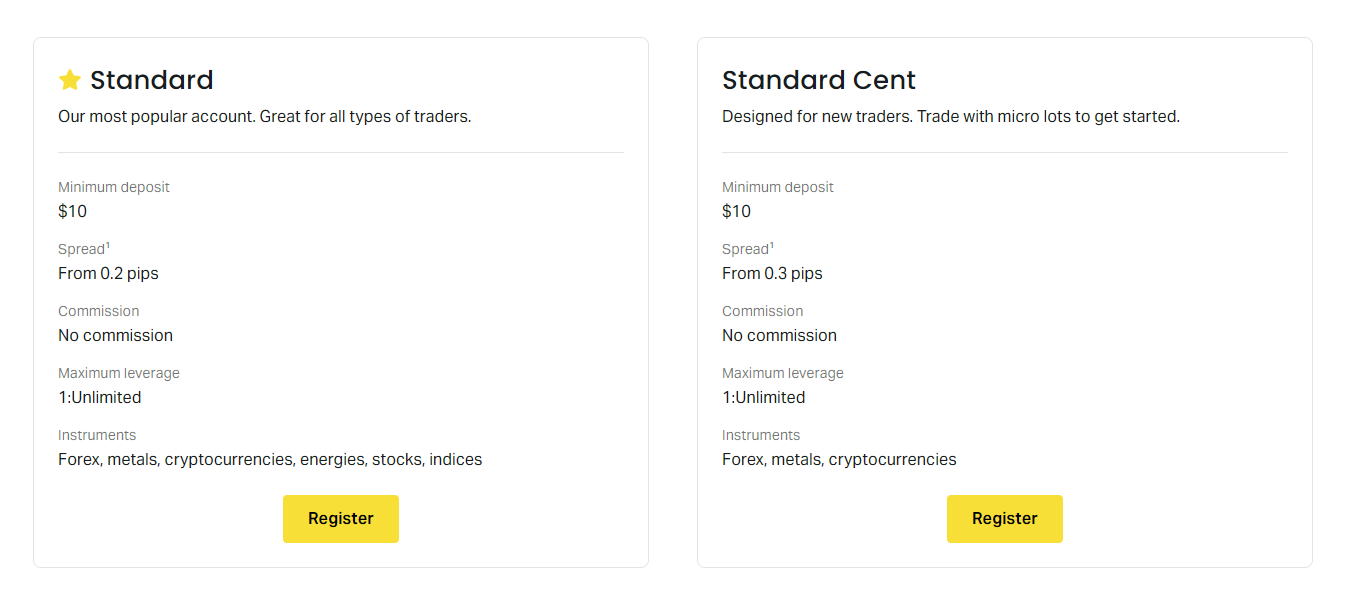
The Exness Standard Account is the broker's most widely used retail offering. It sits at the entry point of the account lineup, designed for traders who want straightforward pricing without commissions and a low barrier to entry. This account type supports both MetaTrader 4 and MetaTrader 5, plus the proprietary Exness Web Terminal and mobile app. It covers forex, metals, energies, indices, stocks, and cryptocurrencies — all from a single login.
Contents
- 1. Exness Standard Account Trading Conditions
- 2. Minimum Deposit and Funding Requirements
- 3. Spreads, Swaps, and Total Trading Costs
- 4. Platforms Available for Standard Account
- 5. Standard Account vs Standard Cent Account
- 6. Standard Account vs Professional Account Types
- 7. Leverage, Margin, and Risk Controls
- 8. Opening a Standard Account Step by Step
- 9. Who the Standard Account Suits Best
- 10. Regional Availability and Restrictions
- 11. Common Questions About Standard Account Costs
- 12. Standard Account in Practice: A Typical Session
- 13. Final Assessment of Exness Standard Account
What makes the Standard Account distinct is its commission-free structure. Instead of charging a separate fee per lot, Exness builds its revenue into the spread. For major pairs like EURUSD, typical spreads start around 0.3 pips during liquid hours, though they widen during news events or overnight sessions. There is no minimum deposit enforced by the broker globally, though some regional payment processors may impose their own minimums. Leverage reaches up to 1:2000 depending on equity and jurisdiction, and the stop-out level sits at 0%.
Exness Standard Account Trading Conditions
The trading conditions on the Standard Account are built around simplicity. No commissions means the spread you see is the total cost of opening a position. Exness uses market execution with no requotes, and orders fill at the best available price. The broker advertises execution speeds under 25 milliseconds on its core infrastructure, though actual latency depends on your connection and server location. Both instant and market execution modes are available depending on the platform and instrument.
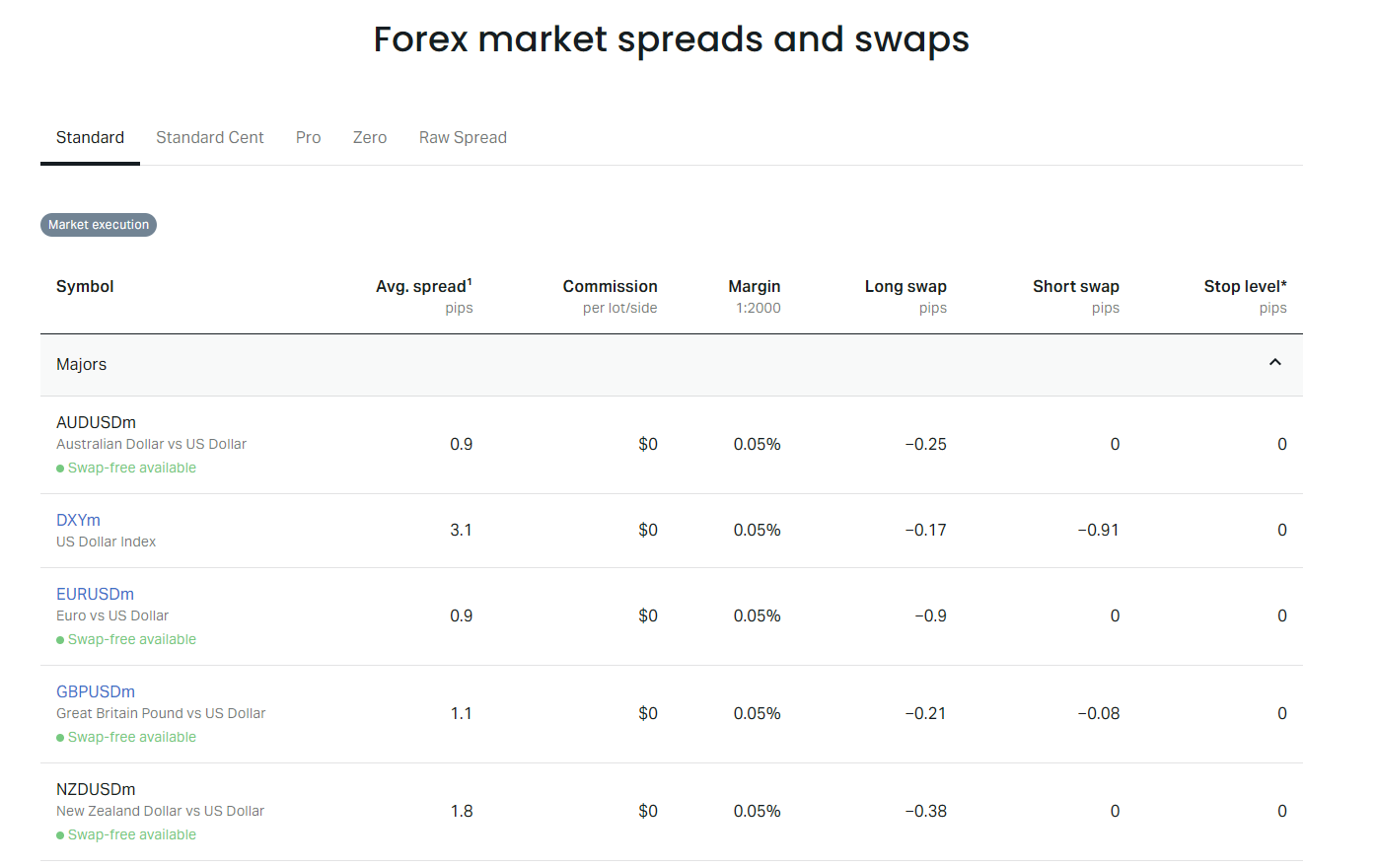
Spreads are floating and vary by instrument. Major forex pairs tend to stay tight during the London–New York overlap. Cross pairs and exotic currencies carry wider spreads. Gold (XAUUSD) typically trades around 1.5–3 pips on this account, while crude oil and major indices sit in the 0.5–2 pip range for most sessions. Cryptocurrency spreads are wider, reflecting the underlying market structure. Swap rates apply to positions held overnight, with swap-free options available for eligible accounts.
The account supports hedging and netting modes on MT5, while MT4 uses hedging only. Minimum trade size is 0.01 lots across all instruments. Maximum position size varies by instrument but generally allows several hundred lots for major pairs. There are no restrictions on scalping, expert advisors, or news trading. The broker does not impose a minimum distance for stop-loss or take-profit orders on this account type.
Minimum Deposit and Funding Requirements
Exness does not set a global minimum deposit for the Standard Account. You can technically open the account with whatever amount your chosen payment method allows. In practice, most electronic methods — cards, e-wallets, local bank transfers — start around $10 equivalent. Cryptocurrency deposits have no minimum on the broker side, though network fees apply. Bank wire transfers may have higher minimums imposed by intermediary banks, typically $50–$100.
This flexibility makes the Standard Account accessible for traders testing live conditions with small capital. However, trading with very small balances limits practical position sizing. A $10 deposit at 1:2000 leverage allows roughly 0.02 lots on EURUSD before margin pressure becomes significant. Most traders find $100–$500 a more realistic starting point for meaningful risk management. The broker processes deposits instantly for most methods, and withdrawals are often instant for e-wallets and cards, though bank wires take 1–3 business days.
No deposit fees are charged by Exness. Withdrawal fees are also zero on the broker side, though payment processors may deduct their own charges. Currency conversion happens at the broker's internal rate if your account base currency differs from the payment currency. The Standard Account supports USD, EUR, GBP, CHF, JPY, AUD, CAD, NZD, SGD, HKD, and several other base currencies. You can hold multiple Standard Accounts in different currencies under the same Personal Area.
Spreads, Swaps, and Total Trading Costs
Since the Standard Account has no commissions, the spread is the primary cost. Exness publishes average and typical spreads for each instrument on its website, but real-time spreads fluctuate. During high liquidity, EURUSD often trades at 0.3–0.5 pips. GBPUSD and USDJPY sit slightly wider. The spread includes the broker's markup — there is no separate commission line item. This makes cost calculation straightforward: multiply the spread in pips by your position size and pip value.
Swap rates (overnight financing) apply when positions remain open past 23:59 server time. Long and short swap values differ per instrument and can be positive or negative. Exness publishes daily swap rates in the trading platform and on its website. For forex majors, swaps are typically small — often a few cents per lot per night. For cryptocurrencies and some exotic pairs, swaps can be significant. Wednesday night carries triple swap to account for weekend rollover.
Scroll horizontally to see all columns
| Instrument | Typical Spread | Commission | Total Cost Per Lot |
|---|---|---|---|
| EURUSD | 0.3–0.5 pips | None | $3–5 |
| GBPUSD | 0.5–0.8 pips | None | $5–8 |
| USDJPY | 0.4–0.6 pips | None | $4–6 |
| XAUUSD (Gold) | 1.5–3.0 pips | None | $15–30 |
| USOIL (WTI) | 0.5–1.5 pips | None | $5–15 |
| US30 (Dow Jones) | 1.0–2.5 pips | None | $1–2.5 |
| BTCUSD | 20–50 pips | None | $20–50 |
The table above reflects typical conditions during peak hours. Spreads widen during Asian session, major news releases, and market open/close. Total cost per lot assumes standard pip values ($10 per pip for forex majors, $1 per pip for gold, $0.01 per pip for crypto). Always check live spreads in your platform before trading.
Platforms Available for Standard Account
The Standard Account works across every platform Exness offers. MetaTrader 4 remains the most popular choice, especially for traders using custom indicators and expert advisors. MT4 on Exness supports hedging, one-click trading, and the full MQL4 ecosystem. The broker provides enhanced MT4 builds with additional timeframes and graphical tools not found in the standard MetaQuotes release.
MetaTrader 5 adds netting mode, more timeframes, a built-in economic calendar, and depth of market. It also supports exchange-traded instruments where available. Both desktop platforms run on Windows and macOS (via Wine or native MT5 build). Mobile apps for iOS and Android mirror desktop functionality, including charting, order management, and account monitoring. Push notifications for price alerts and margin calls work reliably.
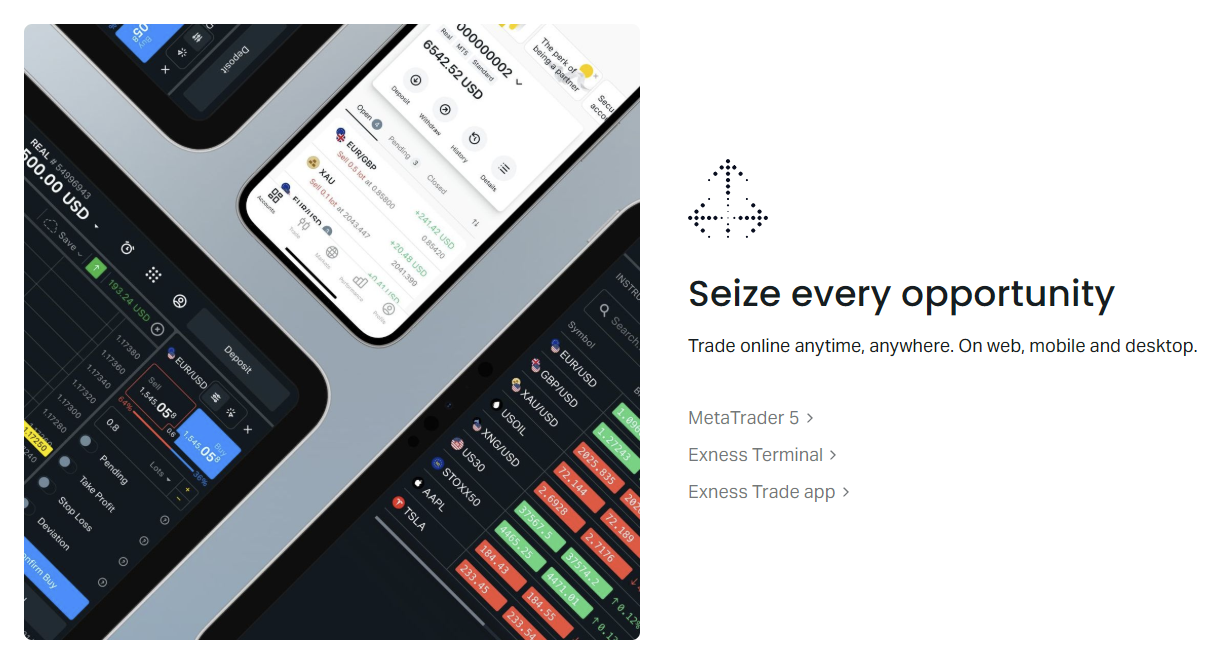
The Exness Web Terminal runs in any modern browser with no installation. It offers a clean interface, TradingView charts, one-click trading, and full account management. The Web Terminal is useful for quick access on restricted machines or when traveling. The Exness Trade mobile app combines trading, deposits, withdrawals, and verification in one interface. It supports biometric login and dark mode.
Standard Account vs Standard Cent Account
Exness offers two Standard variants: Standard and Standard Cent. The core difference is the account currency denomination. Standard Cent accounts denominate balance in cents rather than dollars — a $10 deposit shows as 1,000 cents. Trade sizes are also in cent lots (0.01 cent lot = 1,000 units vs 100,000 units for a standard lot). This effectively reduces position size by a factor of 100, letting traders test live conditions with minimal risk.
Spreads, swaps, leverage, and execution are identical between the two variants. The Cent account caps maximum equity at $2,000 (200,000 cents) before requiring migration to a Standard Account. Maximum open positions and pending orders are also lower on Cent accounts. For beginners learning position sizing and risk management, the Cent variant removes psychological pressure. For anyone trading seriously, the Standard Account's normal lot sizing aligns with industry conventions and third-party tools.
Scroll horizontally to see all columns
| Feature | Standard Account | Standard Cent Account |
|---|---|---|
| Account Currency | USD, EUR, GBP, etc. | USC, EURC, GBPC (cents) |
| Minimum Lot Size | 0.01 lots (1,000 units) | 0.01 cent lots (10 units) |
| Max Equity Before Migration | No limit | $2,000 equivalent |
| Max Open Positions | Unlimited | 200 |
| Max Pending Orders | Unlimited | 200 |
| Spreads & Swaps | Identical | Identical |
| Platforms | All | All |
Standard Account vs Professional Account Types
Exness Professional accounts — Raw Spread, Zero, and Pro — target higher-volume traders with different cost structures. Raw Spread and Zero accounts charge commissions ($3.50 per side per lot on Raw Spread, $0.20–$3.50 on Zero depending on instrument) but offer tighter raw spreads from liquidity providers. The Pro account keeps commission-free pricing but with tighter spreads than Standard, requiring a $200 minimum deposit and higher equity thresholds for maximum leverage.
For a trader doing 10–20 lots per month, the Standard Account's wider spreads often cost less than Raw Spread commissions. The breakeven point depends on your typical instruments and trade frequency. Raw Spread becomes cheaper around 30–50 lots monthly on majors. Zero account suits scalpers and high-frequency strategies where spread consistency matters more than absolute cost. Pro account sits between Standard and Raw Spread — tighter spreads, no commission, but higher entry barrier.
Leverage, Margin, and Risk Controls
The Standard Account offers dynamic leverage up to 1:2000 for equity under $999. Leverage steps down as equity grows: 1:2000 up to $999, 1:1000 up to $4,999, 1:500 up to $29,999, 1:200 above that. These thresholds apply per account, not per Personal Area. You can manually request lower leverage if preferred. The broker does not offer fixed leverage tiers — the system adjusts automatically based on account equity at rollover.
Margin requirements follow the leverage schedule. At 1:2000, a 0.01 lot EURUSD position requires roughly $0.50 margin. Stop-out triggers at 0% margin level — positions close automatically when equity falls to zero. There is no margin call warning level; the platform shows margin level in real time, but no forced notification precedes stop-out. Negative balance protection applies globally: you cannot lose more than your account balance.
High leverage amplifies both gains and losses. At 1:2000, a 50-pip move against a 1-lot position wipes $500 — half a $1,000 account. Most experienced traders cap effective leverage at 1:100 or lower regardless of available maximum. The dynamic leverage system helps by reducing available leverage as accounts grow, but it does not prevent over-leveraging on small accounts. Position sizing discipline remains the trader's responsibility.
Leverage is a tool, not a strategy. The maximum available tells you what the broker allows, not what your account can survive.
Opening a Standard Account Step by Step
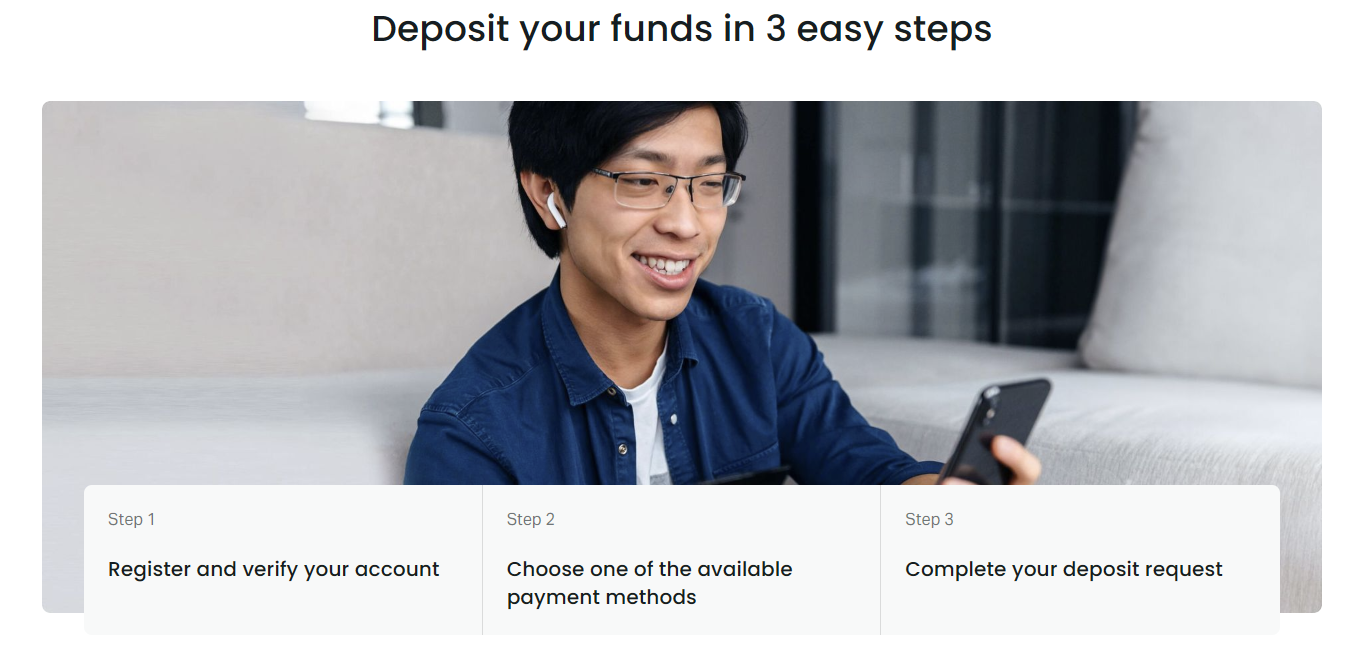
Account opening happens through the Exness website or mobile app. The process takes 5–10 minutes for most users. Start by registering an email and password. You'll receive a verification code. After email confirmation, you enter the Personal Area where you can create a Standard Account instantly — choose base currency, set a trading password, and select MT4 or MT5. A demo account can be created alongside the live account for testing.
- Register email and password on Exness website or app
- Verify email with the code sent to your inbox
- Log into Personal Area
- Click 'Open New Account' and select Standard
- Choose base currency (cannot be changed later)
- Set trading password (different from login password)
- Select platform: MT4 or MT5
- Account number and server details appear immediately
- Download platform or use Web Terminal to start trading
Full verification (KYC) is required before withdrawals. This means uploading a government-issued ID (passport, national ID, or driver's license) and proof of address (utility bill, bank statement) dated within 3 months. The review typically completes within a few hours, sometimes minutes. Unverified accounts can deposit and trade but cannot withdraw. Some jurisdictions require additional documentation or have restrictions on leverage and instruments.
Who the Standard Account Suits Best
The Standard Account fits traders who want commission-free simplicity, low entry barriers, and access to the full instrument range. It works well for swing traders, position traders, and anyone holding trades for hours to days where spread width matters less than overnight swaps. Beginners benefit from the no-minimum-deposit policy and cent variant for live practice. Traders using expert advisors or copy trading services find the unrestricted environment compatible with most third-party tools.
It suits traders less well if you scalp aggressively on low timeframes — the spread cost accumulates fast at high frequency. High-volume traders (50+ lots/month) usually save money on Raw Spread or Zero accounts despite commissions. Traders needing fixed spreads for algorithmic precision won't find them here; all spreads are floating. Islamic/swap-free accounts are available as a separate account type, not a toggle on Standard.
Regional Availability and Restrictions
Exness operates through multiple regulated entities. The Standard Account is available globally through Exness (SC) Ltd (Seychelles), Exness B.V. (Curaçao), and Exness ZA (South Africa). European clients under Exness (Cy) Ltd face ESMA leverage caps: 1:30 for major forex, 1:20 for minors and gold, 1:10 for other CFDs. The 1:2000 maximum applies only to clients onboarded under the Seychelles or Curaçao entities. Some countries — including the US, Canada, Japan, and several sanctioned jurisdictions — are not accepted.
Instrument availability varies by entity. Crypto CFDs may be restricted for EU clients. Stock CFDs have different trading hours and margin requirements depending on the underlying exchange. The broker's website shows available instruments per jurisdiction after login. Always verify your specific entity's conditions in the Personal Area — they determine your actual leverage, spreads, and product access.
Your regulatory entity decides your trading conditions more than your account type does. Check which Exness company holds your account.
Common Questions About Standard Account Costs
Traders often ask whether the Standard Account has hidden fees. It does not charge deposit fees, withdrawal fees, inactivity fees, or account maintenance fees. The only costs are spreads, swaps on overnight positions, and any payment processor fees outside Exness's control. Conversion fees apply if you deposit in a currency different from your account base currency — the broker's rate includes a small markup over mid-market.
Another frequent question: does the Standard Account have requotes? Exness uses market execution with no requotes. Orders fill at the best available price, which may differ from the requested price during fast markets — this is slippage, not a requote. Slippage can be positive or negative. The broker does not guarantee stop-loss execution at the exact price during gaps or extreme volatility; stops fill at the first available price after the trigger.
Standard Account in Practice: A Typical Session
A day trader using the Standard Account on EURUSD might open the London session with a 0.5-pip spread. They place a 0.5-lot buy at 1.0850 with a 15-pip stop and 30-pip target. The spread cost is $2.50 (0.5 pips × 0.5 lots × $10/pip). If the trade hits target in two hours, no swap applies. Net profit before spread: $150. Net after spread: $147.50. The same trade on a Raw Spread account with 0.1-pip spread and $3.50 commission per side would cost $0.50 spread + $7 commission = $7.50 total. Standard wins for this volume.
A swing trader holding GBPUSD for three days faces different math. Spread cost is one-time at entry. Three nights of swaps accumulate — say -$1.20 per lot per night. On a 0.3-lot position, that's -$1.08 total. The wider spread on Standard vs Raw Spread might be 0.4 pips extra, costing $1.20 on 0.3 lots. Total extra cost vs Raw Spread: ~$2.28 over three days. Still negligible for most swing traders. The commission-free model shines when trade frequency is low and holding periods are long.
For low-frequency trading, the commission-free model usually wins. Commissions only pay off when you trade enough lots to amortize the fixed fee.
Final Assessment of Exness Standard Account
The Exness Standard Account delivers on its core promise: commission-free trading with low entry barriers and full platform access. Its floating spreads are competitive during peak hours, and the absence of commissions simplifies cost tracking. The no-minimum-deposit policy (broker-side) and cent variant make it genuinely accessible for new traders. Dynamic leverage up to 1:2000 provides flexibility, though it demands discipline. Execution quality matches the broker's broader reputation — fast, reliable, with minimal slippage under normal conditions.
The trade-offs are clear. Spreads widen noticeably off-peak and during news, which hurts scalpers and news traders. High-volume traders will find Raw Spread or Zero cheaper once monthly volume crosses roughly 30–50 lots. The 0% stop-out level means accounts can hit zero equity before liquidation — negative balance protection prevents debt, but the experience is harsh. EU clients lose the high leverage advantage entirely under ESMA rules. Islamic traders need a separate swap-free account type.
For the majority of retail traders — those doing under 30 lots monthly, holding positions beyond a few minutes, and valuing simplicity over raw spread optimization — the Standard Account remains a solid default choice. It covers every asset class Exness offers, works on every platform, and imposes no strategic restrictions. Open a demo version first, trade your actual strategy for two weeks, then compare real costs against the professional account types before committing significant capital.
Frequently Asked Questions
What is the minimum deposit for Exness Standard Account?
Exness does not set a global minimum deposit. Most payment methods allow deposits from $10 equivalent. Bank wires may have higher minimums from intermediary banks.
Does the Standard Account charge commissions?
No. The Standard Account is commission-free. All trading costs are built into the spread. Swaps apply to overnight positions.
What leverage is available on the Standard Account?
Up to 1:2000 dynamically based on account equity. Leverage steps down as equity increases. EU clients under ESMA regulation are capped at 1:30 for major forex.
Can I use expert advisors on the Standard Account?
Yes. The Standard Account supports EAs, scalping, hedging, and news trading without restrictions on both MT4 and MT5.
What is the difference between Standard and Standard Cent accounts?
Standard Cent denominates balance in cents (100x smaller units) and uses cent lots (100x smaller). Maximum equity is capped at $2,000 before migration. Spreads and conditions are identical.
Are there deposit or withdrawal fees?
Exness charges zero deposit and withdrawal fees. Payment processors may apply their own fees. Currency conversion uses the broker's internal rate if currencies differ.
Which platforms support the Standard Account?
MetaTrader 4, MetaTrader 5, Exness Web Terminal, Exness Trade mobile app (iOS/Android). All platforms offer full functionality.
Is the Standard Account available in my country?
Exness accepts clients from most countries. Restricted jurisdictions include the US, Canada, Japan, and sanctioned countries. Check the website or contact support for your specific location.