
Forex & CFD Trading
Exness Oil Trading: Conditions, Platforms, and Costs
A practical guide to trading WTI and Brent crude on Exness

Senior Forex Trader & Market Analyst
Daniel Chen is an experienced forex trader and financial market analyst with over 15 years of experience in currency trading. He specializes in technical analysis, risk management, and developing practical trading strategies to help traders make informed decisions.
Exness offers crude oil trading through CFDs on two main benchmarks: WTI (US Oil) and Brent (UK Oil). Both are available across all account types and platforms the broker provides. The instruments track the underlying futures markets, so pricing reflects real-time supply and demand dynamics rather than physical delivery.
Contents
- 1. Available Oil Instruments on Exness
- 2. Account Types and Oil Trading Conditions
- 3. Trading Platforms for Oil
- 4. Trading Hours and Session Characteristics
- 5. Swap Rates and Overnight Financing
- 6. Margin Requirements and Position Sizing
- 7. Execution Model and Order Types
- 8. Cost Comparison: Spread vs Commission Accounts
- 9. Risk Factors Specific to Oil CFDs
- 10. Funding, Withdrawals, and Account Management
- 11. Analytical Tools for Oil Traders
- 12. Regulatory Entities and Client Protections
- 13. Practical Steps to Start Trading Oil on Exness
- 14. Common Oil Trading Strategies on Exness
- 15. Tax Implications and Record Keeping
- 16. Final Assessment of Exness Oil Trading
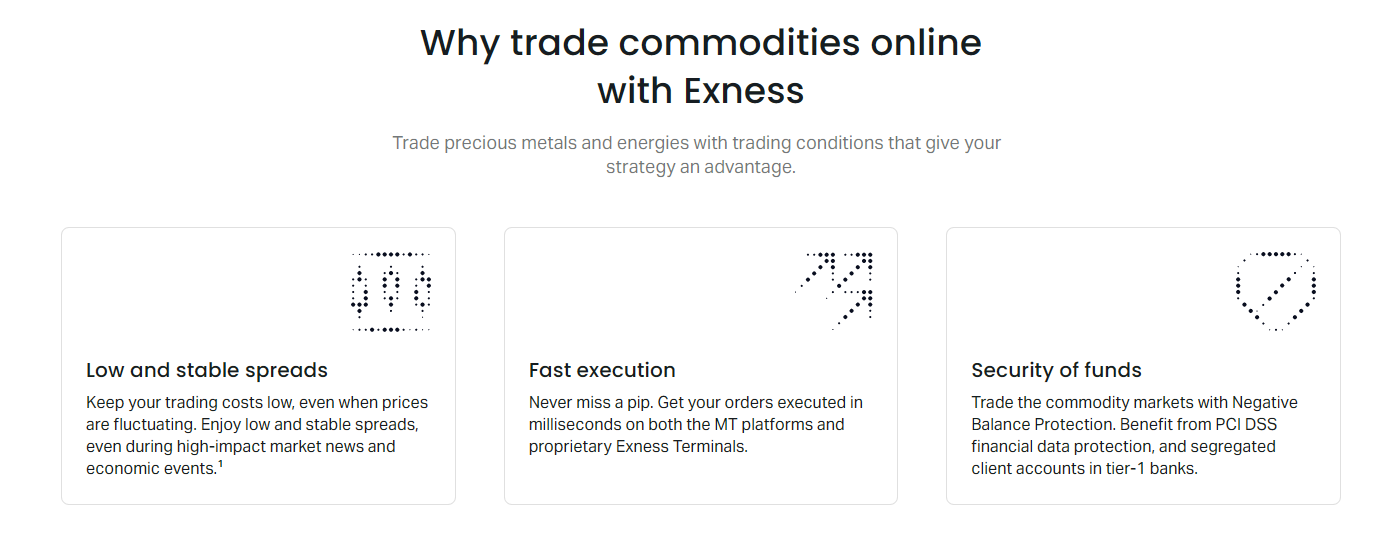
Traders can access oil with leverage up to 1:2000 on certain accounts, though the exact maximum depends on the regulatory entity serving your region. Spreads start from zero on Raw Spread and Zero accounts, while Standard accounts apply a markup. There are no commissions on Standard accounts; Raw Spread and Zero accounts charge a fixed commission per lot per side.
Oil markets operate nearly 24 hours a day, five days a week, with a daily break that varies by instrument. Exness follows the standard CME Globex schedule for WTI and the ICE schedule for Brent. Overnight financing (swap) applies to positions held past the daily rollover, and the rate differs between long and short sides.
Available Oil Instruments on Exness
The broker lists two primary crude oil CFDs. WTI tracks the NYMEX light sweet crude futures contract, quoted in USD per barrel. Brent tracks the ICE Brent crude futures contract, also quoted in USD per barrel. Both are cash-settled CFDs, meaning no physical delivery occurs at expiry.
- USOIL (WTI) — NYMEX light sweet crude, most actively traded benchmark
- UKOIL (Brent) — ICE Brent crude, global pricing reference for two-thirds of world oil
- Both offered as spot CFDs with continuous pricing via front-month futures rollover
- Tick size: 0.01 USD per barrel; contract size: 100 barrels per standard lot
Some regions may also see additional energy products such as natural gas or heating oil, but WTI and Brent are the core oil offerings globally. The symbols appear as USOIL and UKOIL in MetaTrader 4, MetaTrader 5, the Exness Web Terminal, and the mobile app.
Account Types and Oil Trading Conditions
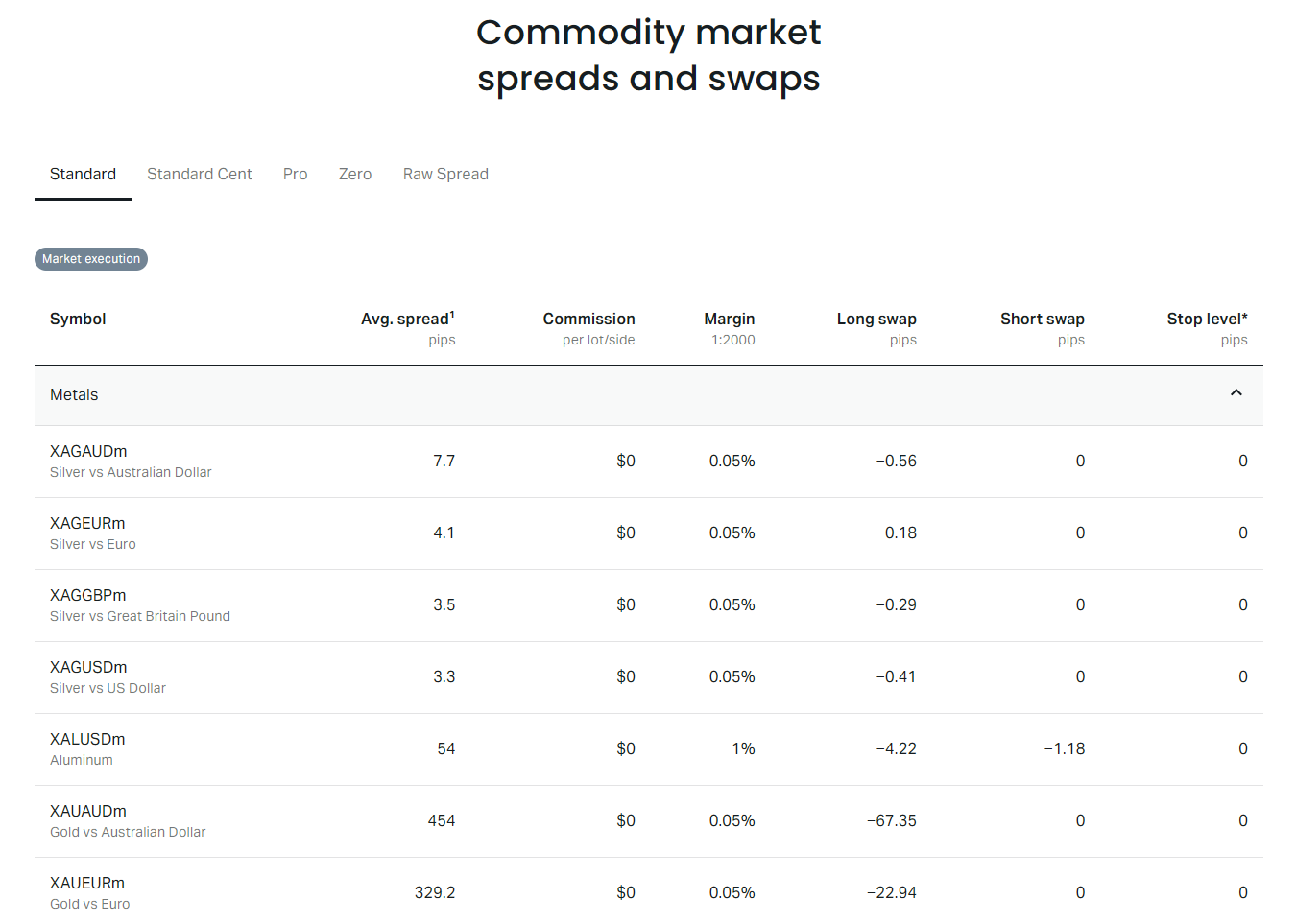
Exness provides several account categories, each with different cost structures for oil. Standard and Standard Cent accounts use spread-only pricing with no commission. Raw Spread and Zero accounts charge a commission but offer tighter spreads. Pro accounts sit between them with low spreads and no commission.
Scroll horizontally to see all columns
| Account | Typical WTI Spread | Typical Brent Spread | Commission (per lot/side) | Max Leverage |
|---|---|---|---|---|
| Standard | ~0.05–0.10 USD | ~0.05–0.10 USD | None | 1:2000 |
| Standard Cent | ~0.05–0.10 USD | ~0.05–0.10 USD | None | 1:2000 |
| Pro | ~0.02–0.05 USD | ~0.02–0.05 USD | None | 1:2000 |
| Raw Spread | ~0.00–0.02 USD | ~0.00–0.02 USD | ~$3.50 | 1:2000 |
| Zero | 0.00 USD (fixed) | 0.00 USD (fixed) | ~$3.50–$5.00 | 1:2000 |
Spreads fluctuate with market volatility. During major news events — OPEC decisions, EIA inventory releases, geopolitical escalations — spreads can widen significantly on all account types. The Zero account guarantees a fixed zero spread for oil during standard market hours, but the commission is slightly higher than Raw Spread.
Trading Platforms for Oil
All Exness platforms support oil CFDs. MetaTrader 4 and MetaTrader 5 remain the most widely used, offering full charting, automated trading via Expert Advisors, and a deep ecosystem of custom indicators. The Exness Web Terminal runs in a browser with no installation required and includes TradingView charts. The mobile app mirrors the web terminal's functionality for on-the-go access.
The Web Terminal is convenient for quick checks or trading from restricted devices, but MT4 and MT5 remain superior for serious technical analysis, backtesting, and algorithmic execution. VPS hosting is available free for qualifying accounts, which matters for oil traders running EAs during the Asian session when liquidity thins.
Trading Hours and Session Characteristics
WTI and Brent trade nearly 24/5 with a daily maintenance break. WTI follows the CME Globex schedule: Sunday 18:00 ET to Friday 17:00 ET, with a 60-minute break each day at 17:00–18:00 ET. Brent follows ICE: Sunday 18:00 ET to Friday 17:00 ET, with a 30-minute break at 17:00–17:30 ET. Exness applies these schedules directly.
- Asian session (Tokyo/Singapore): thinner liquidity, wider spreads, range-bound price action
- European session (London): volume picks up, Brent often leads direction
- US session (New York): highest volume for WTI, EIA data releases at 10:30 ET Wednesdays
- Overlap (London/New York): tightest spreads, best execution for larger orders
The daily break coincides with the settlement window for the underlying futures. During this window, Exness suspends new orders and may widen spreads on existing positions. Orders placed just before the break can experience slippage if the market gaps on reopen.
Swap Rates and Overnight Financing
Holding oil positions past the daily rollover incurs a swap charge or credit. The rate derives from the interest rate differential between USD and the cost of carry for the underlying futures, plus the broker's markup. Long and short swaps differ; one side may be positive while the other is negative.
Scroll horizontally to see all columns
| Instrument | Long Swap | Short Swap | Triple Swap Day |
|---|---|---|---|
| USOIL (WTI) | -12 to -18 | +4 to +8 | Wednesday |
| UKOIL (Brent) | -10 to -16 | +3 to +7 | Wednesday |
Swap rates update daily and reflect current market conditions. The triple swap day (Wednesday) accounts for weekend financing. Islamic accounts swap-free status applies to oil CFDs, but an administration fee may replace the swap after a certain holding period — check the specific terms in your Personal Area.
Margin Requirements and Position Sizing
Margin for oil CFDs calculates as: (contract size × price × lots) ÷ leverage. With 1:2000 leverage, a single lot of WTI at $75 requires roughly $3.75 margin. At 1:30 (EU/UK retail cap), the same position needs $250. The difference dramatically affects how many lots a given account can support.
- Standard lot = 100 barrels; mini lot = 10 barrels; micro lot = 1 barrel (Cent accounts)
- Minimum trade size: 0.01 lots (1 barrel on Standard, 0.1 barrel on Cent)
- Margin call at 60% margin level; stop out at 0% (Exness uses 0% stop out)
- Hedged margin: 50% of the larger leg for opposite positions on same instrument
The 0% stop out means positions close only when equity hits zero, not at a fixed margin level. This gives more room during volatile spikes but also means losses can exceed the initial margin if price moves sharply against you. Negative balance protection applies — you cannot lose more than your account balance.
Execution Model and Order Types
Exness uses market execution for all account types. Orders fill at the best available price from liquidity providers; there is no requote. Slippage can occur during high volatility or low liquidity. Limit and stop orders (including stop loss and take profit) become market orders once triggered.
The broker publishes execution statistics quarterly, showing average fill speed, slippage distribution, and requote rates. For oil, fills typically complete in under 20 milliseconds during peak hours. During the daily break or major news, slippage of several ticks is normal. No dealer intervention exists — the platform routes orders directly to the liquidity pool.
Market execution means you accept the price the market gives you at that moment. It's transparent but requires discipline around news events.
Cost Comparison: Spread vs Commission Accounts
Choosing between spread-only and commission-based accounts depends on trade frequency and size. A scalper entering 20 oil trades daily saves significantly on Raw Spread or Zero accounts despite the commission. A swing trader holding positions for days may prefer Standard or Pro to avoid the per-trade fee.
Scroll horizontally to see all columns
| Account | WTI Spread Cost | Commission | Total Round-Trip |
|---|---|---|---|
| Standard | ~$10 | $0 | ~$10 |
| Pro | ~$4 | $0 | ~$4 |
| Raw Spread | ~$1 | $7 | ~$8 |
| Zero | $0 | $7–$10 | ~$7–$10 |
These estimates assume typical spreads during active hours. During volatile periods, Standard and Pro spreads can double or triple, while Zero spreads remain fixed. The commission on Raw Spread and Zero is charged per side, so a round trip pays twice.
Risk Factors Specific to Oil CFDs
Oil prices react to a distinct set of drivers: OPEC+ production decisions, US inventory data (EIA weekly), geopolitical risk in producing regions, global demand forecasts (IEA, OPEC monthly reports), and USD strength. These can produce gaps, especially over weekends or during the daily break.
- Weekend gaps: positions held Friday to Sunday expose you to Monday open risk
- EIA data (Wednesdays 10:30 ET): typical 1–2% moves in minutes
- OPEC meetings: scheduled and emergency sessions can shift trend direction
- Contango/backwardation: futures curve structure affects rollover costs
- Correlation with USD: oil priced in dollars, so DXY moves inversely
Leverage amplifies both gains and losses. A 2% adverse move on a 1:2000 position wipes out the margin. At 1:30, the same move consumes only ~6% of margin. Position sizing relative to account equity matters more than the maximum leverage available.
The biggest risk in oil isn't volatility — it's holding a leveraged position through a predictable event without a plan for the outcome.
Funding, Withdrawals, and Account Management
Exness supports a wide range of deposit methods: bank cards, wire transfer, e-wallets (Skrill, Neteller, WebMoney, Perfect Money), and regional options like Pix, UPI, or local bank transfers. Most methods process instantly. Withdrawals return to the same source where possible; card refunds can take 3–10 business days depending on the issuer.
- Minimum deposit: $1 for most methods (varies by region and payment system)
- No deposit fees from Exness; payment providers may charge their own
- Instant withdrawal available for e-wallets and crypto; cards and wires take longer
- No withdrawal fees from Exness; third-party fees possible
Verification (KYC) is required before first withdrawal. The process typically completes within a few hours if documents are clear. Proof of identity and proof of address are standard. Some regions require source-of-funds declaration for larger amounts.
Analytical Tools for Oil Traders
Exness provides an economic calendar with filterable events, including EIA inventory, OPEC meetings, and API data releases. The calendar shows forecast, previous, and actual values with impact ratings. Trading Central signals cover oil with technical setups, though they're best used as confirmation rather than primary signals.
The trading calculator helps estimate margin, pip value, and swap for any oil position size. It accounts for account currency, leverage, and current prices. For multi-leg strategies (spreads between WTI and Brent, or calendar spreads), manual calculation or a spreadsheet is more reliable.
Regulatory Entities and Client Protections
Exness operates through multiple regulated entities: Exness (SC) Ltd (Seychelles FSA), Exness B.V. (Curaçao), Exness (VG) Ltd (BVI FSC), Exness ZA (South Africa FSCA), Exness (UK) Ltd (FCA), Exness (CY) Ltd (CySEC), and Exness (AU) Pty Ltd (ASIC). Your onboarding entity determines leverage limits, negative balance protection scope, and compensation scheme eligibility.
- FCA/CySEC/ASIC entities: retail leverage capped at 1:30 for commodities, FSCS/ICF compensation up to £85k/€20k/AUD$1M
- Offshore entities (Seychelles, Curaçao, BVI): leverage up to 1:2000, no investor compensation fund
- Negative balance protection applies across all entities
- Segregated accounts at top-tier banks for all entities
Clients can request entity transfer in some cases, but it requires re-verification and may change trading conditions. The entity is assigned automatically based on residence during registration. Check your Personal Area to confirm which entity services your account.
Higher leverage doesn't mean higher risk if you size positions the same way. It just means less margin tied up per trade — which can be useful or dangerous depending on discipline.
Practical Steps to Start Trading Oil on Exness
Opening an oil trading account follows the standard Exness flow. Register with email, set a password, complete the economic profile questionnaire, verify identity and address, then fund the account. The process takes 10–20 minutes if documents are ready.
- Choose account type: Standard for simplicity, Raw Spread/Zero for active trading, Pro for balance
- Select platform: MT5 recommended for oil (more timeframes, depth of market, netting/hedging)
- Enable 2FA in Personal Area for withdrawal security
- Test on demo first — oil volatility behaves differently than forex majors
- Set default stop loss/take profit in platform settings to avoid naked positions
The demo account mirrors live conditions including spreads, swaps, and execution. Use it to test position sizing, overnight costs, and platform familiarity. Demo accounts expire after 30 days of inactivity but can be reopened instantly.
Common Oil Trading Strategies on Exness
Traders approach oil with various timeframes. Day traders focus on the London/New York overlap using 5–15 minute charts and volume profile. Swing traders hold days to weeks, tracking inventory trends and OPEC compliance. Position traders follow macro cycles — supply investment cycles, demand growth forecasts, energy transition narratives.
- Breakout trading: enter on EIA surprise or OPEC headline with tight stop
- Mean reversion: fade extreme RSI readings during low-volatility Asian session
- Trend following: 50/200 EMA crossover on daily chart with trailing stop
- Spread trading: long WTI / short Brent (or vice versa) on structural divergence
- Calendar awareness: reduce size ahead of known events, widen stops if holding
No strategy works in all regimes. Oil shifts between trending (2020–2022) and range-bound (2023–2024) periods. Adapting position size and timeframe to current volatility is more effective than forcing a single approach.
Tax Implications and Record Keeping
CFD profits are taxable in most jurisdictions. The classification varies: capital gains, ordinary income, or speculative income depending on local law and trading frequency. Exness provides account statements in CSV and PDF formats covering all trades, swaps, commissions, and adjustments. These serve as the primary record for tax reporting.
- Download monthly statements from Personal Area → Transaction History
- Statements include: open/close time, instrument, lots, price, swap, commission, profit
- Corporate actions (dividends on stock CFDs) don't apply to oil
- Rollover adjustments appear as separate line items on swap days
Consult a tax professional familiar with CFD treatment in your country. Some jurisdictions allow loss carryforward; others ring-fence CFD losses. The broker does not withhold tax or issue tax forms (no 1099, no annual statement for tax authorities).
Frequently Asked Questions
What is the minimum deposit to trade oil on Exness?
Most payment methods accept $1 minimum deposit. However, practical position sizing for oil requires enough margin for at least 0.01 lots. At 1:2000 leverage and $75 oil, that's roughly $0.38 margin plus buffer — so $10–$20 is a realistic starting point.
Does Exness charge overnight fees for oil positions?
Yes. Swap rates apply to positions held past the daily rollover (typically 17:00 ET for WTI, 17:00 ET for Brent). Long and short swaps differ; check the current rates in the platform or trading calculator. Islamic accounts are swap-free but may incur an administration fee after several days.
Can I trade oil on Exness during weekends?
No. Oil markets close Friday 17:00 ET and reopen Sunday 18:00 ET. Exness follows the underlying exchange schedules. Positions held over the weekend are exposed to gap risk at Sunday open.
What leverage is available for oil on Exness?
Up to 1:2000 on offshore entities (Seychelles, Curaçao, BVI). FCA, CySEC, and ASIC entities cap retail leverage at 1:30 for commodities. Your entity is assigned by residence at registration.
Are there commissions on oil trades?
Standard, Standard Cent, and Pro accounts have no commission — cost is in the spread. Raw Spread and Zero accounts charge approximately $3.50–$5.00 per lot per side with tighter or zero spreads.
Which platform is best for oil trading on Exness?
MetaTrader 5 offers more timeframes, depth of market, and netting/hedging modes — useful for oil's volatility. The Web Terminal works for basic execution. Mobile app mirrors web functionality. VPS is free for qualifying accounts running EAs.
How do I see current oil spreads on Exness?
In MT4/MT5, right-click the Market Watch window → Spreads. In the Web Terminal or app, the instrument details show live spread. The Exness website also publishes typical spreads per account type.
Final Assessment of Exness Oil Trading
Exness delivers a competent oil trading offering with two liquid benchmarks, multiple account structures, and reliable execution. The choice between spread-only and commission accounts lets traders match costs to their frequency. Leverage up to 1:2000 (where permitted) provides flexibility, though the 1:30 cap in major regulated jurisdictions is a real constraint for retail clients. Swap rates are competitive, and the 0% stop out with negative balance protection adds a safety layer. The main gaps are the lack of explicit calendar spread instruments and limited energy variety beyond WTI and Brent. For most traders, the platform combination of MT5, Web Terminal, and mobile covers the practical needs. Test the specific account type on demo first — spread behavior during news events differs enough from forex that assumptions can be costly.