

Forex Trading Guides
Exness NZDUSD Trading Conditions and Platform Features
Complete guide to trading the New Zealand dollar against the US dollar on Exness platforms.

Senior Forex Trader & Market Analyst
Daniel Chen is an experienced forex trader and financial market analyst with over 15 years of experience in currency trading. He specializes in technical analysis, risk management, and developing practical trading strategies to help traders make informed decisions.
The NZDUSD pair, often called the Kiwi, represents the New Zealand dollar against the US dollar. It ranks among the ten most traded currency pairs globally, offering decent liquidity and recognizable technical patterns. Exness provides access to this pair across all its account types and platforms, with conditions that vary depending on the account you choose.
Contents
- 1. NZDUSD Pair Characteristics on Exness
- 2. Trading Platforms for NZDUSD
- 2.1. MetaTrader 4 for NZDUSD
- 2.2. MetaTrader 5 for NZDUSD
- 2.3. Exness Web Terminal
- 3. Account Types and NZDUSD Conditions
- 3.1. Professional Accounts for NZDUSD
- 4. Spreads, Commissions, and Swaps
- 5. Leverage and Margin Requirements
- 6. Trading Hours and Sessions
- 7. Risk Management Tools
- 8. Technical Analysis Resources
- 9. Deposits and Withdrawals for NZDUSD Traders
- 10. NZDUSD Trading Strategies on Exness
- 11. Regulation and Fund Safety
- 12. Final Assessment of Exness NZDUSD Trading
New Zealand's economy relies heavily on agricultural exports, particularly dairy products. This makes the Kiwi sensitive to commodity price shifts and Chinese demand data. The Reserve Bank of New Zealand sets monetary policy, and its decisions often create tradable volatility. On the other side, the US dollar responds to Federal Reserve policy, employment data, and broader risk sentiment. Understanding both sides helps when planning entries and exits.
Exness offers NZDUSD trading with spreads starting from 0.0 pips on Raw Spread and Zero accounts, while Standard accounts typically see spreads around 1.0 to 1.5 pips during normal market hours. Commission structures differ by account type. Execution speed is a highlighted feature, with the broker advertising sub-millisecond order processing on its professional accounts. These conditions matter for scalpers and day traders who rely on tight costs.
NZDUSD Pair Characteristics on Exness
The Kiwi tends to move in correlation with AUDUSD, though the correlation is not perfect. Both are commodity-linked currencies, but New Zealand's economy has a stronger dairy focus while Australia leans toward iron ore and coal. During risk-on periods, NZDUSD often rises as carry trades gain favor. During risk-off moves, the pair can drop sharply as traders unwind positions and seek dollar safety.
Typical daily ranges for NZDUSD fall between 50 and 80 pips during quiet periods, expanding to 100-plus pips around major economic releases. The Asian session often sees lower volatility unless New Zealand or Australian data hits the wires. The London and New York overlap produces the most volume and tightest spreads. Exness maintains consistent pricing through these sessions, though spreads can widen briefly around high-impact news.
- Pip value: $10 per standard lot for a 1-pip move
- Contract size: 100,000 units of base currency (NZD)
- Minimum trade size: 0.01 lots (1,000 NZD) on most accounts
- Maximum leverage: up to 1:2000 depending on account equity and regulation
- Swap charges apply for positions held overnight, varying by account type
The pair responds well to technical analysis. Support and resistance levels, trend lines, and moving averages tend to hold respectably. Fibonacci retracements work on larger timeframes. However, sudden central bank commentary or unexpected dairy auction results can break technical structures quickly. Traders should combine technical setups with awareness of the economic calendar.
Trading Platforms for NZDUSD
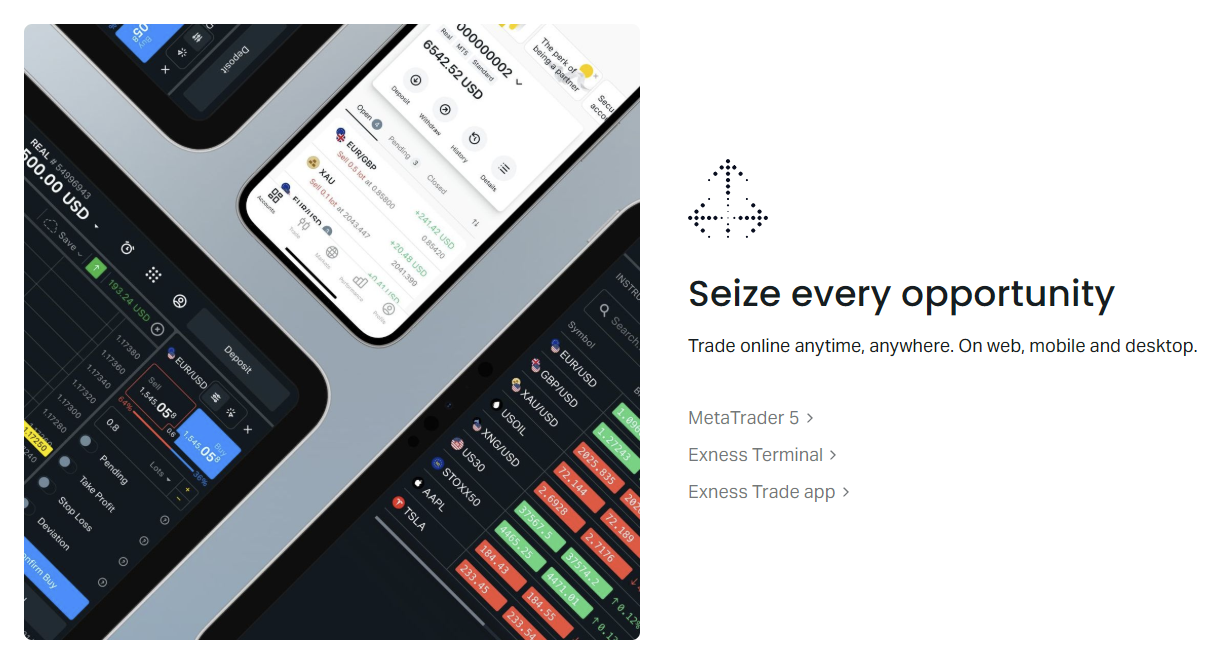
Exness supports NZDUSD trading on MetaTrader 4, MetaTrader 5, the proprietary Exness Web Terminal, and mobile apps for both MetaTrader versions. Each platform has distinct advantages. The choice often comes down to personal workflow, charting needs, and whether you prefer desktop or browser-based access.
MetaTrader 4 remains the most widely used platform globally. It offers nine timeframes, 30 built-in indicators, and support for expert advisors. The interface is familiar to most forex traders. Exness provides MT4 for Windows, macOS, iOS, and Android. The mobile version includes most desktop features, though screen space limits complex multi-chart layouts.
MetaTrader 4 for NZDUSD
MT4 on Exness delivers raw spreads on professional accounts and standard spreads on retail accounts. One-click trading works directly from charts. The platform supports hedging by default, which some NZDUSD traders use during uncertain news events. Custom indicators and EAs install easily. The strategy tester allows backtesting against historical tick data, though the quality depends on the data source.
A practical limitation: MT4 does not natively display depth of market or tick charts. Traders who rely on order flow analysis need third-party tools or a different platform. The platform also lacks built-in economic calendar integration, so you'll want a separate calendar window open during NZDUSD trading hours.
MetaTrader 5 for NZDUSD
MT5 adds 21 timeframes, 38 built-in indicators, and a more advanced strategy tester with multi-currency backtesting. Depth of market is available, showing liquidity levels at different prices. This can help NZDUSD traders gauge where large orders sit. The platform also supports netting and hedging modes, though Exness accounts default to hedging.
The economic calendar integrates directly into MT5, appearing as a tab in the toolbox. News events show expected impact and previous values. For NZDUSD, this means Reserve Bank of New Zealand rate decisions, Global Dairy Trade auction results, and US non-farm payrolls appear without leaving the platform. The calendar updates in real time.
Exness Web Terminal
The Web Terminal runs in any modern browser without installation. It loads quickly and provides a clean charting interface with TradingView-powered charts. You get 15 drawing tools, multiple chart types, and a good selection of indicators. The platform syncs with your Exness account instantly. One-click trading, pending orders, and stop-loss/take-profit modification work smoothly.
Web Terminal suits traders who switch devices or cannot install software. It lacks expert advisor support and custom indicator installation. The mobile browser version works but feels cramped on phones. For serious NZDUSD analysis, the desktop browser experience is solid. Charts save your layout and drawings across sessions.
Account Types and NZDUSD Conditions
Exness offers Standard, Standard Cent, Pro, Raw Spread, and Zero accounts. Each handles NZDUSD differently. The main differences lie in spread structure, commission charges, minimum deposits, and leverage limits. Your trading style and capital should guide the choice.
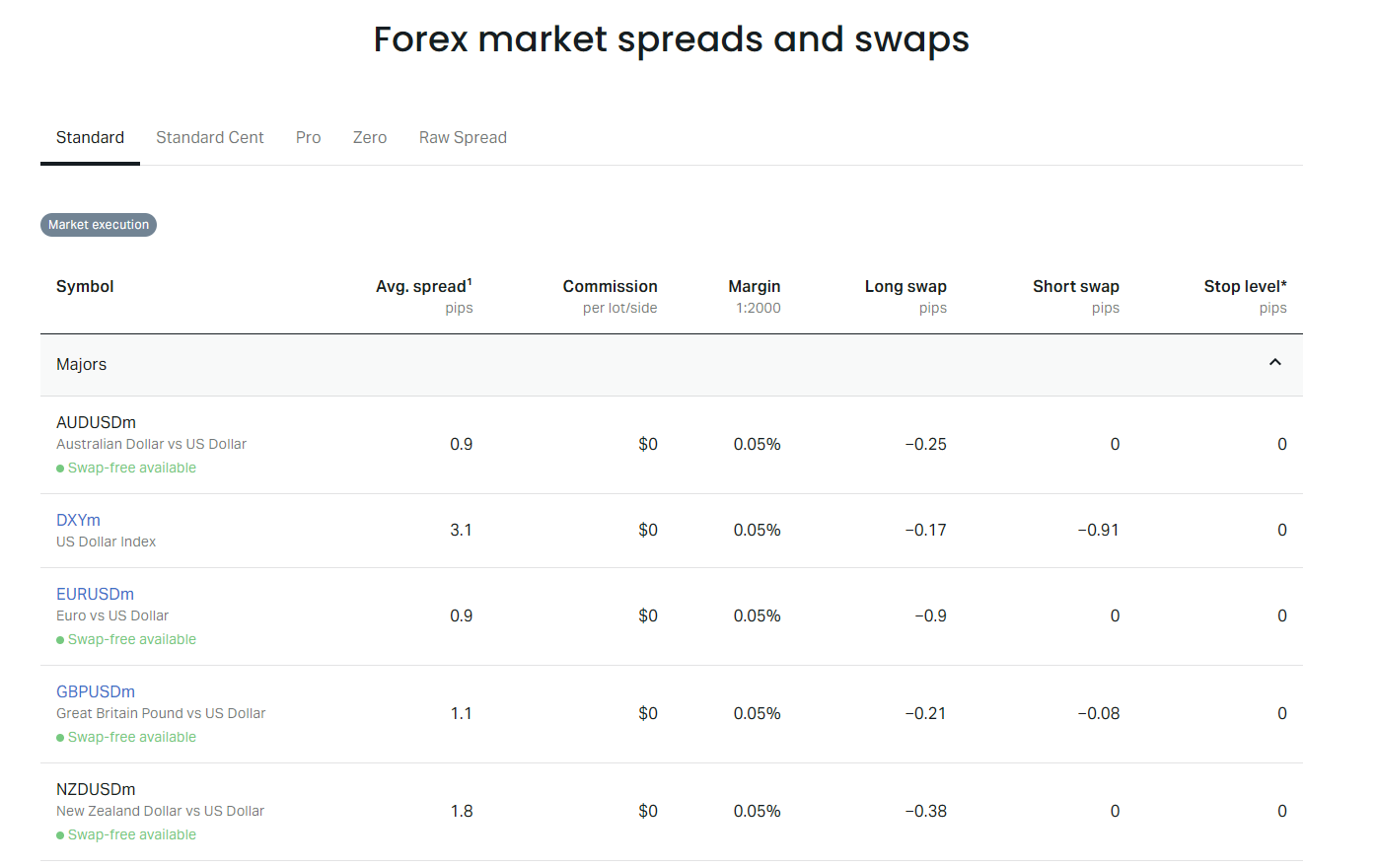
Standard accounts charge no commission. The spread includes the broker's markup. For NZDUSD, expect typical spreads of 1.0 to 1.5 pips during active hours. Standard Cent accounts function identically but denominate balances in cents, allowing micro-position sizing with small deposits. This helps beginners learn NZDUSD dynamics without risking meaningful capital.
Professional Accounts for NZDUSD
Pro accounts offer lower spreads than Standard, typically around 0.3 to 0.7 pips on NZDUSD, with no commission. The minimum deposit is higher. Raw Spread accounts show spreads from 0.0 pips with a commission of $3.5 per side per lot. Zero accounts also start from 0.0 pips but charge $3.5 per side per lot with a slightly different spread profile. For high-frequency NZDUSD strategies, the commission-based accounts often cost less overall.
Scroll horizontally to see all columns
| Account Type | Typical Spread | Commission (per lot/side) | Min Deposit | Max Leverage |
|---|---|---|---|---|
| Standard | 1.0-1.5 pips | None | $1 | 1:2000 |
| Standard Cent | 1.0-1.5 pips | None | $1 | 1:2000 |
| Pro | 0.3-0.7 pips | None | $200 | 1:2000 |
| Raw Spread | 0.0-0.2 pips | $3.50 | $200 | 1:2000 |
| Zero | 0.0-0.2 pips | $3.50 | $200 | 1:2000 |
Leverage up to 1:2000 is available on most accounts, but it scales down as equity grows. Above $2,000 equity, maximum leverage drops to 1:1000. Above $5,000, it drops to 1:500. This tiered structure protects both the trader and the broker. For NZDUSD, where daily moves of 1% are rare, excessive leverage rarely makes sense. Most experienced traders stay well below the maximum.
Spreads, Commissions, and Swaps
Spreads on NZDUSD fluctuate with market conditions. During the Asian session, spreads often widen by 0.2 to 0.5 pips compared to the London-New York overlap. Major news events like RBNZ rate decisions or US CPI releases can cause spreads to spike temporarily. Exness uses variable spreads on all account types. Fixed spreads are not offered.
Commission on Raw Spread and Zero accounts is charged per side. A round turn on one standard lot costs $7. At a typical 0.1 pip raw spread, the total cost per round turn is roughly $7 plus $1 for the spread, totaling $8. On a Standard account with a 1.2 pip spread and no commission, the cost is $12 per round turn. For traders executing more than a few lots monthly, the commission model usually wins.
The commission model rewards volume. If you trade NZDUSD frequently, Raw Spread or Zero accounts reduce costs significantly compared to spread-only pricing.
Swap rates for NZDUSD depend on the interest rate differential between New Zealand and the US. When the RBNZ rate exceeds the Fed rate, long NZDUSD positions earn positive swap. When the Fed rate is higher, shorts earn positive swap. Exness publishes current swap rates in the contract specifications and trading platforms. Swap-free accounts are available for Islamic finance compliance, though they may carry alternative fees.
Leverage and Margin Requirements
Margin requirements for NZDUSD follow the standard forex formula: position size divided by leverage. At 1:500 leverage, a 1-lot NZDUSD position requires $200 margin (100,000 NZD / 500, converted at current rate). At 1:100, the same position needs $1,000 margin. Exness calculates margin in the account currency, converting automatically.
Stop-out level is set at 0% on most Exness accounts. This means positions close automatically when margin level hits zero, not at a higher threshold like 20% or 50% seen at some brokers. While this gives trades maximum room, it also means losses can exceed the account balance in extreme gaps. Negative balance protection applies, capping losses at the deposited amount.
Trading Hours and Sessions
NZDUSD trades 24 hours a day, five days a week on Exness. The market opens Sunday 22:05 UTC (Monday 00:05 server time) and closes Friday 21:55 UTC. Server time is GMT+2 in winter, GMT+3 in summer. The daily rollover occurs at 22:00 UTC, when swaps are charged or credited.
Three main sessions affect NZDUSD liquidity. The Sydney session (22:00-07:00 UTC) sees moderate volume with New Zealand and Australian participants. The Tokyo session (00:00-09:00 UTC) adds Japanese institutional flow. The London session (08:00-17:00 UTC) brings the deepest liquidity and tightest spreads. The New York session (13:00-22:00 UTC) overlaps with London for the highest volume period.
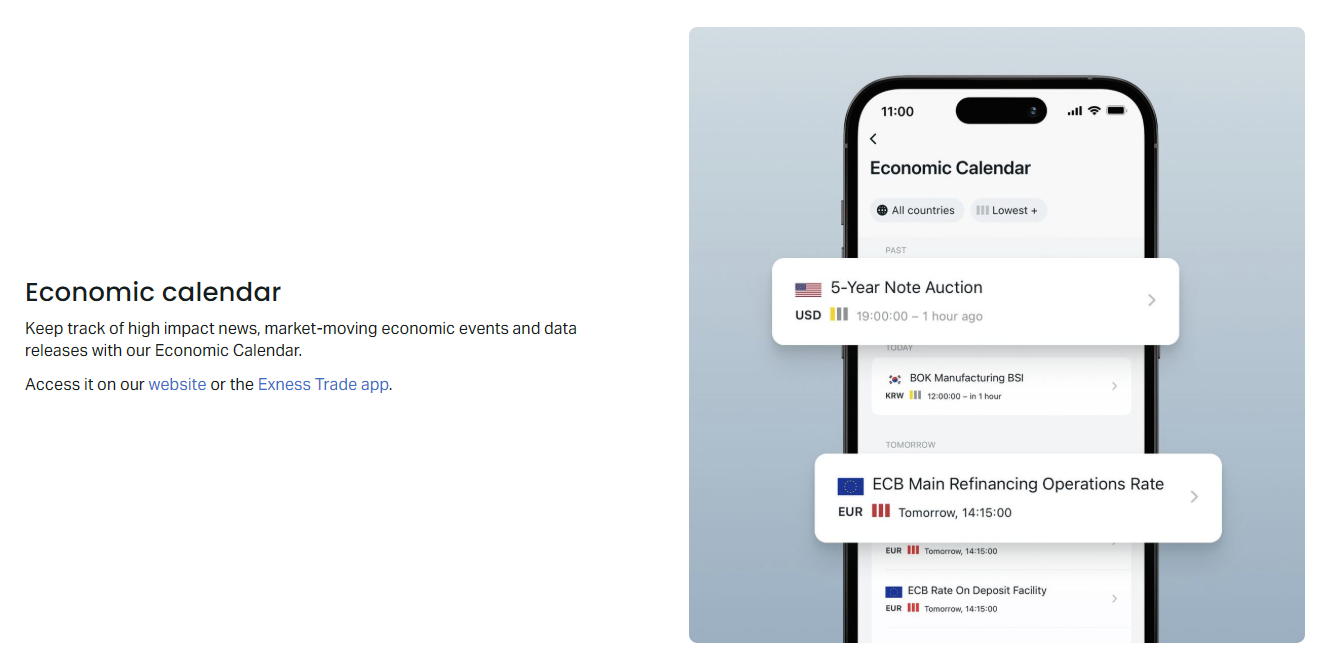
Key economic events for NZDUSD traders include the RBNZ monetary policy statement (quarterly), Global Dairy Trade auctions (twice monthly), New Zealand employment data (quarterly), and US non-farm payrolls (monthly). The Exness economic calendar flags these with impact ratings. During high-impact events, spreads widen and slippage risk increases. Some traders reduce position size or avoid new entries 15 minutes before and after major releases.
Risk Management Tools
Exness provides standard risk management tools: stop-loss, take-profit, trailing stop, and pending orders. Stop-loss and take-profit can be set at order entry or modified on open positions. Trailing stop activates once price moves in your favor by a specified distance, then follows price at that distance. It only works while the platform runs, except on the Web Terminal where it operates server-side.
Pending orders include buy limit, sell limit, buy stop, sell stop, buy stop limit, and sell stop limit. These help NZDUSD traders enter on breakouts or pullbacks without watching charts constantly. Expiration can be set to GTC (good till cancelled), day, or specific date/time. One-cancels-other (OCO) orders are not natively supported but can be simulated with expert advisors.
Technical Analysis Resources
Exness integrates TradingView charts into the Web Terminal and provides market analysis through its website and app. The economic calendar, mentioned earlier, includes technical levels for major pairs. Trading Central signals appear in the personal area and on some platforms, offering pattern recognition and key levels for NZDUSD.
The Exness mobile app includes a dedicated analysis section with daily technical outlooks for major pairs. These cover support/resistance zones, trend direction, and potential scenarios. They are not trading signals but rather analytical frameworks. For NZDUSD, the analysis typically references commodity price correlations and interest rate differentials alongside chart patterns.
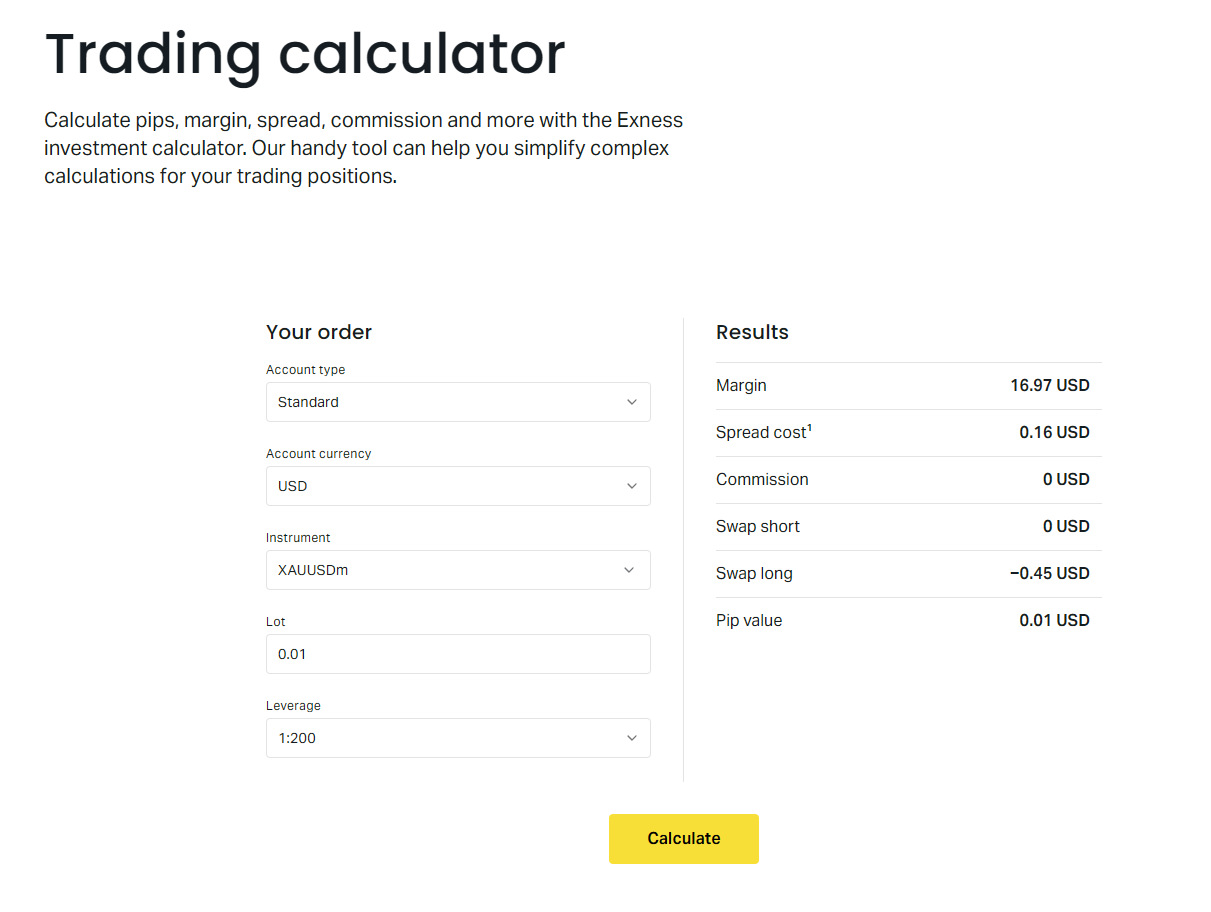
The trading calculator in the personal area helps plan NZDUSD trades. Input account type, leverage, position size, entry price, stop-loss, and take-profit. It outputs required margin, pip value, swap costs, and potential profit/loss. This tool is especially useful when comparing account types or testing different leverage scenarios before committing real capital.
The calculator removes guesswork from position sizing. Use it before every trade until the math becomes automatic.
Deposits and Withdrawals for NZDUSD Traders
Exness supports numerous deposit and withdrawal methods: bank cards, wire transfers, electronic wallets (Skrill, Neteller, WebMoney, Perfect Money), and regional options. Most methods process deposits instantly. Withdrawals to cards and e-wallets are often instant after the first successful verification. Bank wires take 1-3 business days. No fees are charged by Exness for deposits or withdrawals, though payment providers may apply their own charges.
Minimum deposit is $1 on Standard and Standard Cent accounts. Professional accounts require $200 minimum. There is no maximum deposit limit. Withdrawal minimums vary by method but start around $1-$10. The personal area tracks all transactions. Verification (KYC) is required before first withdrawal, typically completed within a few hours during business days.
NZDUSD Trading Strategies on Exness
Common NZDUSD approaches on Exness include trend following on H4 and daily charts, range trading during Asian session, and news-based strategies around RBNZ and Fed announcements. Carry trade strategies work when the interest rate differential favors NZD, though swap costs on Standard accounts can erode returns. Scalpers favor Raw Spread or Zero accounts during London-New York overlap for the tightest effective costs.
Breakout strategies around the London open (08:00 UTC) capture the session's initial momentum. The Asian session high/low often defines a range that breaks when European traders enter. False breakouts are common, so waiting for a retest or using a volatility filter helps. Exness execution speed matters here; slippage on stop orders during fast moves can affect results.
- Trend following: Daily EMA alignment, pullbacks to 20 EMA on H4
- Range trading: Asian session boundaries, RSI extremes, 15-min charts
- News trading: Straddle orders before RBNZ/Fed, wide stops, quick exits
- Carry trade: Long NZDUSD when RBNZ > Fed, monitor swap credits
- Correlation trade: NZDUSD vs AUDUSD divergence, mean reversion
Automated trading via expert advisors works on MT4 and MT5. Exness does not restrict EA usage. VPS hosting is available for $30/month (free for accounts with $500+ equity and 5+ lots monthly volume). The VPS runs near Exness servers, reducing latency to under 5ms. For NZDUSD EAs that trade during news or scalp small moves, the VPS can improve fill quality noticeably.
Regulation and Fund Safety
Exness operates under multiple regulatory licenses. The main entities include Exness (SC) Ltd regulated by the Seychelles FSA, Exness B.V. regulated by the Dutch AFM, and Exness (UK) Ltd regulated by the FCA. Client funds are segregated from company funds. The FCA entity offers FSCS protection up to £85,000. Other entities have their own compensation schemes or insurance arrangements.
Negative balance protection applies across all entities. This means you cannot lose more than your deposited funds, even during extreme market events like the 2015 CHF unpegging. Exness publishes audited financial statements and maintains capital ratios well above regulatory minimums. The broker has operated since 2008 without major regulatory sanctions.
Multi-jurisdiction regulation means your protections depend on which entity onboards you. Check your contract details in the personal area.
Frequently Asked Questions
What is the minimum deposit to trade NZDUSD on Exness?
Standard and Standard Cent accounts require $1 minimum deposit. Professional accounts (Pro, Raw Spread, Zero) require $200 minimum deposit.
Which Exness account type has the lowest cost for NZDUSD scalping?
Raw Spread and Zero accounts offer spreads from 0.0 pips with $3.50 commission per side per lot. For high-frequency scalping, these typically cost less than Standard accounts with 1.0-1.5 pip spreads and no commission.
Does Exness offer swap-free NZDUSD trading?
Yes, Islamic/swap-free accounts are available. They do not charge or credit overnight swaps but may have alternative fee structures. Contact support to enable this option on your account.
What leverage is available for NZDUSD on Exness?
Up to 1:2000 depending on account equity. Leverage tiers reduce at $2,000 equity (1:1000 max) and $5,000 equity (1:500 max). Professional clients may access higher limits under certain regulators.
Can I trade NZDUSD on Exness Web Terminal without installing software?
Yes, the Web Terminal runs in any modern browser and provides full NZDUSD trading capability with TradingView charts, one-click trading, and all order types.
How fast are NZDUSD withdrawals on Exness?
Withdrawals to e-wallets and cards are often instant after first verification. Bank wires take 1-3 business days. Exness charges no withdrawal fees.
Does Exness provide NZDUSD trading signals?
Exness offers Trading Central technical analysis and daily market outlooks in the personal area and mobile app. These are analytical frameworks, not explicit buy/sell signals.
Final Assessment of Exness NZDUSD Trading
Exness delivers competitive NZDUSD trading conditions across a range of account types and platforms. The Raw Spread and Zero accounts stand out for active traders who value tight effective costs. Standard accounts work fine for lower-frequency traders who prefer simplicity. The Web Terminal with TradingView charts is a genuine strength for browser-based analysis. Execution quality matches the broker's claims in normal conditions, though slippage during major news is unavoidable industry-wide.
The tiered leverage structure and 0% stop-out level give trades maximum room but require disciplined risk management. Negative balance protection adds a safety floor. Multi-jurisdiction regulation means protections vary by entity; check which one holds your account. Deposit and withdrawal processes are smooth, with instant options for most methods. For NZDUSD specifically, the pair's commodity sensitivity and session-based volatility patterns align well with Exness's platform tools and trading hours.
If you trade NZDUSD regularly, test the Raw Spread account on a demo first. Compare total costs (spread plus commission) against your current broker. The VPS offer becomes valuable once you cross the volume threshold. Overall, Exness provides a professional-grade environment for this pair without gimmicks or hidden conditions.