

Forex Trading
Exness Gold Trading XAUUSD: Complete Guide
Everything you need to know about trading XAUUSD on Exness, from account types to execution quality.

Senior Forex Trader & Market Analyst
Daniel Chen is an experienced forex trader and financial market analyst with over 15 years of experience in currency trading. He specializes in technical analysis, risk management, and developing practical trading strategies to help traders make informed decisions.
Gold remains one of the most actively traded instruments across global markets. Traders turn to XAUUSD for its liquidity, its tendency to trend during uncertainty, and its role as a hedge against currency debasement. Exness offers access to this market through CFDs with conditions that suit both short-term scalpers and longer-term position traders. This guide covers the practical details you need before placing your first gold trade on the platform.
Contents
- 1. Why Trade Gold on Exness
- 2. XAUUSD Trading Specifications
- 3. Account Types and Gold Trading Costs
- 4. Leverage and Margin Requirements
- 5. Trading Platforms for XAUUSD
- 6. Execution Quality and Slippage
- 7. Risk Management Tools
- 8. Gold Trading Sessions and Volatility Patterns
- 9. Common Gold Trading Strategies on Exness
- 9.1. Trend Following on Higher Timeframes
- 9.2. Breakout Trading at Key Levels
- 9.3. Mean Reversion in Ranging Conditions
- 9.4. News Straddle Ahead of High-Impact Events
- 10. Funding, Withdrawals, and Gold Profits
- 11. Demo Account for Gold Practice
- 12. Regulatory Protections and Entity Differences
- 13. Tax Considerations for Gold CFD Profits
- 14. Final Assessment of Exness Gold Trading
The broker provides gold trading across all account types, including Standard, Standard Cent, Pro, Raw Spread, and Zero. Each account applies different spread and commission structures, which directly affect the cost of trading XAUUSD. Understanding those differences helps you pick the right setup for your strategy. The sections below break down specifications, costs, platforms, execution, and risk controls so you can decide whether Exness fits your approach to the gold market.
Before diving into the specifics, it helps to know that Exness operates under multiple regulatory licenses, including CySEC in Europe, FCA in the UK, FSCA in South Africa, and FSA in Seychelles. The entity you register with determines your maximum leverage, negative balance protection, and investor compensation eligibility. Retail clients under CySEC or FCA see leverage capped at 1:20 for gold, while professional clients and those under the Seychelles entity can access up to 1:2000. Always confirm which entity governs your account before sizing positions.
Why Trade Gold on Exness
Exness has built a reputation for stable spreads during volatile sessions, instant withdrawals, and a proprietary web terminal that loads without installation. For gold traders, the combination of deep liquidity and low latency matters. The broker aggregates prices from multiple tier-one banks and non-bank liquidity providers, which keeps the XAUUSD spread tight even when New York and London sessions overlap. During major news events — non-farm payrolls, CPI releases, FOMC decisions — spreads widen across the industry, but Exness tends to normalize faster than many competitors.
Another practical advantage is the absence of requotes on market execution accounts. When you click buy or sell on XAUUSD, the order fills at the best available price from the liquidity pool. Slippage can still occur during gaps, but the broker does not reject orders or delay fills to protect its own book. This matters for strategies that rely on precise entries, such as breakout trades around key psychological levels like $2,000 or $1,900.
The platform ecosystem includes MetaTrader 4, MetaTrader 5, the Exness Web Terminal, and mobile apps for iOS and Android. All support full XAUUSD functionality: one-click trading, depth of market, custom indicators, and automated strategies via Expert Advisors. The web terminal is particularly useful for traders who cannot install software on work computers or who switch devices frequently. It preserves chart templates, drawing tools, and indicator settings across sessions.
XAUUSD Trading Specifications
Every broker defines contract specifications slightly differently. On Exness, one standard lot of XAUUSD represents 100 troy ounces of gold. The minimum trade size is 0.01 lots (one ounce) on Standard and Pro accounts, and 0.001 lots on Cent accounts where the lot size is 100 ounces but denominated in cents. The tick size is $0.01 per ounce, meaning each tick on a standard lot equals $1. Swap rates apply to positions held past 23:59 server time and vary by account type and direction (long vs short).
Scroll horizontally to see all columns
| Parameter | Standard / Pro | Raw Spread / Zero | Standard Cent |
|---|---|---|---|
| Contract Size | 100 oz | 100 oz | 100 oz |
| Min Lot | 0.01 | 0.01 | 0.001 |
| Max Lot per Ticket | 200 | 200 | 200 |
| Tick Value (per lot) | $1 | $1 | $0.01 |
| Margin Currency | USD | USD | USC (cents) |
| Trading Hours (Server Time) | Mon 00:05 – Fri 23:55 | Mon 00:05 – Fri 23:55 | Mon 00:05 – Fri 23:55 |
| Daily Break | 23:55 – 00:05 | 23:55 – 00:05 | 23:55 – 00:05 |
The daily break from 23:55 to 00:05 server time (GMT+2 or GMT+3 depending on daylight saving) is when the broker rolls positions and applies swaps. During this window, spreads widen significantly and liquidity drops. Avoid opening new gold trades or modifying stops during those ten minutes unless your strategy specifically targets the rollover. The trading week opens Monday 00:05 and closes Friday 23:55, giving roughly 120 hours of continuous access.
Account Types and Gold Trading Costs
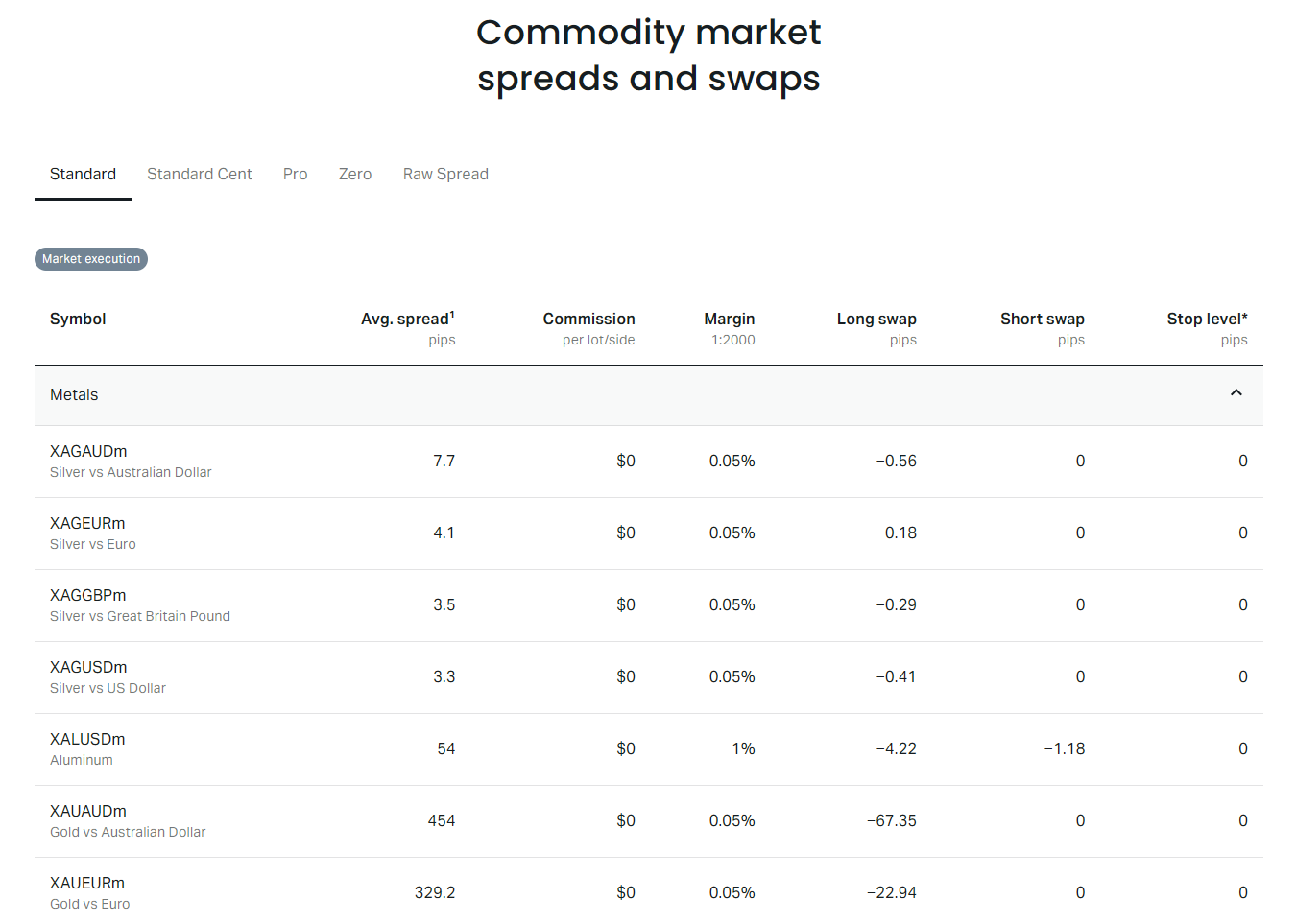
Exness offers five live account types, and each handles XAUUSD costs differently. Standard and Standard Cent accounts charge no commission; the spread includes the broker's markup. Pro accounts also run commission-free but with tighter spreads. Raw Spread and Zero accounts charge a round-turn commission per lot in exchange for spreads that start from zero pips. For gold, the commission on Raw Spread is $3.5 per side per lot ($7 round turn), while Zero accounts charge $3.5 per side per lot on most instruments but may differ for metals — check the current specification sheet in your Personal Area.
Scroll horizontally to see all columns
| Account Type | Avg Spread (pips) | Commission (per lot round turn) | Effective Cost (approx) |
|---|---|---|---|
| Standard | 15–25 | None | $15–25 per lot |
| Standard Cent | 15–25 | None | $0.15–0.25 per micro lot |
| Pro | 8–15 | None | $8–15 per lot |
| Raw Spread | 0–5 | $7 | $7–12 per lot |
| Zero | 0–3 | $7 | $7–10 per lot |
Spreads are floating and widen during low-liquidity periods: the Asian session before Tokyo opens, the daily rollover window, and major news releases. The figures above represent typical averages during the London–New York overlap. If you scalp gold on the 1-minute or 5-minute chart, the Raw Spread or Zero account usually yields the lowest all-in cost despite the commission. Swing traders holding positions for days may prefer Pro or Standard to avoid commission drag on larger position sizes.
Swap rates deserve attention if you hold gold overnight. Long XAUUSD positions typically pay negative swap (you pay), while short positions may receive positive swap (you earn) depending on the interest rate differential between USD and the gold lease rate. Exness publishes daily swap values in the contract specifications and in the Market Watch window of MT4/MT5. For reference, a long position of 1 lot might incur roughly -$1.5 to -$3 per night, while a short position could earn $0.5 to $1.5. These numbers fluctuate with central bank policy and gold forward rates.
Leverage and Margin Requirements
Leverage on XAUUSD depends on your account equity, regulatory jurisdiction, and the specific instrument tier. Exness uses a dynamic leverage model: as your account equity grows, maximum leverage steps down. For gold, the tiers typically look like this: up to $999 equity — 1:2000 (or 1:200 for retail EU/UK), $1,000–$4,999 — 1:1000, $5,000–$29,999 — 1:500, $30,000–$99,999 — 1:200, above $100,000 — 1:100. Professional clients and accounts under the Seychelles entity can maintain higher leverage at all equity levels.
Margin is calculated as (contract size × lot size × market price) ÷ leverage. At $2,000 per ounce, one standard lot (100 oz) has a notional value of $200,000. With 1:500 leverage, required margin is $400. With 1:20 (retail EU/UK cap), margin jumps to $10,000 per lot. This difference dramatically affects how many lots you can hold simultaneously. Always monitor the Margin Level indicator in your terminal; stop-out triggers at 0% on most Exness accounts, meaning positions close automatically when equity falls to zero. There is no separate margin call warning level.
Exness also offers a leverage limiter in the Personal Area. You can cap your maximum leverage below the system maximum — for example, setting a personal cap of 1:100 even if the system allows 1:500. This is a useful discipline tool for traders who want to avoid accidental over-leveraging during volatile gold sessions. The setting applies account-wide and takes effect immediately on new positions.
Trading Platforms for XAUUSD
All Exness platforms support gold trading with full charting, order management, and analysis tools. MetaTrader 4 remains popular for its lightweight footprint and vast library of custom indicators and Expert Advisors. MetaTrader 5 adds more timeframes (21 vs 9), a built-in economic calendar, depth of market, and netting/hedging account options. The Exness Web Terminal runs in any modern browser and syncs chart layouts, templates, and drawings with the desktop terminals. Mobile apps for iOS and Android mirror the core functionality, including one-tap trading and push notifications for price alerts.
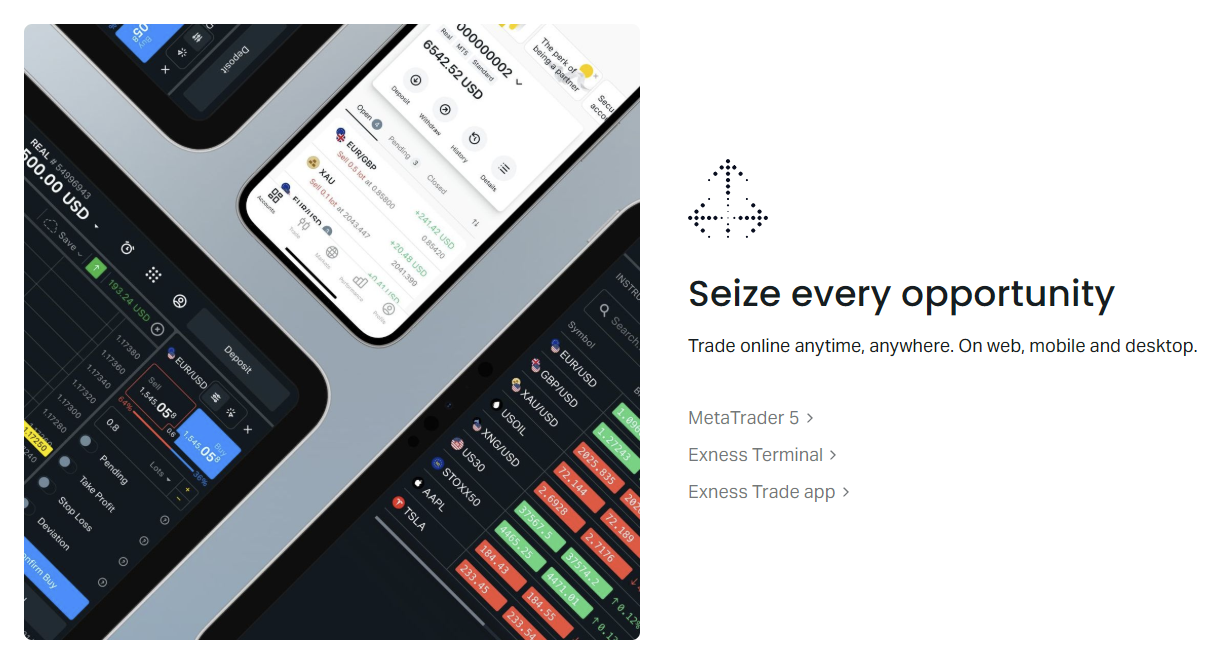
For gold specifically, the depth of market (DOM) feature in MT5 and the Web Terminal shows real-time liquidity at each price level. This helps when placing large orders or trading breakouts where you want to see if there is sufficient volume to absorb your position without excessive slippage. The Web Terminal also includes Trading Central signals and an economic calendar overlay on charts, which can highlight upcoming events that typically move XAUUSD — Fed speeches, inflation data, geopolitical escalations.
The web terminal loads in seconds and remembers your gold chart setup across devices. No installation, no updates, no compatibility issues.
Automated trading works on all platforms. If you run an Expert Advisor for gold — whether a trend-following system, a mean-reversion bot, or a news-straddle script — ensure it handles the daily rollover window correctly. Many EAs fail because they send orders during the 23:55–00:05 break when spreads are wide and liquidity is thin. Test thoroughly on a demo account using real tick data before deploying live. Exness provides free VPS hosting for accounts with at least $500 equity and 5 lots traded monthly, which reduces latency for EA traders.
Execution Quality and Slippage
Exness operates a no-dealing-desk model with market execution. Orders route to a pool of liquidity providers — major banks, prime brokers, and non-bank market makers — and fill at the best available price. The broker publishes execution statistics quarterly, showing average fill speed, slippage distribution, and requote rates. For XAUUSD, median execution time is typically under 20 milliseconds during peak hours. Positive slippage (better price than requested) occurs roughly as often as negative slippage, which suggests fair flow handling.
During high-impact news — NFP, CPI, FOMC — spreads on gold can widen from 10–15 pips to 50–100 pips or more. Market orders filled in those seconds may experience slippage of several dollars per ounce. Limit and stop-limit orders give you price control but risk non-fill if the market gaps through your level. Stop-loss orders on Exness are guaranteed only for professional clients under specific conditions; retail clients face standard market execution on stops, meaning they can slip during gaps. Plan position sizes and stop distances accordingly.
Scroll horizontally to see all columns
| Order Type | Execution | Price Guarantee | Best For |
|---|---|---|---|
| Market Buy/Sell | Instant at best available | No | Immediate entry |
| Buy/Sell Limit | At specified price or better | Yes (limit price) | Better entry on pullback |
| Buy/Sell Stop | Market once triggered | No | Breakout entry |
| Buy/Sell Stop Limit | Limit once triggered | Yes (limit price) | Controlled breakout entry |
| Stop Loss | Market once triggered | No (retail) | Risk control |
| Take Profit | Limit | Yes | Target exit |
The broker does not offer guaranteed stop-loss orders (GSLO) for retail clients. If you need absolute downside protection regardless of gapping, you must either reduce position size, use options (not available on Exness), or accept the risk. Some traders mitigate overnight gap risk by closing gold positions before the weekend or before major scheduled events. Others use hedging — opening an opposite position in a correlated instrument like silver (XAGUSD) or a gold mining stock CFD — though correlation breaks down during crises.
Risk Management Tools
Beyond standard stop-loss and take-profit orders, Exness provides several platform-level risk controls. The margin call and stop-out levels are visible in the terminal's trade tab. You can set price alerts for key gold levels — psychological round numbers, prior highs/lows, moving averages — and receive push notifications on mobile or email. The trading calculator in the Personal Area and on the website lets you compute margin, pip value, swap, and profit/loss for any XAUUSD position size before you trade.
Negative balance protection applies to all retail clients under CySEC, FCA, and FSCA regulation. If your account goes negative due to extreme slippage or a flash crash, Exness absorbs the loss and resets the balance to zero. Professional clients and clients under the Seychelles entity do not receive this protection by default. Check your client classification in the Personal Area to confirm your coverage. The distinction matters: a 5% gap against a highly leveraged gold position can exceed your deposit, and without negative balance protection, you would owe the deficit.
The Exness mobile app includes a 'Risk Manager' feature that lets you set daily loss limits. Once hit, the app can block new trades for the remainder of the session. This is a soft lock — you can override it — but it adds a friction layer that helps prevent revenge trading after a string of losing gold trades. The web terminal and desktop platforms do not yet have this feature, so mobile users get an extra behavioral guardrail.
Gold Trading Sessions and Volatility Patterns
XAUUSD trades 23 hours a day, five days a week, but volume and volatility follow a clear pattern. The Asian session (Tokyo open 00:00–09:00 GMT) is typically quiet, with gold ranging in a tight band unless China economic data or geopolitical headlines hit. The London open (07:00–08:00 GMT) brings the first real volume spike. The London–New York overlap (12:00–16:00 GMT) is the most liquid and volatile window — this is where trends develop, breakouts sustain, and spreads are tightest. The New York afternoon (16:00–21:00 GMT) often sees profit-taking and range contraction into the daily close.
Seasonal patterns also appear in gold. Historically, January and August show stronger bullish bias due to portfolio rebalancing and festival demand in India and China. Summer months (June–July) can be choppy with lower volume. December often sees reduced liquidity into year-end. These are tendencies, not rules — a crisis overrides any seasonal pattern. The economic calendar in your terminal flags high-impact events: US CPI, PPI, retail sales, ISM PMI, Fed minutes, ECB decisions, and geopolitical risk events. Gold reacts most violently to real yields (TIPS yields) and the dollar index (DXY). When real yields fall, gold typically rises, and vice versa.
Gold does not care about earnings reports. It cares about real rates, the dollar, and fear. Align your trades with those drivers.
Weekend gaps are a specific risk for gold holders. Since the market closes Friday 23:55 and reopens Monday 00:05, any major event over the weekend — war escalation, central bank emergency action, financial crisis — will cause a gap at the open. Your stop-loss will fill at the first available price, which could be far from your level. The only ways to avoid weekend gap risk are closing positions before Friday close or using very small position sizes relative to equity. Some traders hedge with options on other venues, but that adds complexity and cost.
Common Gold Trading Strategies on Exness
No single strategy works in all market conditions. Below are approaches that gold traders commonly use on Exness, with notes on how the broker's conditions affect each.
Trend Following on Higher Timeframes
Swing traders use the 4-hour, daily, or weekly charts to ride multi-week trends. They enter on pullbacks to moving averages (20 EMA, 50 SMA) or Fibonacci retracements, with stops below recent swing lows (for longs) or above swing highs (for shorts). Exness's low overnight swap costs on Raw Spread and Zero accounts make holding these positions for weeks viable. On Standard or Pro accounts, the wider spread matters less because the target is hundreds of pips. The key is avoiding over-leverage: a 1-lot position held for a month at 1:100 leverage ties up $2,000 margin at $2,000 gold, leaving room for normal drawdown.
Breakout Trading at Key Levels
Gold respects psychological levels ($1,800, $1,900, $2,000, $2,100) and prior session highs/lows. Breakout traders place buy stops above resistance and sell stops below support, expecting momentum to carry price through. Exness's market execution fills these stops at the next available price. During the London–New York overlap, fills are usually within 1–2 pips of the trigger. In thin conditions, slippage can be 5–10 pips. Using stop-limit orders instead of plain stops caps slippage but risks missing the move entirely if price gaps through the limit. Test both approaches on demo to see which matches your risk profile.
Mean Reversion in Ranging Conditions
When gold consolidates — often during Asian session or ahead of major news — mean reversion traders buy near support and sell near resistance, targeting the middle of the range. Bollinger Bands, RSI extremes, and Keltner Channels help identify overextension. This style requires tight spreads and low commissions because profit per trade is small (20–50 pips). Raw Spread or Zero accounts are essential here; the $7 round-turn commission on a 0.5-lot scalp still leaves net profit if the spread is near zero. On Standard accounts, the 15–25 pip spread eats most of the edge.
News Straddle Ahead of High-Impact Events
Before CPI, NFP, or FOMC, some traders place a buy stop 15–20 pips above current price and a sell stop 15–20 pips below, with stop-losses on the opposite side of the current price. The idea: whichever direction the market breaks, you catch the move. Exness allows this, but be aware that spreads widen dramatically in the seconds before the release. Your stops may trigger on the widened spread before the actual move, then get stopped out on the reversal. A wider buffer (30–50 pips) reduces false triggers but increases risk. This is a high-variance approach; most retail traders lose money on straddles over time.
Funding, Withdrawals, and Gold Profits
Exness supports a wide range of deposit and withdrawal methods: bank cards (Visa, Mastercard), e-wallets (Skrill, Neteller, WebMoney, Perfect Money), crypto (USDT, USDC, BTC, ETH, and others via third-party processors), and local bank transfers in many countries. Minimum deposit is $1 for most methods, though some e-wallets require $10. Deposits are instant for cards and e-wallets; crypto confirmations depend on blockchain congestion. Withdrawals process automatically 24/7 for e-wallets and crypto — most complete within minutes. Bank cards take 1–3 business days; bank transfers take 1–5 business days.
There are no withdrawal fees from Exness's side. Payment processors may charge their own fees (e.g., Skrill charges ~1% on withdrawals). Crypto network fees apply on-chain. The broker does not impose limits on withdrawal amounts, but your payment method may have daily or monthly caps. Profits from gold trading withdraw just like any other instrument — no special restrictions, no holding periods. The only requirement is that the withdrawal method matches a previously used deposit method (closed-loop policy) for anti-money-laundering compliance.
Withdrawal speed is where Exness genuinely differs. Gold profits hit your e-wallet in minutes, not days. That changes how you manage trading capital.
Currency conversion happens automatically if your account base currency differs from the payment method currency. Exness uses its own conversion rates, which include a small markup over mid-market. For large withdrawals, it can be cheaper to withdraw in your account currency to a multi-currency account (like Wise or Revolut) and convert there. Check the conversion rate in the Personal Area before confirming a large withdrawal.
Demo Account for Gold Practice
Exness offers unlimited demo accounts with virtual funds up to $100,000 (or equivalent). Demo conditions mirror live: same spreads, same execution, same swaps, same platform features. The only differences are psychological — no real money at risk — and occasional liquidity discrepancies during extreme events where demo liquidity may be deeper. Use demo to test your gold strategy across different account types, verify EA behavior during rollover, and practice position sizing with the margin calculator. Demo accounts expire after 30 days of inactivity but can be recreated instantly.
A practical demo routine: trade XAUUSD on a Raw Spread demo for two weeks, logging every trade with entry, exit, rationale, and outcome. Compare your results to the same strategy on a Standard demo. The difference in net profit will show whether the commission model suits your frequency and win rate. Many traders discover they overtrade on commission-free accounts because the cost feels invisible, while the commission discipline on Raw Spread forces selectivity.
Regulatory Protections and Entity Differences
Your regulatory protections depend entirely on which Exness entity onboards you. The main entities are: Exness (Cy) Ltd (CySEC, EU/EEA), Exness UK Ltd (FCA, UK), Exness (SC) Ltd (FSA, Seychelles), Exness (ZA) Ltd (FSCA, South Africa), and Exness (VG) Ltd (FSC, British Virgin Islands). CySEC and FCA entities offer retail leverage caps (1:20 for gold), negative balance protection, investor compensation funds (ICF up to €20k, FSCS up to £85k), and strict segregation of client funds. The Seychelles and BVI entities offer up to 1:2000 leverage, no compensation fund, and no negative balance protection for retail clients.
You cannot choose your entity arbitrarily — it is assigned based on your country of residence. If you live in Germany, you get the CySEC entity. If you live in Nigeria, you likely get the Seychelles entity. This is not a broker choice; it is a regulatory requirement. Some traders attempt to register under a different jurisdiction using a VPN or foreign address. This violates terms of service and can lead to account closure and fund withholding during verification. Do not do it.
Scroll horizontally to see all columns
| Feature | CySEC / FCA (Retail) | FSCA (Retail) | FSA Seychelles |
|---|---|---|---|
| Max Gold Leverage | 1:20 | 1:200 | 1:2000 |
| Negative Balance Protection | Yes | Yes | No |
| Compensation Fund | ICF €20k / FSCS £85k | FSCA scheme | None |
| Stop-Out Level | 0% | 0% | 0% |
| Leverage Limiter Available | Yes | Yes | Yes |
Professional client classification is available under CySEC and FCA if you meet two of three quantitative criteria: financial instrument portfolio over €500,000, average of 10 trades per quarter over the last four quarters, or relevant professional experience in the financial sector. Professional clients lose negative balance protection and compensation fund coverage but gain leverage up to 1:200 (CySEC) or 1:500 (FCA) on gold. The trade-off is rarely worth it unless you have a large account and need the leverage for capital efficiency. Most gold traders stay retail.
Tax Considerations for Gold CFD Profits
Tax treatment of CFD profits varies by country. In the UK, CFD gains are subject to capital gains tax (CGT) with an annual exempt amount (£3,000 for 2024/25). Spread betting is tax-free but not offered by Exness. In Germany, CFD profits are taxed as private sales transactions (Spekulationssteuer) if held under one year, at your marginal rate. In Australia, CFDs are taxed as revenue gains (ordinary income) for traders, or capital gains for investors — the distinction depends on frequency, volume, and intent. In many emerging markets, forex and CFD gains are technically taxable but enforcement varies.
Exness does not withhold tax or issue tax forms for most jurisdictions. You are responsible for declaring profits and paying any owed tax. Keep detailed records: every trade's entry/exit time, price, lot size, profit/loss, swap, and commission. The MT4/MT5 history export and the Personal Area transaction history provide this data. Some traders use portfolio tracking software (CoinTracking, Koinly, custom spreadsheets) to automate tax calculations. Consult a qualified tax advisor in your country — this article does not constitute tax advice.
Final Assessment of Exness Gold Trading
Exness delivers a competent gold trading experience with few friction points. The spreads on Raw Spread and Zero accounts are among the tightest in the industry for XAUUSD, and the commission structure is transparent. Execution quality holds up during normal and elevated volatility, though no broker eliminates slippage during news gaps. The instant withdrawal system works as advertised — a genuine operational advantage for active traders who move capital frequently. Platform stability across MT4, MT5, web, and mobile is reliable, and the proprietary web terminal is a legitimate alternative to desktop installs.
The main limitations are regulatory, not technical. If you reside in the EU or UK, the 1:20 leverage cap on gold forces larger margin commitments, which may exclude smaller accounts from meaningful position sizing. The absence of guaranteed stop-losses for retail clients means tail risk remains fully on you. Weekend gap risk is industry-standard but worth repeating: do not hold leveraged gold positions over the weekend unless your position size is trivial relative to equity. The dynamic leverage step-downs at higher equity tiers are sensible but can surprise traders who scale up without adjusting position sizing.
For a new trader, the Standard or Pro account on a demo is the right starting point. Move to Raw Spread only after you have a verified edge and understand the commission math. For an experienced trader with a tested strategy, the Zero account with VPS hosting offers the lowest all-in cost for high-frequency gold trading. The broker's entity assignment is non-negotiable — check which one applies to your country before funding. If you get the Seychelles entity, you gain leverage but lose the safety net. That trade-off defines the risk profile more than any spread or commission difference.
Frequently Asked Questions
What is the minimum deposit to trade gold on Exness?
The minimum deposit is $1 for most payment methods, though some e-wallets require $10. You can open a Standard Cent account and trade 0.001 lots (0.1 ounce) with just a few dollars.
Does Exness charge commission on XAUUSD?
Standard, Standard Cent, and Pro accounts charge no commission — the cost is built into the spread. Raw Spread and Zero accounts charge a round-turn commission of approximately $7 per lot in exchange for near-zero spreads.
What leverage can I get on gold with Exness?
Retail clients under CySEC or FCA are capped at 1:20. FSCA retail clients can access up to 1:200. Professional clients and clients under the Seychelles entity can use up to 1:2000, with dynamic step-downs as equity grows.
Are gold profits withdrawable instantly?
Yes. Withdrawals to e-wallets (Skrill, Neteller, etc.) and crypto process automatically 24/7 and typically complete within minutes. Bank cards take 1–3 business days; bank transfers take 1–5 business days.
Does Exness offer guaranteed stop-loss on XAUUSD?
No. Retail clients do not have access to guaranteed stop-loss orders. Stop-losses execute at the next available market price, which can slip during gaps. Professional clients may have different terms — check your agreement.
Can I trade gold on Exness during weekends?
No. XAUUSD trading hours are Monday 00:05 to Friday 23:55 server time (GMT+2/GMT+3). The market is closed on weekends, and positions held over the weekend are exposed to gap risk at Monday open.
Which Exness account type is best for scalping gold?
Raw Spread or Zero accounts are best for scalping due to near-zero spreads. The $7 round-turn commission per lot is offset by the tight spread on high-frequency, small-target trades. Standard and Pro accounts have wider spreads that erode scalping profits.
How do I know which regulatory entity governs my Exness account?
Your entity is assigned automatically based on your country of residence during registration. You can see the entity name and regulator in your Personal Area under account details. You cannot choose a different entity.