
Forex Affiliate Programs
Exness Affiliate Program: Commission Structure and Partner Benefits
Complete guide to Exness partner commissions, tracking, and payout options

Senior Forex Trader & Market Analyst
Daniel Chen is an experienced forex trader and financial market analyst with over 15 years of experience in currency trading. He specializes in technical analysis, risk management, and developing practical trading strategies to help traders make informed decisions.
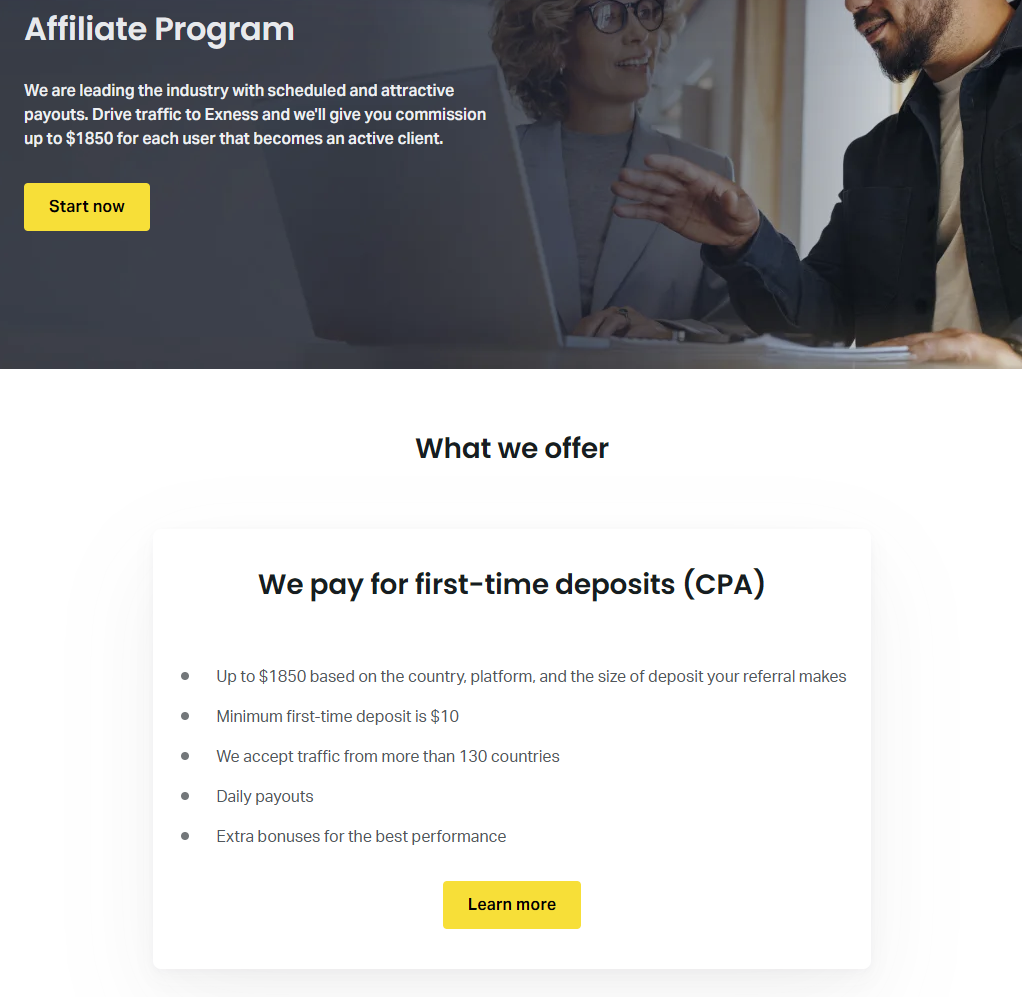
The Exness affiliate program operates as a multi-tier partnership system designed for individuals and companies who refer traders to the broker. Unlike simple referral schemes that pay a one-time bonus, this program builds ongoing revenue through the trading activity of referred clients. Partners earn commissions based on the spreads and commissions generated by their referrals, creating a recurring income stream that scales with client volume and trading frequency.
Contents
- 1. How the Exness Affiliate Program Works
- 2. Commission Models: CPA vs Revenue Share
- 3. Partner Tiers and Earning Potential
- 4. Tracking and Reporting Tools
- 5. Payment Methods and Withdrawal Terms
- 6. Marketing Materials and Partner Resources
- 7. Introducing Broker vs Affiliate Differences
- 8. Compliance and Regulatory Considerations
- 9. Client Quality and Retention Factors
- 10. Common Challenges and Solutions
- 11. Scaling Strategies for Established Partners
- 12. Tax Implications for Partners
- 13. Platform Reliability and Partner Support
- 14. Comparison with Competing Broker Programs
- 15. Final Assessment of Exness Affiliate Program
Exness structures its partnership offering around two primary models: the classic affiliate track and the introducing broker (IB) track. Both share the same core infrastructure — tracking links, reporting dashboards, and payment processing — but differ in commission structure, support level, and eligibility requirements. Understanding which track aligns with your audience and business model determines how effectively you can monetize referrals.
The program has grown significantly since its launch, reflecting Exness's broader expansion in retail forex and CFD markets. Partners range from individual content creators and trading educators to established financial websites and fund managers. The broker's competitive trading conditions — tight spreads, fast execution, and instant withdrawals — make the referral pitch straightforward, since the product largely sells itself once traders experience the platform.
How the Exness Affiliate Program Works
Registration begins through the Exness partner portal, where applicants provide basic information about their promotional channels and traffic sources. The compliance team reviews each application, typically within one to two business days. Approved partners receive a unique partner ID and access to the dashboard, which generates tracking links for web, social media, email, and direct referral scenarios.
When a prospective trader clicks a partner link, a cookie is placed with a 30-day attribution window. If the user registers and verifies their account within that period, the partner receives credit for all future trading activity. The system also supports post-back URLs and API integration for partners who operate their own tracking infrastructure or need to synchronize data with external CRM platforms.
Commissions accrue in real time as referred clients trade. The dashboard updates multiple times per day, showing clicks, registrations, first-time depositors (FTDs), active traders, and estimated earnings. Partners can filter by date range, instrument group, account type, and individual client to analyze performance granularity. This transparency helps partners optimize campaigns by identifying which traffic sources produce depositing traders versus mere registrations.
The program imposes no minimum traffic thresholds to remain active. However, partners who consistently deliver quality traffic — measured by conversion rates, deposit sizes, and trader retention — gain access to higher commission tiers and dedicated account managers. Exness evaluates partner performance monthly, with tier adjustments taking effect at the start of the following calendar month.
Commission Models: CPA vs Revenue Share
Exness offers two primary commission structures. The cost-per-acquisition (CPA) model pays a fixed amount for each qualified first-time depositor. Qualification criteria typically require a minimum deposit — often $10 or equivalent — and a minimum trading volume within a specified period, such as five lots within 30 days. CPA rates vary by client country and account type, ranging from approximately $50 to $1,200 per qualified trader.
Revenue share, the default model for most partners, pays a percentage of the spread or commission generated by referred clients. Standard accounts typically yield 20 to 30 percent of the spread markup, while raw spread and zero accounts generate commission-based revenue share of 15 to 25 percent. The exact percentage depends on partner tier, client region, and instrument category. Forex majors generally carry higher revenue share rates than exotic pairs, indices, or cryptocurrencies.
Partners can request a hybrid model combining a reduced CPA with ongoing revenue share. This arrangement suits partners who invest heavily in paid acquisition and need upfront cash flow to sustain campaigns, while still benefiting from long-term client value. Hybrid terms are negotiated individually and require demonstrated traffic volume and conversion history.
Scroll horizontally to see all columns
| Model | Payment Trigger | Typical Rate Range | Best For |
|---|---|---|---|
| CPA | Qualified FTD | $50–$1,200 per trader | Paid traffic, media buyers |
| Revenue Share | Ongoing trading | 15–30% of spread/commission | Content sites, educators, long-term |
| Hybrid | FTD + ongoing | Reduced CPA + reduced rev share | High-volume partners with ad spend |
Revenue share calculations use the net spread or commission after Exness deducts liquidity provider costs, payment processor fees, and operational overhead. This net-revenue basis means partners earn a slice of the broker's actual margin, not the gross spread displayed to traders. During periods of extreme volatility when spreads widen, revenue share earnings can increase proportionally, though trading volume often drops during such events.
Partner Tiers and Earning Potential
Exness operates a four-tier partner hierarchy: Standard, Silver, Gold, and Platinum. All new partners enter at Standard tier with base revenue share rates. Advancement depends on monthly metrics: number of active traders, total trading volume, and net revenue generated. Silver typically requires 10+ active traders and $5,000+ monthly net revenue. Gold raises the bar to 50+ active traders and $25,000+ monthly net revenue. Platinum, by invitation only, serves partners generating $100,000+ monthly net revenue with 200+ active traders.
Each tier unlocks progressively better revenue share percentages, priority support, and additional perks. Silver partners receive a dedicated partner manager and access to exclusive promotional materials. Gold adds custom landing pages, co-branded educational content, and invitation to partner events. Platinum partners negotiate bespoke terms, including potential equity arrangements, white-label solutions, and direct API access to trading infrastructure.
Tier evaluation occurs on the first business day of each month based on the prior month's finalized data. Partners can be downgraded if metrics fall below thresholds for two consecutive months, though Exness typically provides a grace period and guidance before reducing tier status. This structure incentivizes consistent quality over short-term volume spikes.
Tracking and Reporting Tools
The partner dashboard provides a comprehensive reporting suite. The overview tab displays real-time counters for clicks, registrations, FTDs, active traders, and estimated earnings. The clients tab lists every referred trader with their registration date, account type, country, trading volume, and individual revenue contribution. Partners can export this data as CSV for offline analysis or CRM integration.
Sub-ID tracking allows partners to tag individual campaigns, traffic sources, or creative variations. By appending a sub_id parameter to referral links — for example, ?partner_id=12345&sub_id=facebook_q4_campaign — partners can segment performance without creating separate partner accounts. The dashboard aggregates sub-ID data automatically, showing which channels deliver the highest conversion rates and trader lifetime values.
Post-back notifications enable real-time server-to-server communication. When a referred user completes a registration, deposits, or trades, Exness sends an HTTP POST to the partner's specified endpoint with event details. This capability is essential for partners running performance marketing campaigns who need to optimize ad spend based on downstream events, not just clicks or registrations.
Payment Methods and Withdrawal Terms
Commissions are calculated daily and finalized on the first business day of the following month. Partners can withdraw earnings once the monthly finalization completes, typically by the third business day. Minimum withdrawal is $10 for most methods. Exness processes partner withdrawals through the same payment infrastructure used for client withdrawals, meaning partners benefit from the broker's instant withdrawal technology for supported methods.
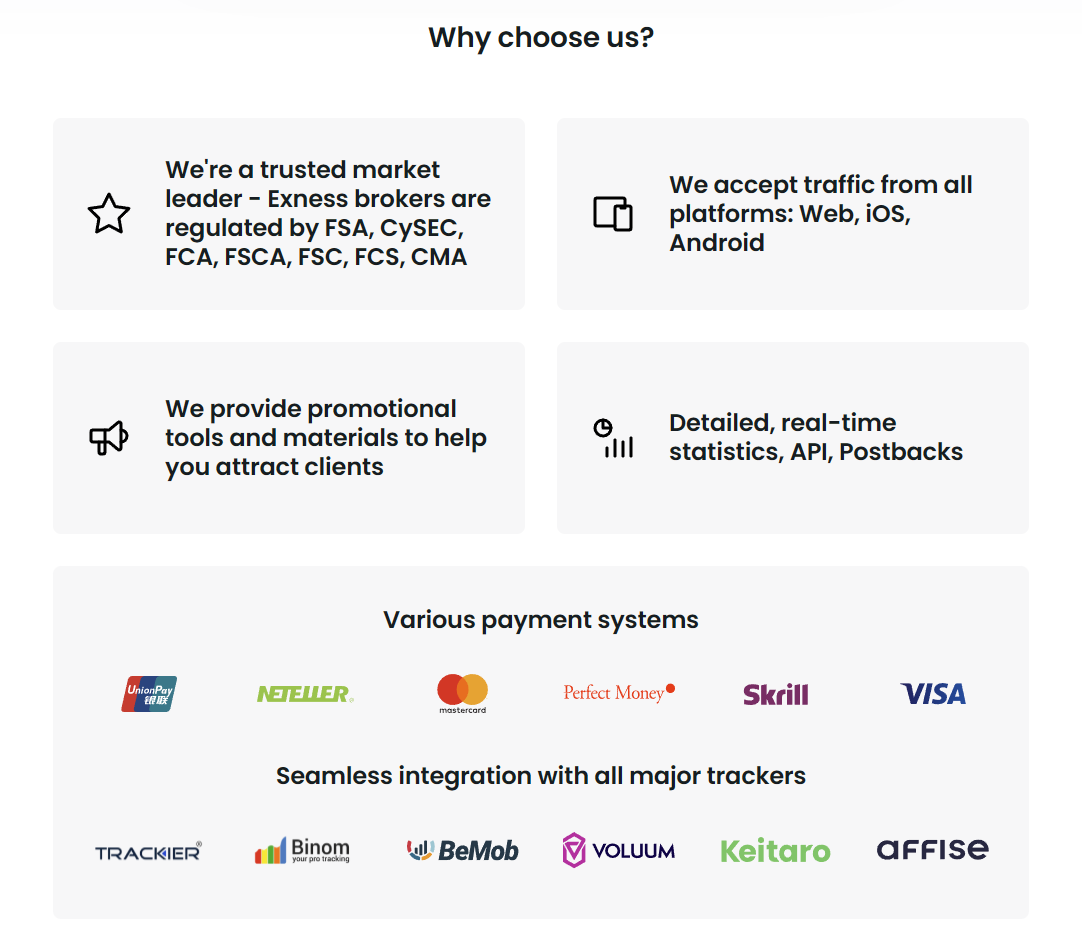
Available withdrawal methods include bank wire, credit/debit cards, Skrill, Neteller, WebMoney, Perfect Money, and various regional options like Pix (Brazil), UPI (India), and local bank transfers in Southeast Asia and Africa. Cryptocurrency withdrawals (USDT, USDC, BTC, ETH) are also supported with near-instant processing. Bank wires may take one to three business days depending on the partner's bank and country.
Partners must complete KYC verification before first withdrawal — government-issued ID, proof of address, and in some cases, source of funds documentation. Corporate partners provide certificate of incorporation, register of directors, and beneficial ownership details. Exness reserves the right to request additional documentation for large withdrawals or unusual activity patterns, consistent with AML obligations.
Scroll horizontally to see all columns
| Method | Processing Time | Minimum | Fees |
|---|---|---|---|
| Bank Wire | 1–3 business days | $10 | Varies by bank |
| Credit/Debit Card | Instant–24 hours | $10 | Usually free |
| Skrill/Neteller | Instant | $10 | Free |
| Cryptocurrency | Instant–1 hour | $10 | Network fee only |
| Regional (Pix, UPI, etc.) | Instant–2 hours | $10 equivalent | Usually free |
Marketing Materials and Partner Resources
Exness provides a library of marketing assets accessible through the partner portal. These include banner ads in standard IAB sizes, landing page templates optimized for conversion, email templates, social media graphics, and educational content packages. Assets are available in multiple languages and updated quarterly to reflect current promotions, platform features, and regulatory messaging requirements.
Partners at Silver tier and above can request custom creative development. The Exness design team produces tailored banners, landing pages, and video content aligned with the partner's brand and audience. Turnaround is typically five to ten business days. Gold and Platinum partners receive priority queue access and can collaborate directly with the marketing team on campaign strategy.
The broker also supplies educational resources partners can share with their audience: trading guides, platform tutorials, market analysis articles, and video courses. These assets serve dual purpose — they provide value to potential traders while embedding partner tracking links naturally. Partners who position themselves as educators rather than pure promoters tend to achieve higher conversion rates and better trader retention.
Exness runs periodic partner contests with cash prizes, funded trading accounts, and luxury rewards. These contests typically reward metrics like new FTDs, trading volume, or revenue generated over a defined period. Participation is automatic for eligible partners. Contest terms are announced via the partner portal and email newsletter.
Introducing Broker vs Affiliate Differences
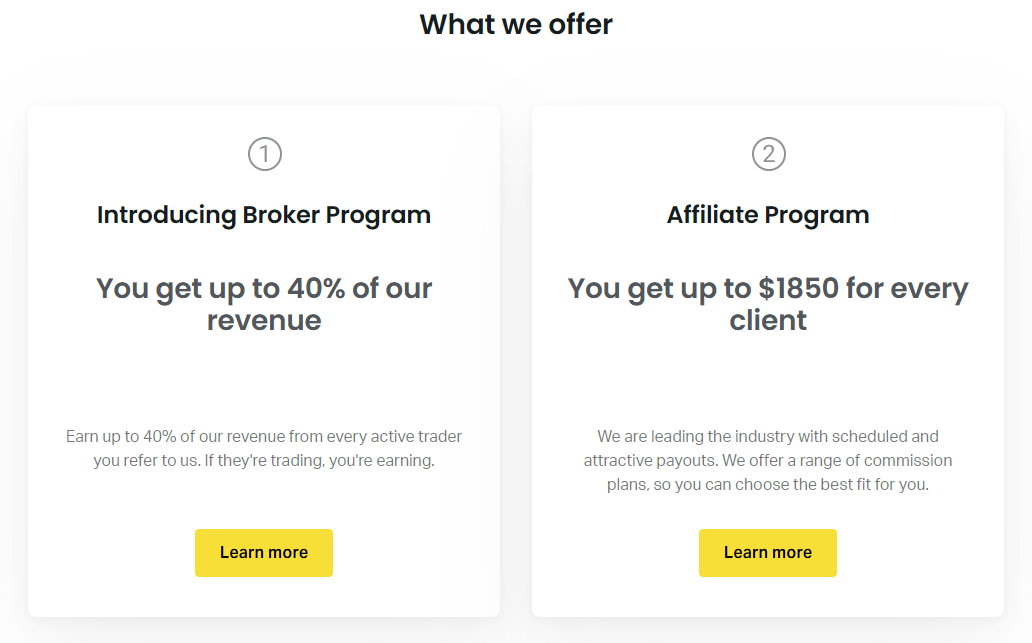
While both tracks operate within the same partner ecosystem, the introducing broker (IB) model targets partners who maintain direct relationships with traders — fund managers, trading signal providers, educators with private communities, and proprietary trading firms. IBs typically onboard clients personally, assist with account setup, and provide ongoing support. This hands-on role justifies higher commission rates compared to the arms-length affiliate model.
IB commission structures use a lot-based rebate system rather than revenue share percentages. Standard accounts pay approximately $8–$12 per lot traded by referred clients. Raw spread and zero accounts pay $4–$8 per lot. Rates scale with monthly volume tiers. IBs also receive access to a dedicated IB portal with enhanced reporting, client management tools, and the ability to create sub-IBs — effectively building a multi-level partner network.
The sub-IB feature allows established IBs to recruit and manage their own network of introducing brokers, earning override commissions on sub-IB client activity. This creates a scalable business model for partners with industry connections. Override rates are negotiated individually and typically range from 10 to 30 percent of the sub-IB's earned commissions.
Compliance and Regulatory Considerations
Exness operates under multiple regulatory licenses including CySEC (Cyprus), FCA (UK), FSCA (South Africa), FSA (Seychelles), and CBCS (Curaçao). Partners must comply with the marketing regulations applicable to their target jurisdictions. The partner agreement prohibits misleading claims, guaranteed returns promises, and marketing to restricted jurisdictions including the United States, Iran, North Korea, and others listed in the partner portal.
Financial promotion rules vary significantly by region. In the EU and UK, partners must include risk warnings, avoid targeting retail clients with professional-only products, and ensure marketing materials are fair, clear, and not misleading. Exness provides compliant disclaimer templates and pre-approved copy for major jurisdictions. Partners running paid advertising campaigns should verify platform-specific policies — Google, Meta, and TikTok each maintain their own financial services advertising requirements.
The broker conducts periodic compliance audits of partner websites and promotional channels. Non-compliant partners receive warnings and a remediation period. Repeated or egregious violations can result in commission clawbacks, account suspension, or termination. Partners should maintain records of all promotional materials and be prepared to demonstrate compliance upon request.
Client Quality and Retention Factors
Not all referred traders generate equal revenue. Partners who understand the factors driving trader lifetime value can optimize their acquisition strategies. Account type matters significantly — professional accounts (Raw Spread, Zero, Pro) generate higher per-lot commissions but require larger deposits and attract more experienced traders. Standard and Standard Cent accounts convert more easily but yield lower per-trader revenue.
Geographic origin strongly influences trader behavior. Clients from Western Europe, Australia, and Singapore tend to deposit larger amounts and trade longer. Emerging market clients often start with smaller deposits but can scale significantly over time. Exness's regional payment method coverage — local bank transfers, mobile money, crypto — reduces deposit friction in markets where international cards are less prevalent.
Trader education correlates with retention. Partners who provide or facilitate access to trading education — whether through their own content, Exness's educational library, or third-party courses — see higher client lifetime values. Educated traders understand risk management, trade more consistently, and are less likely to blow up accounts quickly. This aligns partner incentives with client outcomes, a rare feature in affiliate marketing.
The partners who earn consistently aren't chasing quick conversions. They're building audiences that understand what they're getting into.
Common Challenges and Solutions
Attribution gaps occur when users clear cookies, switch devices, or use privacy-focused browsers. Exness mitigates this through fingerprinting backup and email-based attribution for users who register with the same email used during the initial click. Partners can improve attribution by encouraging direct link clicks rather than relying on organic search after brand exposure.
Conversion drop-off between registration and first deposit is a universal challenge. Exness addresses this with automated onboarding emails, deposit bonus offers (where permitted), and a streamlined deposit flow. Partners can supplement by creating content that walks prospects through the registration and deposit process, addressing common friction points like document verification and payment method selection.
Seasonal volatility affects earnings. Major holiday periods (late December, Chinese New Year, Ramadan) typically see reduced trading volume. Summer months in the Northern Hemisphere also trend lower. Experienced partners plan content calendars and ad spend around these cycles, focusing on education and audience building during slow periods to capture demand when markets re-engage.
Scaling Strategies for Established Partners
Partners reaching Gold tier often face a scaling ceiling with organic content alone. Diversification into paid acquisition — search, social, native, and programmatic — becomes necessary for continued growth. Exness's competitive CPA rates make paid campaigns viable when conversion funnels are optimized. Partners should start with retargeting campaigns to capture users who clicked but didn't convert, then expand to lookalike audiences based on depositing trader profiles.
Building an email list remains one of the highest-ROI assets for financial affiliates. Partners who capture leads through lead magnets (trading guides, calculator tools, webinar registrations) and nurture them with educational sequences convert at significantly higher rates than cold traffic. Exness's marketing team occasionally provides co-branded lead magnet templates for Gold and Platinum partners.
International expansion offers another growth lever. Exness supports over 130 countries with localized payment methods and language support. Partners with multilingual capabilities or access to translation resources can tap underserved markets. Southeast Asia, Latin America, and Africa represent growing trader populations with lower affiliate competition than saturated Western markets.
Scroll horizontally to see all columns
| Stage | Primary Focus | Key Actions | Investment Level |
|---|---|---|---|
| Standard (0–$1K/mo) | Content & SEO | Educational articles, platform tutorials, comparison pages | Time only |
| Silver ($1K–$5K/mo) | Email & Retargeting | Lead magnets, nurture sequences, retargeting ads | Low ($100–$500/mo) |
| Gold ($5K–$25K/mo) | Paid Acquisition | Search/social ads, lookalike audiences, custom creatives | Medium ($1K–$10K/mo) |
| Platinum ($25K+/mo) | Team & International | Hire specialists, multilingual content, sub-IB network | High ($10K+/mo) |
Tax Implications for Partners
Exness does not withhold taxes on partner commissions. Partners are responsible for declaring and paying taxes according to their country of residence and business structure. Individual partners typically report earnings as self-employment or miscellaneous income. Corporate partners treat commissions as business revenue. Exness provides monthly statements and annual earnings summaries suitable for tax filing.
Partners operating across multiple jurisdictions should consult tax professionals familiar with cross-border digital income. Double taxation treaties may apply. VAT/GST obligations vary — some countries treat affiliate commissions as electronic services subject to local VAT, while others classify them as B2B services taxed at the partner's location. Exness's partner agreement includes standard tax indemnification clauses.
Cryptocurrency withdrawals introduce additional tax complexity. Converting USDT or BTC to fiat may trigger capital gains events depending on jurisdiction. Partners withdrawing in crypto should maintain detailed records of receipt dates, values, and subsequent dispositions. Some partners prefer stablecoin withdrawals to simplify accounting, treating the stablecoin as a USD-equivalent cash equivalent.
Platform Reliability and Partner Support
The partner portal runs on dedicated infrastructure separate from the client trading platform. Uptime exceeds 99.9 percent historically, with scheduled maintenance windows communicated in advance. The dashboard handles high data volumes without noticeable latency, even for partners with thousands of referred clients. Mobile-responsive design allows monitoring on the go, though the full reporting suite works best on desktop.
Support quality scales with partner tier. Standard partners access email support with 24-hour typical response. Silver and Gold receive priority email and live chat during business hours. Platinum partners get a dedicated account manager with direct phone and messaging access. The partner support team is distinct from client support, staffed by specialists who understand commission structures, tracking technicalities, and compliance nuances.
Exness hosts an annual partner conference (virtual since 2020, with hybrid events planned) where partners network, attend product roadmap sessions, and provide direct feedback to leadership. Gold and Platinum partners receive complimentary passes. Regional meetups occur in major hubs like Bangkok, Lagos, Johannesburg, and São Paulo, reflecting the broker's global partner distribution.
A partner program is only as good as the product behind it. Exness's trading conditions make the referral conversation easy — the platform does the heavy lifting.
Comparison with Competing Broker Programs
Most major forex brokers offer affiliate or IB programs with broadly similar structures: revenue share, CPA, or hybrid models with tiered rates. Exness differentiates through several factors. Instant withdrawals for clients reduce deposit hesitation and churn — a direct revenue benefit for partners. The proprietary web terminal and mobile app provide a polished experience that retains traders longer than brokers relying solely on MT4/MT5.
Commission competitiveness varies by segment. For standard account revenue share, Exness sits in the upper quartile among Tier-1 regulated brokers. CPA rates for Tier-1 countries (UK, Germany, Australia) are competitive but not always the highest — some brokers offer aggressive introductory CPAs that drop after the first month. Exness's rates are stable and published transparently in the partner portal.
The sub-IB network capability is less common among retail-focused brokers and represents a genuine scaling advantage for partners with industry networks. Multi-level partner structures are more typical in institutional prime brokerage. Exness bringing this to retail IBs expands the addressable partner market significantly.
Scroll horizontally to see all columns
| Feature | Exness | Typical Competitor Range |
|---|---|---|
| Revenue Share (Standard) | 20–30% | 15–25% |
| CPA (Tier-1 Countries) | Up to $1,200 | $200–$1,500 |
| Client Withdrawal Speed | Instant (most methods) | Hours to days |
| Sub-IB Network | Yes | Rare |
| Dedicated Manager Threshold | Silver (10 active) | Often 50+ active |
| Payment Frequency | Monthly, auto-finalized | Monthly, manual request |
Final Assessment of Exness Affiliate Program
The Exness affiliate program stands out for its structural clarity, reliable payments, and a product that genuinely converts and retains traders. The revenue share model aligns partner and broker incentives cleanly — both benefit when traders stay active and trade volume grows. The tier system provides a clear progression path without gatekeeping; partners advance by delivering results, not by negotiating special deals.
The program's weaknesses are typical of the industry: attribution imperfections, regulatory restrictions in major markets like the US, and earnings volatility tied to market conditions. Partners dependent on paid traffic should model unit economics carefully — CPA rates in competitive geos can compress margins when ad costs rise. The hybrid model mitigates this but requires negotiation.
For content-driven partners — educators, reviewers, community builders — the revenue share model with Exness offers a sustainable long-term income stream. The broker's investment in proprietary technology (web terminal, mobile app, instant withdrawals) creates a differentiated product that reduces churn. For media buyers and performance marketers, the CPA and hybrid options provide flexibility, though the compliance burden for financial services advertising remains substantial.
The sub-IB feature deserves more attention than it typically receives. Partners who treat the program as a business building exercise — recruiting and training other partners — can create enterprise value beyond personal commission earnings. This path remains underutilized, partly because it requires a different skill set than traffic generation.
Frequently Asked Questions
How long does the Exness affiliate cookie last?
The attribution cookie lasts 30 days. If a user clicks your link and registers within 30 days, you receive credit for their trading activity.
What is the minimum withdrawal for partner commissions?
The minimum withdrawal is $10 for most payment methods, including bank wire, cards, e-wallets, and cryptocurrency.
Can I promote Exness in the United States?
No. Exness does not accept clients from the United States, and partners are prohibited from marketing to US residents under the partner agreement.
How often are partner commissions paid?
Commissions are finalized on the first business day of each month for the prior month's activity. Withdrawals can be requested immediately after finalization.
Do I need a website to join the Exness affiliate program?
No. Partners can promote through social media, email, messaging apps, or direct referrals. A website is not required but may strengthen your application.
What is the difference between the affiliate and IB programs?
Affiliates drive traffic through links and content without direct client interaction. IBs personally onboard and support traders, earning per-lot rebates and gaining access to sub-IB network building.
Are there any fees to join the Exness partner program?
No. Registration and participation are free. Exness deducts no fees from partner commissions beyond the standard revenue share split.
Can I run paid advertising for Exness?
Yes, but you must comply with Exness marketing guidelines and the advertising policies of each platform (Google, Meta, TikTok, etc.). Some jurisdictions restrict financial services advertising.