
Forex Broker Guides
Exness Argentina: Complete Guide for Local Traders
Everything Argentine traders need to know about Exness broker features and local accessibility.

Senior Forex Trader & Market Analyst
Daniel Chen is an experienced forex trader and financial market analyst with over 15 years of experience in currency trading. He specializes in technical analysis, risk management, and developing practical trading strategies to help traders make informed decisions.
Exness has established a significant presence among Argentine traders seeking access to global financial markets. The broker operates internationally with multiple regulatory licenses, and Argentine residents can open accounts through the global entity. This creates both opportunities and considerations for local traders who want to trade forex, stocks, indices, commodities, and cryptocurrencies through a single platform.
Contents
- 1. Regulatory Framework for Argentine Traders
- 2. Account Types Available to Argentine Clients
- 3. Trading Platforms and Technology
- 4. Deposit and Withdrawal Methods for Argentina
- 5. Trading Instruments and Market Access
- 6. Leverage, Margin, and Risk Management
- 7. Spreads, Commissions, and Trading Costs
- 8. Execution Quality and Order Types
- 9. Customer Support and Local Accessibility
- 10. Advantages and Limitations for Argentine Traders
- 11. Account Registration and First Steps
- 12. Final Assessment of Exness Argentina
Argentina's economic environment, characterized by currency controls, high inflation, and restrictions on foreign currency purchases, makes offshore broker access particularly relevant. Many Argentine traders use international brokers to diversify holdings, hedge against peso devaluation, and access markets unavailable through local financial institutions. Exness positions itself as an option with low spreads, instant withdrawals, and multiple account types suited to different experience levels.
This guide examines the practical aspects of using Exness from Argentina: regulatory framework, account registration, available trading platforms, deposit and withdrawal methods that work locally, trading conditions, and the advantages and limitations Argentine traders should weigh before committing capital.
Regulatory Framework for Argentine Traders
Exness operates through several legal entities regulated by different authorities. The primary entities include Exness (SC) Ltd registered in Seychelles under FSA regulation, Exness B.V. registered in Curaçao, and Exness (VG) Ltd in the British Virgin Islands. Argentine traders typically register under the Seychelles or Curaçao entities, as Exness does not hold a license from Argentina's Comisión Nacional de Valores (CNV).
The absence of local CNV regulation means Argentine traders do not benefit from domestic investor protection schemes or local dispute resolution mechanisms. However, the broker's international licenses from the FSA (Seychelles), CySEC (Cyprus) for European operations, and FCA (UK) for its UK entity provide baseline regulatory oversight including client fund segregation, audit requirements, and operational standards.
Argentine tax obligations remain the trader's responsibility. Profits from foreign broker accounts must be declared under Argentina's income tax regime. The broker does not withhold taxes for Argentine residents, and no automatic reporting to AFIP occurs. Traders should consult local tax advisors regarding declaration requirements for foreign investment income and potential implications of the country's foreign asset reporting obligations.
Account Types Available to Argentine Clients
Exness offers two main account categories: Standard and Professional. Each category contains specific account variants designed for different trading styles and capital levels. Argentine traders can access all account types during registration, with the choice affecting spreads, commissions, minimum deposits, and available leverage.
Standard accounts include the Standard account and Standard Cent account. The Standard account requires a minimum deposit of $10 (or equivalent) and offers spreads from 0.3 pips on major pairs with no commission. The Standard Cent account allows trading in cents rather than dollars, with a $1 minimum deposit and spreads from 0.3 pips, making it suitable for beginners testing strategies with minimal risk.
Professional accounts comprise Raw Spread, Zero, and Pro accounts. Raw Spread offers spreads from 0.0 pips with a $3.50 per lot per side commission and $200 minimum deposit. Zero account provides 0.0 pip spreads on top 30 instruments with $3.50 per lot per side commission and $200 minimum. Pro account features spreads from 0.1 pips with no commission and $200 minimum deposit. All professional accounts support higher leverage tiers.
Scroll horizontally to see all columns
| Account Type | Min Deposit | Spreads From | Commission | Best For |
|---|---|---|---|---|
| Standard | $10 | 0.3 pips | None | General trading, beginners |
| Standard Cent | $1 | 0.3 pips | None | Micro trading, strategy testing |
| Raw Spread | $200 | 0.0 pips | $3.50/lot/side | Scalpers, high-volume traders |
| Zero | $200 | 0.0 pips (top 30) | $3.50/lot/side | Major pair specialists |
| Pro | $200 | 0.1 pips | None | Swing traders, no-commission preference |
Islamic swap-free accounts are available across all account types for traders who require compliance with Sharia principles. These accounts replace overnight swap charges with fixed administration fees on certain instruments. Argentine traders can request swap-free status during registration or convert existing accounts through support.
Demo accounts mirror live account conditions and require no deposit. Argentine traders can open unlimited demo accounts across all account types to test platforms, strategies, and trading conditions before committing real funds. Demo accounts expire after 30 days of inactivity but can be reopened instantly.
Trading Platforms and Technology
Exness provides access to MetaTrader 4, MetaTrader 5, the proprietary Exness Web Terminal, and mobile applications for iOS and Android. Argentine traders can use any combination simultaneously, with account credentials working across all platforms. The broker also offers a dedicated Exness Trade app designed for streamlined mobile trading.
MetaTrader 4 remains the most widely used platform globally, offering extensive expert advisor support, custom indicators, and a large marketplace of automated trading tools. Exness MT4 includes all standard features plus broker-specific additions like one-click trading, depth of market, and integrated economic calendar. The platform supports hedging and netting modes.
MetaTrader 5 adds more timeframes, additional order types, an integrated economic calendar, improved strategy tester with multi-currency backtesting, and support for exchange-traded instruments like stocks. Exness MT5 provides access to the full instrument range including shares CFDs that are not available on MT4. Argentine traders interested in stock CFDs should use MT5 or the Web Terminal.
The Exness Web Terminal runs in any modern browser without installation. It offers a clean interface with TradingView charts, one-click trading, full order management, and access to all account types. For Argentine traders who cannot install software on work computers or prefer browser-based access, the Web Terminal provides near-parity with desktop platforms. It also supports Trading Central signals integration.
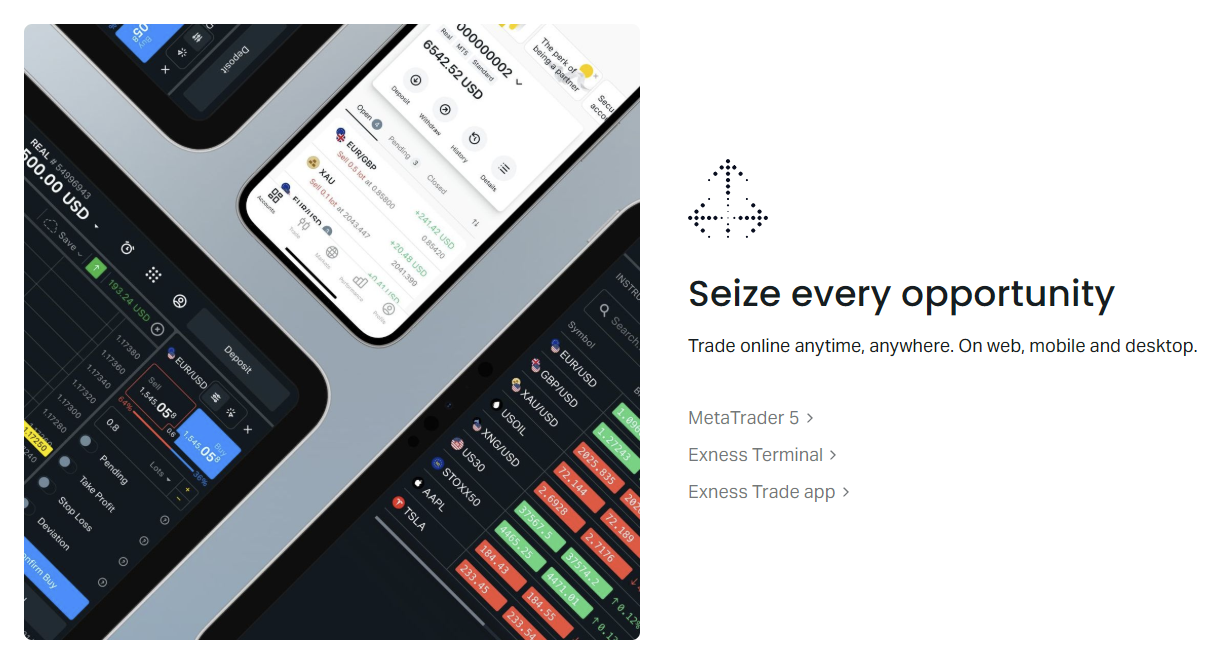
Mobile applications for both MT4 and MT5 provide full trading functionality including chart analysis, order placement, position management, and account monitoring. The Exness Trade app adds a simplified interface focused on quick execution, market news, and account management. All mobile apps support biometric login and push notifications for price alerts and margin calls.
Deposit and Withdrawal Methods for Argentina
Payment method availability is a critical factor for Argentine traders due to local currency controls and banking restrictions. Exness supports a wide range of deposit and withdrawal channels, but not all work equally well from Argentina. The broker processes withdrawals automatically 24/7 for most methods, with funds typically reaching the destination within minutes to hours depending on the payment provider.
International credit and debit cards (Visa, Mastercard) issued by Argentine banks often face restrictions for foreign currency transactions. The monthly $200 limit for foreign currency purchases applies to card transactions, and many local banks block transactions to forex brokers entirely. Traders report mixed success with local cards, and card withdrawals can take 3-10 business days to process back to the original card.
Electronic payment systems provide more reliable alternatives. Skrill, Neteller, and WebMoney accept Argentine users and support USD accounts, bypassing local card limits. These e-wallets allow deposits and withdrawals in USD, with instant processing on the Exness side. However, funding the e-wallet from Argentina may require peer-to-peer exchanges or cryptocurrency intermediaries, adding cost and complexity.
Cryptocurrency deposits and withdrawals via USDT (Tether) on TRC20 and ERC20 networks have become popular among Argentine traders. USDT transfers avoid the banking system entirely, process within minutes, and have no amount limits imposed by Exness. The main consideration is network fees and the need to acquire USDT locally, typically through P2P platforms or local exchanges at a premium to the official exchange rate.
Scroll horizontally to see all columns
| Method | Deposit Time | Withdrawal Time | Fees (Exness) | Argentina Viability |
|---|---|---|---|---|
| Visa/Mastercard | Instant | 3-10 business days | None | Limited - $200 monthly cap, bank blocks common |
| Skrill/Neteller | Instant | Instant | None | Good - USD accounts, but funding e-wallet is challenge |
| WebMoney | Instant | Instant | None | Moderate - Less common in Argentina |
| USDT TRC20/ERC20 | Minutes | Minutes | Network fee only | High - Bypasses banking, widely used locally |
| Bank Wire (USD) | 1-3 business days | 1-5 business days | None (bank fees apply) | Low - SWIFT access restricted, high fees |
| Perfect Money | Instant | Instant | None | Moderate - Available via local exchangers |
Perfect Money and other regional payment systems work through local exchangers who convert pesos to USD in the payment system. This adds a layer of counterparty risk and typically 3-8% spread over the parallel dollar rate. Exness does not charge deposit or withdrawal fees for any method, but payment providers and blockchain networks apply their own fees.
Trading Instruments and Market Access
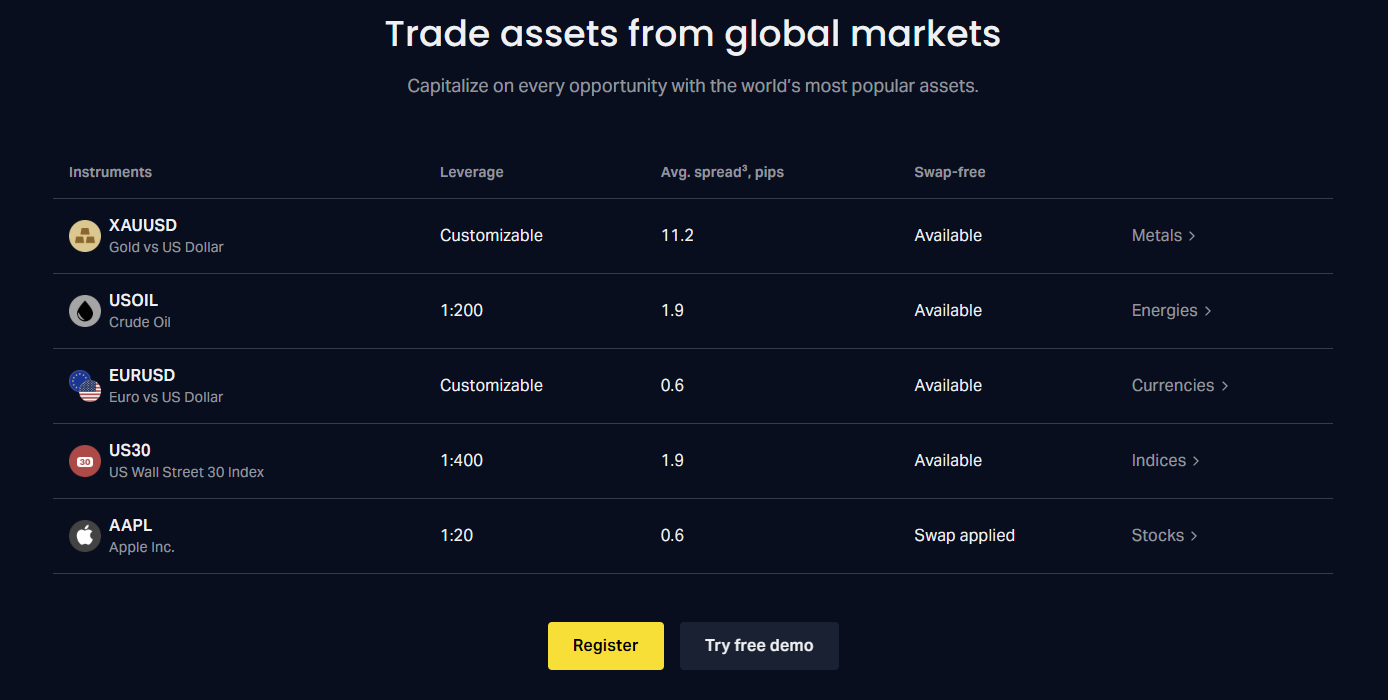
Exness provides access to over 200 trading instruments across multiple asset classes. Argentine traders can trade forex pairs, metals, energies, indices, stocks, and cryptocurrencies from a single account. The instrument range varies slightly by account type and platform, with MT5 and Web Terminal offering the broadest selection including individual stock CFDs.
Forex coverage includes major, minor, and exotic pairs. Major pairs like EURUSD, GBPUSD, USDJPY, and USDCHF offer the tightest spreads and highest liquidity. Minor pairs such as EURGBP, EURJPY, and GBPJPY have slightly wider spreads. Exotic pairs involving emerging market currencies carry significantly wider spreads and lower liquidity, with some unavailable during low-liquidity hours.
Metals trading covers gold (XAUUSD), silver (XAGUSD), platinum, and palladium against USD. Gold is the most actively traded metal with spreads from 0.1 pips on Raw Spread accounts. Energies include US crude oil (WTI), UK crude oil (Brent), and natural gas. These instruments see increased volatility during inventory reports and geopolitical events.
Indices CFDs provide exposure to major global stock indices including US30 (Dow Jones), US500 (S&P 500), USTEC (Nasdaq 100), GER40 (DAX), UK100 (FTSE 100), and others. Index trading allows speculation on broad market movements without individual stock selection. Spreads on major indices start from 0.4 points on professional accounts.
Stock CFDs on MT5 and Web Terminal cover major US and EU companies including Apple, Tesla, Amazon, Microsoft, Google, and European blue chips. Stock CFDs carry commission per lot and wider spreads than forex. Dividend adjustments apply to long and short positions. Argentine traders should note that stock CFD trading hours follow the underlying exchange schedule (NYSE, NASDAQ, etc.).
Cryptocurrency CFDs include Bitcoin, Ethereum, Litecoin, Ripple, Bitcoin Cash, and several altcoins against USD. Crypto CFDs trade 24/7 with leverage up to 1:400 on professional accounts. Spreads are wider than spot crypto exchanges but offer the advantage of short selling without borrowing and integration with the same risk management tools as other instruments.
Trading hours follow the global forex market: Monday 00:00 server time to Friday 23:59 server time (GMT+2 or GMT+3 depending on daylight saving). Individual instruments have specific trading breaks. Argentine traders in GMT-3 should note the server time difference when planning around news events and session opens.
Leverage, Margin, and Risk Management
Exness offers dynamic leverage up to 1:2000 on forex and metals for professional accounts, with leverage adjusting automatically based on account equity. Standard accounts access up to 1:2000 as well. Indices leverage reaches 1:200, energies 1:200, stocks 1:20, and cryptocurrencies 1:400. The unlimited leverage feature (1:2000+) activates when account equity exceeds $1000 and the trader has sufficient trading history.
Margin requirements change with leverage tiers. At 1:2000 leverage, margin requirement is 0.05% of notional value. At 1:500, it's 0.2%. At 1:100, it's 1%. The broker uses a margin call at 60% margin level and stop out at 0% margin level, meaning positions close automatically when equity reaches zero. This stop-out level is more aggressive than many brokers who stop out at 20-50% margin level.
Negative balance protection applies to all retail clients. If a stop-out occurs during extreme volatility and the account goes negative, Exness absorbs the loss and resets the balance to zero. This protection is standard across regulated entities and provides a safety net for Argentine traders using high leverage.
Scroll horizontally to see all columns
| Instrument Class | Max Leverage | Margin at Max Leverage | Margin Call | Stop Out |
|---|---|---|---|---|
| Forex Majors | 1:2000 | 0.05% | 60% | 0% |
| Forex Minors/Exotics | 1:2000 | 0.05% | 60% | 0% |
| Metals (Gold, Silver) | 1:2000 | 0.05% | 60% | 0% |
| Indices | 1:200 | 0.5% | 60% | 0% |
| Energies | 1:200 | 0.5% | 60% | 0% |
| Stocks | 1:20 | 5% | 60% | 0% |
| Cryptocurrencies | 1:400 | 0.25% | 60% | 0% |
The Exness trading calculator helps traders compute margin, pip value, swap, and profit/loss for any position size before entering trades. This tool is accessible in the Personal Area and Web Terminal. Argentine traders should use it to understand the actual capital at risk, especially when using high leverage on volatile instruments like cryptocurrencies or exotic forex pairs.
Spreads, Commissions, and Trading Costs
Trading costs on Exness vary significantly by account type and instrument. The Raw Spread and Zero accounts offer the lowest spreads but charge commission per lot. The Standard and Pro accounts embed costs in the spread with no commission. For Argentine traders funding accounts in USD, understanding the all-in cost per trade is essential for strategy profitability.
On the EURUSD pair, typical spreads during London/New York overlap are: Standard account 0.8-1.2 pips, Pro account 0.4-0.7 pips, Raw Spread 0.0-0.2 pips plus $7 round-trip commission per lot, Zero account 0.0-0.1 pips plus $7 round-trip commission per lot. For a 1 lot trade, the all-in cost on Raw Spread is approximately $7-9 versus $8-12 on Standard, making Raw Spread cheaper for high-volume traders.
Swap charges (overnight financing) apply to positions held past 23:59 server time. Swap rates vary by instrument and direction (long/short). Forex swaps reflect interest rate differentials between currencies. Gold swaps are typically negative for both directions. Cryptocurrency swaps are significantly higher due to borrowing costs. The swap-free Islamic account option replaces swaps with fixed daily fees on certain instruments.
No deposit or withdrawal fees are charged by Exness. Inactivity fees apply after 180 days of no trading activity: $10 per month deducted from the account balance until trading resumes or balance reaches zero. Argentine traders who trade intermittently should either maintain minimal activity or withdraw funds during extended breaks.
The commission versus spread trade-off matters most for scalpers and high-frequency traders. For swing traders holding positions days or weeks, the spread difference is negligible compared to swap costs and market movement.
Execution Quality and Order Types
Exness operates a hybrid execution model combining market execution for most accounts with instant execution available on Standard accounts for certain instruments. Market execution fills orders at the best available price with no requotes but potential slippage during volatility. Instant execution allows price confirmation before fill but may generate requotes if the price moves.
The broker publishes execution statistics including average execution speed (typically under 25 milliseconds), slippage distribution, and requote rates. During normal market conditions, most orders fill at requested prices. During major news events (NFP, CPI, central bank decisions), slippage increases and spreads widen significantly across all brokers, including Exness.
Available order types include market orders, pending orders (buy limit, sell limit, buy stop, sell stop, buy stop limit, sell stop limit), stop loss, take profit, and trailing stop. One-click trading is available on all platforms. The Web Terminal and MT5 support partial position closing and position reversal with a single click.
VPS hosting is offered free for traders meeting volume requirements (typically 5 lots per month) or available for a monthly fee. The VPS runs in Equinix data centers near Exness trade servers, reducing latency for expert advisors and high-frequency strategies. Argentine traders using automated systems should consider the VPS to avoid local internet instability affecting execution.
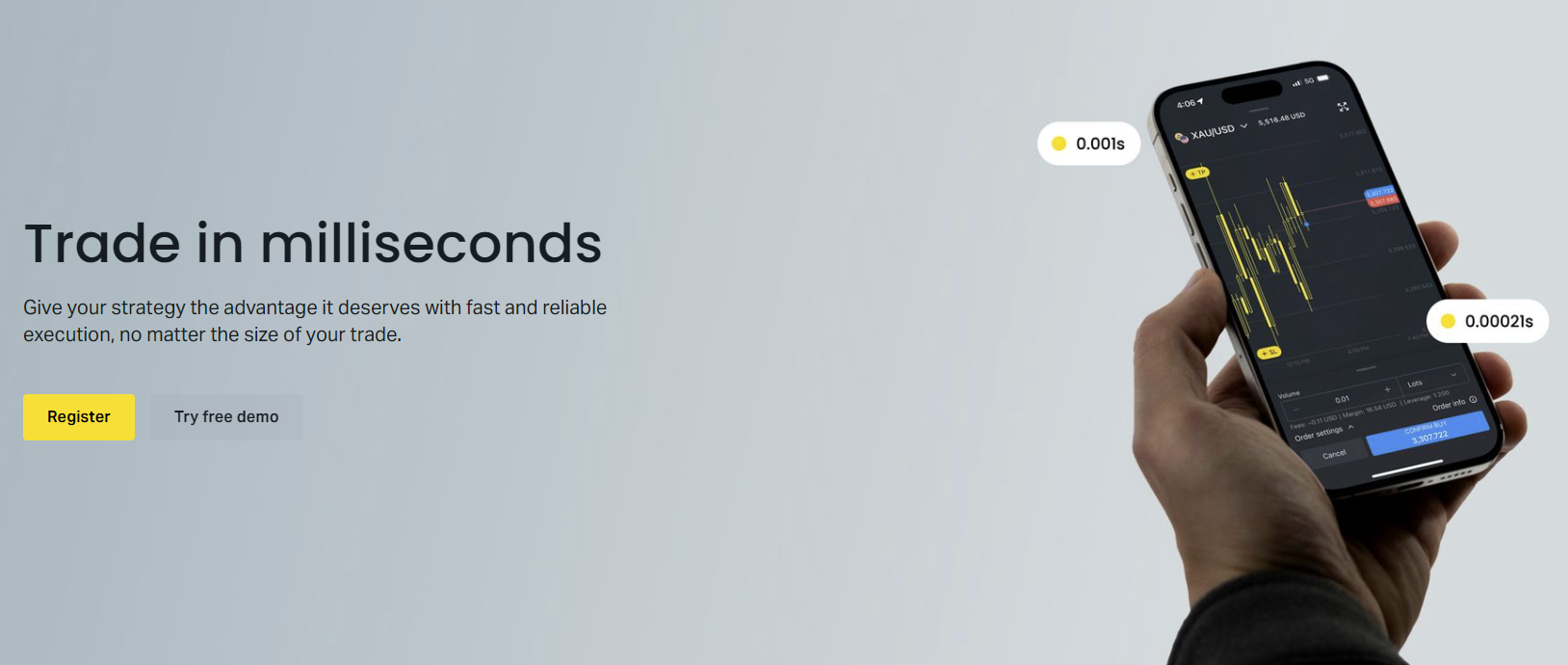
Trading Central signals integrate with the Web Terminal and provide technical analysis, pivot points, and trade ideas for major instruments. These signals are informational only and not trading advice. Argentine traders can use them as a supplementary input but should not rely on them exclusively for trade decisions.
Customer Support and Local Accessibility
Exness provides 24/7 customer support via live chat, email, and phone. Live chat responds within minutes in English, Spanish, Portuguese, Chinese, Thai, Vietnamese, and several other languages. Spanish support is available, which benefits Argentine traders. Phone support includes international numbers and callback requests. Email responses typically arrive within a few hours.
The website, Personal Area, trading platforms, and mobile apps are fully translated into Spanish. Documentation, tutorials, and the help center are also available in Spanish. This localization reduces friction for Argentine traders who prefer operating in their native language. The registration process, verification, and account management all function in Spanish.
Verification (KYC) requires proof of identity (passport, DNI, or driver's license) and proof of address (utility bill, bank statement, or government document issued within 3 months). Argentine DNI is accepted for identity verification. Address documents in Spanish are accepted. Verification typically completes within a few hours but can take up to 24 hours during high volume periods.
Educational resources include webinars, video tutorials, articles, and a trading glossary. The Exness blog covers market analysis, platform guides, and trading psychology. While not Argentina-specific, the content applies universally. The economic calendar in the Personal Area and platforms shows global events with expected impact ratings, helping Argentine traders plan around major data releases.
Advantages and Limitations for Argentine Traders
Exness offers several advantages that align with Argentine traders' needs. Instant withdrawals on most methods (especially USDT) solve the critical problem of capital mobility in a restricted financial environment. Low minimum deposits ($1 for Cent, $10 for Standard) allow starting with minimal capital. High leverage up to 1:2000 enables meaningful position sizes with small accounts, though it amplifies risk.
The Spanish-language interface and support remove language barriers. Multiple platform choices accommodate different trading styles. The broad instrument range allows diversification across forex, gold, indices, and crypto from one account. No deposit/withdrawal fees from the broker side reduce friction. Negative balance protection provides a safety net during extreme volatility.
Limitations include the lack of CNV regulation, meaning no local legal recourse or investor compensation fund. Funding and withdrawing remains the biggest practical challenge due to Argentina's capital controls, even though Exness itself processes payments instantly. The $200 monthly card limit, bank blocks on forex transactions, and SWIFT restrictions force most traders toward cryptocurrency or P2P e-wallet funding, adding cost and counterparty risk.
Tax complexity is another consideration. Argentine traders must self-report foreign broker profits, track cost basis across multiple instruments and currencies, and navigate AFIP requirements for foreign assets. The broker provides account statements but no tax reporting tailored to Argentine law. Professional tax advice is recommended for accounts with significant activity.
Scroll horizontally to see all columns
| Advantages | Limitations |
|---|---|
| Instant USDT withdrawals 24/7 | No CNV regulation or local investor protection |
| Low minimum deposits ($1-$10) | Funding/withdrawal bottlenecks due to capital controls |
| High leverage up to 1:2000 | Tax reporting complexity for Argentine residents |
| Full Spanish language support | No local payment methods (Mercado Pago, bank transfers in ARS) |
| Wide instrument range (200+) | E-wallet funding requires P2P exchangers (added cost) |
| Negative balance protection | Inactivity fee after 180 days |
| Multiple platforms (MT4, MT5, Web, Mobile) | High leverage increases loss risk for inexperienced traders |
| No broker deposit/withdrawal fees | Swap costs on overnight positions |
For Argentine traders, the ability to move money in and out quickly via USDT is the single most valuable feature. Everything else is secondary if you cannot fund the account or withdraw profits reliably.
Account Registration and First Steps
Opening an Exness account from Argentina takes 5-10 minutes. Visit the Exness website, select registration, enter email and password, choose country (Argentina), and select account currency (USD recommended). The system redirects to the Personal Area where you can open additional accounts, deposit funds, and download platforms.
Complete verification immediately after registration to unlock full functionality including withdrawals. Upload DNI or passport and a recent utility bill or bank statement showing your Argentine address. Verification typically completes within hours. Once verified, you can deposit via your preferred method and start trading on demo or live accounts.
New traders should start with a Standard Cent account on demo to learn the platform and test strategies without risk. The Cent account allows trading real market conditions with cent-denominated positions, so a $10 deposit behaves like $1000 in standard lots. This bridges the gap between demo and live trading psychologically and technically.
Frequently Asked Questions
Is Exness legal for Argentine residents to use?
Yes, Argentine residents can legally use Exness through its international entities. The broker does not hold a CNV license, so local investor protections do not apply, but there is no law prohibiting individuals from using offshore brokers.
What is the best deposit method for Argentine traders?
USDT (Tether) on the TRC20 network is currently the most reliable method. It bypasses the $200 monthly card limit, bank blocks, and SWIFT restrictions. Funds arrive in minutes with no Exness fees.
Can I deposit Argentine pesos directly to Exness?
No, Exness does not accept ARS deposits directly. You must convert pesos to USD or USDT through a local exchange or P2P platform, then deposit in USD or USDT.
Does Exness report my earnings to AFIP?
No, Exness does not automatically report to Argentine tax authorities. You are responsible for declaring trading profits under Argentine income tax law and complying with foreign asset reporting requirements.
What leverage should a beginner from Argentina use?
Beginners should start with 1:100 or lower. High leverage (1:500+) amplifies both gains and losses. The 1:2000 maximum is suitable only for experienced traders with strict risk management.
Are there any Argentina-specific bonuses or promotions?
Exness does not offer country-specific bonuses. Promotions are generally global and subject to terms. The broker focuses on trading conditions rather than bonus incentives.
How long do withdrawals take to reach my USDT wallet?
USDT withdrawals are processed automatically 24/7 and typically arrive within 5-30 minutes, depending on blockchain confirmation times. TRC20 is faster and cheaper than ERC20.
Can I use Mercado Pago or local bank transfers in pesos?
No, Exness does not integrate with Mercado Pago or Argentine peso bank transfers. All deposits and withdrawals are in USD, USDT, or other supported foreign currencies.
Final Assessment of Exness Argentina
Exness presents a viable option for Argentine traders who understand the regulatory gap and can navigate the funding challenges. The broker's technical offering — tight spreads, instant withdrawals, high leverage, multiple platforms, and Spanish support — is competitive globally. The critical factor for Argentine users is not the broker's features but the practical reality of moving capital across Argentina's capital controls.
Traders who already have access to USDT or reliable e-wallet funding channels will find Exness efficient and cost-effective. Those dependent on local bank cards or peso transfers will face persistent obstacles that no broker can solve. The absence of CNV regulation means the decision rests on trust in international licenses and the broker's operational track record rather than local legal protections.
For Argentine traders evaluating Exness, the recommended approach is: verify USDT funding access first, open a Standard Cent demo account to test platforms and execution, complete KYC verification, test a small USDT deposit and withdrawal cycle, then scale gradually. The broker's conditions reward high-volume traders with Raw Spread or Zero accounts, while beginners benefit from the Cent account's low-risk live trading environment. Tax compliance remains an individual responsibility requiring local professional guidance.