

Forex Trading Education
Exness Maximum Leverage: Limits by Account and Instrument
Understand Exness leverage limits, regulatory caps, and how to choose the right level for your trading strategy.

Senior Forex Trader & Market Analyst
Daniel Chen is an experienced forex trader and financial market analyst with over 15 years of experience in currency trading. He specializes in technical analysis, risk management, and developing practical trading strategies to help traders make informed decisions.
Leverage defines how much market exposure a trader can control relative to the capital in their account. Exness offers some of the highest leverage ratios in the industry, but the actual maximum available depends on several factors: the account type, the instrument being traded, the regulatory jurisdiction governing the account, and the current equity balance. Understanding these variables is essential because leverage amplifies both potential profits and potential losses.
Contents
- 1. What Leverage Means in Forex and CFD Trading
- 2. Exness Maximum Leverage Overview
- 3. Maximum Leverage by Trading Instrument
- 4. Dynamic Leverage and Equity Thresholds
- 5. Regulatory Restrictions on Leverage
- 6. How Leverage Affects Margin Requirements
- 7. Risk Management with High Leverage
- 8. How to Check and Change Leverage on Exness
- 9. Pros and Cons of Maximum Leverage
- 10. Comparison with Other Major Brokers
- 11. Final Assessment of Exness Maximum Leverage
This article breaks down the maximum leverage Exness provides across its account lineup, explains how instrument-specific caps work, outlines the regulatory restrictions that may lower the ceiling for certain clients, and shows how to check or adjust leverage in the Personal Area. It also covers the margin mechanics behind leverage, risk considerations when using high ratios, and a comparison with other major brokers.
Traders often focus on the headline number — unlimited leverage — without realizing that unlimited leverage applies only to specific account types, specific instruments, and accounts registered under certain entities. For many retail clients, the practical maximum is far lower. The sections below walk through each layer of the leverage structure so you can determine what actually applies to your situation.
What Leverage Means in Forex and CFD Trading
Leverage is a ratio that expresses the relationship between the notional value of a position and the margin required to open it. A leverage of 1:100 means a trader can control a $100,000 position with $1,000 of margin. The margin is not a fee; it is collateral held by the broker while the position remains open. If the market moves against the position, the margin absorbs the loss. When equity falls below the stop-out level, the broker closes positions to prevent further losses.
Higher leverage reduces the margin required per trade, freeing capital for other positions or providing a larger buffer against adverse price moves. However, it also means a smaller price movement can wipe out the account. A 1% move against a position at 1:100 leverage results in a 100% loss of the margin allocated to that trade. At 1:2000, a 0.05% move has the same effect. The mathematical relationship is linear: required margin equals notional value divided by leverage.
Leverage is a tool, not a strategy. The maximum available ratio tells you what the broker permits, not what your risk model should tolerate.
Exness Maximum Leverage Overview
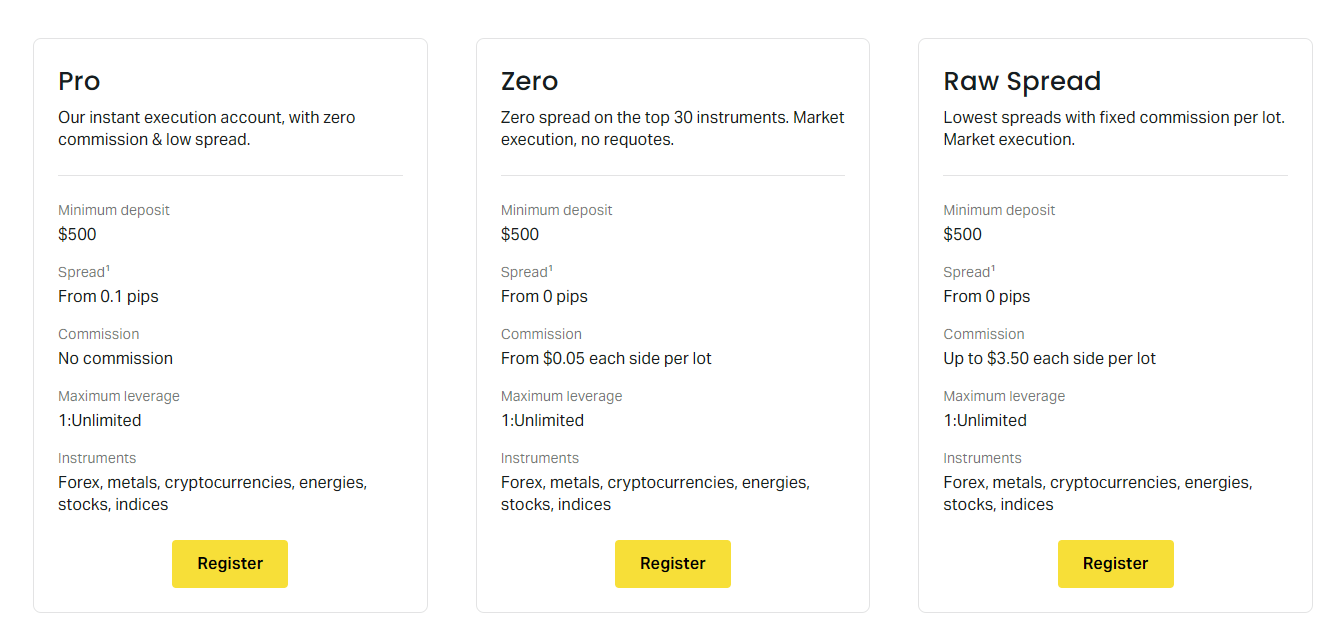
Exness advertises unlimited leverage for eligible accounts. In practice, unlimited leverage means the broker does not impose a hard cap on the leverage ratio for certain account types and instruments. The margin requirement for these accounts can be as low as 0.01% of notional value, which translates to an effective leverage of 1:10,000 or higher. However, this unlimited leverage is available only on Professional accounts (Raw Spread, Zero, and Pro) and only for forex majors and a few other instruments. Standard and Standard Cent accounts have fixed maximums, and all accounts face instrument-specific caps.
The following table summarizes the headline maximum leverage by account type for forex major pairs. These figures assume the account is registered under an entity that permits high leverage (such as Exness SC Ltd in Seychelles) and that the account equity is below the thresholds where dynamic leverage reductions apply.
Scroll horizontally to see all columns
| Account Type | Maximum Leverage | Margin Requirement |
|---|---|---|
| Standard | 1:2000 | 0.05% |
| Standard Cent | 1:2000 | 0.05% |
| Pro | Unlimited | From 0.01% |
| Raw Spread | Unlimited | From 0.01% |
| Zero | Unlimited | From 0.01% |
Unlimited leverage on Professional accounts is not truly infinite. Exness sets a practical floor of 0.01% margin requirement, which corresponds to 1:10,000 leverage. The platform displays "Unlimited" in the leverage selector, but the effective maximum is constrained by this minimum margin percentage. For Standard and Standard Cent accounts, the 1:2000 cap is fixed regardless of equity, though dynamic leverage rules can reduce it further for large positions.
The distinction between account types matters because each targets a different trader profile. Standard and Standard Cent accounts are designed for beginners and smaller balances, with fixed spreads and no commissions. Professional accounts charge commissions but offer raw spreads and the highest leverage. Choosing an account type solely for leverage without considering trading costs, execution model, and minimum deposit requirements can be counterproductive.
Maximum Leverage by Trading Instrument
Leverage caps vary significantly across asset classes. Forex majors receive the highest ratios. Minor and exotic pairs have lower maximums. Metals, energies, indices, stocks, and cryptocurrencies each have their own ceilings. The table below shows typical maximum leverage for each instrument category on Professional accounts under the Seychelles entity. Standard accounts follow the same instrument ratios but are additionally capped at 1:2000 overall.
Scroll horizontally to see all columns
| Instrument Category | Maximum Leverage | Typical Margin |
|---|---|---|
| Forex Majors (EURUSD, GBPUSD, USDJPY, etc.) | Unlimited (1:10,000 effective) | 0.01% |
| Forex Minors (EURGBP, AUDJPY, etc.) | 1:2000 | 0.05% |
| Forex Exotics (USDTRY, USDZAR, etc.) | 1:200 | 0.5% |
| Gold (XAUUSD) | 1:2000 | 0.05% |
| Silver (XAGUSD) | 1:1000 | 0.1% |
| Other Metals (Platinum, Palladium) | 1:500 | 0.2% |
| Energies (USOIL, UKOIL, Natural Gas) | 1:200 | 0.5% |
| Major Indices (US30, US500, USTEC, etc.) | 1:200 | 0.5% |
| Other Indices | 1:100 | 1% |
| Stocks (US, EU shares) | 1:20 | 5% |
| Cryptocurrencies (BTCUSD, ETHUSD, etc.) | 1:400 | 0.25% |
These instrument caps exist because volatility and liquidity differ across markets. A currency pair like EURUSD trades with tight spreads and deep liquidity around the clock, allowing the broker to offer high leverage with manageable risk. An individual stock can gap significantly on earnings news, and cryptocurrency markets can move 10% in minutes. Lower leverage on these instruments protects both the trader and the broker from extreme adverse moves that could blow through margin and create negative balances.
Dynamic Leverage and Equity Thresholds
Exness applies dynamic leverage reductions based on the total notional value of open positions across the account. As position size grows, the maximum allowed leverage decreases in steps. This protects the broker from concentrated exposure to a single client. The thresholds and corresponding leverage reductions differ by instrument category. For forex majors on Professional accounts, the first tier typically allows unlimited leverage up to a certain notional amount (often $5 million or equivalent), after which leverage steps down to 1:2000, then 1:1000, and so on.
Standard and Standard Cent accounts also have dynamic leverage, but their starting ceiling is already 1:2000. The reduction tiers apply once the notional value exceeds the threshold for that instrument. For example, a Standard account trading EURUSD might enjoy 1:2000 up to $5 million notional, then 1:1000 for the next $5 million, then 1:500 beyond that. The exact thresholds are published in the Exness contract specifications and can be viewed in the Personal Area under trading conditions.
Scroll horizontally to see all columns
| Notional Value Tier | Professional Accounts | Standard Accounts |
|---|---|---|
| Up to $5M | Unlimited (1:10,000) | 1:2000 |
| $5M – $10M | 1:2000 | 1:1000 |
| $10M – $20M | 1:1000 | 1:500 |
| $20M – $50M | 1:500 | 1:200 |
| Above $50M | 1:200 | 1:100 |
Dynamic leverage is calculated per instrument category, not per symbol. If you have large positions in both EURUSD and GBPUSD, their notional values combine for the forex majors tier. However, a large gold position and a large EURUSD position are assessed separately because they belong to different categories (metals vs. forex majors). This means a trader can maintain high leverage on one category while another category is already in a reduced tier.
Dynamic leverage kicks in at sizes most retail traders never reach. For accounts under $100,000 equity, the headline maximum is usually the practical maximum.
Regulatory Restrictions on Leverage
The leverage available to a specific trader depends on the Exness legal entity that holds their account. Exness operates through multiple regulated entities: Exness (Cy) Ltd regulated by CySEC in Cyprus, Exness B.V. regulated by the FSCA in South Africa, Exness SC Ltd registered in Seychelles, and others. Each regulator imposes its own leverage caps for retail clients. Professional clients (those who meet certain experience and capital criteria) may qualify for higher limits under some jurisdictions.
Under CySEC (EU) regulation, retail clients are limited to 1:30 for forex majors, 1:20 for minors and gold, 1:10 for other commodities and indices, 1:5 for stocks, and 1:2 for cryptocurrencies. These are hard caps that cannot be overridden by the broker. The Seychelles entity (FSA) does not impose retail leverage limits, allowing the full Exness leverage range. The South African entity (FSCA) permits up to 1:2000 for forex. Traders cannot choose their entity arbitrarily; it is determined by their country of residence during registration.
Scroll horizontally to see all columns
| Entity / Regulator | Forex Majors | Gold | Indices | Stocks | Crypto |
|---|---|---|---|---|---|
| Exness (Cy) Ltd / CySEC (EU) | 1:30 | 1:20 | 1:10 | 1:5 | 1:2 |
| Exness B.V. / FSCA (South Africa) | 1:2000 | 1:2000 | 1:200 | 1:20 | 1:400 |
| Exness SC Ltd / FSA (Seychelles) | Unlimited | 1:2000 | 1:200 | 1:20 | 1:400 |
Professional client classification can lift these restrictions under CySEC and FSCA. To qualify, a client must meet at least two of three criteria: (1) portfolio of financial instruments exceeding €500,000, (2) at least one year of relevant professional experience in the financial sector, or (3) an average of 10 trades per quarter of significant size over the past four quarters. The application process requires documentation and approval. Once classified as professional, the client loses certain retail protections such as negative balance protection (though Exness voluntarily maintains it) and access to the Financial Ombudsman.
Traders often ask whether they can open an account under a different entity to access higher leverage. Exness compliance policies prevent this. The entity is assigned based on verified residence documents during KYC. Attempting to register with false address information violates the terms of service and can lead to account closure and forfeiture of profits. The only legitimate path to higher leverage under a restrictive regulator is professional client classification, which has strict eligibility requirements.
How Leverage Affects Margin Requirements
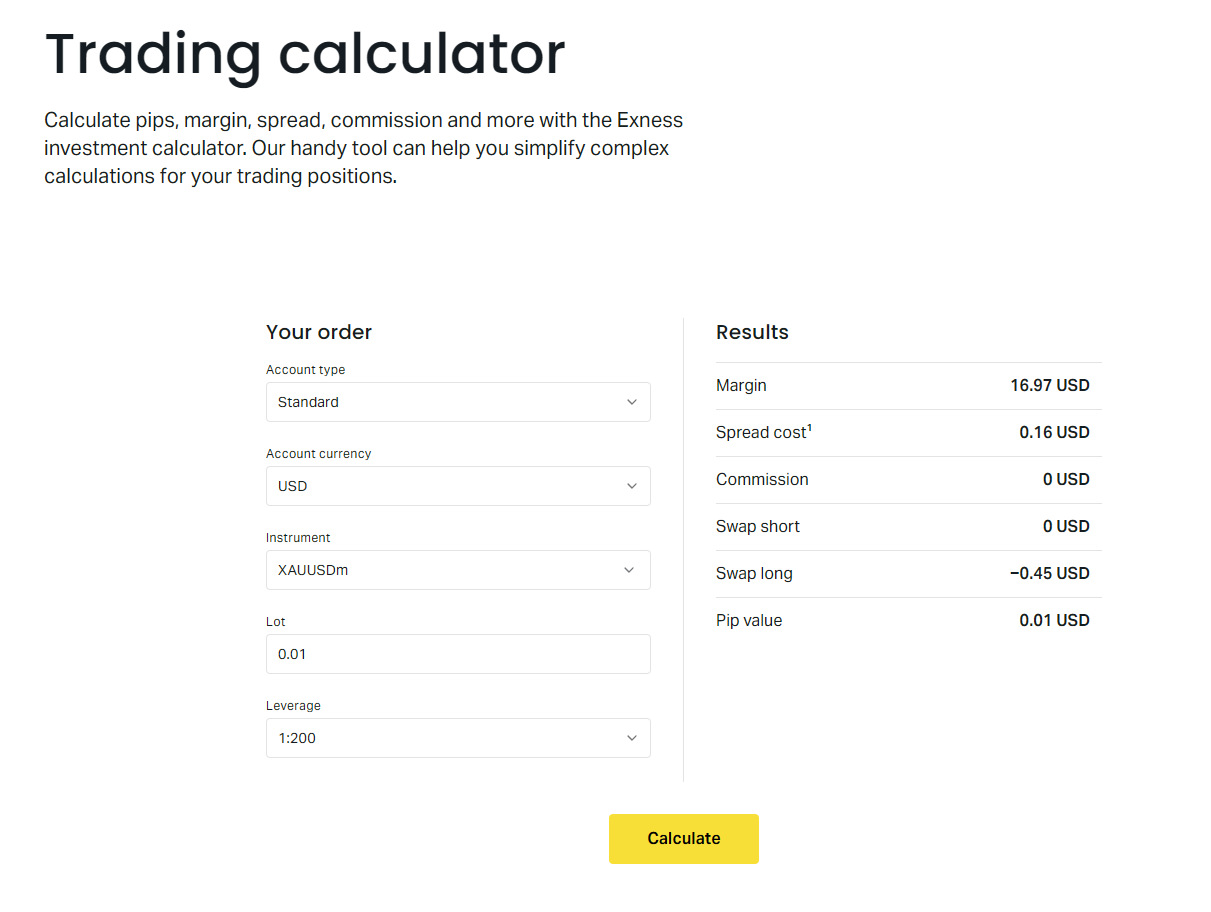
Margin is the capital locked by the broker to keep a position open. Required margin equals notional value divided by leverage. For a 1 lot EURUSD position (100,000 EUR notional) at 1:2000 leverage, required margin is 50 EUR. At 1:30 (EU retail cap), the same position requires 3,333 EUR. The difference is dramatic: high leverage frees capital but leaves less buffer against adverse moves. The stop-out level at Exness is 0% for most accounts, meaning positions are closed when equity equals used margin. With high leverage, a small price move can trigger stop-out.
Exness also offers a margin calculator in the Personal Area and on the website. It lets traders input account type, instrument, volume, and leverage to see exact margin requirements. This is useful for position sizing before entering a trade. The calculator accounts for dynamic leverage tiers, so if the notional value entered exceeds a threshold, it shows the reduced leverage and higher margin that will apply.
Scroll horizontally to see all columns
| Leverage | Required Margin (EUR) | Price Move to Stop-Out (pips) |
|---|---|---|
| 1:30 (EU Retail) | 3,333 | ~50 |
| 1:200 (FSCA Retail) | 500 | ~333 |
| 1:2000 (Standard Max) | 50 | ~3,333 |
| 1:10,000 (Unlimited Effective) | 10 | ~16,667 |
The "Price Move to Stop-Out" column assumes the account has no other equity beyond the required margin. In practice, traders maintain free margin above the used margin. The pip values are approximate and depend on the account currency and current exchange rate. The key insight: at 1:30 leverage, a 50-pip move against the position wipes the margin. At 1:2000, the position can withstand over 3,000 pips. This buffer is why some traders prefer high leverage even when they do not intend to use full position sizing — it provides a wider safety net.
High leverage with small position size is safer than low leverage with large position size. The risk comes from the notional exposure, not the leverage ratio itself.
Risk Management with High Leverage
Access to unlimited leverage does not mean using it fully. Professional traders typically use effective leverage (notional value divided by account equity) well below the maximum available. A common guideline is to keep effective leverage under 1:10 or 1:20 regardless of the account's maximum. This means a $10,000 account should not control more than $100,000–$200,000 in notional positions at any time. The extra leverage capacity serves as a buffer, not a target.
Exness provides several risk management tools. Stop-loss orders are essential; they define the maximum loss per trade in pips or price terms. The platform also shows margin level in real time: equity divided by used margin, expressed as a percentage. When margin level approaches 100%, the account is near stop-out. Traders can set margin call alerts in the Personal Area to receive notifications at custom thresholds. Negative balance protection ensures the account cannot go below zero, but it does not prevent the loss of the entire deposit.
- Define risk per trade as a percentage of equity (typically 1–2%)
- Calculate position size from stop-loss distance, not from available margin
- Monitor margin level daily; keep it above 500% for comfort
- Use stop-loss on every position without exception
- Avoid correlating positions that amplify directional risk
- Reduce position size during high-impact news events
- Withdraw profits regularly to reduce equity at risk
How to Check and Change Leverage on Exness
Leverage is set per trading account, not globally for the entire Personal Area. A client can have multiple accounts with different leverage settings. To view or change leverage, log into the Personal Area, select the desired trading account, and open the account settings. The leverage dropdown shows all available options for that account type and entity. For Professional accounts, the options include numeric ratios (1:50, 1:100, 1:200, 1:500, 1:1000, 1:2000) and "Unlimited." Standard accounts show up to 1:2000. Changing leverage takes effect immediately for new positions; existing positions retain the leverage at which they were opened.
The leverage setting can also be changed via the Exness mobile app under Account Settings. Some traders lower leverage temporarily during volatile periods (e.g., major economic releases) to increase margin requirements and force smaller position sizes. This is a behavioral guardrail, not a mathematical necessity. Note that reducing leverage on an account with open positions does not change the margin already allocated to those positions. Only new positions use the new leverage.
- Log into Personal Area at my.exness.com
- Click the trading account number to open settings
- Find the Leverage dropdown in Account Information
- Select desired ratio or Unlimited (if available)
- Confirm the change; new positions use new leverage
- Existing positions keep original leverage until closed
Pros and Cons of Maximum Leverage
High leverage offers flexibility but introduces temptation. The advantages include lower capital requirements for a given position size, the ability to diversify across more instruments simultaneously, and a larger buffer against stop-out for the same position size. The disadvantages are psychological: traders with access to high leverage often overtrade, size positions too aggressively, and ignore risk management because the platform allows it. The broker's business model benefits from high trading volume, which high leverage facilitates.
Scroll horizontally to see all columns
| Advantages | Disadvantages |
|---|---|
| Lower margin per trade frees capital | Encourages oversizing positions |
| Wider stop-out buffer for same position | Small moves can wipe account if oversized |
| Enables diversification across many pairs | Increases temptation to overtrade |
| Useful for hedging strategies | Can lead to neglect of risk management |
| No need to deposit more for larger trades | Amplifies losses proportionally to gains |
The practical difference between 1:2000 and unlimited leverage is minimal for most traders. Both provide more than enough margin efficiency for any reasonable position size. The unlimited label is largely marketing. What matters is whether the trader has the discipline to size positions based on risk tolerance rather than available margin. A trader who cannot resist using 1:2000 will not suddenly become disciplined at 1:30; they will simply deposit more to achieve the same notional exposure.
The best leverage setting is the one that removes margin anxiety without inviting recklessness. For most, that is 1:200 to 1:500.
Comparison with Other Major Brokers
Exness stands out for offering unlimited leverage on Professional accounts. Most competitors cap maximum leverage at 1:500 or 1:1000 even for professional clients. IC Markets offers 1:500. Pepperstone offers 1:500 (1:30 retail EU). XM offers 1:1000. FP Markets offers 1:500. Only a handful of offshore brokers match Exness's unlimited offering. However, many traders do not need leverage beyond 1:500, and the regulatory environment of the broker matters more than the headline number.
Scroll horizontally to see all columns
| Broker | Max Leverage (Pro) | Regulation (Top Tier) |
|---|---|---|
| Exness | Unlimited (1:10,000 effective) | CySEC, FCA, FSCA |
| IC Markets | 1:500 | ASIC, CySEC, FSA |
| Pepperstone | 1:500 | FCA, ASIC, CySEC |
| XM | 1:1000 | CySEC, ASIC, FCA |
| FP Markets | 1:500 | ASIC, CySEC |
| FxPro | 1:500 | FCA, CySEC, FSCA |
Brokers with top-tier regulation (FCA, ASIC, CySEC) are restricted to 1:30 for retail clients regardless of their offshore offerings. Exness's multi-entity structure means a trader's leverage is determined by their assigned entity, not by the broker's global maximum. A UK resident gets 1:30 from Exness (Cy) Ltd even though Exness SC Ltd offers unlimited. Traders should compare brokers based on the entity that will actually hold their account, not the highest number advertised on the global website.
Final Assessment of Exness Maximum Leverage
Exness provides the highest maximum leverage in the industry for eligible accounts, with unlimited leverage on Professional accounts for forex majors and gold. The practical effective ceiling of 1:10,000 (0.01% margin) is more than sufficient for any rational position sizing. Standard accounts offer 1:2000, which is also far beyond what disciplined trading requires. Instrument-specific caps, dynamic leverage tiers, and regulatory entity assignments create a layered structure where the actual maximum for a given trader may be significantly lower than the headline number.
For retail clients under CySEC (EU), the 1:30 cap makes the unlimited leverage discussion academic. For clients under the Seychelles entity, the full range is available but should be used with caution. The broker's negative balance protection, instant withdrawals, and stable execution at high volumes make the high leverage offering viable rather than predatory. However, the responsibility for position sizing rests entirely with the trader. Exness provides the tools — margin calculator, real-time margin level, stop-loss orders, leverage selector — but does not enforce conservative usage.
Traders should choose leverage based on their risk model, not the maximum available. A setting of 1:200 to 1:500 provides ample margin efficiency while keeping effective leverage in a manageable range. The unlimited option is best treated as a buffer that prevents margin calls during temporary drawdowns, not as an invitation to maximize notional exposure. Used wisely, Exness's leverage flexibility is an advantage. Used recklessly, it is the fastest path to account depletion.
Frequently Asked Questions
What is the maximum leverage Exness offers?
Exness offers unlimited leverage on Professional accounts (Pro, Raw Spread, Zero) for forex majors and gold, with an effective maximum of 1:10,000 (0.01% margin). Standard and Standard Cent accounts are capped at 1:2000.
Can I get unlimited leverage on a Standard account?
No. Standard and Standard Cent accounts have a fixed maximum leverage of 1:2000. Unlimited leverage is only available on Professional account types.
Does my country of residence affect the leverage I can use?
Yes. Your residence determines which Exness entity holds your account. EU residents fall under CySEC (1:30 retail max). South African residents fall under FSCA (1:2000 retail max). Most other regions fall under the Seychelles entity (unlimited for Professional accounts).
What is dynamic leverage and when does it apply?
Dynamic leverage reduces the maximum allowed leverage as the total notional value of your open positions increases. It applies per instrument category (forex majors, metals, indices, etc.) and kicks in at different thresholds depending on the account type and instrument.
How do I change leverage on my Exness account?
Log into the Personal Area, select the trading account, open Account Settings, and choose a new leverage from the dropdown. Changes apply to new positions only; existing positions keep their original leverage.
Is unlimited leverage dangerous for beginners?
High leverage increases the risk of rapid account loss if positions are oversized. Beginners should use conservative effective leverage (1:10 to 1:20) regardless of the maximum available, and always use stop-loss orders.
Does Exness offer negative balance protection with high leverage?
Yes. Exness provides negative balance protection for all retail clients regardless of leverage used. Professional clients also benefit from this protection voluntarily, though it is not a regulatory requirement for them.
What leverage should I use for gold trading on Exness?
Gold (XAUUSD) has a maximum leverage of 1:2000 on Professional accounts and 1:2000 on Standard accounts. For risk management, consider using 1:100 to 1:500 effective leverage depending on your stop-loss distance and account size.