

Forex Broker Reviews
Exness Japan: Trading Platform Access and Features for Japanese Users
What Japanese traders need to know about Exness trading conditions, regulation, and platform access.

Senior Forex Trader & Market Analyst
Daniel Chen is an experienced forex trader and financial market analyst with over 15 years of experience in currency trading. He specializes in technical analysis, risk management, and developing practical trading strategies to help traders make informed decisions.
Japanese traders looking for a global forex and CFD broker often come across Exness. The company has built a significant international presence since its founding in 2008, and Japan represents one of the more active markets in Asia for retail trading. This article examines what Exness actually offers to residents of Japan, covering regulation, account types, platforms, costs, and practical considerations.
Contents
- 1. Exness Availability and Regulation for Japanese Residents
- 2. Account Types Available to Japanese Traders
- 3. Trading Platforms: MT4, MT5, Web Terminal, and Mobile
- 4. Trading Instruments: Forex, Metals, Indices, Crypto, and Energies
- 5. Spreads, Commissions, and Total Trading Costs
- 6. Leverage and Margin Requirements
- 7. Deposit and Withdrawal Methods for Japan
- 8. VPS Hosting and Trading Tools
- 9. Security, Fund Protection, and Account Safety
- 10. Partner, IB, and Affiliate Programs
- 11. Customer Support for Japanese Users
- 12. Practical Considerations for Japanese Traders
- 13. Final Assessment of Exness Japan
The broker operates through several entities globally. For Japanese clients, the relevant entity is typically Exness (SC) Ltd, registered in Seychelles, or Exness B.V., registered in Curaçao. Neither holds a license from Japan's Financial Services Agency (FSA). This means Exness accepts Japanese residents as clients but does so under offshore regulation rather than domestic oversight. Traders should understand the implications: no access to Japan's investor compensation schemes, and disputes fall under the regulator of the entity holding the account.
Exness Availability and Regulation for Japanese Residents
Exness does not block Japanese IP addresses or require a VPN. The website offers a Japanese language version, and customer support includes Japanese-speaking agents during business hours. Account registration follows the standard international process: email verification, personal details, and identity verification (KYC) using a passport or My Number card plus a proof of address such as a utility bill or bank statement.
The lack of FSA registration is the single most important regulatory fact. Japan's FSA maintains a warning list of unregistered foreign brokers soliciting residents. Exness has appeared on this list in the past. That does not make trading with them illegal for individuals — Japanese law does not prohibit residents from using overseas brokers — but it does mean the broker operates outside the domestic regulatory perimeter. No segregation guarantee under Japanese law, no mandatory membership in the Investor Protection Fund, and no FSA supervision of capital adequacy or conduct.
Account Types Available to Japanese Traders
Exness offers two broad account categories: Standard and Professional. Each contains specific variants. Standard accounts include Standard and Standard Cent. Professional accounts include Pro, Raw Spread, and Zero. The main differences come down to minimum deposit, spread structure, commission, and available leverage.
Standard accounts use spread-only pricing with no commission. The Standard account starts at a $1 minimum deposit (roughly 150 JPY at current rates) and offers spreads from 0.3 pips on EURUSD. Standard Cent denominates the balance in cents rather than dollars, so a $10 deposit shows as 1,000 cents. This helps beginners manage position sizing psychologically. Spreads on Cent accounts are slightly wider, typically from 0.5 pips on majors.
Professional accounts target higher-volume traders. The Pro account keeps spread-only pricing from 0.1 pips with a $200 minimum. Raw Spread and Zero accounts charge commission per lot — $3.5 per side on Raw Spread, $3.5 per side on Zero — in exchange for spreads from 0.0 pips. The Zero account fixes commission at $3.5 per lot per side on top 30 instruments; Raw Spread commission varies by instrument. Minimum deposit for both is $200.
Scroll horizontally to see all columns
| Account | Min Deposit | Pricing Model | Typical EURUSD Spread | Commission |
|---|---|---|---|---|
| Standard | $1 (≈150 JPY) | Spread only | From 0.3 pips | None |
| Standard Cent | $1 (≈150 JPY) | Spread only | From 0.5 pips | None |
| Pro | $200 (≈30,000 JPY) | Spread only | From 0.1 pips | None |
| Raw Spread | $200 (≈30,000 JPY) | Commission + spread | From 0.0 pips | $3.5/lot/side |
| Zero | $200 (≈30,000 JPY) | Commission + spread | 0.0 pips (top 30) | $3.5/lot/side fixed |
Islamic (swap-free) accounts are available on request for all account types. Exness does not charge swap fees on these accounts but may apply an administration fee on positions held longer than a certain period, typically after 7–14 days depending on the instrument. Japanese traders who follow Sharia principles should confirm the exact terms before opening positions intended for longer holds.
Trading Platforms: MT4, MT5, Web Terminal, and Mobile
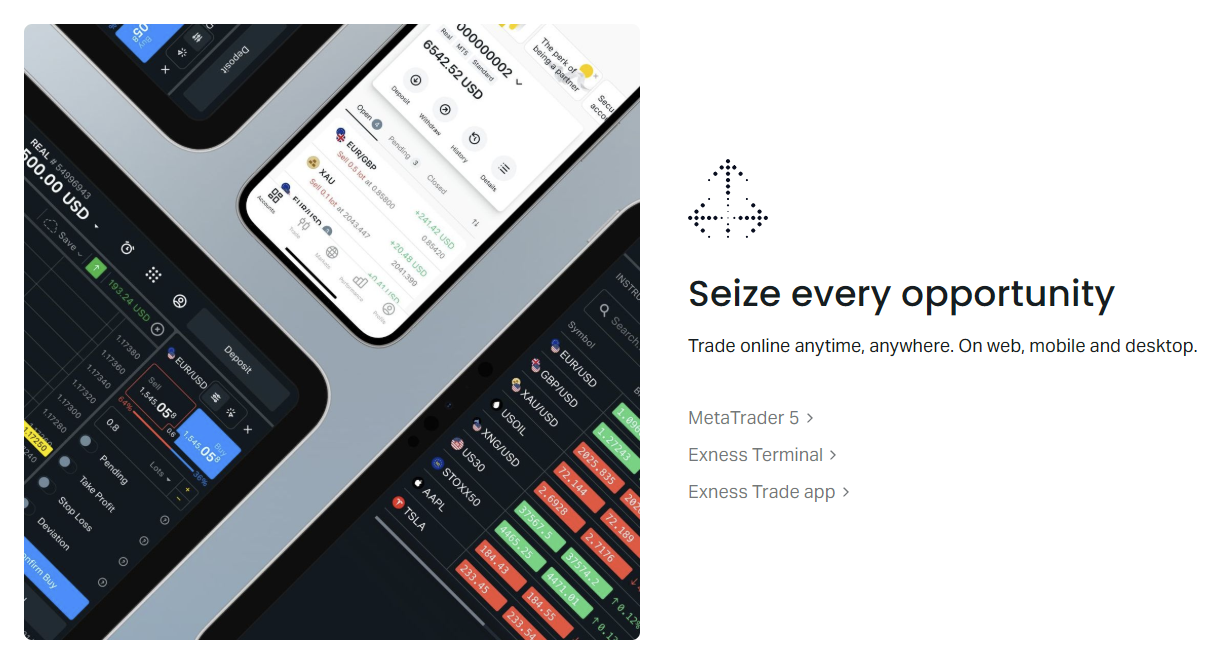
Exness supports MetaTrader 4, MetaTrader 5, a proprietary Web Terminal, and mobile apps for iOS and Android. The Web Terminal runs in a browser with no installation required — useful for traders on corporate networks that block software installs. It includes TradingView charts, one-click trading, and most standard indicators. The mobile app replicates core functionality: charting, order management, deposits and withdrawals, and push notifications.
MT4 remains the most popular choice globally and in Japan. Exness provides the standard build with no proprietary modifications. Expert Advisors (EAs), custom indicators, and scripts work as expected. MT5 adds more timeframes, additional order types (including netting and hedging modes), an economic calendar, and a built-in marketplace. Japanese traders who rely on specific MT4 EAs should verify compatibility before switching — MT5 uses MQL5, a different language.
The Web Terminal deserves attention for its convenience. It loads quickly, saves chart layouts per browser, and supports multi-account switching within the same session. For traders who move between home and office machines, it eliminates the need to sync templates or profiles. The trade-off: no EA support and fewer customization options than the desktop terminals.
Trading Instruments: Forex, Metals, Indices, Crypto, and Energies
Exness offers over 100 currency pairs, including all majors, minors, and a wide selection of exotics. USDJPY, EURJPY, GBPJPY, and AUDJPY see the highest volume from Japanese traders. Spreads on yen crosses are generally tight — USDJPY often trades at 0.1–0.3 pips on Raw Spread and Zero accounts during Tokyo and London overlap hours.
Precious metals include gold (XAUUSD), silver (XAGUSD), platinum, and palladium. Gold is the most actively traded, with spreads from 0.1 pips on Zero accounts. Indices cover major global benchmarks: US30 (Dow), US500 (S&P 500), USTEC (Nasdaq 100), JP225 (Nikkei 225), UK100 (FTSE), DE40 (DAX), and others. The Nikkei 225 CFD is particularly relevant for domestic traders wanting exposure to Japanese equities without a securities account.
Cryptocurrency CFDs include BTCUSD, ETHUSD, LTCUSD, XRPUSD, and several altcoin pairs. Crypto trading is available 24/7, including weekends, with wider spreads reflecting lower liquidity outside traditional hours. Energies cover USOIL (WTI), UKOIL (Brent), and natural gas. All instruments are CFDs — no physical delivery, no ownership of underlying assets.
Scroll horizontally to see all columns
| Category | Examples | Raw Spread Typical | Zero Account Typical | Trading Hours |
|---|---|---|---|---|
| Major Forex | USDJPY, EURUSD, GBPUSD | 0.0–0.2 pips | 0.0 pips | 24/5 |
| Yen Crosses | EURJPY, GBPJPY, AUDJPY | 0.1–0.3 pips | 0.0–0.1 pips | 24/5 |
| Gold | XAUUSD | 0.1–0.3 pips | 0.1 pips | 24/5 |
| Indices | JP225, US500, USTEC | 0.4–1.0 points | 0.4–1.0 points | Near 24/5 |
| Crypto | BTCUSD, ETHUSD | 0.15–0.40% | 0.15–0.40% | 24/7 |
| Energies | USOIL, UKOIL, NGAS | 2–5 points | 2–5 points | Near 24/5 |
Spreads, Commissions, and Total Trading Costs
Total cost depends on account type, instrument, and time of day. On a Standard account trading USDJPY at 0.3 pips spread with a 1 lot position (100,000 units), the round-trip cost is roughly $30 (≈4,500 JPY). On a Zero account with 0.0 pip spread and $3.5 commission per side, the same trade costs $7 (≈1,050 JPY) — less than a quarter. For high-frequency or scalping strategies, the commission-based accounts almost always win.
Swap rates (overnight financing) apply to positions held past 22:00 UTC (07:00 JST). Exness publishes swap values daily in the trading terminal and on its website. Long positions on high-yield currencies earn swap; short positions pay. For yen pairs, the interest rate differential often means paying swap on long USDJPY and earning on short. Traders holding positions for weeks should factor this into profitability calculations.
Leverage and Margin Requirements
Exness offers dynamic leverage up to 1:2000 (0.05% margin) on forex for accounts with equity below $1,000. As equity grows, maximum leverage steps down: 1:2000 under $1,000, 1:1000 up to $5,000, 1:500 up to $30,000, 1:200 above that. This applies automatically — no need to request changes. Japanese traders used to domestic brokers capped at 1:25 (4% margin) by FSA rules will find this dramatically higher. Higher leverage amplifies both gains and losses. A 1% adverse move on 1:2000 leverage wipes out the position.
Margin requirements differ by instrument. Major forex pairs use the dynamic leverage schedule. Gold and major indices typically max out at 1:200 (0.5% margin). Minor forex, exotic pairs, and crypto CFDs have lower maximum leverage — often 1:20 to 1:100 depending on volatility. Stop-out level is 0% across all account types, meaning positions close automatically when margin hits zero. No margin call warnings are guaranteed; the system liquidates at stop-out.
Scroll horizontally to see all columns
| Account Equity | Major Forex | Gold / Major Indices | Minor Forex / Crypto | Exotic Pairs |
|---|---|---|---|---|
| Under $1,000 | 1:2000 | 1:200 | 1:100 | 1:20 |
| $1,000 – $5,000 | 1:1000 | 1:200 | 1:100 | 1:20 |
| $5,000 – $30,000 | 1:500 | 1:200 | 1:100 | 1:20 |
| Over $30,000 | 1:200 | 1:200 | 1:100 | 1:20 |
Deposit and Withdrawal Methods for Japan
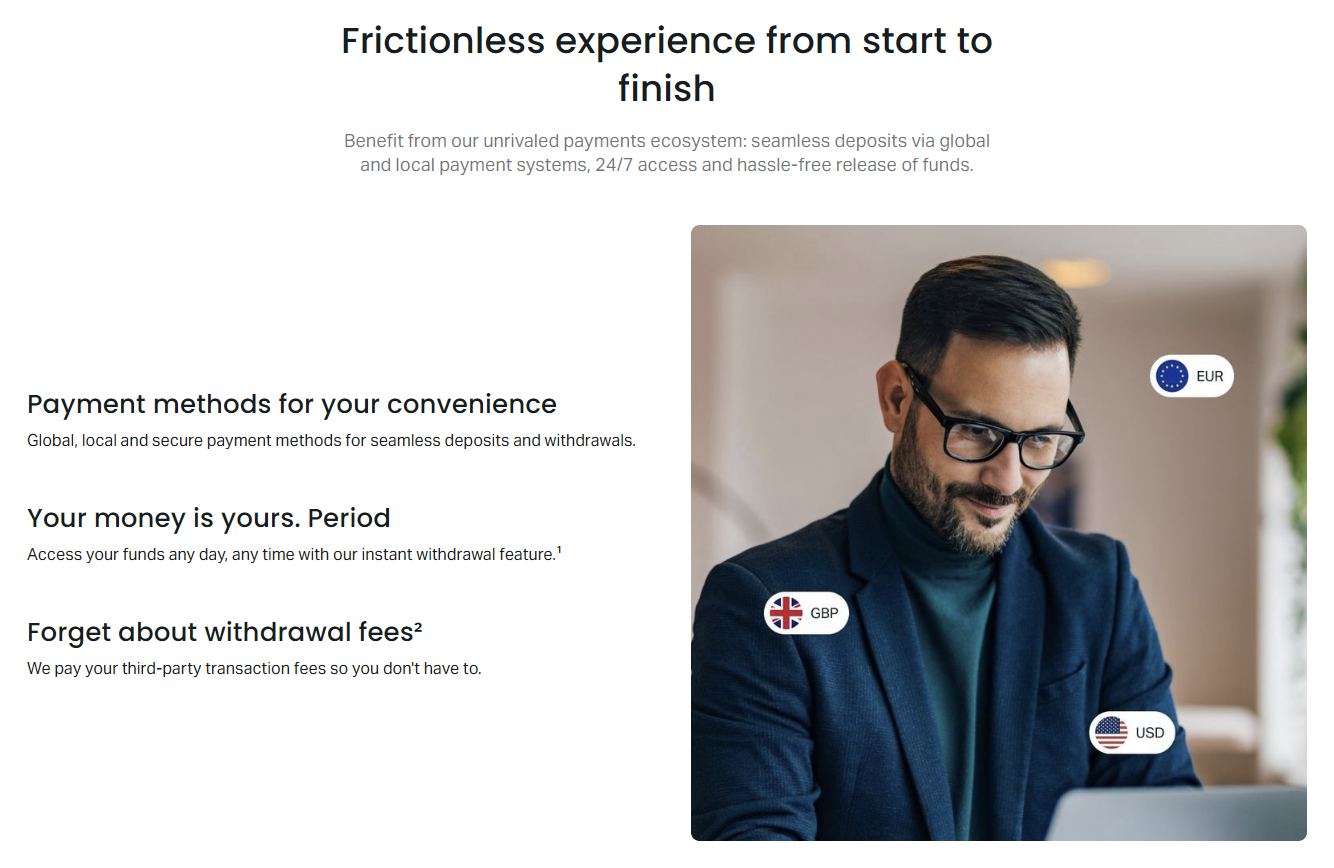
Exness supports a wide range of payment methods, but availability varies by country. For Japan, the most reliable options are bank wire transfer (SWIFT), credit/debit cards (Visa, Mastercard, JCB), and electronic wallets. Domestic bank transfers in JPY are not directly supported — deposits arrive via SWIFT in USD or EUR, converted at the receiving bank's rate. This adds cost and delay: typically 1–3 business days plus intermediary bank fees.
Card deposits are instant and free on Exness's side, though card issuers may charge cash advance fees or foreign transaction fees. JCB works for Japanese-issued cards. E-wallets like Skrill, Neteller, and Perfect Money are available but less common in Japan. Cryptocurrency deposits (USDT, USDC, BTC, ETH) process on-chain and credit within minutes after confirmations. Minimum deposit is $1 for most methods; bank wires may have higher minimums imposed by the sending bank.
Withdrawals follow the same methods and must return to the original deposit source up to the deposited amount (closed-loop policy). Profits can be withdrawn to any verified method. Exness processes withdrawal requests 24/7, including weekends. Card refunds take 1–10 business days depending on the issuer. Bank wires take 1–5 business days. Crypto withdrawals are fastest — usually under an hour. No withdrawal fees from Exness, but network fees apply to crypto.
Verification (KYC) is required before the first withdrawal. Documents needed: government-issued photo ID (passport, driver's license, My Number card) and proof of address issued within 3 months (utility bill, bank statement, residence certificate). Japanese residents can use a Juminhyo (certificate of residence) as address proof. The process typically completes within a few hours during business days.
VPS Hosting and Trading Tools
Exness offers a free VPS (Virtual Private Server) for traders who meet volume requirements: 5 lots per month on Standard/Pro accounts, or 3 lots on Raw Spread/Zero accounts. The VPS runs on Equinix data centers in London, New York, Singapore, and Tokyo. For Japanese traders using EAs or copying signals, the Tokyo node provides sub-millisecond latency to Exness trade servers. Setup is managed through the Personal Area — no technical configuration required.
The trading calculator suite includes margin, pip value, profit, and swap calculators. These work in the browser and mobile app. The economic calendar integrates with the terminal and filters by currency, impact, and time zone — useful for setting JST alerts. Trading Central signals appear in the terminal and web platform, providing technical analysis entries, targets, and stops. Social trading (copy trading) is available through the Exness Social Trading app, separate from the main trading app.
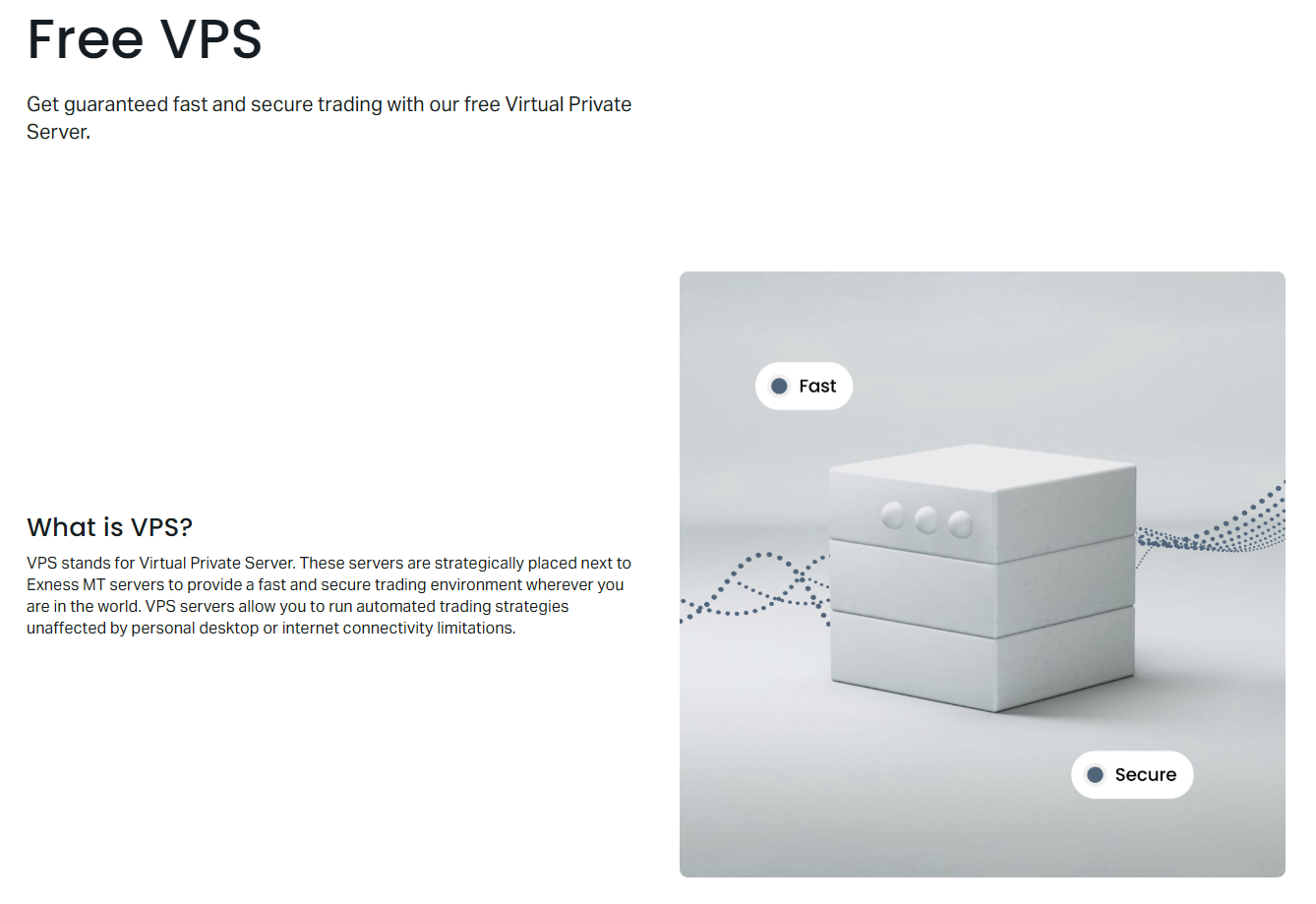
One practical note: the free VPS requires maintaining the monthly volume threshold. If volume drops below the requirement, the VPS is suspended after a grace period. Traders with inconsistent volume may prefer a paid third-party VPS for continuity. Exness does not lock traders into their VPS — any MT4/MT5 instance can connect to Exness servers.
Security, Fund Protection, and Account Safety
Exness implements several security layers. Client funds are held in segregated accounts at banks including Barclays, Standard Chartered, and others — separate from company operating funds. Negative balance protection ensures accounts cannot go below zero; losses exceeding equity are absorbed by the broker. Two-factor authentication (2FA) via SMS, authenticator app, or email is available and recommended. The Personal Area shows active sessions and allows remote logout.
The Financial Commission membership provides external dispute resolution and a compensation fund up to €20,000 per client. This is not a government-backed scheme but an industry self-regulatory body. Exness also publishes quarterly financial reports and undergoes annual audits by Deloitte. Transparency around financial health is better than many offshore brokers, though it does not replace domestic regulatory oversight.
For Japanese traders, the practical security question is: what happens if Exness becomes insolvent? Segregated accounts at reputable banks provide a layer of protection, but recovery depends on the jurisdiction of the holding entity (Seychelles or Curaçao) and the bank's location. The Financial Commission fund adds a backstop, but €20,000 may not cover large accounts. Traders with significant capital should consider whether this risk profile aligns with their tolerance.
Partner, IB, and Affiliate Programs
Exness runs an Introducing Broker (IB) program and an affiliate program. IBs earn rebates based on referred clients' trading volume — up to $1,550 per lot on Standard accounts, with tiered rates for Professional accounts. Affiliates earn CPA (cost per acquisition) or revenue share. Both programs provide marketing materials, tracking dashboards, and multi-language support including Japanese. Payouts are weekly with no minimum threshold for most methods.
The IB program includes a Premier tier for high-volume partners, offering dedicated support, custom reporting, and higher rebate caps. Japanese affiliates with existing audiences — trading educators, signal providers, community managers — may find the revenue share model more sustainable than one-time CPA. Exness does not allow self-referral (trading through your own IB link).
Customer Support for Japanese Users
Exness offers 24/7 live chat in multiple languages, including Japanese during business hours (approximately 09:00–18:00 JST). Outside those hours, English-speaking agents handle queries with translation assistance. Email support responds within a few hours typically. Phone support is not offered — a common cost-saving measure among brokers. The help center contains hundreds of articles in Japanese covering account opening, verification, deposits, withdrawals, platform setup, and trading conditions.
Response quality varies. Simple questions (spreads, leverage, deposit status) get quick, accurate answers. Complex issues (withdrawal delays, technical platform bugs, dispute resolution) may require escalation and take longer. Japanese-speaking agents are generally knowledgeable about local payment nuances — JCB card issues, SWIFT routing for Japanese banks, My Number card acceptance. This local awareness is a practical advantage over brokers with only English support.
Support quality often matters more than spreads when something goes wrong. Exness invests in multilingual teams, and Japanese coverage during business hours is a genuine differentiator for this market.
Practical Considerations for Japanese Traders
Tax reporting is the trader's responsibility. Japan taxes forex and CFD gains as miscellaneous income (雑所得) at progressive rates up to 45% plus 10% inhabitant tax. Losses can offset gains within the same category but not against salary income. Exness does not issue Japanese tax statements (年間取引報告書). Traders must download trade history (CSV or PDF) from the Personal Area and calculate gains/losses themselves or engage a tax accountant familiar with overseas broker reporting.
Time zone alignment matters. Tokyo session (09:00–18:00 JST) overlaps with Sydney and early London. Spreads on yen pairs tighten during this window. Major economic releases — BOJ policy decisions, Japan CPI, Tankan survey — move JPY pairs sharply. Exness's economic calendar flags these events. Traders using EAs should test performance during Asian session liquidity conditions, which differ from London/New York.
Language support extends beyond the website. The MT4/MT5 terminals, Web Terminal, and mobile app all offer Japanese UI. Trading Central signals and market news include Japanese translations. This reduces friction for traders who prefer operating in their native language. However, some advanced settings, EA marketplace descriptions, and community forums remain English-dominant.
Final Assessment of Exness Japan
Exness delivers a competent, low-cost trading environment with tight spreads, high leverage, instant withdrawals, and Japanese language support. The platform ecosystem — MT4, MT5, Web Terminal, mobile — covers every preference. VPS hosting, Trading Central signals, and social trading add value for active traders. The commission-based accounts (Raw Spread, Zero) are among the cheapest in the industry for high-volume trading on majors and gold.
The regulatory gap is the defining trade-off. No FSA license means no domestic investor protection, no mandatory segregation at Japanese trust banks, and no access to the Investor Protection Fund. Exness substitutes its own safeguards: segregated accounts at global banks, negative balance protection, Financial Commission membership, and audited financials. For many traders, these are sufficient. For those with large accounts or low risk tolerance, the absence of Japanese regulatory oversight may be a dealbreaker.
Japanese traders should weigh three factors: trading volume (commission accounts win above ~3 lots/month), risk tolerance for offshore regulation, and need for Japanese-language support. Exness excels on the first and third. The second is a personal judgment. The broker is transparent about its regulatory status — it does not claim FSA registration. That honesty, combined with operational reliability, makes it a viable choice for traders who understand and accept the offshore model.
Frequently Asked Questions
Is Exness legal for Japanese residents to use?
Yes. Japanese law does not prohibit individuals from trading with overseas brokers. Exness accepts Japanese clients and provides Japanese language support. However, Exness is not licensed by Japan's Financial Services Agency (FSA), so domestic investor protections do not apply.
What is the minimum deposit for Japanese traders?
The Standard and Standard Cent accounts require only $1 (approximately 150 JPY). Professional accounts (Pro, Raw Spread, Zero) require $200 (approximately 30,000 JPY).
Does Exness offer JPY-denominated accounts?
No. Account base currencies are USD, EUR, and a few others. Deposits in JPY are converted at the payment processor's or bank's exchange rate. Trading profit/loss is calculated in the account currency.
What leverage is available to Japanese clients?
Dynamic leverage up to 1:2000 on major forex for accounts under $1,000 equity, stepping down to 1:200 above $30,000. Gold and major indices max at 1:200. Crypto and exotic pairs have lower limits. This far exceeds Japan's domestic 1:25 cap.
How fast are withdrawals for Japanese bank accounts?
SWIFT withdrawals take 1–5 business days to reach Japanese banks. Exness processes requests 24/7 with no fees, but intermediary banks may charge. Crypto withdrawals are fastest (under an hour). Card refunds take 1–10 business days depending on the issuer.
Does Exness provide Japanese tax reporting documents?
No. Exness does not issue Japanese annual transaction reports (年間取引報告書). Traders must download trade history from the Personal Area and calculate gains/losses for tax filing themselves or with a tax accountant.
Is there a free VPS for Japanese traders?
Yes, if you trade at least 5 lots/month on Standard/Pro or 3 lots/month on Raw Spread/Zero. The Tokyo VPS node offers low latency. Volume is checked monthly; falling below the threshold suspends the VPS after a grace period.
What happens if Exness goes bankrupt?
Client funds are held in segregated accounts at banks like Barclays and Standard Chartered. Negative balance protection prevents losses exceeding equity. The Financial Commission compensation fund covers up to €20,000 per client. Recovery depends on the entity's jurisdiction (Seychelles or Curaçao) and is not guaranteed by any Japanese scheme.