

Forex & CFD Trading Guides
Trading Dow Jones on Exness: Complete Guide to US30
Platform features, trading conditions, and strategies for US30 index CFDs

Senior Forex Trader & Market Analyst
Daniel Chen is an experienced forex trader and financial market analyst with over 15 years of experience in currency trading. He specializes in technical analysis, risk management, and developing practical trading strategies to help traders make informed decisions.
The Dow Jones Industrial Average remains one of the most watched stock market benchmarks in the world. Traders who want exposure to this index without buying individual shares often turn to CFD brokers. Exness offers the Dow Jones — listed as US30 on its platforms — with conditions that suit both short-term scalpers and longer-term position traders. This guide covers everything you need to know about trading US30 on Exness, from account selection and platform choice to spreads, leverage, trading hours, and practical risk management.
Contents
- 1. What Is the Dow Jones Industrial Average
- 2. Why Trade Dow Jones on Exness
- 3. Exness Account Types for Index Trading
- 4. Trading Platforms Available for US30
- 5. US30 Trading Conditions: Spreads, Swaps, and Sessions
- 6. How to Open Your First US30 Trade on Exness
- 7. Risk Management for Dow Jones CFDs
- 8. Common Dow Jones Trading Strategies
- 8.1. Opening Range Breakout (5–15 Minute)
- 8.2. Mean Reversion to VWAP (Intraday)
- 8.3. Swing Trading Earnings Catalysts (Daily)
- 9. Technical Analysis Tools on Exness Platforms
- 10. Fundamental Drivers of the Dow Jones
- 11. Exness Web Terminal for Index Traders
- 12. Mobile Trading Dow Jones on the Exness App
- 13. Cost Comparison: Exness vs Other Brokers for US30
- 14. Demo Account Testing Before Live Trading
- 15. Tax Implications of Index CFD Trading
- 16. Common Mistakes When Trading US30 on Exness
- 17. Final Assessment of Exness for Dow Jones Trading
Exness has built its reputation on fast execution, stable spreads during volatile sessions, and instant withdrawals. Those features matter when trading an index that can move dozens of points in minutes. The broker provides US30 across all its account types — Standard, Standard Cent, Pro, Raw Spread, and Zero — each with different cost structures. Understanding which account fits your trading style is the first step toward consistent results.
You will also find the index available on MetaTrader 4, MetaTrader 5, the Exness Web Terminal, and the Exness mobile app. The Web Terminal is particularly useful for index traders who want charting tools and one-click trading without installing software. Mobile access means you can manage positions during US market hours even when away from your desk.
What Is the Dow Jones Industrial Average
The Dow Jones Industrial Average tracks 30 large, publicly traded companies listed on US exchanges. Unlike the S&P 500, which weights constituents by market capitalization, the Dow is price-weighted. A stock trading at $300 influences the index more than one trading at $50, regardless of company size. This methodology means a few high-priced components — such as UnitedHealth, Goldman Sachs, or Microsoft — can drive outsized moves.
Exness lists the instrument as US30 or US30.cash depending on the platform. The .cash suffix denotes a spot CFD with no expiry date, while the futures version (US30.fut) follows the CME E-mini Dow futures contract and rolls quarterly. Most retail traders stick with the cash CFD because it avoids rollover complications and mirrors the real-time index value closely.
The index covers sectors including technology, financials, healthcare, industrials, and consumer goods. Because it holds only 30 stocks, earnings reports from a single component can shift the entire index. Traders who follow US30 need an earnings calendar and awareness of Federal Reserve policy meetings, both of which create predictable volatility windows.
Why Trade Dow Jones on Exness
Exness offers several advantages for index traders. Spreads on US30 start from 0.4 pips on Raw Spread and Zero accounts, and from around 1.5 pips on Standard accounts. During the New York session, spreads typically remain tight even when the index moves sharply. The broker does not widen spreads artificially around news events, which is a common frustration at some competing brokers.
Leverage reaches 1:2000 on Standard and Pro accounts for indices, though Raw Spread and Zero accounts cap at 1:200. High leverage lets you control larger positions with less margin, but it also amplifies losses. Exness provides negative balance protection, so you cannot lose more than your account equity. Margin calls and stop-out levels are transparent — 0% stop-out on most accounts means positions close only when equity hits zero.
Execution speed is another factor. Exness publishes execution statistics showing median order fill times under 25 milliseconds. For a fast-moving index like US30, slippage of even a few ticks can change a trade outcome. The broker uses market execution with no requotes, and you can enable one-click trading on all platforms.
Instant withdrawals are a practical benefit. Most brokers process withdrawals in 24–48 hours. Exness processes the majority of requests automatically within minutes, including weekends. If you need to pull profits quickly after a successful US30 session, the funds reach your wallet or bank card without delay.
Exness Account Types for Index Trading
Choosing the right account affects your trading costs directly. Exness offers five live account types, and all support US30. The table below summarizes the key differences for index traders.
Scroll horizontally to see all columns
| Account | Min Deposit | US30 Spread | Commission | Max Leverage | Best For |
|---|---|---|---|---|---|
| Standard | $1 | ~1.5 pips | None | 1:2000 | Beginners, small accounts |
| Standard Cent | $1 | ~1.5 pips | None | 1:2000 | Micro position sizing |
| Pro | $200 | ~0.6 pips | None | 1:2000 | Active traders, no commission |
| Raw Spread | $200 | ~0.4 pips | $3.5 per lot/side | 1:200 | Scalpers, high volume |
| Zero | $200 | 0.0 pips* | $3.5 per lot/side | 1:200 | Algorithmic, precise entries |
Zero account spreads can reach 0.0 pips during peak liquidity, but the $7 round-trip commission per lot applies regardless. For a typical US30 lot size of 1 contract, that commission equals roughly $7. On Raw Spread, the spread plus commission often works out similar to Zero during normal hours. Pro accounts charge no commission and offer higher leverage, making them popular with swing traders who hold positions overnight and want to avoid swap costs eating into profits.
Standard Cent accounts denominate balance in cents rather than dollars. A $10 deposit shows as 1,000 cents. This lets you trade micro-lots (0.01 lot = 1 cent per pip) and practice real-money risk management with tiny capital. The spread is identical to Standard, so costs scale proportionally.
Trading Platforms Available for US30
Exness supports four trading environments. MetaTrader 4 remains the most widely used platform globally, with a massive library of custom indicators and expert advisors. MetaTrader 5 adds more timeframes, a built-in economic calendar, and depth of market. The Exness Web Terminal runs in any browser with no installation. The Exness mobile app provides full trading functionality on iOS and Android.
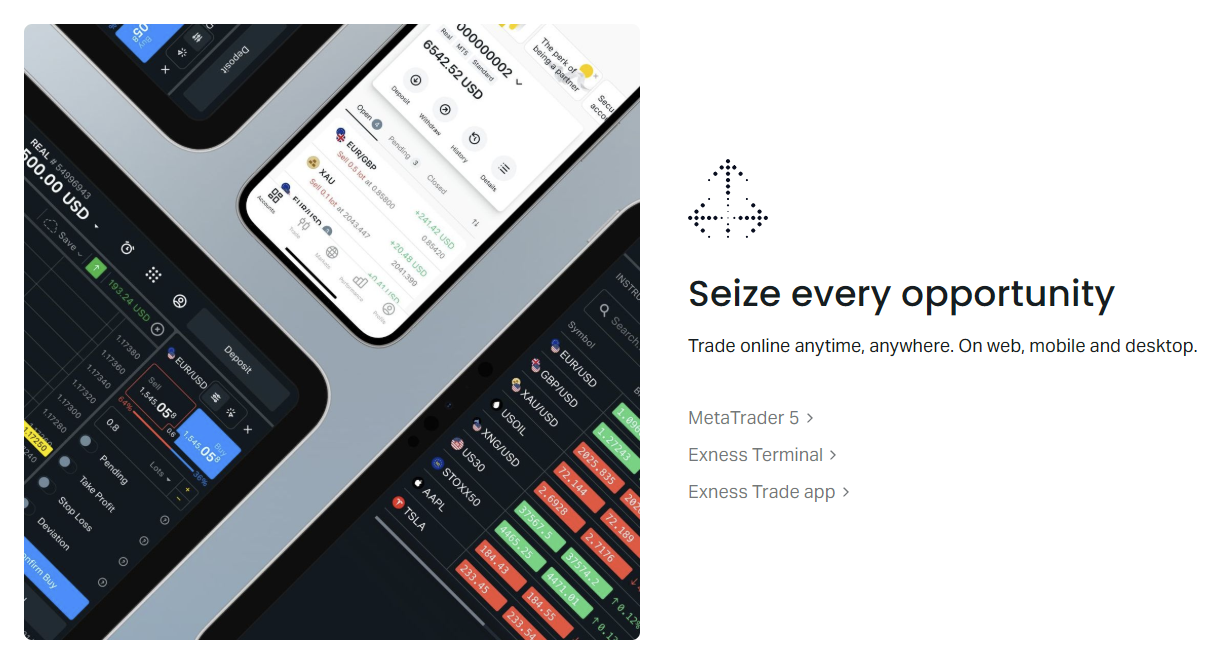
For index trading specifically, MT5 offers a slight edge. Its 21 timeframes include 2-hour and 8-hour charts that align well with US session structure. The depth of market feature shows liquidity at each price level, useful when placing larger US30 orders. The Web Terminal replicates most MT5 charting tools and adds a clean, modern interface that loads quickly on any device.
Mobile traders get push notifications for price alerts, margin calls, and executed orders. The app includes Trading Central signals integrated directly into the chart, which can highlight potential US30 setups based on technical patterns. You can also deposit, withdraw, and manage account settings without leaving the app.
US30 Trading Conditions: Spreads, Swaps, and Sessions
Spreads on US30 vary by account type and time of day. The tightest spreads occur during the overlap of the London and New York sessions, roughly 13:00–17:00 UTC. Outside those hours, spreads widen moderately. Exness publishes real-time spread history in the personal area, so you can verify average costs for your trading window.
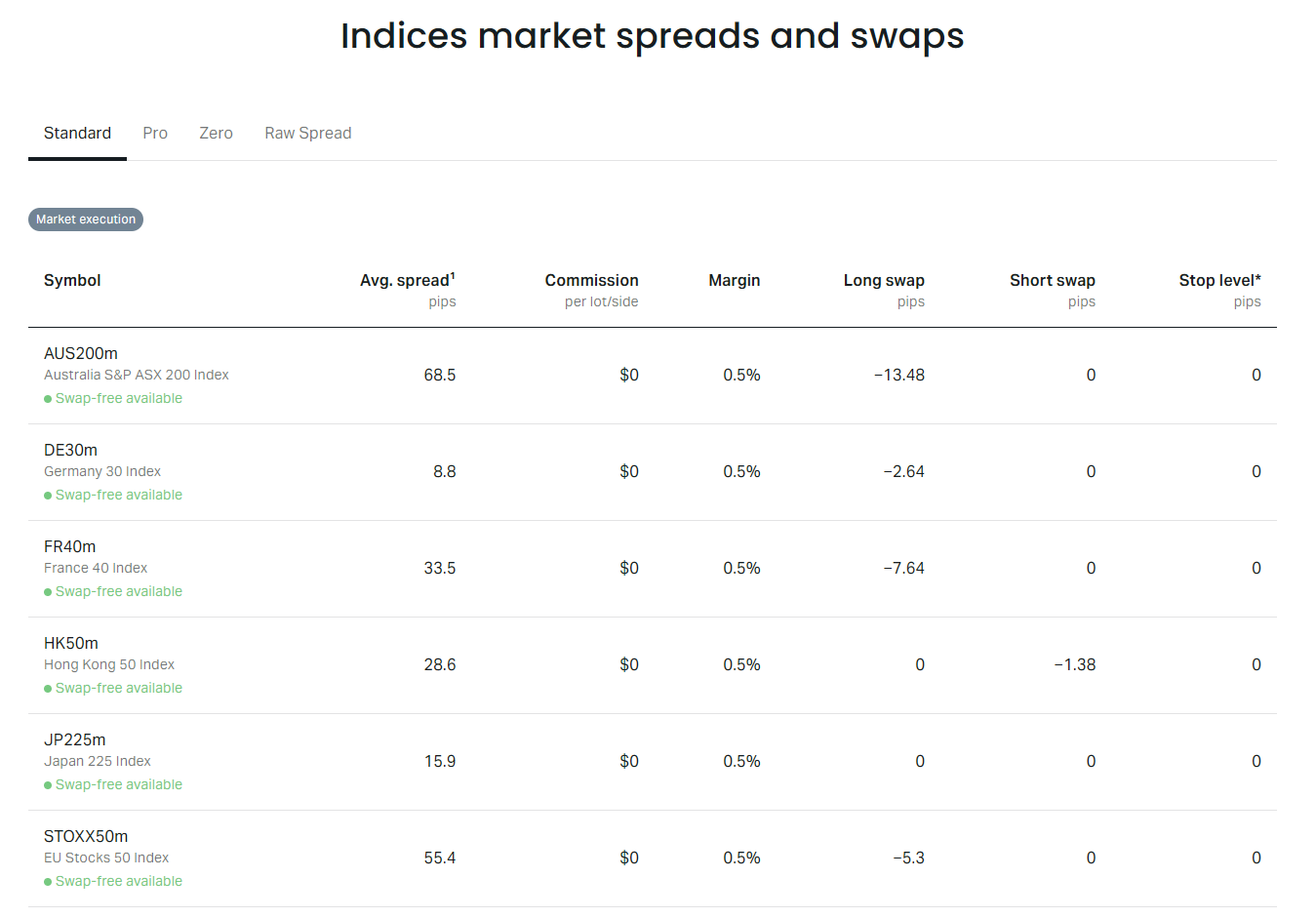
Swap rates apply to positions held past 22:00 UTC (server time). For US30, long positions typically pay a negative swap (cost) while short positions may receive a small positive swap (credit), though this flips depending on interest rate differentials. The exact rates update daily in the contract specifications. Swing traders should factor swaps into hold-time calculations — a week of negative swaps can erase a modest profit on a small move.
Trading hours for US30.cash follow the CME Globex schedule: Sunday 22:05 UTC to Friday 21:00 UTC, with a daily break 21:00–22:05 UTC. The futures version (US30.fut) has a 15-minute break at 21:00 UTC and closes Friday 21:00 UTC. Liquidity thins during the Asian session, so spreads widen and slippage risk increases. Most volume concentrates in the first two hours of the New York session (13:30–15:30 UTC) and the last hour before the close (20:00–21:00 UTC).
How to Open Your First US30 Trade on Exness
If you already have an Exness account, log into your personal area and ensure you have a live trading account with funds. If not, registration takes a few minutes — email, password, and basic profile information. Verification (KYC) is required before withdrawals but not for depositing or trading. You can fund via card, crypto, or local payment methods depending on your region.
Once funded, open your chosen platform. In MT4 or MT5, find US30 in the Market Watch window — it may appear as US30, US30.cash, or DJ30 depending on the server. Right-click and select Chart Window. The Web Terminal and mobile app have searchable symbol lists. Drag the symbol onto a chart or click New Order.
Set your volume. One standard lot on US30 equals $1 per index point. A 10-point move yields $10 per lot. Mini lots (0.1) and micro lots (0.01) are available. Choose market execution for immediate fill or pending orders (buy limit, sell limit, buy stop, sell stop) for entries at specific prices. Always set a stop loss. For US30, a typical intraday stop might be 20–50 points depending on volatility.
Click Buy or Sell. The position appears in the Trade tab. Monitor unrealized P/L in real time. To close, right-click the position and select Close Order, or use the one-click close button if enabled. Partial closes are supported — you can scale out of winning positions by closing half at a target and trailing the remainder.
Risk Management for Dow Jones CFDs
Index CFDs move faster than most forex pairs. A 1% daily move in US30 equals roughly 350–400 points. At $1 per point per lot, that is $350–400 per lot per day. Without proper position sizing, a few adverse days can drain an account. The first rule: risk no more than 1–2% of equity per trade. On a $1,000 account, that means a $10–20 maximum loss per trade.
Calculate position size from your stop loss distance. If your stop is 30 points and you risk $20, your maximum lot size is 0.66 lots ($20 / 30 points). Round down to 0.6 lots. Exness allows lot sizes down to 0.01, so you can always fit the risk model. Never increase lot size to compensate for a wider stop — widen the stop only if the setup genuinely requires it, then reduce lot size accordingly.
Correlation risk matters if you trade multiple indices. US30, US500 (S&P 500), and USTEC (Nasdaq 100) often move together. Holding long positions in all three simultaneously triples your effective exposure to US equity sentiment. Diversify across uncorrelated assets — for example, gold (XAUUSD) or yen pairs — if you want genuine portfolio diversification.
Common Dow Jones Trading Strategies
No single strategy works in all market conditions. Below are three approaches used by Exness traders on US30, each suited to different timeframes and risk profiles.
Opening Range Breakout (5–15 Minute)
The first 15–30 minutes of the New York session (13:30–14:00 UTC) establish a high and low. A break above the opening range high with volume confirms bullish momentum; a break below signals bearish pressure. Enter on the breakout candle close, place stop loss at the opposite range boundary, and target 1.5–2× the range height. This works best on days with clear directional bias from pre-market news or earnings.
Mean Reversion to VWAP (Intraday)
Volume Weighted Average Price (VWAP) acts as a magnet during ranging sessions. When US30 deviates more than 1.5 standard deviations from VWAP on a 5-minute chart, a reversion trade can offer favorable risk-reward. Enter long below VWAP with a tight stop (15–20 points), target VWAP or the upper deviation band. Exit before the 20:00 UTC close to avoid overnight gap risk. This strategy fails during strong trending days — use ADX above 25 as a filter to avoid fighting trends.
Swing Trading Earnings Catalysts (Daily)
Dow components report earnings quarterly. A beat or miss from a high-weighted stock like Apple or Microsoft can move the index 1–2% in a session. Track the earnings calendar, identify components with high options-implied volatility, and position ahead of the report if your analysis supports a directional bias. Use wider stops (80–150 points) and hold 1–5 days. Reduce size to account for gap risk — earnings gaps can exceed normal daily ranges.
Technical Analysis Tools on Exness Platforms
All Exness platforms include standard indicators: moving averages, Bollinger Bands, RSI, MACD, ATR, and Fibonacci retracements. MT5 adds the Ichimoku Cloud, which many index traders use for trend identification and dynamic support/resistance. The Web Terminal offers a clean indicator panel with search, and you can save chart templates for quick setup.
Trading Central signals appear on MT4, MT5, Web Terminal, and the mobile app. They flag patterns like triangles, wedges, and double tops/bottoms on US30 across multiple timeframes. Treat these as idea generators, not trade signals. Confirm with your own analysis — check volume, session context, and news calendar before acting.
Custom indicators and expert advisors run on MT4 and MT5. If you use an EA for US30, test it on a demo account first. Exness demo accounts mirror live conditions including spreads and execution. Run the EA for at least two weeks across different market phases (trending, ranging, high volatility) before committing real capital.
Fundamental Drivers of the Dow Jones
US30 reacts to a handful of recurring fundamental catalysts. Federal Reserve interest rate decisions and press conferences create the largest moves. A surprise rate cut or hawkish guidance can swing the index 2–3% in minutes. Non-farm payrolls (first Friday monthly), CPI (mid-month), and ISM manufacturing/services PMIs also drive volatility. Exness provides an economic calendar in the personal area and on MT5 with impact ratings and consensus forecasts.
Earnings season (January, April, July, October) brings daily stock-specific moves that aggregate into index action. The Dow's price-weighting means a 5% move in a $300 stock adds more index points than a 10% move in a $50 stock. Track the top 10 components by price — they contribute disproportionately to index moves.
Geopolitical events, fiscal policy announcements, and commodity shocks (oil spikes) affect market sentiment broadly. US30 often correlates with risk appetite — it rises when equities rally and falls during flight-to-safety episodes. Monitor the VIX (volatility index) and USD index (DXY) as secondary gauges. A rising VIX above 25 typically coincides with US30 pullbacks.
Exness Web Terminal for Index Traders
The Web Terminal deserves specific attention for index traders. It loads in seconds, requires no download, and works on any operating system — Windows, macOS, Linux, Chrome OS. The interface includes multi-chart layouts, 30+ indicators, drawing tools, and one-click trading from the chart. You can detach charts into separate browser windows for multi-monitor setups.
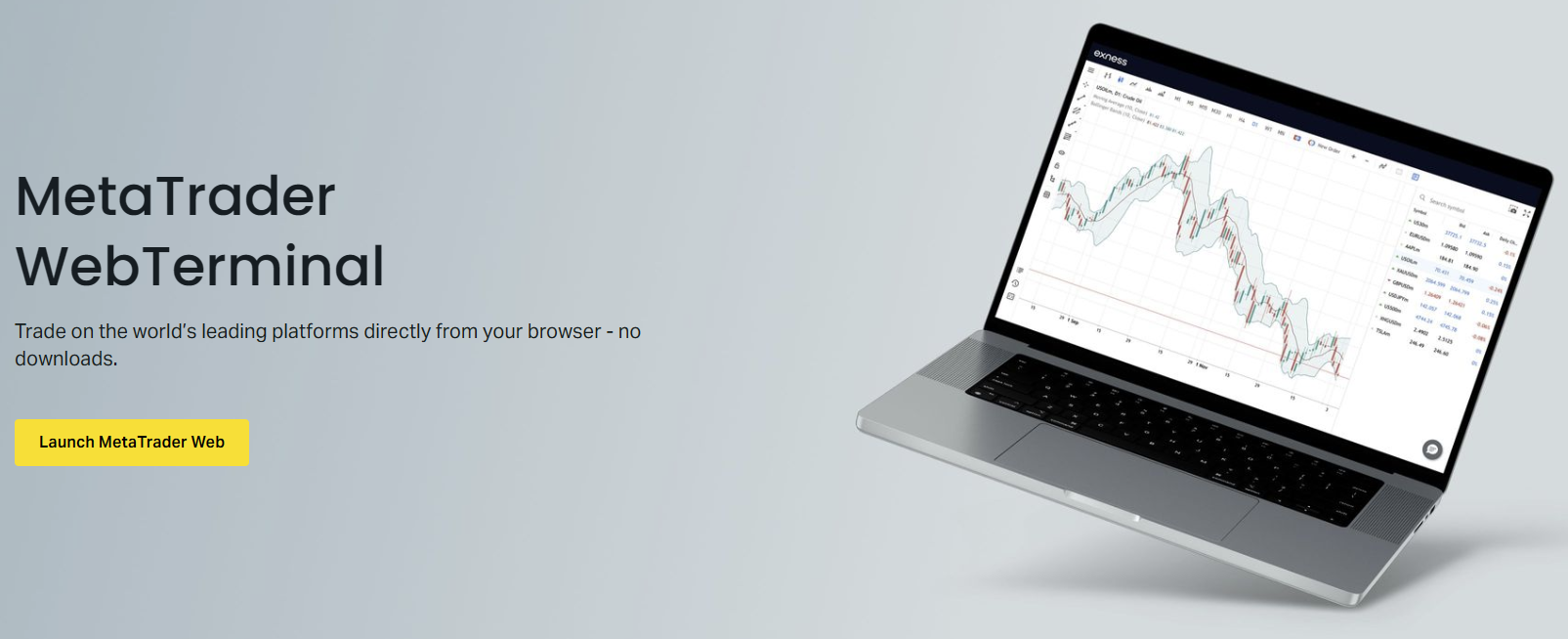
Order management is streamlined. The trade panel shows margin used, free margin, and margin level in real time. You can set default stop loss and take profit distances in points, which speeds up order entry during fast markets. The terminal also displays swap rates and contract specifications for each symbol without leaving the chart.
One limitation: custom indicators and EAs cannot run in the Web Terminal. If your strategy depends on proprietary tools, use MT4 or MT5. For discretionary traders who rely on price action, standard indicators, and drawing tools, the Web Terminal is often faster and more stable than the desktop platforms.
Mobile Trading Dow Jones on the Exness App
The Exness mobile app (iOS and Android) replicates core trading functions. You get real-time quotes, interactive charts with 9 timeframes, 30+ indicators, and the full order suite — market, pending, stop loss, take profit. Push notifications alert you to margin calls, executed orders, and price levels you set.
For US30 traders, the app is valuable during the New York session if you cannot be at your desk. You can monitor positions, adjust stops, or close trades from your phone. The charting is responsive — pinch to zoom, swipe to scroll, tap to add indicators. Trading Central signals appear as overlays on the chart with entry, stop, and target levels.
Account management features include deposit/withdrawal, leverage changes, and account switching. You can also contact support via in-app chat. The app uses biometric login (Face ID, fingerprint) for security. One drawback: screen space limits multi-chart analysis. For serious technical work, use the desktop or web platform; treat mobile as a monitoring and execution tool.
Cost Comparison: Exness vs Other Brokers for US30
Trading costs determine long-term profitability. The table below compares Exness Raw Spread account (typical for active index traders) with two unnamed major competitors offering similar ECN-style pricing. All figures are approximate averages during London/New York overlap.
Scroll horizontally to see all columns
| Broker | Avg Spread (pips) | Commission ($) | Total Cost ($) | Effective Spread (pips) |
|---|---|---|---|---|
| Exness Raw Spread | 0.4 | 7.00 | 11.00 | 1.1 |
| Competitor A | 0.6 | 6.00 | 12.00 | 1.2 |
| Competitor B | 0.8 | 5.00 | 13.00 | 1.3 |
Exness comes out slightly ahead on total cost. The difference of $1–2 per lot compounds over hundreds of trades. More importantly, Exness does not charge swap fees on indices for Islamic (swap-free) accounts, while some competitors mark up swaps significantly. If you hold positions overnight regularly, the swap-free option saves meaningful money.
Demo Account Testing Before Live Trading
Exness offers unlimited demo accounts with virtual funds up to $100,000. Demo conditions mirror live — same spreads, execution, swaps, and platform features. Use demo to test your US30 strategy for at least 20–30 trades across different market conditions. Track your win rate, average risk-reward, maximum drawdown, and emotional discipline.
Treat demo seriously. If you over-leverage, revenge-trade, or ignore stops on demo, you will do the same live. The only difference is psychological — real money triggers fear and greed that demo cannot replicate. Transition to live with a small amount you can afford to lose ($100–500) and trade the same position sizes relative to account equity.
Exness also provides a cent account for live micro-trading. A $10 deposit on Standard Cent gives you 1,000 cents of buying power. You experience real execution and psychology with negligible financial risk. This bridges the gap between demo and full-size live trading better than any simulation.
Tax Implications of Index CFD Trading
CFD profits are taxable in most jurisdictions. The treatment varies — some countries tax as capital gains, others as ordinary income, and a few (like the UK for spread betting) offer tax-free status for certain products. Exness does not provide tax advice and does not issue tax forms for most regions. You are responsible for recording every trade: entry/exit time, price, lot size, P/L, commissions, and swaps.
Export your trade history from the personal area or MT4/MT5 regularly. The CSV export includes all required fields. Use a spreadsheet or dedicated trading journal software to calculate net P/L per tax year. If you trade across multiple brokers, consolidate records. Consult a tax professional familiar with derivative trading in your country — rules change and penalties for misreporting can be severe.
Common Mistakes When Trading US30 on Exness
New index traders often repeat the same errors. Over-leveraging tops the list. Just because 1:2000 leverage is available does not mean you should use it. At 1:2000, a 0.5% move against you wipes 100% of margin. Professional index traders rarely exceed 1:10 effective leverage (position value / equity).
Ignoring the economic calendar is another frequent mistake. Trading US30 blindly into FOMC, NFP, or CPI releases is gambling, not trading. Either close positions before high-impact news, widen stops significantly, or use pending orders to catch the post-news trend. Exness calendar shows impact level and consensus — check it each morning.
Chasing moves after the fact leads to poor entries. If US30 has already rallied 200 points in an hour, the easy money is gone. Wait for a pullback to a logical level — VWAP, prior resistance turned support, Fibonacci retracement — before entering. Patience preserves capital.
Failing to adjust for dividend adjustments on cash indices can surprise swing traders. When a Dow component goes ex-dividend, the index drops by the dividend amount weighted by the price-weighting formula. Exness applies a dividend adjustment to positions held overnight on the ex-date. Long positions receive a credit; short positions pay a debit. Check the corporate action calendar if holding through earnings season.
Frequently Asked Questions
What is the minimum deposit to trade Dow Jones on Exness?
Standard and Standard Cent accounts require only $1. Pro, Raw Spread, and Zero accounts require $200. You can start with $1 on a cent account and trade micro-lots.
Does Exness offer swap-free trading on US30?
Yes. Islamic (swap-free) accounts are available on request for eligible clients. No overnight swap charges apply on any instrument, including US30. Contact support after registration to apply.
What are the typical spreads on US30 during the New York session?
On Raw Spread and Zero accounts, spreads average 0.4–0.6 pips. On Pro accounts, around 0.6–0.8 pips. Standard accounts see 1.5–2.0 pips. Spreads widen outside main session hours.
Can I use expert advisors for US30 on Exness?
Yes. MT4 and MT5 support EAs without restrictions. The Web Terminal and mobile app do not support custom EAs. Test any EA on demo for at least two weeks before live use.
How do I calculate pip value for US30 on Exness?
One standard lot (1.00) on US30 equals $1 per index point. A 10-point move = $10 per lot. Mini lot (0.10) = $1 per 10 points. Micro lot (0.01) = $0.10 per 10 points.
What trading hours apply to US30.cash on Exness?
Sunday 22:05 UTC to Friday 21:00 UTC, with a daily break 21:00–22:05 UTC. Server time is UTC. Most liquidity occurs 13:30–21:00 UTC (New York session).
Are there any restrictions on scalping US30?
No. Exness allows scalping, hedging, and high-frequency trading on all accounts. No minimum hold time, no trade frequency limits. Raw Spread and Zero accounts are designed for this style.
How fast are withdrawals after trading US30 profits?
Most withdrawals process automatically within minutes, 24/7 including weekends. Card withdrawals may take 1–3 business days to appear on your statement depending on your bank.
Final Assessment of Exness for Dow Jones Trading
Exness delivers a competitive package for US30 traders. Tight spreads, high leverage options, multiple platforms, and instant withdrawals address the practical needs of active index traders. The Raw Spread and Zero accounts offer the lowest all-in costs for high-frequency strategies, while Pro accounts suit swing traders who prefer commission-free pricing with higher leverage. The Web Terminal and mobile app provide genuine flexibility — you can analyze, enter, and manage US30 trades from anywhere without installing software.
The main limitations are not unique to Exness. Index CFDs carry overnight swap costs, dividend adjustments, and gap risk that forex traders may not expect. The 30-stock concentration of the Dow means single-stock news creates outsized volatility. Traders must respect these characteristics regardless of broker. Exness does not hide them — contract specifications, swap rates, and trading hours are transparent in the personal area.
For a trader starting with US30, the recommended path is: open a Standard Cent account, trade micro-lots on demo for two weeks, then move to live cent with $50–100. Scale to Standard or Pro once consistency appears. Avoid Raw Spread or Zero until your volume justifies the commission structure. Use the economic calendar daily, keep a trade journal, and treat every loss as data. The market does not care about your account size — it rewards discipline and punishes impulse.