

Forex Broker Execution
Exness Execution Speed, Types, and Quality Explained
A detailed look at execution technology, order routing, and what it means for your trading costs.

Senior Forex Trader & Market Analyst
Daniel Chen is an experienced forex trader and financial market analyst with over 15 years of experience in currency trading. He specializes in technical analysis, risk management, and developing practical trading strategies to help traders make informed decisions.
Execution is where trading theory meets reality. A strategy that looks perfect on paper can fall apart if orders fill at worse prices, suffer delays, or get rejected during volatile moments. Exness has built its reputation partly on execution quality, advertising sub-millisecond speeds and a no-requotes model. This article breaks down what that actually means in practice — the execution types available, how they differ across account types and platforms, where the technology sits, and what traders should watch for.
Contents
- 1. Market Execution vs Instant Execution on Exness
- 2. Execution Speed Claims and Measured Reality
- 3. Slippage, Requotes, and Price Improvement
- 4. Order Types and How They Execute
- 5. Platform Differences in Execution
- 6. VPS Hosting and Latency Reduction
- 7. Liquidity Sources and Order Routing
- 8. Execution During News and High Volatility
- 9. Comparing Exness Execution to Industry Peers
- 10. Practical Implications for Different Trading Styles
- 11. Execution Quality Metrics Published by Exness
- 12. Common Execution Misconceptions
- 13. Regulatory Context and Client Protection
- 14. How to Test Execution Quality Yourself
- 15. Final Assessment of Exness Execution
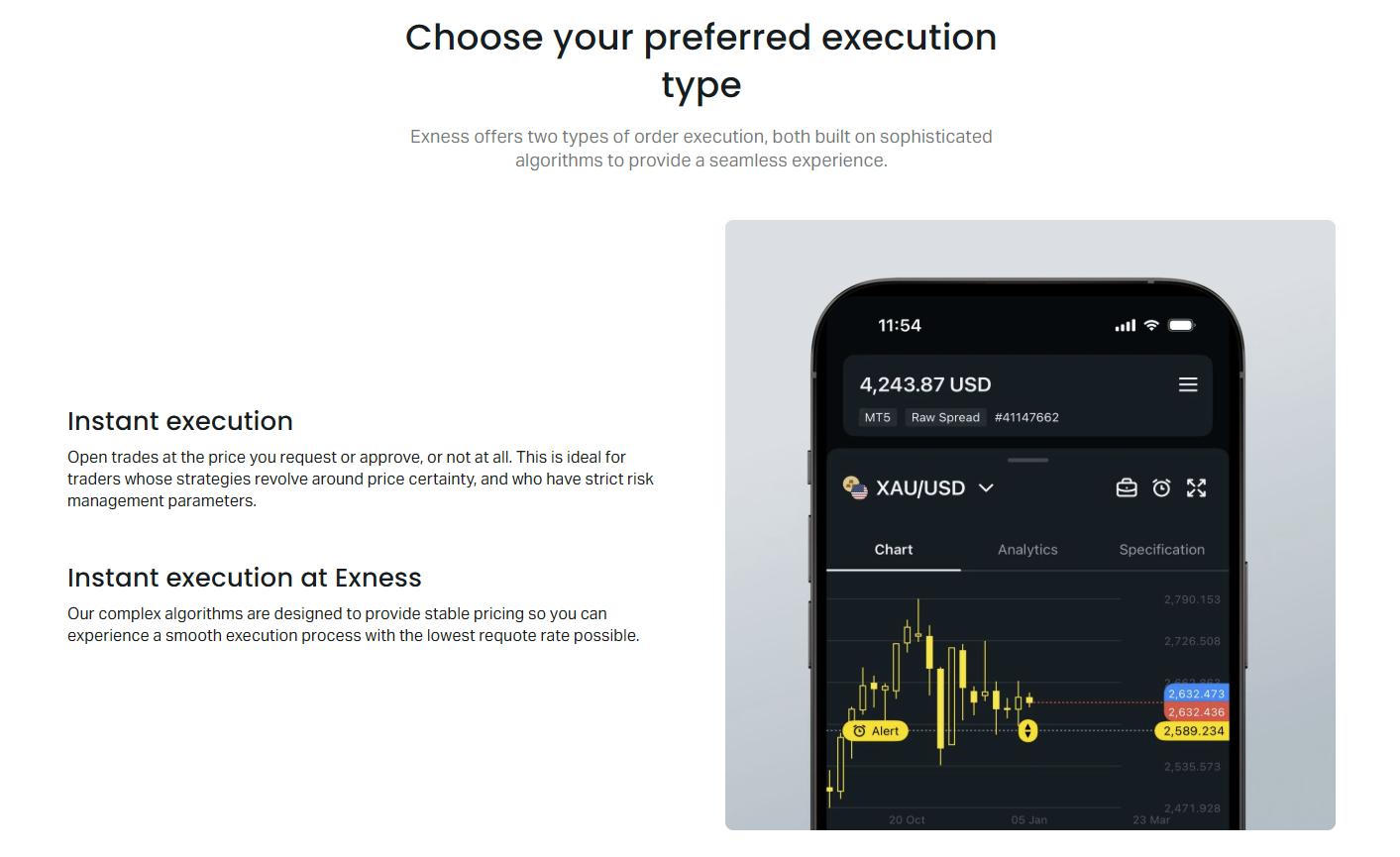
Most brokers offer either market execution or instant execution. Exness provides both, but the default and most common is market execution. The distinction matters because it determines whether you control the fill price or the broker does, whether slippage can occur, and whether requotes are possible. Understanding which mode your account uses — and why — is the first step to evaluating whether the execution environment matches your strategy.
Market Execution vs Instant Execution on Exness
Market execution means your order fills at the best available price in the market at the moment it reaches the liquidity pool. You do not set a maximum deviation. The trade executes at whatever price is available, which can be better or worse than the price you saw when you clicked. There are no requotes because the broker does not guarantee a specific price. This is the standard for ECN-style and raw spread accounts, and it is the default on Exness Professional accounts — Raw Spread, Zero, and Pro.
Instant execution works differently. The broker quotes a price, and you decide whether to accept it. If the market moves before the order reaches the dealer, the broker can requote — offering a new price — or reject the order. Exness offers instant execution on Standard and Standard Cent accounts. This setup gives the broker more control over fills, which can mean fewer negative slippage events during normal conditions, but it also opens the door to requotes when volatility spikes.
The practical difference shows up most during news events. On a Raw Spread account with market execution, your stop loss or market order will fill at the next available price — sometimes several pips away from your intended level. On a Standard account with instant execution, you might get a requote instead, forcing you to confirm a new price or miss the entry entirely. Neither is universally better. Scalpers and algorithmic traders usually prefer market execution for its transparency and speed. Discretionary traders who trade smaller sizes during quiet hours may find instant execution more predictable.
Execution Speed Claims and Measured Reality
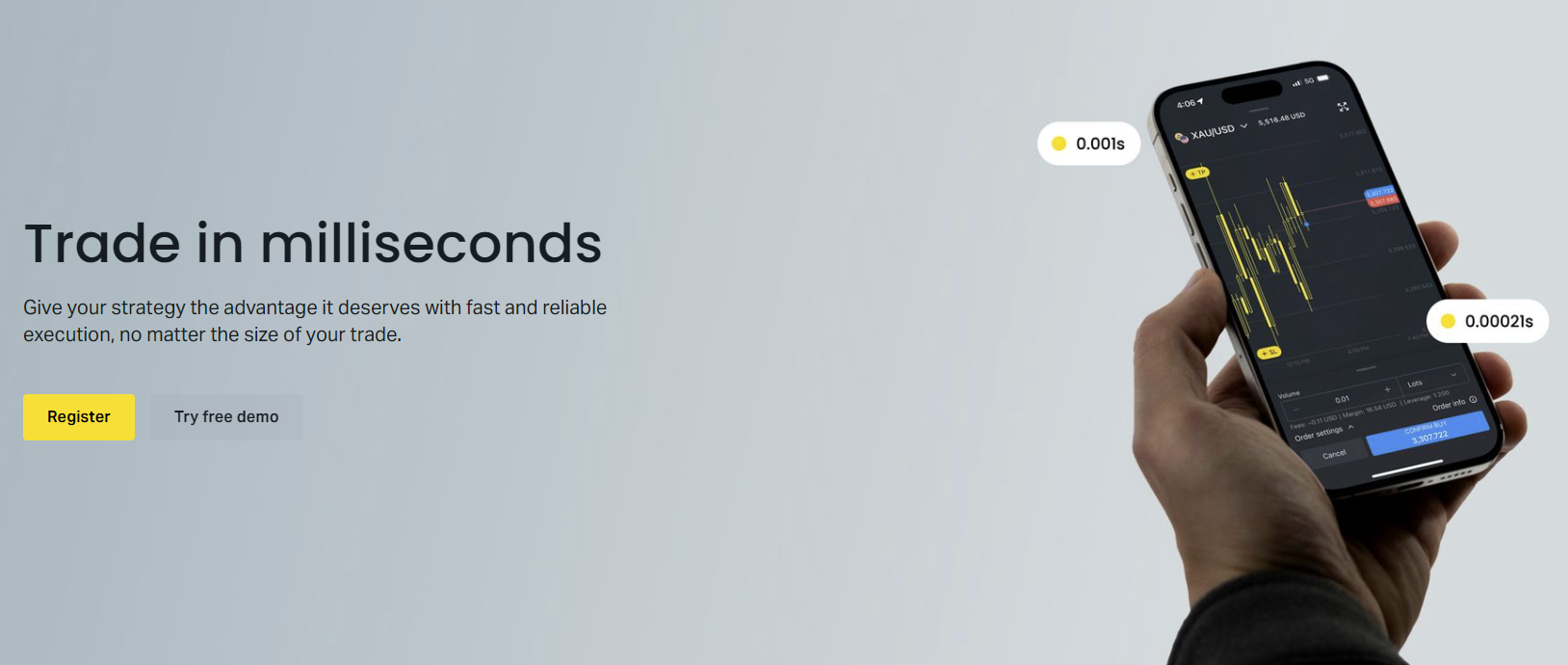
Exness advertises average execution speeds under 10 milliseconds, with many trades filling in under 5 ms. These figures come from internal measurements between the trade server and the liquidity venue. They do not include the round-trip from your device to the trade server — that depends on your internet connection, physical distance to the data center, and whether you use a VPS. For a trader in London on a fiber connection, the total latency might be 30–50 ms. From Southeast Asia on residential broadband, it could be 150–250 ms.
The broker publishes execution statistics quarterly, showing median execution time, slippage distribution, and fill rates. In recent reports, over 99% of orders executed without requotes on market execution accounts, and positive slippage occurred more often than negative slippage on major pairs. That positive skew is a byproduct of price improvement — when the market moves in your favor between order submission and fill. It is not guaranteed, but it is a real feature of market execution with deep liquidity.
Scroll horizontally to see all columns
| Component | Typical Range |
|---|---|
| Client to trade server | 20–250 ms |
| Trade server processing | 1–5 ms |
| Liquidity venue match | 1–10 ms |
| Total round-trip (VPS London) | 5–15 ms |
| Total round-trip (home Asia) | 150–300 ms |
Speed matters most for strategies that rely on tight stops, high frequency, or news straddles. For swing traders holding positions for hours or days, a 50 ms versus 10 ms difference rarely changes outcomes. The marketing emphasis on sub-millisecond server-side processing is real, but the client-side latency usually dominates. That is why Exness offers free VPS hosting for qualifying accounts — it removes the biggest variable.
Slippage, Requotes, and Price Improvement
Slippage is the difference between the expected price and the fill price. On market execution accounts, it is unavoidable during gaps or thin liquidity. Exness does not guarantee stop loss execution at the exact level — stops become market orders once triggered. During the CHF unpegging in 2015 or the COVID flash crash in 2020, slippage on major pairs reached dozens of pips across the industry. Exness was not immune, but its deep liquidity pool and multiple venue connections limited the damage compared to brokers with single liquidity providers.
Positive slippage — price improvement — happens when your buy order fills lower than requested or your sell fills higher. Exness reports that positive slippage occurs more frequently than negative on EURUSD and other majors during normal hours. This is not charity; it is a natural result of market execution with multiple liquidity sources competing for flow. The broker passes the best available price. If that price is better than your limit, you get the improvement.
Order Types and How They Execute
Exness supports the standard MetaTrader order types: market orders, pending limits and stops, stop loss, and take profit. Each behaves differently under market execution. A buy limit sits below current price and only fills at the limit price or better — no negative slippage possible. A buy stop sits above current price and becomes a market order once triggered, so it can slip. Sell limits and sell stops mirror this logic. Understanding which pending order type matches your intent prevents surprises.
- Buy Limit: fills at limit price or lower (better for buyer)
- Sell Limit: fills at limit price or higher (better for seller)
- Buy Stop: triggers at price, then fills as market order (can slip)
- Sell Stop: triggers at price, then fills as market order (can slip)
- Stop Loss: triggers at price, becomes market order (can slip)
- Take Profit: fills at limit price or better (no negative slippage)
One nuance: on instant execution accounts, pending orders work similarly but the initial trigger price is the broker's quote. If the market gaps through your level, the order may fill at the next available quote — which functions like slippage but originates from the dealer rather than the market. The distinction is technical; the result for your P&L is similar.
Platform Differences in Execution
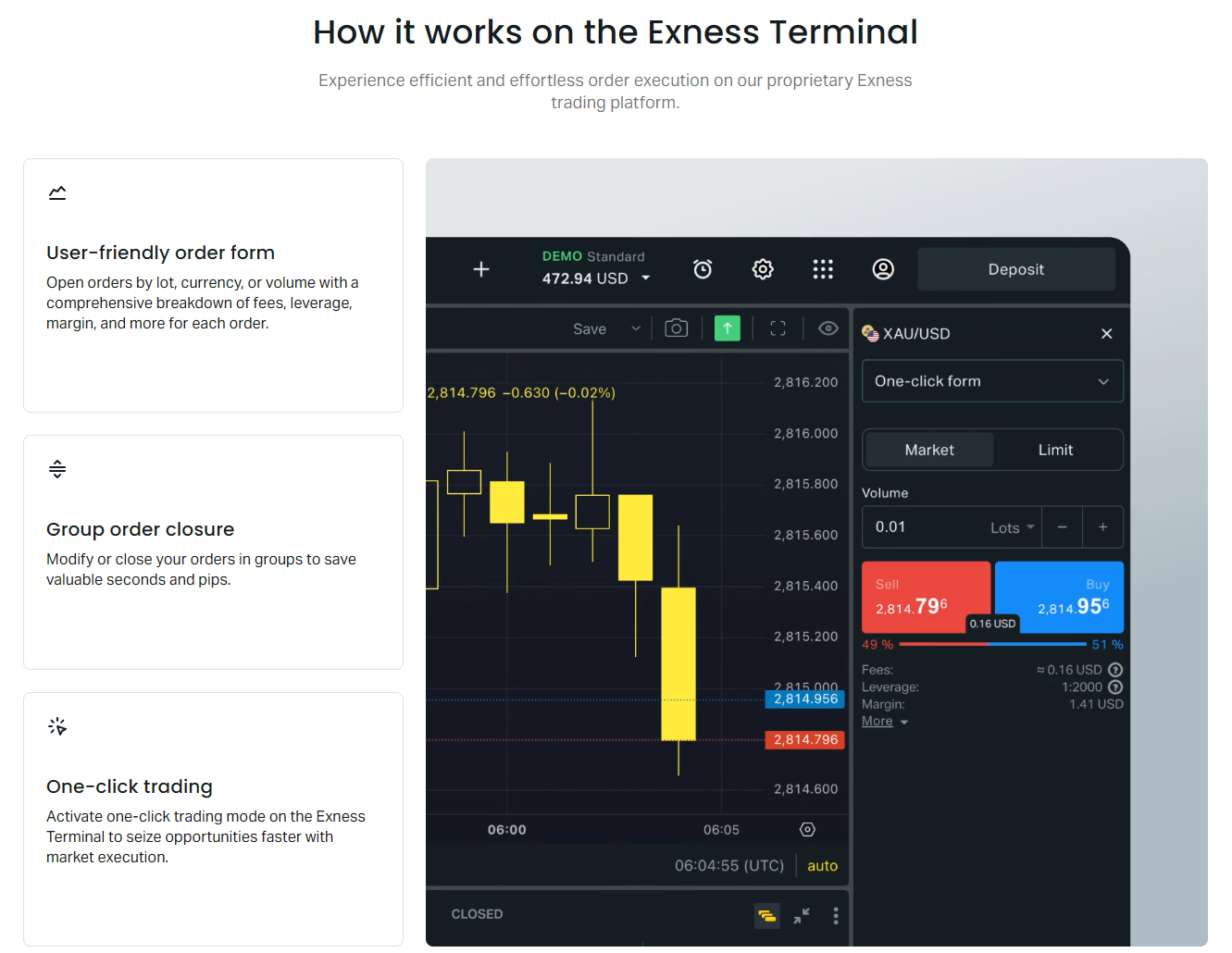
Exness offers MetaTrader 4, MetaTrader 5, the Exness Web Terminal, and mobile apps for iOS and Android. The execution engine is the same across all — orders route to the same trade servers and liquidity pool. However, the user experience differs. MT4 and MT5 desktop terminals allow one-click trading, custom expert advisors, and direct API access for algorithmic strategies. The Web Terminal runs in a browser with no installation, but it lacks EA support and has slightly higher latency due to the extra network hop through the web gateway.
Mobile apps use the same trade servers but connect over mobile networks, which adds latency and jitter. For manual trading, the difference is negligible. For EAs or high-frequency scalping, mobile is not suitable. The Web Terminal is convenient for checking positions or placing occasional trades from a borrowed computer, but serious algorithmic work requires the desktop terminal on a VPS.
VPS Hosting and Latency Reduction
Exness provides free VPS hosting to clients who meet volume or equity thresholds — typically $500 equity or 5 lots traded monthly. The VPS runs in the same Equinix data center as the trade servers, reducing client-to-server latency to 1–2 ms. For traders running EAs, this is essential. A home connection with 80 ms latency means your EA sees price data 80 ms old and its orders take another 80 ms to arrive. That 160 ms round-trip is an eternity for a scalper targeting 2–3 pip moves.
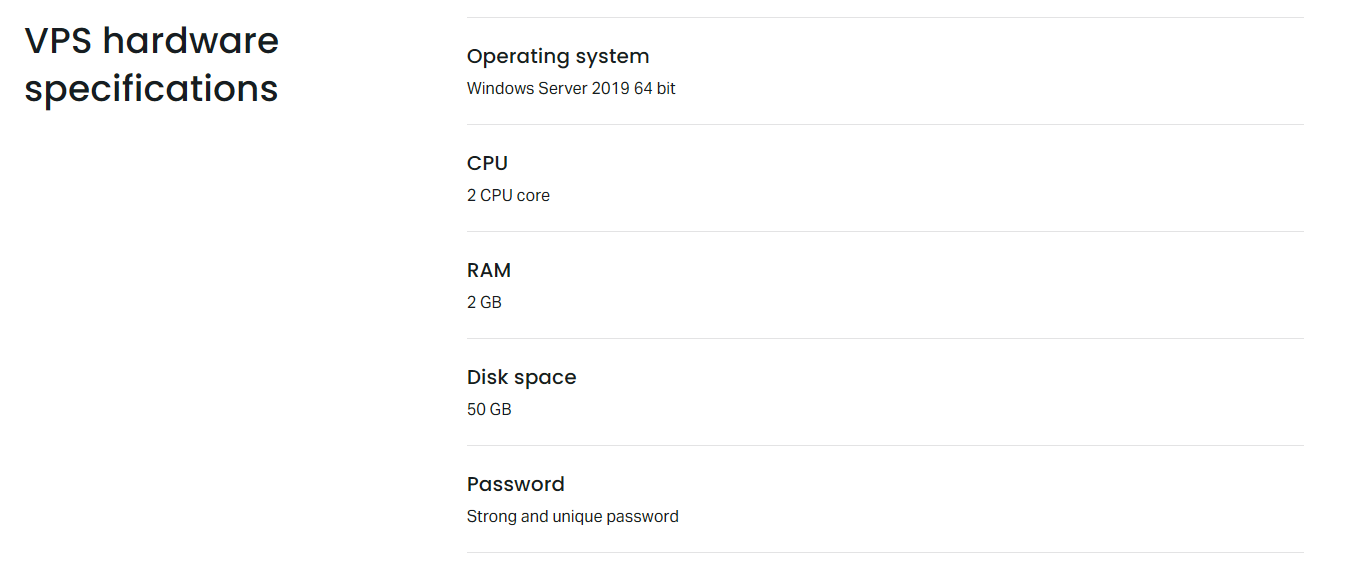
The VPS specifications are modest — 1 CPU core, 1–2 GB RAM, 30 GB SSD — but sufficient for a few MT4/MT5 instances. You cannot install custom software beyond the trading platforms. Access is via RDP. The free tier covers one VPS per qualifying account. Traders who do not meet the threshold can rent a VPS from third parties, but the latency advantage only holds if the VPS is in the same data center (LD4/LD5 in London).
Liquidity Sources and Order Routing
Exness aggregates liquidity from multiple tier-1 banks, non-bank market makers, and ECN venues. The exact counterparties are not public, but the broker states it uses a smart order router that selects the best price across venues for each order. This multi-venue approach reduces the risk of single-provider outages and improves fill quality during volatile periods when one venue might widen spreads or pause quoting.
Order routing is not visible to the client. You see the fill price and that is it. There is no market depth (Level 2) display on standard Exness accounts — the broker does not publish its order book. Some competitors offer DOM views; Exness does not. For most retail traders, this does not matter. For institutional-style flow analysis, it is a limitation.
Scroll horizontally to see all columns
| Pair Category | Typical Spread (Raw Spread) | Liquidity Depth | Slippage Risk |
|---|---|---|---|
| Majors (EURUSD, GBPUSD, USDJPY) | 0.0–0.2 pips | Very High | Low |
| Minors (EURGBP, AUDJPY) | 0.2–0.6 pips | High | Moderate |
| Exotics (USDMXN, USDTRY) | 5–30+ pips | Low | High |
| Metals (XAUUSD, XAGUSD) | 0.5–2.0 pips | High | Moderate |
| Crypto (BTCUSD, ETHUSD) | 0.1–0.5% | Variable | High |
Execution During News and High Volatility
News events — NFP, CPI, central bank decisions — test execution quality more than any marketing claim. Spreads widen, liquidity thins, and latency spikes. Exness handles this by keeping its liquidity venues active and not widening spreads artificially beyond what the underlying market dictates. However, the underlying market itself widens dramatically. A 0.1 pip EURUSD spread can become 3–5 pips in the seconds after NFP. Market orders fill at those widened spreads. Stops trigger at the next available price, which can be far from the stop level.
Traders who need to avoid news slippage have two practical options: avoid trading during the event window, or use limit orders (buy limit, sell limit) which cannot suffer negative slippage. The trade-off is that limit orders may not fill at all if the market gaps through your price. There is no free lunch. Exness does not offer guaranteed stops or fixed spreads during news, unlike some market-maker brokers who charge higher base spreads for that protection.
The best execution during news is often no execution at all. If your strategy cannot tolerate 10-pip slippage, do not have working orders during NFP.
Comparing Exness Execution to Industry Peers
Against major competitors — IC Markets, Pepperstone, FP Markets, Tickmill — Exness holds its ground on raw speed and slippage symmetry. Where it differs is the account structure. Most peers offer a single raw spread account with commission. Exness splits Raw Spread (commission-based) and Zero (commission-free with slightly wider spreads) and Pro (no commission, low spreads, higher minimum deposit). This gives traders more granularity but adds complexity. The execution engine is the same across all three.
On the instant execution side, Standard and Standard Cent accounts compete with brokers like XM, HotForex, and FBS. Exness Standard spreads start around 0.3 pips on EURUSD with no commission, which is competitive. The instant execution model means requotes can happen, but Exness reports requote rates under 1% in normal conditions. During extreme volatility, requotes rise — that is the nature of the model.
Practical Implications for Different Trading Styles
Scalpers targeting 1–3 pip profits need market execution, low spreads, and minimal latency. Raw Spread or Zero account on MT5 with VPS is the correct setup. The commission on Raw Spread ($3.50 per side per lot) is a known cost; the spread on Zero is slightly wider but commission-free. Do the math for your volume. Swing traders holding days to weeks care less about milliseconds and more about swap rates and rollover stability. Standard or Pro accounts work fine. The instant execution on Standard may actually reduce negative slippage on entry during quiet Asian session hours.
Algorithmic traders need the VPS. The free tier requires $500 equity or 5 lots monthly — achievable for serious EAs. The VPS latency of 1–2 ms to the trade server is the only way to run latency-sensitive strategies reliably. Without it, you are trading on stale data. News traders face a structural problem: no broker offers good execution during a true liquidity vacuum. The only reliable approach is to flatten exposure before the event and re-enter after the dust settles.
- Scalpers: Raw Spread/Zero + MT5 + VPS mandatory
- Day traders: Pro or Raw Spread, VPS recommended
- Swing traders: Standard or Pro, VPS optional
- Algo/EA: VPS required, Raw Spread preferred
- News traders: Avoid market orders during events
- Beginners: Standard Cent for low-risk learning
Execution Quality Metrics Published by Exness
Exness publishes quarterly execution quality reports covering median execution speed, slippage distribution (positive vs negative), requote rates, and fill rates. The reports are audited by a third party — typically Deloitte or similar — which adds credibility. In recent quarters, median execution time on market execution accounts ranged from 4–8 ms. Positive slippage occurred on 40–55% of trades on majors, negative on 15–25%, with the remainder filling at the requested price. Requote rates on instant execution accounts stayed below 0.5% outside major news.
These numbers are aggregates. Your personal experience will vary by pair, time of day, position size, and connection quality. A 10-lot EURUSD order during London open will fill differently than a 0.01 lot USDTRY order at 3 AM server time. The reports are useful for benchmarking the broker against peers, not for predicting your next trade's fill.
Scroll horizontally to see all columns
| Metric | Market Execution | Instant Execution |
|---|---|---|
| Median execution time | 4–8 ms | 12–25 ms |
| Positive slippage frequency | 40–55% | N/A |
| Negative slippage frequency | 15–25% | N/A |
| Requote rate (normal hours) | 0% | <0.5% |
| Fill rate | 99.9%+ | 99.5%+ |
Common Execution Misconceptions
Several myths persist about Exness execution. First, that 'no requotes' means no slippage. False. Market execution has no requotes by definition, but slippage is normal. Second, that instant execution protects you from slippage. False — it replaces slippage with requotes or rejections, which can be worse during fast moves. Third, that the free VPS makes you faster than the market. False — it makes you as fast as the broker's server allows. You still compete with HFT firms co-located in the same rack. Fourth, that Exness is an ECN broker. It uses an ECN-style model on Professional accounts but is technically a hybrid — it internalizes some flow and hedges the rest. The distinction matters for regulation and conflict-of-interest analysis, not for fill quality.
Regulatory Context and Client Protection
Exness operates under multiple licenses — CySEC in Europe, FCA in the UK, FSCA in South Africa, FSA in Seychelles, and others. Execution quality is a regulatory focus area. MiFID II in Europe requires best execution policies, transaction cost analysis, and quarterly reporting. Exness publishes its best execution policy and RTS 27/28 reports for EU entities. These reports show venue-level execution quality, giving professionals data to assess whether the broker routes orders to the best available venues. The existence of these reports is a positive signal; many offshore brokers provide nothing comparable.
Client funds are segregated at top-tier banks. Negative balance protection applies to all retail clients under CySEC and FCA rules. Professional clients (who opt in and meet criteria) lose negative balance protection but gain higher leverage. This classification does not change execution mode — it changes margin requirements and legal protections. Execution quality is the same for retail and professional clients on the same account type.
Regulatory reporting on execution quality is the only objective benchmark most traders will ever see. Read the RTS 27 reports if you want data, not marketing.
How to Test Execution Quality Yourself
You do not need to trust reports. Open a demo account — Exness offers unlimited demo with real market conditions — and run a simple test. Place 50 market orders on EURUSD during London open, record fill prices versus the bid/ask at click time, and calculate average slippage. Repeat on a live account with small size (0.01 lots). Compare. Do the same for stop loss triggers using pending buy stops above market. The demo will be close but not identical; live liquidity is deeper. This hands-on test tells you more than any article.
- Open demo and live micro accounts
- Test 50 market orders on EURUSD at London open
- Record bid/ask at click vs fill price
- Calculate average slippage in pips
- Test stop triggers with buy/sell stops
- Compare demo vs live — expect live to be slightly better
- Repeat during Asian session for contrast
Final Assessment of Exness Execution
Exness execution is genuinely strong where it matters: market execution accounts deliver sub-10 ms server-side speeds, symmetric slippage with a positive skew on majors, and no requotes. The free VPS for qualifying traders removes the biggest latency variable for algorithmic strategies. The multi-venue liquidity pool holds up during normal volatility, though no broker can defy physics during true liquidity crises. The instant execution Standard accounts behave as expected — fewer negative slips in quiet markets, requotes during chaos. The lack of DOM/Level 2 data and guaranteed stops are the main gaps for advanced users. For the vast majority of retail and semi-professional traders, Exness execution is a competitive advantage, not a concern. Choose the account type that matches your execution model preference, use a VPS if you run EAs, and test with real micro-lots before scaling.

Frequently Asked Questions
Does Exness guarantee stop loss execution at the exact price?
No. Stop losses become market orders once triggered and fill at the next available price. Slippage can occur, especially during news or low liquidity. Exness does not offer guaranteed stops on standard accounts.
Which Exness accounts use market execution?
Professional accounts — Raw Spread, Zero, and Pro — use market execution. Standard and Standard Cent accounts use instant execution.
Can I get positive slippage on Exness?
Yes. On market execution accounts, positive slippage (price improvement) occurs frequently on major pairs. Exness reports it happens on 40–55% of trades during normal conditions.
Is the free VPS really free?
Yes, if you maintain $500 equity or trade 5 lots per month. The VPS runs in the same data center as Exness trade servers, giving 1–2 ms latency. One VPS per qualifying account.
Does Exness widen spreads artificially during news?
Exness states it does not artificially widen spreads beyond what its liquidity providers quote. However, underlying market spreads widen dramatically during major news events, and those wider spreads are passed through.
Can I see market depth (Level 2) on Exness?
No. Exness does not provide DOM or Level 2 order book data on any account type. You see only the best bid and ask.
Is Exness an ECN broker?
Exness uses an ECN-style model on Professional accounts with commission-based raw spreads, but it is technically a hybrid — it internalizes some flow and hedges the rest. The execution quality is comparable to pure ECN venues.
How do I check my actual execution quality?
Open a demo and a live micro account. Place 50+ market orders on EURUSD during active hours, record the bid/ask at click time versus fill price, and calculate average slippage. Compare demo vs live results.