

Cryptocurrency Trading
Exness Ethereum Trading ETHUSD: Complete Guide
Everything you need to know about trading ETHUSD on Exness, from platforms to risk management.

Senior Forex Trader & Market Analyst
Daniel Chen is an experienced forex trader and financial market analyst with over 15 years of experience in currency trading. He specializes in technical analysis, risk management, and developing practical trading strategies to help traders make informed decisions.
Ethereum has become one of the most actively traded cryptocurrencies worldwide, and Exness offers ETHUSD as a contract for difference (CFD) across its full range of platforms. This means you can speculate on Ethereum price movements against the US dollar without owning the underlying asset. The broker provides access through MetaTrader 4, MetaTrader 5, its proprietary Web Terminal, and mobile apps, each with slightly different toolsets but the same core pricing engine.
Contents
- 1. What Is ETHUSD Trading on Exness
- 2. Exness Platforms for Ethereum Trading
- 2.1. MetaTrader 5 for ETHUSD
- 2.2. MetaTrader 4 for Ethereum
- 2.3. Exness Web Terminal
- 2.4. Mobile Trading App
- 3. Account Types for Crypto Trading
- 4. Trading Conditions for ETHUSD
- 5. Trading Hours and Market Access
- 6. Risk Management Tools
- 7. Deposits and Withdrawals for Crypto Traders
- 8. Analysis and Research Tools
- 9. Demo Account for Practice
- 10. Comparing Exness ETHUSD Trading to Alternatives
- 11. Final Assessment of Exness Ethereum Trading
Trading ETHUSD on Exness differs from spot crypto exchanges in several ways. You trade with leverage, which amplifies both gains and losses. You can go long or short with equal ease. Spreads and commissions apply instead of exchange fees, and positions can be held overnight with swap charges or credits depending on the direction. The broker also offers negative balance protection, which caps losses at your account equity — a feature not always available on unregulated crypto venues.
This guide covers the practical details: which platforms work best for Ethereum, how spreads and commissions compare across account types, what leverage limits apply, when the market is open, and how to manage risk. It also looks at deposit and withdrawal options, analysis tools, and how Exness stacks up against other brokers offering ETHUSD CFDs.
What Is ETHUSD Trading on Exness
ETHUSD on Exness is a CFD pair that tracks the price of Ethereum quoted in US dollars. When you open a position, you are not buying or selling actual ETH tokens. Instead, you enter a contract that settles the price difference between entry and exit. This structure allows leverage up to 1:20 for retail clients under most regulatory frameworks, and higher for professional clients who qualify. The minimum trade size is 0.01 lots, which represents a fraction of a single Ethereum unit depending on the current price.
Pricing comes from Exness's liquidity providers and is aggregated into a single feed. The broker does not act as a market maker for crypto CFDs; it passes orders to external liquidity venues. This means spreads can widen during periods of low liquidity — weekends, major news events, or exchange outages — but they generally remain competitive during normal hours. The symbol appears as ETHUSD in the Market Watch window on MT4 and MT5, and in the instrument list on the Web Terminal and mobile app.
Exness Platforms for Ethereum Trading
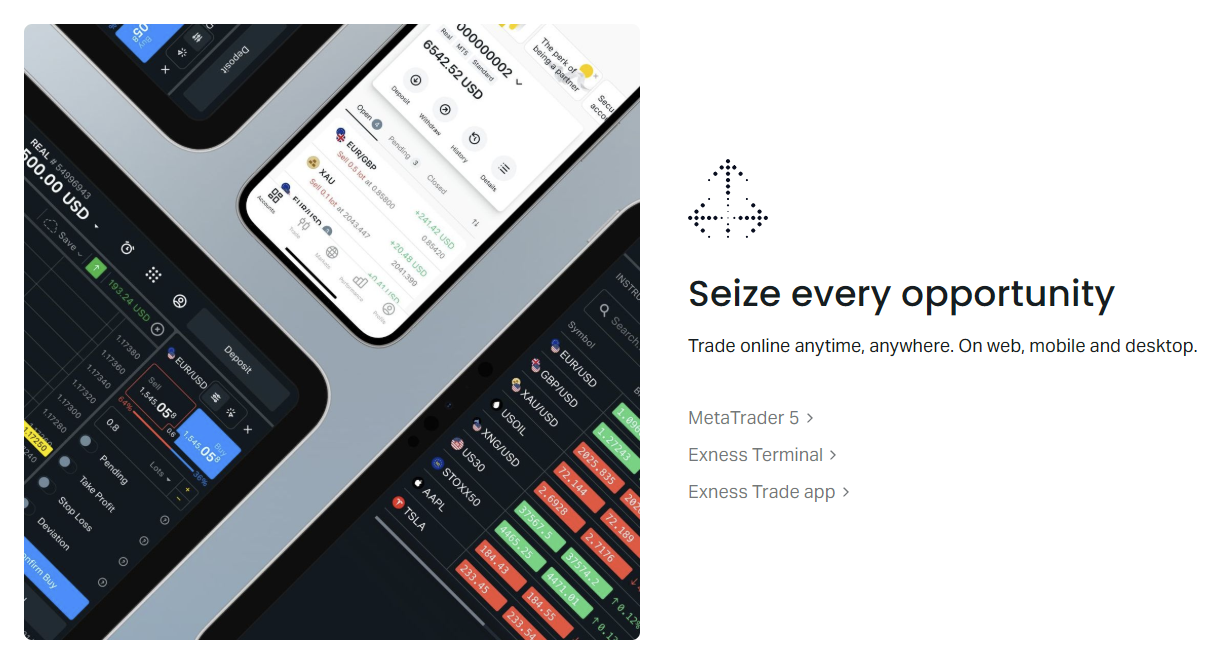
Exness supports ETHUSD on four main platforms. Each has the same pricing and account backend, but the trading experience differs. MetaTrader 5 is the most feature-complete for crypto CFDs, offering more timeframes, order types, and built-in indicators. MetaTrader 4 remains popular for its simplicity and vast library of custom indicators and expert advisors. The Web Terminal runs in a browser with no installation, and the mobile app covers both iOS and Android with full charting and order management.
Switching between platforms is seamless. Your login credentials work across all of them, and positions opened on one platform are visible and manageable on the others. This flexibility matters for Ethereum traders who may want to analyze charts on a desktop MT5 setup but manage positions from a phone while away from the desk.
MetaTrader 5 for ETHUSD
MT5 is the recommended platform for serious Ethereum CFD trading. It provides 21 timeframes versus MT4's nine, which helps when analyzing crypto's often volatile intraday moves. The Depth of Market (DOM) feature shows liquidity levels, useful for spotting support and resistance zones on ETHUSD. MT5 also supports netting and hedging modes, though Exness defaults to hedging for all account types. The built-in economic calendar includes crypto-relevant events like network upgrades, ETF decisions, and major token unlocks.
Custom indicators and Expert Advisors written in MQL5 can automate ETHUSD strategies. The Strategy Tester allows backtesting against historical tick data, which Exness provides for several years. One limitation: MT5 on macOS requires a wrapper like CrossOver or a virtual machine, though the Web Terminal and mobile app work natively on any OS.
MetaTrader 4 for Ethereum
MT4 remains widely used despite its age. The interface is lighter, and many traders have existing templates, profiles, and EAs built for it. ETHUSD functions identically on MT4 — same spreads, same leverage, same execution. The main gaps are fewer timeframes, no DOM, and a less capable backtester. If your workflow depends on specific MT4-only tools, there is no disadvantage to staying on MT4 for Ethereum. Exness continues to support and update the MT4 build.
Exness Web Terminal
The Web Terminal is Exness's proprietary browser-based platform. It loads quickly, requires no download, and works on any modern browser including Chrome, Firefox, Safari, and Edge. Charting is powered by TradingView, giving access to a large indicator library and drawing tools. You can trade directly from charts, set alerts, and use one-click trading panels. The layout is customizable with detachable charts and multiple workspace tabs.
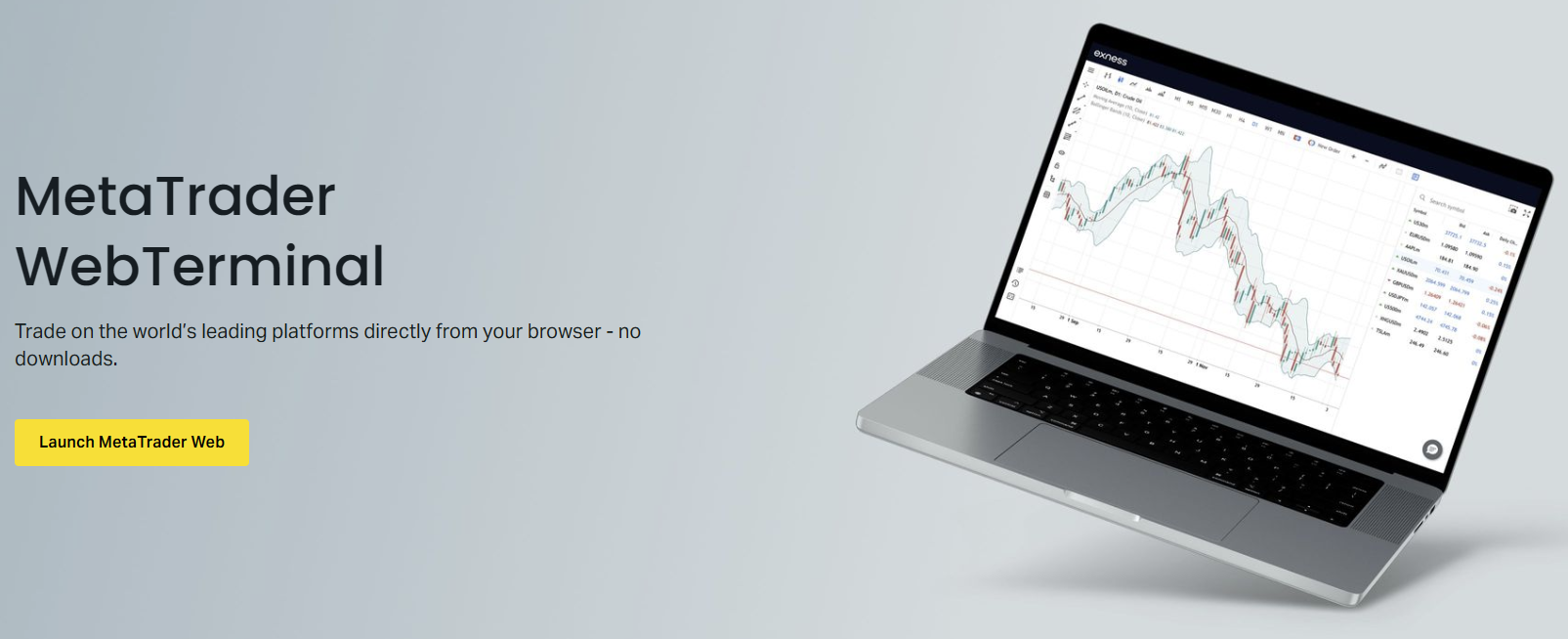
For Ethereum traders, the Web Terminal's TradingView integration means access to crypto-specific indicators like Bitcoin dominance, Ethereum gas fees, and on-chain metrics — if you subscribe to TradingView's premium data. The free version still covers standard technical analysis needs. Session persistence keeps your layout and drawings intact across logins.
Mobile Trading App
The Exness mobile app (iOS and Android) provides full charting, order entry, and account management. ETHUSD charts support multiple timeframes, indicators, and drawing tools. Push notifications alert you to price levels, margin calls, and news events. The app also includes the economic calendar, deposit and withdrawal functions, and access to the Exness social trading features. Biometric login and dark mode are supported.
One practical note: the mobile app's charting is capable but screen space limits complex multi-timeframe analysis. Many traders use the app for monitoring and quick execution while relying on desktop platforms for deep analysis. The app syncs watchlists and alert settings with the Web Terminal and desktop platforms.
Account Types for Crypto Trading
Exness offers several account types, and all of them support ETHUSD trading. The main differences lie in spreads, commissions, minimum deposits, and leverage caps. Standard and Standard Cent accounts are commission-free with wider spreads. Raw Spread, Zero, and Pro accounts charge commissions but offer tighter raw spreads. For Ethereum, where spreads are naturally wider than major forex pairs, the commission-based accounts often work out cheaper for active traders.
Scroll horizontally to see all columns
| Account | Min Deposit | ETHUSD Spread | Commission | Max Leverage |
|---|---|---|---|---|
| Standard | $1 | From 1.5 pips | None | 1:2000 |
| Standard Cent | $1 | From 1.5 pips | None | 1:2000 |
| Raw Spread | $10 | From 0.0 pips | $3.5 per side/lot | 1:2000 |
| Zero | $200 | From 0.0 pips | $0.2 per side/lot | 1:2000 |
| Pro | $200 | From 0.1 pips | None | 1:2000 |
The spread values above are indicative minimums; actual spreads fluctuate with market conditions. Crypto spreads are typically wider than forex majors. The commission on Raw Spread and Zero accounts is charged per lot per side — so a round trip costs double the per-side rate. Pro accounts have no commission but slightly wider spreads than Raw Spread. For a trader doing several ETHUSD lots per day, Raw Spread or Zero usually costs less overall.
Trading Conditions for ETHUSD
Beyond spreads and commissions, several conditions affect Ethereum CFD trading on Exness. Leverage for retail clients is capped at 1:20 for crypto CFDs under ESMA and similar regulations, though the platform may display higher maximums for other instruments. Professional clients who meet eligibility criteria can access up to 1:200 on crypto. Margin requirements scale with leverage — at 1:20, you need 5% of the notional value as margin. The stop-out level is 0% for most entities, meaning positions close automatically when equity hits zero, but negative balance protection prevents owing more than your deposit.
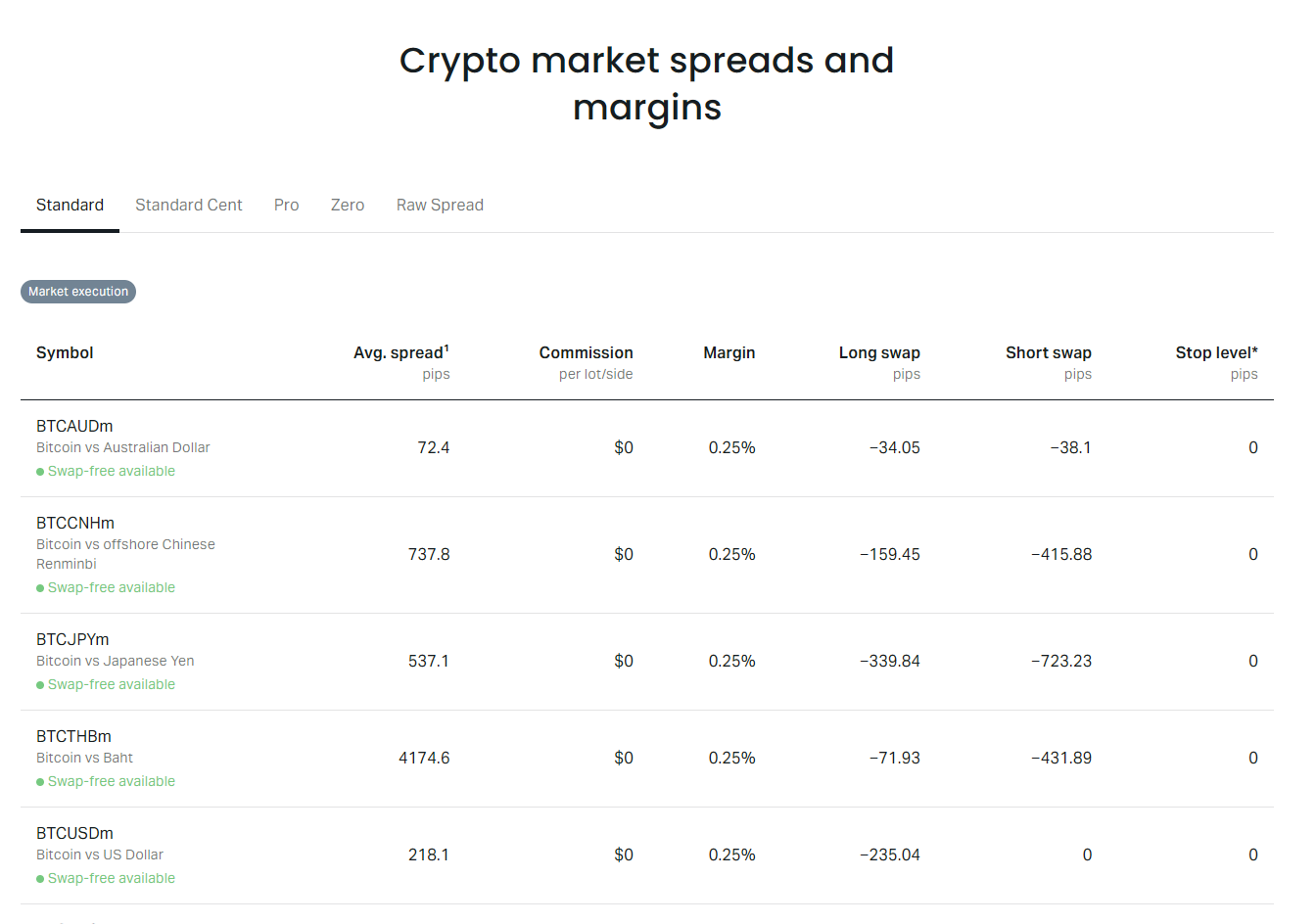
Swap rates (overnight financing) apply to positions held past 22:00 UTC. For ETHUSD, long positions typically pay a negative swap (cost) and short positions may receive a positive swap (credit), though this flips depending on interest rate differentials and funding markets. Swap-free accounts are available for clients who cannot earn or pay interest for religious reasons — these accounts replace swaps with a fixed daily administration fee after a grace period. The exact swap values are visible in the contract specifications on each platform.
Scroll horizontally to see all columns
| Parameter | Value |
|---|---|
| Symbol | ETHUSD |
| Contract Size | 1 ETH per lot |
| Min Volume | 0.01 lots |
| Max Volume | 100 lots |
| Volume Step | 0.01 lots |
| Margin Currency | USD |
| Trading Hours | 24/7 with brief maintenance |
| Execution Type | Market |
Execution is market execution only — no requotes, but slippage can occur during high volatility. Exness publishes execution statistics quarterly, showing average execution speed and slippage distribution. For ETHUSD, most orders fill within milliseconds under normal conditions. During major news (FOMC, ETH network upgrades, ETF approvals), spreads widen and slippage increases. The platform does not offer guaranteed stop-loss orders for crypto CFDs.
Crypto CFD spreads are never fixed. They reflect real-time liquidity from multiple venues. Anyone promising fixed spreads on Ethereum is likely acting as a market maker with a conflict of interest.
Trading Hours and Market Access
ETHUSD trades 24 hours a day, 7 days a week on Exness, with a brief daily maintenance window typically around 23:55–00:05 server time (GMT+2 or GMT+3 depending on DST). This matches the underlying crypto spot markets, which never close. However, liquidity varies significantly by session. The overlap of European and US daytime hours (roughly 13:00–21:00 UTC) sees the tightest spreads and deepest order books. Asian hours are thinner, and weekends often have wider spreads due to reduced institutional participation.
Exness does not halt trading during major crypto exchange outages, but pricing may become less reliable if liquidity providers pull quotes. The broker's risk systems may widen spreads or increase margin requirements temporarily. Traders holding positions over weekends should account for potential gap risk — Ethereum can move significantly while traditional markets are closed, and stops may execute at worse prices than expected.
Risk Management Tools
Exness provides standard risk tools: stop-loss, take-profit, trailing stop (on MT4/MT5), and margin call/stop-out alerts. The broker also offers a margin calculator and pip calculator in the Personal Area and on the website. For ETHUSD, where daily moves of 5–10% are common, position sizing is critical. The margin calculator lets you input account currency, leverage, volume, and symbol to see required margin and pip value before entering a trade.
Negative balance protection is automatic and cannot be opted out of. If a sudden move blows through your stop-loss and equity goes negative, Exness absorbs the loss and resets the account to zero. This is a regulatory requirement for retail clients in most jurisdictions. Professional clients may waive this protection in exchange for higher leverage, but doing so means they can lose more than their deposit.
The Exness mobile app and Web Terminal push margin call notifications when equity drops below 100% of required margin, and stop-out warnings at 50%. These alerts help prevent accidental liquidation, but they are not a substitute for monitoring your own positions. During extreme volatility, the gap between margin call and stop-out can be seconds.
Deposits and Withdrawals for Crypto Traders
Funding an Exness account for ETHUSD trading works through the same methods as other instruments: bank cards, bank wire, electronic wallets (Skrill, Neteller, WebMoney, Perfect Money), and regional payment systems. Minimum deposit is $1 for Standard and Standard Cent accounts, $10 for Raw Spread, and $200 for Zero and Pro. Most methods are instant and fee-free on the Exness side, though payment providers may charge their own fees. Withdrawals process back to the original deposit method where possible, with priority given to card refunds up to the deposited amount.
Exness also supports cryptocurrency deposits and withdrawals via USDT (TRC20 and ERC20), USDC, BTC, and ETH. This is convenient for traders who already hold crypto and want to fund a CFD account without converting to fiat first. Crypto deposits require blockchain confirmations (typically 1–3 for USDT TRC20, more for ERC20 and BTC). Withdrawals to crypto wallets are processed automatically 24/7, usually within minutes after internal approval. There are no Exness fees for crypto transactions, only network fees.
Analysis and Research Tools
Exness provides several research resources relevant to Ethereum traders. The economic calendar covers macro events (CPI, NFP, rate decisions) and crypto-specific events (network upgrades, token unlocks, ETF filings). Trading Central signals are integrated into MT4, MT5, and the Web Terminal, offering technical analysis patterns and key levels for ETHUSD. The Exness blog and market news feed (powered by FXStreet) publish daily commentary on crypto markets.
The Web Terminal's TradingView charts include a wide range of built-in indicators and the ability to add community scripts. For on-chain analysis, you would need a separate tool like Glassnode, CryptoQuant, or Nansen — Exness does not integrate on-chain metrics natively. The broker's calculator suite includes margin, pip, profit, and swap calculators, all accessible without logging in.
Technical analysis on ETHUSD works, but crypto respects macro liquidity flows more than most assets. Watch global risk sentiment, dollar strength, and BTC correlation — they often override pure chart patterns.
Demo Account for Practice
Exness offers unlimited demo accounts with virtual funds up to $100,000 (configurable). Demo conditions mirror live pricing, spreads, and execution for ETHUSD. This is the best way to test platforms, strategies, and risk management without financial risk. Demo accounts do not expire if used at least once every 30 days. You can open multiple demos under the same email to test different account types or leverage settings side by side.
One limitation: demo execution does not perfectly replicate live slippage and requote behavior during extreme volatility. The liquidity pool for demo is separate. Treat demo results as indicative, not guaranteed. When transitioning to live, start with a Standard Cent account to experience real psychology with minimal capital at risk.
Comparing Exness ETHUSD Trading to Alternatives
Compared to spot exchanges like Binance, Coinbase, or Kraken, Exness ETHUSD CFDs offer leverage, short selling without borrowing, negative balance protection, and unified account management across forex, metals, indices, and stocks. The trade-offs: you don't own the asset, can't withdraw ETH to a wallet, pay overnight swaps, and face wider spreads during low liquidity. Compared to other CFD brokers (IC Markets, Pepperstone, FP Markets), Exness stands out for instant withdrawals (including crypto), no minimum deposit on Standard accounts, and a proprietary Web Terminal with TradingView charts.
Scroll horizontally to see all columns
| Feature | Exness ETHUSD CFD | Spot Exchange | Typical CFD Broker |
|---|---|---|---|
| Leverage | Up to 1:20 retail | 1:1 (spot), up to 1:100 futures | Up to 1:20 retail |
| Short Selling | Native, no borrow | Requires margin/futures account | Native |
| Asset Ownership | No | Yes | No |
| Withdrawal Speed | Instant (most methods) | Blockchain confirmations | Hours to days |
| Negative Balance Protection | Yes (retail) | No | Varies |
| Trading Hours | 24/7 | 24/7 | Often 24/5 or limited crypto hours |
For traders who want pure price exposure with leverage and fast fiat on/off ramps, Exness is a strong choice. For those who want to hold ETH long-term, stake it, or use it in DeFi, a spot exchange or self-custody wallet is necessary. Some traders use both: spot for accumulation, CFDs for tactical leveraged trades.
Final Assessment of Exness Ethereum Trading
Exness delivers a competent ETHUSD CFD offering across all its platforms. The pricing is competitive, execution is fast, and the combination of instant withdrawals, negative balance protection, and crypto funding options addresses the main pain points of CFD trading. The Web Terminal with TradingView charts is a genuine advantage for technical analysts who want browser-based access. Raw Spread and Zero accounts make high-frequency Ethereum trading cost-effective. The main drawbacks are the lack of guaranteed stops, swap costs for overnight positions, and the inherent conflict of interest in any CFD arrangement — the broker profits when clients lose, even with hedged execution.
For most retail traders, the Standard or Raw Spread account on MT5 or Web Terminal provides the best balance of cost and features. Professional clients who qualify for higher leverage should weigh the loss of negative balance protection carefully. As with any leveraged product, the risk of losing your entire deposit is real and frequent. Use the demo extensively, start small, and treat ETHUSD CFDs as a tactical tool, not a long-term investment vehicle.
Frequently Asked Questions
What is the minimum deposit to trade ETHUSD on Exness?
$1 for Standard and Standard Cent accounts, $10 for Raw Spread, $200 for Zero and Pro accounts.
Can I trade ETHUSD on Exness 24/7?
Yes, ETHUSD trades 24/7 with a brief daily maintenance window around 23:55–00:05 server time.
What leverage is available for ETHUSD on Exness?
Retail clients: up to 1:20. Professional clients: up to 1:200, subject to eligibility verification.
Does Exness charge commission on ETHUSD trades?
Standard and Pro accounts have no commission (wider spreads). Raw Spread charges $3.5 per side per lot. Zero charges $0.2 per side per lot.
Can I deposit and withdraw using Ethereum or USDT on Exness?
Yes, Exness supports USDT (TRC20/ERC20), USDC, BTC, and ETH for deposits and withdrawals. Network fees apply.
Is there a demo account for practicing ETHUSD trading?
Yes, unlimited demo accounts with up to $100,000 virtual funds. Conditions mirror live pricing and spreads.
What platforms support ETHUSD on Exness?
MetaTrader 4, MetaTrader 5, Exness Web Terminal (browser), and Exness mobile app (iOS/Android).
Does Exness offer negative balance protection for ETHUSD?
Yes, for retail clients. Professional clients may waive this protection for higher leverage.