

Forex Trading Costs
Exness Spread Explained: Costs, Account Types, and Gold Pricing
Understand trading costs, commission structures, and how spreads vary by instrument and account type at Exness.

Senior Forex Trader & Market Analyst
Daniel Chen is an experienced forex trader and financial market analyst with over 15 years of experience in currency trading. He specializes in technical analysis, risk management, and developing practical trading strategies to help traders make informed decisions.
Spreads represent the primary cost for most forex and CFD traders. At Exness, the spread you pay depends heavily on which account type you choose, what instrument you trade, and market conditions at the moment you execute. This guide breaks down how Exness structures its spreads across different account offerings, what you can expect on major pairs like EURUSD and commodities like gold, and how commissions factor into the total cost picture.
Contents
- 1. How Exness Spreads Work Across Account Types
- 1.1. Standard and Standard Cent Accounts
- 1.2. Professional Accounts: Raw Spread, Zero, and Pro
- 2. Exness Spread on Gold and Major Forex Pairs
- 2.1. XAUUSD Spread Details
- 2.2. Major Currency Pair Spreads
- 3. Commission Structure and Raw Spread Pricing
- 4. Spread Stability During High Volatility
- 5. Comparing Exness Spreads to Industry Averages
- 6. How to Check Live Spreads on Exness Platforms
- 7. Spread Costs for Different Trading Styles
- 7.1. Scalping and Day Trading Considerations
- 7.2. Swing Trading and Position Trading
- 8. Final Assessment of Exness Spread Pricing
Many traders focus only on the advertised minimum spread, but the reality is more nuanced. Average spreads during normal market hours, spread widening during news events, and the commission charged on raw spread accounts all affect your bottom line. Understanding these components helps you pick the right account type for your strategy and avoid surprises when costs spike.
Exness offers several account categories, each with a distinct spread and commission model. Standard accounts build the cost into the spread with no separate commission. Professional accounts — Raw Spread, Zero, and Pro — charge a commission per lot but offer tighter spreads. The difference can be significant for high-volume traders or those running automated strategies where every fraction of a pip matters.
How Exness Spreads Work Across Account Types
The broker structures its pricing around two main philosophies: spread-only pricing for standard accounts and spread-plus-commission for professional accounts. This distinction shapes everything from your minimum deposit to the way costs scale with volume.
Standard and Standard Cent Accounts
Standard accounts use a spread-only model. The broker earns its revenue by marking up the raw market spread. On major pairs like EURUSD, the typical spread starts around 0.3 pips during liquid hours, though it can widen to 1 pip or more during low liquidity or high volatility. There is no separate commission charge, which simplifies cost calculation — what you see on the platform is what you pay.
Standard Cent accounts function identically but denominate balances in cents rather than dollars. This lets traders test live conditions with very small position sizes. The spread markup is the same as the regular Standard account, so cost proportions remain consistent regardless of account currency.
- No commission charges on any instrument
- Spreads start from 0.3 pips on EURUSD
- Minimum deposit of $1 for Standard, $1 for Standard Cent
- Suitable for beginners and low-volume traders
- Spread markup includes all broker compensation
Professional Accounts: Raw Spread, Zero, and Pro
Professional accounts separate the spread from the commission. Raw Spread accounts offer spreads from 0.0 pips on major pairs with a commission of $3.5 per side per lot ($7 round trip). Zero accounts fix the commission at $3.5 per side but guarantee 0.0 pip spreads on the top 30 instruments during trading hours. Pro accounts charge no commission but offer slightly wider spreads than Raw Spread, starting around 0.1 pips on EURUSD.
The commission structure means high-volume traders often save money on professional accounts despite the per-lot fee. A trader executing 50 lots per month on EURUSD would pay roughly $350 in commissions on a Raw Spread account but benefit from spreads that can be 0.2–0.3 pips tighter than the Standard account. That spread difference on 50 lots equals $100–$150 in savings, making the professional account cheaper overall.
Scroll horizontally to see all columns
| Account Type | EURUSD Spread | Commission (per lot/side) | Min Deposit |
|---|---|---|---|
| Standard | From 0.3 pips | None | $1 |
| Standard Cent | From 0.3 pips | None | $1 |
| Raw Spread | From 0.0 pips | $3.5 | $200 |
| Zero | 0.0 pips (top 30) | $3.5 | $200 |
| Pro | From 0.1 pips | None | $200 |
The choice between these accounts often comes down to trading frequency and style. Scalpers and algorithmic traders typically prefer Raw Spread or Zero for the tightest possible entry and exit prices. Swing traders holding positions for days may find the Standard account simpler, since overnight swap costs often dwarf the spread difference.
Exness Spread on Gold and Major Forex Pairs
Gold (XAUUSD) deserves special attention because it behaves differently from currency pairs. The spread on gold is quoted in dollars per ounce rather than pips, and it tends to be wider in absolute terms due to gold's higher volatility and different liquidity profile.
XAUUSD Spread Details
On Standard accounts, the gold spread typically starts around $0.35 per ounce (35 cents) during peak London and New York overlap hours. On Raw Spread and Zero accounts, the spread can drop to $0.05–$0.10 plus the $3.5 commission per side. For a standard lot (100 ounces), a $0.30 spread difference equals $30 per round trip — significant for gold traders who move size.
Gold spreads widen notably during the Asian session and around major economic releases like US CPI, FOMC decisions, or non-farm payrolls. It's not uncommon to see spreads double or triple during these windows. Traders holding gold positions overnight should also account for swap costs, which can be substantial on long positions due to the interest rate differential.
Major Currency Pair Spreads
EURUSD remains the tightest major pair, often showing 0.0–0.1 pips on Raw Spread accounts during peak liquidity. GBPUSD and USDJPY typically run 0.1–0.2 pips wider. Cross pairs like EURGBP or EURJPY carry wider spreads, often 0.3–0.5 pips on professional accounts and 0.8–1.5 pips on Standard accounts.
Scroll horizontally to see all columns
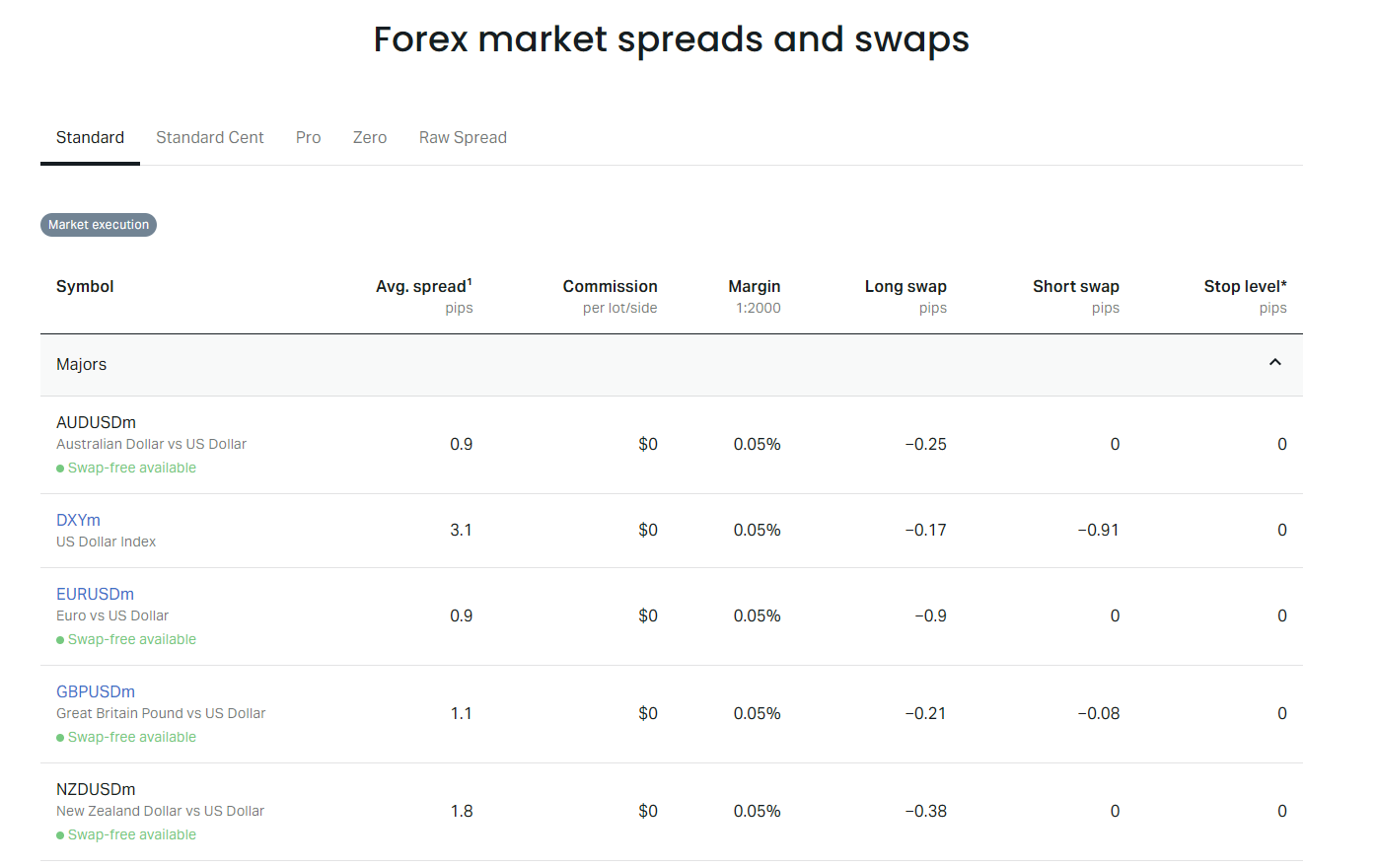
| Instrument | Peak Hours | Off-Peak | News Events |
|---|---|---|---|
| EURUSD | 0.0–0.1 pips | 0.2–0.4 pips | 1.0–3.0 pips |
| GBPUSD | 0.1–0.2 pips | 0.3–0.5 pips | 1.5–4.0 pips |
| USDJPY | 0.1–0.2 pips | 0.3–0.5 pips | 1.0–3.0 pips |
| XAUUSD | $0.05–$0.15 | $0.20–$0.40 | $0.50–$1.50 |
| EURGBP | 0.2–0.4 pips | 0.5–0.8 pips | 1.5–4.0 pips |
These ranges reflect typical conditions but can vary. Exness uses market execution, meaning spreads float with liquidity provider quotes. During the daily rollover at 5 PM New York time, spreads on all instruments widen temporarily as liquidity providers adjust positions. Most platforms display live spreads in the Market Watch window, so you can monitor real-time conditions before entering.
The spread you see at 2 PM London time is not the spread you'll get at 3 AM Tokyo time. Plan your entries around liquidity windows if costs matter to your strategy.
Commission Structure and Raw Spread Pricing
The commission on Raw Spread and Zero accounts is charged per side, per lot. A round trip (open and close) on one standard lot costs $7 in commission. This applies to forex, metals, energies, indices, and crypto on these account types. Stock CFDs have a different commission structure — typically 0.01% to 0.1% of notional value depending on the exchange.
Commission is deducted at trade opening on MT4 and MT5. On the Exness Web Terminal and mobile app, you'll see it reflected in the trade details. The commission does not change based on leverage or position duration. It's a fixed cost per lot, which makes it easy to model: 10 lots = $70 round trip, 100 lots = $700.
- Forex, metals, energies, indices, crypto: $3.5 per side per lot
- Stock CFDs: percentage-based, varies by exchange
- Charged at position opening
- No volume discounts or rebates on standard pricing
- Premier program offers reduced commissions for high-volume clients
Spread Stability During High Volatility
Spread widening during news events is normal across all brokers, but the degree varies. Exness uses a deep liquidity pool with multiple Tier-1 banks and non-bank market makers. This generally keeps spreads tighter than brokers with fewer liquidity sources, but extreme events — Swiss franc unpegging, COVID crash, Brexit referendum — still cause massive widening.
During scheduled high-impact news (NFP, CPI, central bank decisions), spreads on major pairs can widen 5–10x normal levels for seconds to minutes. Gold spreads may widen 3–5x. Stop orders can fill at significantly worse prices. Exness offers stop-out protection and negative balance protection, but slippage on stops is not guaranteed.
No broker can promise tight spreads during a flash crash. The liquidity simply isn't there. What matters is how quickly spreads normalize afterward.
Comparing Exness Spreads to Industry Averages
Benchmarking spreads across brokers is difficult because methodologies differ. Some advertise minimum spreads that occur 1% of the time. Others publish average spreads over a month. Exness publishes average spread data for each account type on its website, updated regularly. These averages tend to fall in the middle of the industry pack for Standard accounts and toward the competitive end for Raw Spread accounts.
A practical comparison requires testing live accounts simultaneously. Demo accounts often show better spreads than live because they don't interact with real liquidity. The most reliable approach: open small live accounts at two or three brokers, trade the same instruments at the same times for a week, and compare actual fill prices and costs.
Scroll horizontally to see all columns
| Broker Type | Standard Account | Raw/ECN Account | Commission |
|---|---|---|---|
| Exness | 0.7–1.0 pips | 0.0–0.2 pips | $3.5/side |
| Typical Market Maker | 1.0–1.5 pips | N/A | None |
| Typical ECN Broker | N/A | 0.1–0.3 pips | $3–$7/side |
| Large Bank Platform | 0.5–0.8 pips | 0.0–0.1 pips | $2–$5/side |
The table above is illustrative. Actual spreads depend on your region, account currency, and the specific liquidity providers connected to your server. Exness operates multiple trading servers; some regions get better pricing due to proximity to liquidivity hubs in London or New York.
How to Check Live Spreads on Exness Platforms
Every Exness platform displays live spreads in real time. On MT4 and MT5, right-click the Market Watch window and select 'Spread' to add a spread column. The spread shows in points (1 pip = 10 points on 5-digit pricing). On the Exness Web Terminal, spreads appear next to each instrument in the watchlist. The mobile app shows spreads in the symbol details screen.
You can also use the Exness trading calculator on the website to estimate costs for a specific trade size, instrument, and account type. It factors in current spread, commission, swap, and margin requirements. This is useful for planning position sizing and risk before you enter a trade.
- MT4/MT5: Market Watch → right-click → Spread column
- Web Terminal: Watchlist shows live spread per symbol
- Mobile app: Tap symbol → Details → Spread
- Website: Trading calculator for cost estimation
- Personal Area: Account specifications page
Spread Costs for Different Trading Styles
The impact of spreads varies dramatically with holding period and frequency. A scalper targeting 5 pips per trade pays a much higher percentage of profit to spreads than a swing trader targeting 200 pips. This is why account choice should align with strategy.
Scalping and Day Trading Considerations
Scalpers executing 20–50 trades daily on 1–5 minute charts need the tightest possible spreads. On a Standard account with 0.8 pip average spread on EURUSD, a scalper making 30 trades of 0.1 lots pays $24 daily in spread costs. On Raw Spread with 0.1 pip spread plus $3.5 commission, the same volume costs about $10.50 in commissions plus $3 in spread — roughly half.
However, scalpers also face higher slippage risk and require fast execution. Exness offers VPS hosting for automated strategies, which reduces latency. The combination of Raw Spread account, VPS, and MT5 is common among serious algorithmic traders on the platform.
Swing Trading and Position Trading
Swing traders holding positions for days or weeks care less about the entry spread and more about swap costs. On EURUSD, the swap for long positions is often negative (you pay), while short positions may earn a small credit. Over two weeks, swap can exceed the spread cost several times over.
For these traders, the Standard account's simplicity often wins. No commission tracking, no per-lot math, and the slightly wider spread is a tiny fraction of the total trade cost. The exception: traders using high leverage on gold or crypto, where swap rates are extreme and every basis point matters.
If you hold a gold long for a month, the swap will cost you more than the spread. If you scalp gold for 10 pips, the spread is your biggest enemy. Same instrument, totally different cost structure.
Final Assessment of Exness Spread Pricing
Exness delivers competitive spreads across its account range, with professional accounts offering genuine raw pricing for traders who understand the commission trade-off. The Standard account remains a solid choice for lower-volume traders who prefer simplicity. Gold spreads are reasonable for a major broker, though they widen predictably during low-liquidity hours. The broker's transparency in publishing average spreads and its lack of requotes on market execution are positives. For most traders, the decision comes down to honest volume assessment: if you trade enough lots to offset the commission, Raw Spread or Zero saves money. If not, Standard keeps things simple. Test both on live micro-accounts before scaling up.
Frequently Asked Questions
What is the typical Exness spread on EURUSD for a Standard account?
During peak London/New York hours, the EURUSD spread on a Standard account typically starts around 0.3 pips and averages 0.7–1.0 pips. It widens during Asian session and news events.
Does Exness charge commission on Raw Spread accounts?
Yes. Raw Spread accounts charge $3.5 per side per lot ($7 round trip) on forex, metals, energies, indices, and crypto. Stock CFDs use a percentage-based commission instead.
How does the Exness gold spread compare to other brokers?
Exness gold spreads on Raw Spread accounts start around $0.05–$0.10 per ounce plus commission. On Standard accounts, expect $0.35+ per ounce. This is competitive with other major brokers offering raw pricing.
Can I switch account types after opening an Exness account?
You cannot convert an existing account to a different type. However, you can open additional accounts of any type in your Personal Area and transfer funds between them instantly.
Why do spreads widen at 5 PM New York time?
This is the daily rollover when liquidity providers reset positions. Spreads widen temporarily for 15–30 minutes, then normalize. Swap charges also apply at this time for positions held overnight.
Are Exness spreads fixed or floating?
All Exness spreads are floating. They change in real time based on liquidity provider quotes. The broker does not offer fixed spread accounts.
How do I see the spread in pips instead of points on MT5?
MT5 displays spreads in points (1 pip = 10 points on 5-digit pricing). Divide the shown value by 10 to get pips. There is no built-in setting to change this display.