
Forex Brokers
Exness South Africa: Trading Conditions and Local Support
A detailed look at Exness for South African traders including regulation, accounts, and trading conditions.

Senior Forex Trader & Market Analyst
Daniel Chen is an experienced forex trader and financial market analyst with over 15 years of experience in currency trading. He specializes in technical analysis, risk management, and developing practical trading strategies to help traders make informed decisions.
Exness has built a significant presence in South Africa over the past several years. The broker operates through Exness (SC) Ltd, which holds a license from the Financial Sector Conduct Authority (FSCA) under license number 51024. This regulatory framework matters because it means South African clients trade with an entity subject to local oversight, including capital requirements, client fund segregation rules, and dispute resolution mechanisms. For traders in Johannesburg, Cape Town, Durban, or anywhere else in the country, that local license changes the practical experience compared to trading with an offshore-only broker.
Contents
- 1. FSCA Regulation and What It Means for You
- 2. Account Types Available to South African Clients
- 3. Trading Platforms: MT4, MT5, Web Terminal, and Mobile
- 4. Instrument Range: Forex, Metals, Indices, Crypto, and Energies
- 5. Spreads, Commissions, and the Real Cost of Trading
- 6. Deposit and Withdrawal Methods for South Africa
- 7. Leverage, Margin, and Stop-Out Rules
- 8. Customer Support and Local Presence
- 9. Exness Partner Program in South Africa
- 10. Security, Fund Protection, and Platform Safeguards
- 11. Final Assessment of Exness South Africa
The South African forex market has grown rapidly, driven by increased internet access, mobile trading adoption, and a younger demographic exploring financial markets. Exness positioned itself early by offering ZAR-denominated accounts, local payment methods like Ozow and bank transfers, and customer support that operates during South African business hours. These aren't minor conveniences — they reduce friction at every step, from funding an account to withdrawing profits.
This article examines what Exness actually delivers for South African traders in 2024. We'll cover the regulatory structure, account types, trading platforms, instrument range, pricing, deposit and withdrawal mechanics, leverage limits, and the partner program. The goal is to give you a clear picture of whether this broker fits your trading approach, without marketing fluff or recycled brochure points.
FSCA Regulation and What It Means for You
The Financial Sector Conduct Authority replaced the Financial Services Board in 2018, bringing a more proactive supervisory approach. Exness (SC) Ltd holds a Category I Financial Services Provider license, which authorizes it to provide advice and intermediary services for forex, contracts for difference, and other derivative instruments. The license number 51024 is verifiable on the FSCA public register. This isn't a vanity registration — it comes with ongoing obligations.
Client funds must be held in segregated accounts at approved South African banks. Exness uses Standard Bank and Nedbank for this purpose. Segregation means your money isn't mixed with the broker's operational capital. If Exness (SC) Ltd faced insolvency, creditors couldn't claim client funds to settle company debts. The FSCA also requires regular audited financial statements, capital adequacy reporting, and compliance with the Financial Advisory and Intermediary Services (FAIS) Act.
The practical difference shows up in withdrawal processing. Because Exness (SC) Ltd operates within the South African payment ecosystem, ZAR withdrawals to local bank accounts typically settle within hours, not days. There's no international wire delay, no correspondent bank fees, and no currency conversion unless you choose it. For a trader withdrawing profits monthly, that reliability compounds.
Account Types Available to South African Clients
Exness offers five main account categories globally, and all are accessible to South African residents through the local entity. The Standard and Standard Cent accounts target newer traders or those testing strategies with smaller position sizes. The Pro, Raw Spread, and Zero accounts cater to higher-volume traders who prioritize tight spreads and commission-based pricing. Each account type can be denominated in ZAR, USD, EUR, or other supported currencies.
Scroll horizontally to see all columns
| Account | Min Deposit | Spread From | Commission | Best For |
|---|---|---|---|---|
| Standard | $10 (≈ R180) | 0.3 pips | None | Beginners, simple pricing |
| Standard Cent | $10 (≈ R180) | 0.3 pips | None | Micro lot practice |
| Pro | $200 (≈ R3,600) | 0.1 pips | None | Active traders, no commission |
| Raw Spread | $200 (≈ R3,600) | 0.0 pips | $3.50 per side/lot | Scalpers, EA users |
| Zero | $200 (≈ R3,600) | 0.0 pips | $0.20–$3.50 per side/lot | Major pair specialists |
The Standard Cent account deserves specific mention. It denominates your balance in cents rather than dollars or rands, so a R1,000 deposit shows as 100,000 cents in the platform. This lets you trade micro lots (0.01 standard lots) with meaningful position sizing while risking very little per trade. It's a genuine learning tool, not a gimmick — the trading conditions mirror the Standard account exactly.
Professional accounts (Pro, Raw Spread, Zero) require a $200 minimum deposit. That's roughly R3,600 at current rates, which is accessible but filters out completely casual users. The Raw Spread and Zero accounts charge commission per lot per side. On major pairs like EURUSD, Raw Spread typically runs $3.50 per side per lot, while Zero varies by instrument but can be lower for the most liquid pairs. Do the math on your typical trade size — if you're trading 0.5 lots per position, the commission difference between Raw Spread and Zero adds up over a month.
Islamic (swap-free) accounts are available across all types. Exness doesn't charge administration fees or widened spreads to compensate for the lack of swaps — a practice some brokers use. Instead, the swap-free status applies indefinitely for eligible clients who declare their religious requirement. This is a meaningful cost saving for Muslim traders holding positions overnight.
Trading Platforms: MT4, MT5, Web Terminal, and Mobile
Exness supports MetaTrader 4, MetaTrader 5, a proprietary Web Terminal, and mobile apps for iOS and Android. The Web Terminal runs in any modern browser with no installation. It includes TradingView charts, one-click trading, and the full instrument list. For South African traders who switch between office desktop, home laptop, and phone, the Web Terminal eliminates the sync hassle — your chart layouts, indicators, and open positions persist across devices.
MetaTrader 4 remains the most widely used platform globally. Exness provides the standard build with no custom modifications that could break expert advisors or custom indicators. The MT4 server infrastructure in Johannesburg and London keeps latency low for South African users. MetaTrader 5 adds more timeframes, an economic calendar, depth of market, and netting/hedging account modes. If you're building or buying EAs, MT5's MQL5 language is more capable, but the ecosystem of ready-made MT4 robots is still larger.
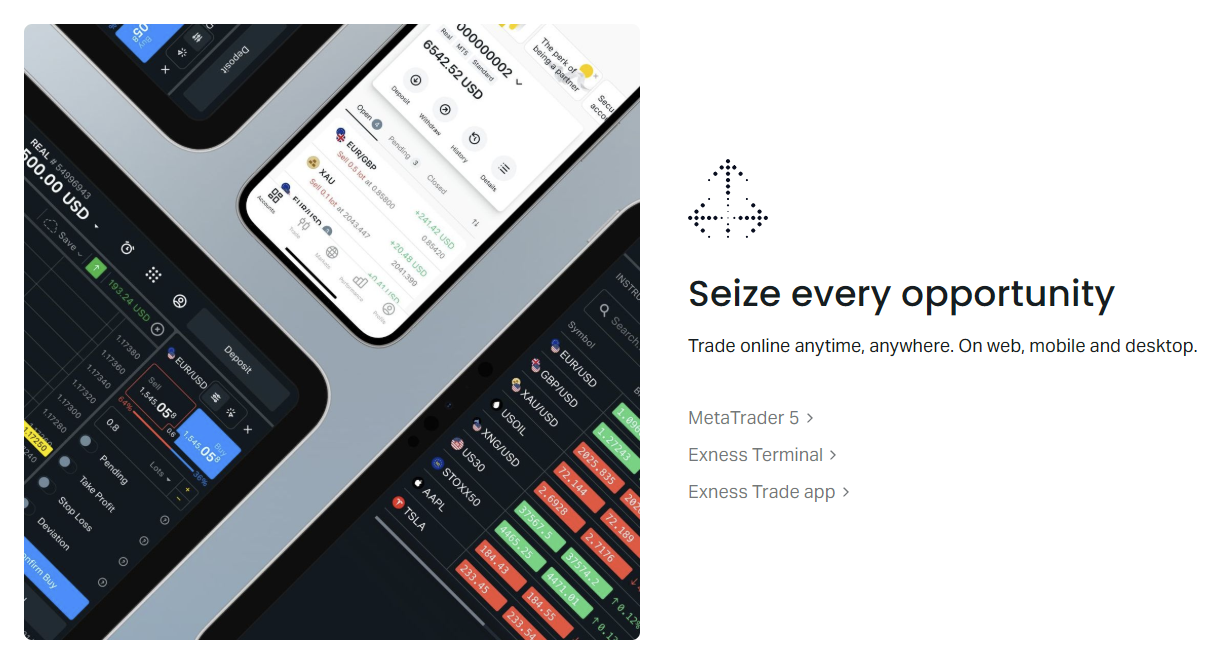
The Exness mobile app (separate from MT4/MT5 mobile) deserves attention. It's a native application built by Exness, not a reskinned MetaQuotes product. It includes account management, deposits and withdrawals, trading signals from Trading Central, an economic calendar, and a clean charting package. You can open and manage positions directly in the app without launching MT4 or MT5. For traders who primarily monitor and adjust positions on the go, it's often faster than the MetaTrader mobile apps.
The proprietary Web Terminal and mobile app reduce dependency on MetaQuotes infrastructure. That matters when MetaQuotes pushes updates that temporarily break third-party tools.
Instrument Range: Forex, Metals, Indices, Crypto, and Energies
South African clients access the full Exness instrument catalog: over 100 forex pairs (majors, minors, exotics), spot metals (gold, silver, platinum, palladium), major global indices (US30, US500, USTEC, GER40, UK100, JPN225, AUS200), cryptocurrencies (BTC, ETH, LTC, XRP, BCH, ADA, DOT, LINK, and more), and energies (USOIL, UKOIL, NGAS). The exotic forex pairs include USDZAR, EURZAR, and GBPZAR — directly relevant for traders wanting exposure to rand movements without synthetic positions.
Gold (XAUUSD) and silver (XAGUSD) trade with tight spreads on Raw Spread and Zero accounts — often 0.0 to 0.3 pips plus commission. During high-volatility sessions (London/New York overlap), spreads can widen, but Exness doesn't impose artificial spread caps that trigger requotes. The index CFDs track cash indices with dividend adjustments applied automatically. Crypto CFDs trade 24/7 with leverage up to 1:400 on major coins, though leverage reduces during extreme volatility.
Scroll horizontally to see all columns
| Instrument | Typical Spread | Commission (per side/lot) | Max Leverage |
|---|---|---|---|
| EURUSD | 0.0–0.1 pips | $3.50 | 1:2000 |
| GBPUSD | 0.0–0.2 pips | $3.50 | 1:2000 |
| USDZAR | 15–30 pips | $3.50 | 1:200 |
| XAUUSD (Gold) | 0.0–0.3 pips | $3.50 | 1:2000 |
| US500 (S&P 500) | 0.4–0.8 points | $3.50 | 1:200 |
| BTCUSD | 15–40 USD | $3.50 | 1:400 |
USDZAR spreads are wider than majors — typically 15–30 pips on Raw Spread — because the pair is less liquid and more volatile. That's normal across brokers. If you trade rand pairs actively, factor the spread into your strategy. The 1:200 leverage cap on exotics and indices is a regulatory constraint from FSCA, not an Exness choice. Majors and gold can go up to 1:2000 for accounts under $1,000 equity, stepping down at higher equity tiers.
Spreads, Commissions, and the Real Cost of Trading
Spreads on Exness are variable and market-driven. The broker doesn't operate a dealing desk — orders route to liquidity providers (banks, non-bank market makers, ECN venues). During normal conditions, EURUSD on Raw Spread sits at 0.0–0.1 pips. During news events (NFP, CPI, SARB rate decisions), spreads widen across the entire market. Exness doesn't guarantee fixed spreads, and no honest broker does. What matters is that the widening reflects actual liquidity conditions, not an artificial markup.
Commission on Raw Spread and Zero accounts is charged per side per lot. A round turn on EURUSD costs $7 on Raw Spread ($3.50 × 2). On a 0.1 lot trade, that's $0.70. Compare that to a Standard account with 0.8 pip spread on EURUSD — the spread cost on 0.1 lot is $8. The commission model wins for anyone trading more than a few lots per month. The Zero account reduces commission on major pairs (as low as $0.20 per side) but increases it on less liquid instruments. Check the specific commission schedule for your traded pairs before choosing.
Swaps (overnight financing) apply to positions held past 23:59 server time (GMT+2/GMT+3 depending on DST). Exness publishes swap rates daily in the platform and on their website. For long positions, you pay the swap; for short positions, you receive it (or pay less). The rates derive from interbank interest rate differentials plus a small broker markup. On major pairs, the markup is typically 0.25–0.5% annualized. Islamic accounts pay zero swaps with no alternative fee.
Deposit and Withdrawal Methods for South Africa
This is where the local entity makes the biggest daily difference. Exness (SC) Ltd supports ZAR deposits and withdrawals through Ozow (instant EFT), bank transfer (EFT), credit/debit cards (Visa, Mastercard), and several e-wallets (Neteller, Skrill, Perfect Money, WebMoney). Ozow deposits reflect instantly during business hours. Bank transfers take 1–2 business days. Card deposits are instant but withdrawals to cards can take 3–5 business days due to bank processing, not Exness.
Withdrawals are processed 24/7, including weekends. ZAR withdrawals to South African bank accounts via Ozow or EFT typically arrive within a few hours. There are no withdrawal fees from Exness on any method. The minimum withdrawal is $1 (≈ R18) for most methods. This is a genuine operational advantage — many brokers batch withdrawals once daily and charge fees for expedited processing.
Scroll horizontally to see all columns
| Method | Deposit Time | Withdrawal Time | Min Deposit | Fees |
|---|---|---|---|---|
| Ozow (Instant EFT) | Instant | 1–4 hours | R180 | None |
| Bank Transfer (EFT) | 1–2 business days | 1–2 business days | R180 | None |
| Visa/Mastercard | Instant | 3–5 business days | R180 | None |
| Neteller/Skrill | Instant | Instant–1 hour | R180 | None |
Verification (KYC) is required before first withdrawal. Exness asks for proof of identity (passport, ID card, or driver's license) and proof of address (utility bill, bank statement, or SARS document) dated within three months. The process usually completes within a few hours during business days. Once verified, subsequent withdrawals don't require re-verification unless your documents expire or you change personal details.
Leverage, Margin, and Stop-Out Rules
Exness offers dynamic leverage up to 1:2000 (1:unlimited for accounts with equity under $1,000 on certain instruments). The unlimited leverage label is marketing — it applies only to forex majors and gold, and only while account equity stays below $1,000. Once equity crosses $1,000, leverage steps down: 1:2000 up to $5,000 equity, 1:1000 up to $30,000, 1:500 up to $100,000, and 1:200 above that. Exotic pairs, indices, and crypto have fixed lower caps (1:200 for exotics/indices, 1:400 for major crypto).
Margin calls occur at 60% margin level (equity/used margin × 100). Stop-out triggers at 0% margin level — meaning positions close automatically when equity hits zero. This is more generous than brokers who stop out at 20% or 50% margin level. However, it also means you can lose your entire account balance if a position moves sharply against you. Negative balance protection applies: you cannot lose more than your deposited funds. The FSCA requires this protection for all licensed brokers.
The margin calculator in the Exness Personal Area and Web Terminal lets you compute required margin for any position size before entering. Use it. Many traders underestimate margin requirements on volatile pairs like USDZAR or during news events when spreads widen and margin needs spike.
Customer Support and Local Presence
Exness provides 24/7 customer support via live chat, email, and phone. The live chat operates in English, Afrikaans, and Zulu — a notable inclusion for a global broker. Phone support includes a South African number (+27 10 500 8400) during business hours (08:00–17:00 SAST, Monday–Friday). Email responses typically arrive within a few hours. The support team handles account queries, technical issues, verification, and payment questions without escalating to offshore teams for routine matters.
The Exness office in Sandton, Johannesburg serves as the local operational hub. It's not a walk-in branch — appointments are required — but it exists. Having a physical South African address matters for regulatory correspondence and demonstrates commitment beyond a shell registration. The FSCA license requires a local key individual and compliance officer, both based in South Africa.
Multilingual support in Zulu and Afrikaans isn't a token gesture. It reflects actual South African staff handling local clients, not a translation layer over an offshore team.
Exness Partner Program in South Africa
The Exness Partner Program (Introducing Broker/Affiliate) operates fully in South Africa. Partners earn rebates based on the trading volume of referred clients. The structure is tiered: Standard partners start at $8–$12 per lot (round turn), scaling up to $20+ per lot at higher volumes. Payments are daily, automated, and withdrawable instantly. There's no minimum payout threshold. Partners get a dedicated dashboard with real-time stats, marketing materials, and sub-partner management tools.
For South African partners, payouts can go to local bank accounts in ZAR via the same Ozow/EFT rails as client withdrawals. This eliminates the international wire delays and fees that plague partners of offshore-only brokers. The program also includes a Premier tier for high-volume partners with dedicated account managers, custom commission structures, and event sponsorship opportunities.
The affiliate track (CPA model) pays a fixed amount per qualified first-time depositor. Rates vary by region and deposit size but typically range from $200–$600 per qualified client for South Africa. The hybrid model (CPA + revenue share) is available for partners who bring consistent volume. All partner agreements are governed by South African law through the local entity.
Security, Fund Protection, and Platform Safeguards
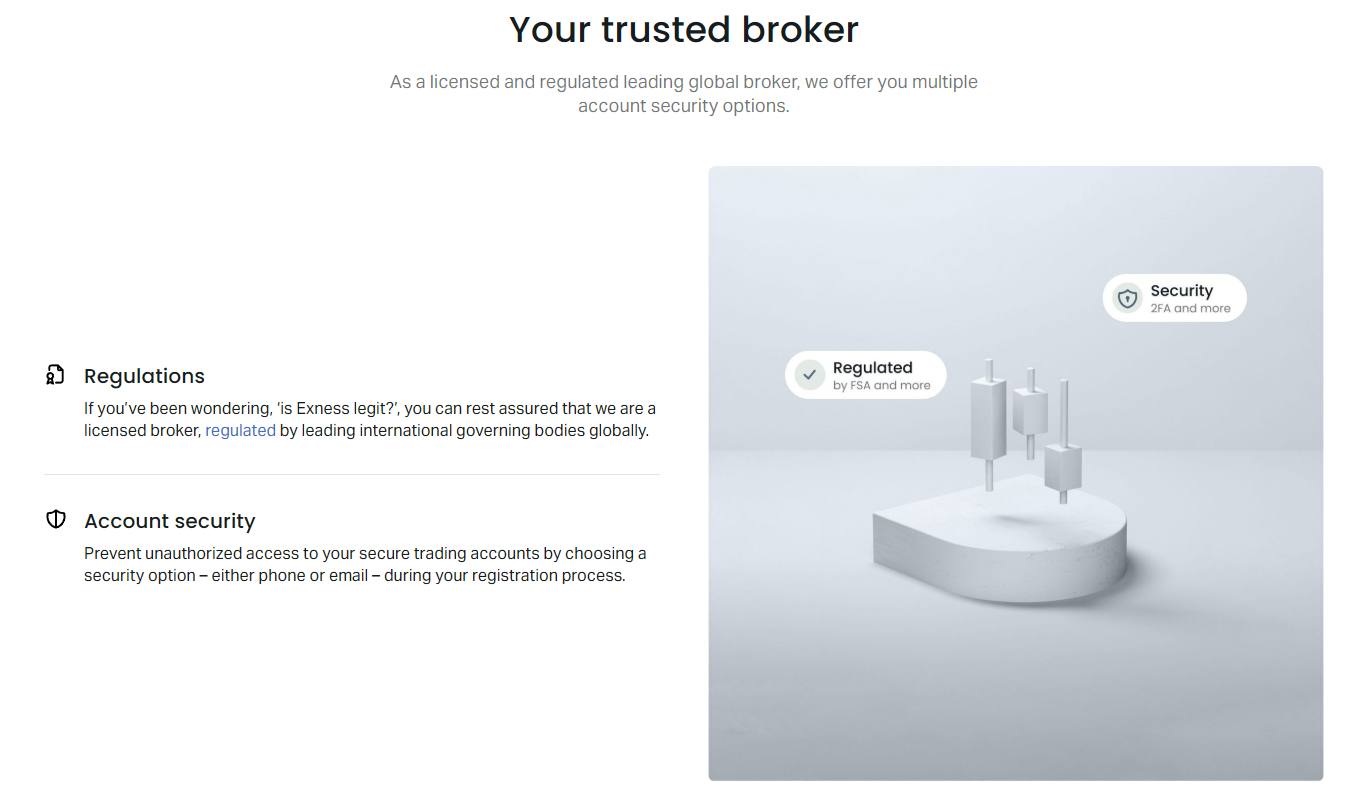
Beyond regulatory segregation, Exness implements several platform-level protections. Two-factor authentication (2FA) via SMS, email, or authenticator app (Google Authenticator, Authy) secures the Personal Area and trading accounts. Login alerts notify you of new device or location access. The platform allows IP whitelisting for API connections. Withdrawal password (separate from login password) adds a second authorization step for fund movements.
Exness participates in the Financial Services Compensation Scheme equivalent through the FSCA's investor protection framework. While South Africa doesn't have a direct FSCS-style fund with fixed payout limits, the FAIS Act provides for compensation through the FAIS Ombud process in cases of broker misconduct or insolvency. The practical protection comes from the segregation requirement — your funds sit in your name at Standard Bank or Nedbank, not in Exness's operational accounts.
The trading platforms themselves (MT4, MT5, Web Terminal) use 128-bit SSL encryption for all data transmission. Exness servers are hosted in Equinix data centers in London, New York, Tokyo, and Johannesburg. The Johannesburg presence reduces latency for South African traders to under 10ms on average — a meaningful edge for scalpers and high-frequency strategies.
Final Assessment of Exness South Africa
Exness South Africa delivers on the basics that matter: FSCA regulation with real segregation, ZAR accounts with local payment rails, instant withdrawals, tight spreads on commission-based accounts, and platforms that work without constant troubleshooting. The unlimited leverage marketing is noise — ignore it and size positions sensibly. The Raw Spread and Zero accounts are the correct choice for anyone trading more than a few lots monthly. The Standard Cent account remains one of the best low-risk learning environments in the industry. Support in local languages and a physical Johannesburg office add credibility that purely offshore brokers can't match. For South African traders in 2024, Exness is a legitimate first-choice option, not a compromise.
Frequently Asked Questions
Is Exness regulated in South Africa?
Yes. Exness (SC) Ltd holds an FSCA license (number 51024) as a Category I Financial Services Provider. Client funds are held in segregated accounts at Standard Bank and Nedbank.
Can I open a ZAR-denominated account with Exness?
Yes. All account types (Standard, Standard Cent, Pro, Raw Spread, Zero) support ZAR as a base currency. Deposits and withdrawals process in ZAR via Ozow, bank transfer, or card.
What is the minimum deposit for South African clients?
The minimum deposit is $10 (approximately R180 at current rates) for Standard and Standard Cent accounts. Professional accounts (Pro, Raw Spread, Zero) require $200 (approximately R3,600).
How fast are withdrawals to South African bank accounts?
ZAR withdrawals via Ozow or EFT typically arrive within 1–4 hours, 24/7 including weekends. There are no withdrawal fees from Exness.
Does Exness offer negative balance protection?
Yes. As an FSCA-licensed broker, Exness provides negative balance protection. You cannot lose more than your deposited funds.
What leverage is available for USDZAR trading?
Exotic pairs like USDZAR have a maximum leverage of 1:200, per FSCA regulatory limits. Major forex pairs and gold offer up to 1:2000 (dynamic based on account equity).
Is there an Exness office in South Africa?
Yes. Exness has an operational office in Sandton, Johannesburg. It serves as the local hub for compliance, support, and partner relations. Appointments are required for visits.
Can I use the Exness Partner Program from South Africa?
Yes. The Introducing Broker and Affiliate programs operate fully in South Africa with ZAR payouts to local bank accounts. Daily automated payments, no minimum threshold.