

Forex Trading Accounts
Exness Standard Cent Account: Features and Trading Conditions
Understanding cent account mechanics and practical trading considerations

Senior Forex Trader & Market Analyst
Daniel Chen is an experienced forex trader and financial market analyst with over 15 years of experience in currency trading. He specializes in technical analysis, risk management, and developing practical trading strategies to help traders make informed decisions.
The Exness Standard Cent Account exists for a specific reason: it lets traders operate with real money while keeping position sizes tiny. Instead of standard lots where one lot equals 100,000 units of base currency, a cent lot represents 1,000 units. Your account balance displays in cents rather than dollars, so a $10 deposit shows as 1,000 cents. This isn't a demo account — profits and losses are real — but the financial exposure stays manageable for anyone learning live execution or testing strategies without risking meaningful capital.
Contents
- 1. How Cent Accounts Differ from Standard Accounts
- 2. Minimum Deposit and Account Opening Process
- 3. Trading Conditions: Spreads, Commissions, and Leverage
- 4. Available Instruments on Cent Account
- 5. Platform Support: MT4, MT5, and Web Terminal
- 6. Execution Model and Order Types
- 7. Comparing Cent Account to Other Exness Account Types
- 8. Practical Considerations for Cent Account Traders
- 9. Limitations You Should Know
- 10. Regional Availability and Entity Differences
- 11. Final Assessment of Exness Standard Cent Account
Cent accounts have been around for years across multiple brokers, but Exness structures theirs with the same trading conditions as the regular Standard Account. That means identical spreads, identical leverage limits, identical execution model, and identical instrument access. The only mechanical difference is the lot denomination and the way balance appears in the platform. For someone moving from demo to live trading, this removes a layer of psychological friction. The platform looks the same, the charts behave the same, and the order flow is the same — just scaled down by a factor of one hundred.
This article walks through every practical aspect of the Exness Standard Cent Account: how it works, what it costs, which platforms support it, where it fits among other Exness account types, and what limitations you should understand before committing time to it. The goal is to give you enough concrete detail to decide whether this account type matches your current trading stage.
How Cent Accounts Differ from Standard Accounts
The core distinction sits in the contract specification. On a Standard Account, one lot of EURUSD means 100,000 euros. On a Standard Cent Account, one lot means 1,000 euros. A 0.01 lot trade on Standard equals 1,000 units; on Cent it equals 10 units. Pip value scales accordingly. On Standard, one pip on 0.01 lot EURUSD is roughly $0.10. On Cent, that same 0.01 lot yields roughly $0.001 per pip — one cent per ten pips. This scaling applies across every instrument: forex pairs, metals, indices, energies, cryptocurrencies, and stocks.
Margin requirements scale the same way. If EURUSD at 1:2000 leverage requires $50 margin for 0.01 lot on Standard, the Cent equivalent requires 50 cents for 0.01 lot. The leverage ceiling remains identical — up to 1:2000 depending on equity tier — but the absolute dollar amount tied up per trade stays small. This matters for traders who want to run multiple concurrent positions or test grid and martingale-style approaches without blowing the account on a single adverse move.
Cent accounts remove the financial pressure that distorts decision-making during early live trading, but they also remove the emotional weight that teaches risk discipline.
Account currency displays in cents. Deposit $10 and the terminal shows 1,000. Withdraw $5 and it shows 500. This can feel disorienting at first — seeing four-digit balances when you know you deposited two digits — but it simplifies position sizing mentally. You stop converting lot sizes in your head. If you want to risk 2% of a 1,000-cent balance, that's 20 cents. On a $10,000 Standard Account, 2% is $200. The math is identical; only the decimal placement shifts.
Minimum Deposit and Account Opening Process
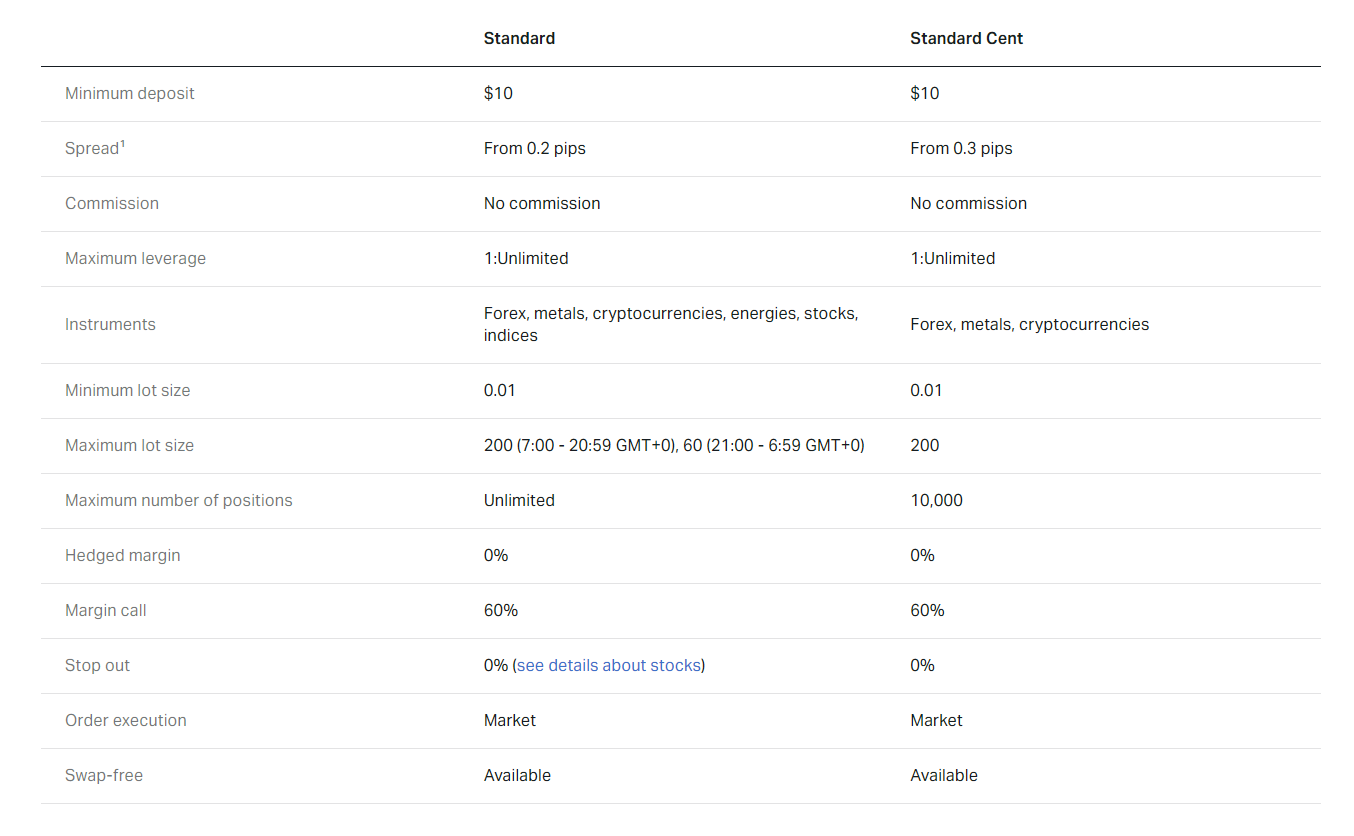
Exness lists the minimum deposit for Standard Cent Account at $1. That is not a typo. One dollar opens a live cent account. In practice, most payment processors impose their own minimums — often $3 to $10 depending on method — but the broker itself sets no higher floor. This makes the cent account the most accessible live trading option Exness offers. The Standard Account requires $10 minimum. Professional accounts (Raw Spread, Zero, Pro) start at $200. The cent account undercuts all of them.
Opening the account happens inside the Personal Area. After registration and email verification, you select "Open New Account," choose "Standard Cent" from the account type dropdown, pick your account currency (USD cents or EUR cents), set a leverage preference, and create a trading password. The account number generates instantly. You can fund it immediately via any supported deposit method: bank cards, electronic wallets (Skrill, Neteller, WebMoney, Perfect Money), crypto (USDT, BTC, ETH, and others), or local bank transfers depending on your region. Most methods credit instantly. Bank wires take one to three business days.
Verification (KYC) is not required to deposit and trade, but it becomes mandatory before any withdrawal. You'll need a government-issued ID (passport, national ID, or driver's license) and proof of address (utility bill or bank statement dated within three months). The review typically completes within a few hours during business days. Until verified, your withdrawal limit stays at zero. This is standard regulatory compliance across all Exness entities.
Trading Conditions: Spreads, Commissions, and Leverage
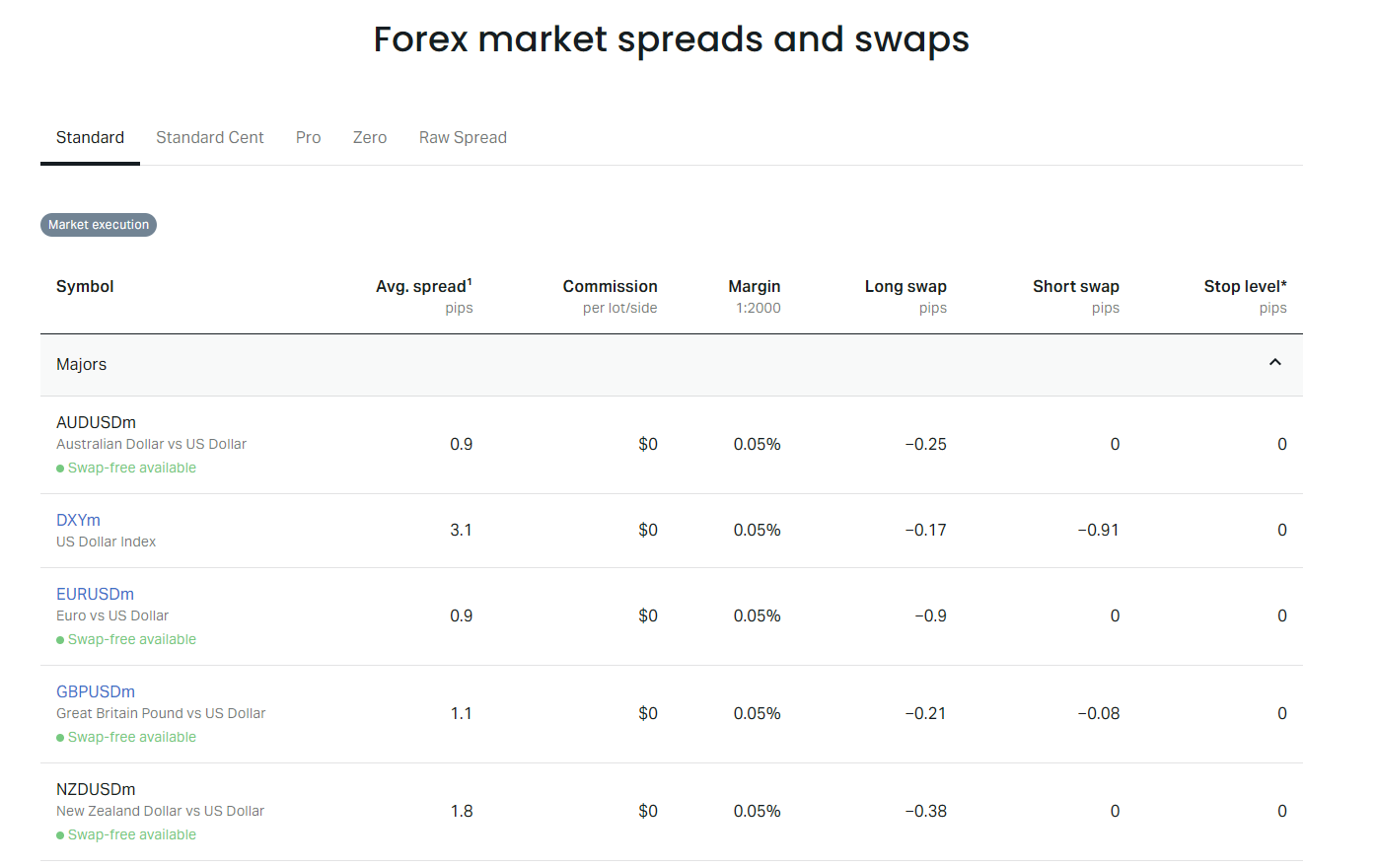
The Standard Cent Account uses market execution with floating spreads and zero commission. Spreads start from 0.3 pips on major pairs like EURUSD during liquid hours, though typical averages sit closer to 0.7–1.0 pips. Exotic pairs widen significantly — USDTRY or USDMXN can exceed 50 pips during low liquidity. There is no separate commission charge; the spread is the full cost. This mirrors the Standard Account exactly. The Raw Spread and Zero accounts offer tighter spreads with per-lot commissions, but those account types do not have cent-denominated variants.
Leverage is dynamic. Accounts below $999 equity (99,900 cents) access up to 1:2000. Between $1,000 and $4,999 equity, maximum drops to 1:1000. Between $5,000 and $29,999, it's 1:500. Above $30,000, 1:200. These thresholds apply to the cent account's displayed equity — so 99,900 cents equals $999. The leverage tiers are identical to Standard Account tiers, just expressed in cent terms. You can request lower leverage in the Personal Area if you prefer stricter margin control.
Scroll horizontally to see all columns
| Equity (Cent Account) | Equity (Standard Account) | Max Leverage |
|---|---|---|
| Up to 99,900 cents | Up to $999 | 1:2000 |
| 100,000 – 499,900 cents | $1,000 – $4,999 | 1:1000 |
| 500,000 – 2,999,900 cents | $5,000 – $29,999 | 1:500 |
| 3,000,000+ cents | $30,000+ | 1:200 |
Swap rates (overnight financing) apply identically to Standard Accounts. Long and short swap values differ per instrument and update daily. You can view current rates in the MetaTrader Market Watch specification window or on the Exness website. Islamic (swap-free) accounts are available for Standard Cent upon request for eligible clients residing in certain jurisdictions. The swap-free status applies to all instruments, not just forex pairs.
Available Instruments on Cent Account
Instrument access mirrors the Standard Account. You can trade forex majors, minors, and exotics — over 100 currency pairs. Metals include gold (XAUUSD), silver (XAGUSD), platinum (XPTUSD), and palladium (XPDUSD). Indices cover major global benchmarks: US30, US500, USTEC, UK100, GER40, FRA40, JPN225, AUS200, HK50, and more. Energies include USOIL (WTI), UKOIL (Brent), and natural gas (XNGUSD). Cryptocurrencies offer BTCUSD, ETHUSD, LTCUSD, XRPUSD, BCHUSD, ADAUSD, DOTUSD, LINKUSD, and several others. Stocks CFDs cover large-cap US equities: AAPL, TSLA, AMZN, GOOGL, META, NVDA, MSFT, and dozens more.
Contract specifications per instrument — lot size, tick size, margin percentage, trading hours — are identical to Standard Account specs. The only difference remains the cent lot denomination. For example, gold on Standard: 1 lot = 100 ounces. On Cent: 1 lot = 1 ounce. US500 index on Standard: 1 lot = 10 contracts. On Cent: 1 lot = 0.1 contracts. This consistency means you can analyze charts and plan trades on a Standard Account demo, then execute the same logic on Cent with adjusted position size.
One practical limitation: some instruments have minimum lot sizes that, even in cent terms, may exceed what a very small balance can support comfortably. For instance, if an index requires 0.01 lot minimum and each cent lot represents 0.1 standard contracts, the notional exposure per trade might still be several dollars. With a $10 deposit (1,000 cents), a single minimum position could use 20–30% of margin at 1:2000 leverage. This isn't a platform restriction — it's just math. Traders with under $50 should stick to forex majors and metals where minimum lots translate to cents of margin.
Platform Support: MT4, MT5, and Web Terminal
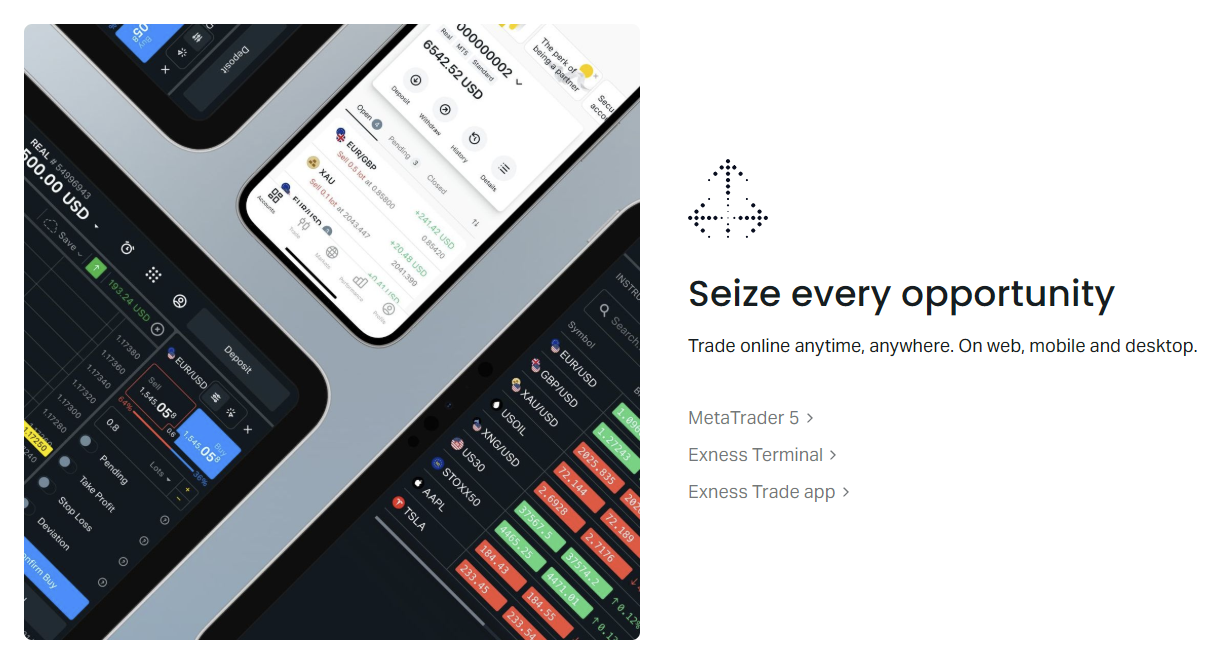
The Standard Cent Account works on MetaTrader 4, MetaTrader 5, and the Exness Web Terminal. Mobile apps for both MT4 and MT5 support cent accounts natively — the account number and password are the same. The Web Terminal requires no installation; log in via the Exness website with your credentials and trade directly in the browser. All three platforms display balance in cents. Charts, indicators, expert advisors, and order management function identically to Standard Accounts.
MetaTrader 5 offers more timeframes (21 vs 9), more order types (including netting/hedging modes), an economic calendar, and depth of market. MetaTrader 4 remains popular for its vast library of custom indicators and EAs written in MQL4. The Web Terminal is convenient for quick checks or trading from restricted machines but lacks EA support and advanced charting. Most cent account traders start on MT4 or MT5 desktop, then add mobile for monitoring.
Expert advisors run without modification on cent accounts because the MQL environment sees the same tick data and order API. However, EA logic that calculates position size based on account balance must account for the cent denomination. An EA risking 2% of balance per trade will calculate 2% of 1,000 cents (20 cents) rather than 2% of $10. If the EA hardcodes lot sizes assuming standard lots, it will open positions 100x smaller than intended. Most modern EAs detect account currency and adjust automatically, but verify before deploying real funds.
Execution Model and Order Types
Exness uses market execution for Standard Cent Accounts. Orders fill at the best available price from liquidity providers at the moment of execution. There is no requote mechanism — the trade either executes at the current market price or rejects if price moves beyond the deviation setting (configurable in MT4/MT5 order window). Slippage can be positive or negative. During normal conditions, major pair fills typically occur within 0.1–0.3 pips of requested price. During news, slippage of several pips is normal.
Supported order types: market buy/sell, buy limit, sell limit, buy stop, sell stop, buy stop limit, sell stop limit (MT5 only). Trailing stops function server-side on MT4 and client-side on MT5. One-click trading works from the chart or Market Watch. Partial fills are possible on large orders, though cent account order sizes rarely trigger partial execution. The maximum single order size is 200 standard lots (20,000 cent lots) — a theoretical limit you will never reach on a cent account.
Market execution means you accept the price the market gives you. On cent accounts, the cost of occasional slippage is negligible in dollar terms, which makes it a safer environment to learn how execution actually works.
Stop-out level is 0% margin level. This means positions close automatically when equity falls to zero — no margin call warning at a higher threshold. Exness does not use a margin call level (like 50% or 100%) before stop-out. You receive a notification when margin level drops below 100%, but forced closure only happens at 0%. This gives maximum room for drawdown recovery but also means a single unhedged position can drain the entire balance if left unchecked. The 0% stop-out applies across all Exness account types.
Comparing Cent Account to Other Exness Account Types
Exness offers five live account families: Standard Cent, Standard, Pro, Raw Spread, and Zero. Standard Cent and Standard share identical trading conditions — spreads, leverage, execution, instruments. Pro, Raw Spread, and Zero offer tighter spreads with commission-based pricing but require $200 minimum deposits and do not have cent-denominated variants. The choice between Standard Cent and Standard is purely about position scaling and psychological comfort. The choice between Standard and professional accounts is about cost structure at volume.
Scroll horizontally to see all columns
| Account | Min Deposit | Spread Type | Commission | Cent Variant |
|---|---|---|---|---|
| Standard Cent | $1 | Floating, from 0.3 pips | None | Yes (native) |
| Standard | $10 | Floating, from 0.3 pips | None | No |
| Pro | $200 | Floating, from 0.1 pips | None | No |
| Raw Spread | $200 | Floating, from 0.0 pips | $3.5 per side per lot | No |
| Zero | $200 | Fixed 0.0 pips on top 30 pairs | $3.5–$20 per side per lot | No |
For a trader doing 10–20 lots per month, Standard Cent or Standard costs less than Raw Spread or Zero because the commission on professional accounts exceeds the spread savings at low volume. The crossover point where Raw Spread becomes cheaper depends on the pair — roughly 30–50 lots monthly on EURUSD. Cent account traders rarely approach this volume. If you scale up, you migrate to Standard first, then evaluate professional accounts when monthly volume justifies the commission model.
The cent account is not a "worse" version of Standard. It is Standard with a different denominator. The professional accounts are genuinely different products with different cost structures.
Practical Considerations for Cent Account Traders
Psychology shifts when real money is on the line, even tiny amounts. Demo trading removes loss aversion entirely. Cent trading reintroduces it at a manageable level. You feel the sting of a bad decision — a $2 loss on a $20 account is 10% — but it's not rent money. This middle ground is where many traders build actual discipline. The habit of honoring stop-losses, sizing positions to risk parameters, and avoiding revenge trades forms here. Those habits transfer directly to larger accounts.
Strategy testing benefits from cent accounts because forward testing on live data captures real spread behavior, slippage, swap costs, and execution latency that backtests miss. A strategy that looks profitable in a backtest may lose to spread costs on a 1-minute scalping approach. Running it on a cent account for 50–100 trades reveals the true expectancy. The cost of this validation is a few dollars. The alternative — discovering the flaw on a $5,000 Standard Account — is expensive.
Withdrawal mechanics work the same as other accounts. Request withdrawal in the Personal Area, choose method, enter amount in cents (or dollars — the interface converts). Minimum withdrawal is $1 equivalent. Most methods process instantly once verified. Bank wires take 1–3 business days. Crypto withdrawals require network confirmations. There are no withdrawal fees from Exness, though payment processors may charge. Withdrawal limits depend on verification level and method; fully verified accounts have no practical ceiling.
Limitations You Should Know
Cent accounts cannot participate in Exness Premier Program (the loyalty program for high-volume traders). Premier requires $10,000+ equity and significant monthly volume — thresholds a cent account won't reach. This means no Premier rebates, no dedicated manager, no priority support tier. Standard support (24/7 live chat, email, phone) remains fully available.
Social trading (copy trading) works with cent accounts as both provider and follower, but the cent denomination creates friction. If a provider trades Standard Account and you copy on Cent, the copier scales positions by equity ratio. A provider with $10,000 equity opening 1 lot gets copied as 0.01 lot on your $100 cent account (10,000 cents). The math works, but the follower's tiny position may fall below minimum lot size for some instruments, causing skipped trades. Conversely, a cent provider copied by Standard followers generates proportionally larger positions. Exness handles the scaling automatically, but minimum lot constraints can break the copy chain.
VPS hosting is available for cent accounts on the same terms as other accounts — free for clients meeting volume thresholds (typically 5 lots monthly), otherwise $30/month. The VPS runs MT4/MT5 with low latency to Exness servers. For cent account EAs, the free tier is attainable: 5 standard lots equals 500 cent lots, which is reasonable for active algorithmic trading. However, most cent account traders don't run EAs 24/7, so VPS is rarely necessary.
Regional Availability and Entity Differences
Exness operates through multiple regulated entities: Exness (SC) Ltd in Seychelles (FSA), Exness B.V. in Curaçao (CBCS), Exness ZA (PTY) Ltd in South Africa (FSCA), Exness (UK) Ltd (FCA), Exness (CY) Ltd (CySEC), and Exness (KE) Ltd (CMA Kenya). The Standard Cent Account is offered by most entities, but leverage caps and instrument lists vary by regulator. FCA and CySEC entities restrict retail leverage to 1:30 on forex majors, 1:20 on minors, 1:10 on commodities and indices, 1:5 on stocks, 1:2 on crypto. Seychelles and Curaçao entities offer up to 1:2000. Your entity assignment depends on residence during registration.
Clients in the UK, EU, Australia, and other regulated jurisdictions cannot choose the high-leverage entity. The registration flow detects your IP and presents the appropriate entity. You cannot manually select a different regulator. This means a UK resident gets 1:30 max leverage on cent account — still usable, but the margin efficiency drops dramatically. A $10 deposit at 1:30 supports roughly 0.03 lots EURUSD. At 1:2000, the same $10 supports 2 lots. The cent account's utility for micro-position scaling diminishes under low-leverage regimes.
Regulatory leverage caps affect cent accounts exactly like Standard Accounts. The cent denomination doesn't bypass jurisdiction rules — it only changes the display currency.
Final Assessment of Exness Standard Cent Account
The Exness Standard Cent Account fills a narrow but valuable role: it is the cheapest way to trade live with real market conditions on Exness infrastructure. For $10–$20, you get identical spreads, execution, platforms, and instruments as a Standard Account trader depositing $10,000. The cent denomination removes the financial pressure that causes premature exits, oversized positions, and emotional decisions during the critical transition from demo to live. It also serves as a low-cost forward-testing environment for strategies that need real tick data and slippage profiles. The limitations — no Premier access, potential copy-trading friction, regulatory leverage caps — are irrelevant for the intended use case. If you are learning live trading, validating a system, or simply want to trade real markets with pocket money, this account type does exactly what it should. When you outgrow it, the migration to Standard Account is seamless — same platform, same conditions, just a different decimal place.
Frequently Asked Questions
What is the minimum deposit for Exness Standard Cent Account?
The broker minimum is $1, though most payment methods require $3–$10. Deposit $10–$20 for practical trading room.
How does lot size work on a cent account?
One cent lot equals 1,000 units of base currency (vs 100,000 on Standard). A 0.01 cent lot is 10 units. Pip value is 1/100th of Standard Account.
Are spreads different on Standard Cent vs Standard Account?
No. Spreads, commissions, leverage tiers, execution model, and instrument access are identical. Only the lot denomination and balance display differ.
Can I use expert advisors on a cent account?
Yes. EAs run natively on MT4/MT5. Ensure the EA detects account currency correctly so position sizing logic accounts for cent denomination.
Is the cent account available in my country?
Available in most countries where Exness operates. Regulatory entity assignment depends on your residence. Leverage caps vary by regulator (1:30 max under FCA/CySEC, up to 1:2000 under FSA/CBCS).
Can I switch from cent account to Standard Account later?
You cannot convert an existing account. Open a new Standard Account in the Personal Area and transfer funds internally. Both accounts run simultaneously.
Does the cent account have swap-free (Islamic) option?
Yes, available upon request for eligible clients in certain jurisdictions. Applies to all instruments, not just forex.
What is the stop-out level on Standard Cent Account?
0% margin level. Positions close automatically when equity reaches zero. No intermediate margin call level exists.