

Forex Trading
Exness Minimum Deposit Requirements by Account Type
What you need to start trading with Exness in 2024

Senior Forex Trader & Market Analyst
Daniel Chen is an experienced forex trader and financial market analyst with over 15 years of experience in currency trading. He specializes in technical analysis, risk management, and developing practical trading strategies to help traders make informed decisions.
Exness sets its minimum deposit requirements based on the account type you choose, not on a single universal figure. Most traders start with the Standard or Standard Cent accounts, which accept deposits as low as one dollar in many regions. Professional accounts such as Pro, Raw Spread, and Zero require higher minimums, typically starting around two hundred dollars. The broker does not charge deposit fees, though your payment provider might. Understanding these thresholds helps you pick an account that matches your capital and trading style without overcommitting funds you are not ready to risk.
Contents
- 1. Exness Account Types and Their Minimum Deposits
- 2. Standard Account Minimum Deposit Details
- 3. Standard Cent Account for Smaller Budgets
- 4. Professional Account Tier Requirements
- 5. Zero and Raw Spread Account Minimums
- 6. Regional Deposit Variations
- 7. Payment Methods and Their Limits
- 8. How to Make Your First Deposit
- 9. Minimum Deposit vs Recommended Starting Capital
- 10. Social Trading and Copy Trading Minimums
- 11. Final Assessment of Exness Minimum Deposit
Minimum deposit is only the entry point. The amount you actually need to trade comfortably depends on leverage, position sizing, and the instruments you prefer. A one-dollar deposit on a cent account lets you open micro-lots and learn platform mechanics with real market exposure. The same dollar on a standard account would restrict you to the smallest possible lot sizes and leave almost no margin buffer. Traders who deposit the bare minimum often hit stop-out levels quickly because a few pips of adverse movement wipe out the available margin. Treating the minimum as a starting capital target rather than a functional trading budget is a common mistake.
This guide breaks down the deposit requirements for every Exness account type, explains how regional payment methods affect the practical minimum, and compares the broker's thresholds to what you realistically need for sustainable trading. We also cover social trading minimums, the difference between deposit minimums and margin requirements, and what happens when you fund an account below the recommended level for your chosen strategy.
Exness Account Types and Their Minimum Deposits
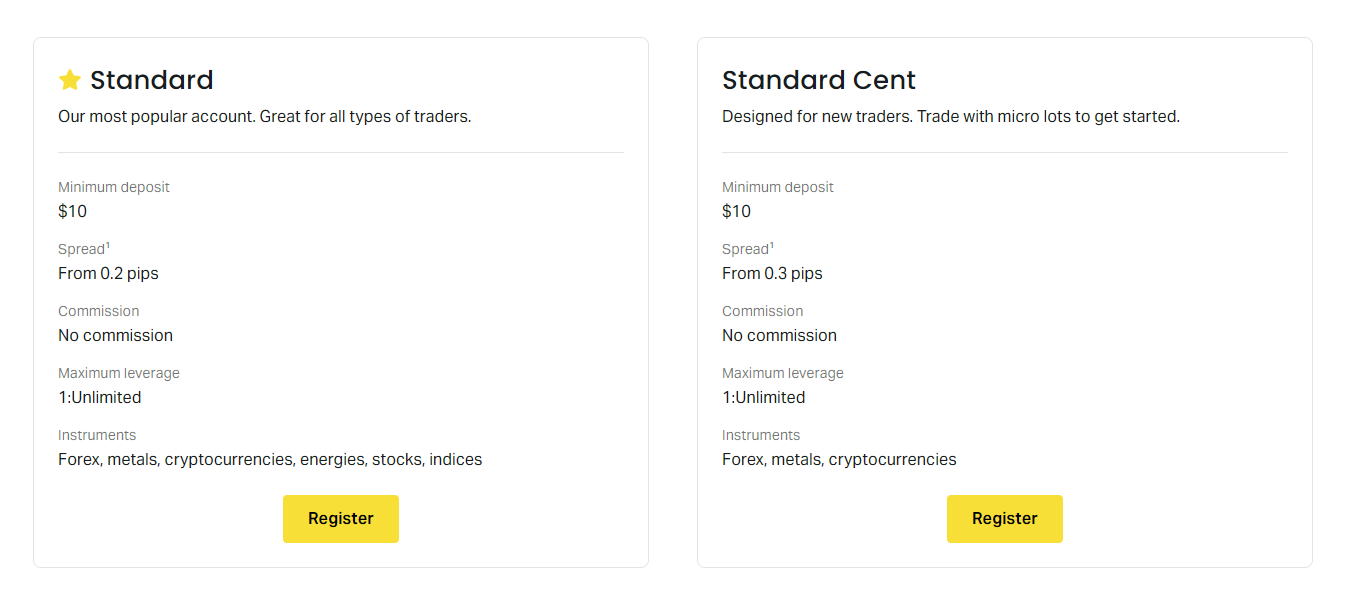
Exness offers two broad account categories: Standard and Professional. Standard accounts include Standard and Standard Cent. Professional accounts include Pro, Raw Spread, and Zero. Each category targets a different experience level and capital base. The Standard category is designed for beginners and traders with smaller balances. The Professional category suits higher-volume traders who want tighter spreads and commission-based pricing. Minimum deposits reflect this segmentation.
Scroll horizontally to see all columns
| Account Type | Category | Typical Minimum Deposit | Spread Type |
|---|---|---|---|
| Standard | Standard | $1 | Floating, no commission |
| Standard Cent | Standard | $1 | Floating, no commission |
| Pro | Professional | $200 | Floating, no commission |
| Raw Spread | Professional | $200 | Near zero, commission per lot |
| Zero | Professional | $200 | Zero on top pairs, commission per lot |
The one-dollar minimum for Standard and Standard Cent accounts applies when you use electronic payment methods such as cards, e-wallets, or local bank transfers in supported regions. Bank wire transfers often carry higher minimums imposed by the sending bank, not by Exness. Professional accounts show a two-hundred-dollar minimum in the client area, but the platform will accept lower amounts if your payment method allows it. The two-hundred-dollar figure is a practical guideline because trading Raw Spread or Zero accounts with less capital makes the per-lot commission disproportionately expensive relative to position size.
Standard Account Minimum Deposit Details
The Standard account is the most popular choice for new Exness clients. It offers floating spreads starting from 0.3 pips on major pairs with no commission. The one-dollar minimum deposit means you can open an account, verify your identity, and fund it with the equivalent of a few dollars in your local currency. This low barrier lets you test live execution, slippage, and swap rates without committing meaningful capital. However, a one-dollar balance on a standard lot account gives you almost no room for drawdown. A single micro-lot (0.01 lots) on EURUSD requires roughly ten dollars of margin at 1:2000 leverage, and the margin requirement rises as leverage tiers decrease with larger balances.
Spreads on the Standard account widen during high-impact news and low-liquidity hours. The broker does not guarantee fixed spreads. For a trader depositing ten to fifty dollars, the spread cost is usually the largest expense. There are no hidden fees, no deposit commissions from Exness, and no inactivity charges. Withdrawals are processed back to the original payment method, and the minimum withdrawal amount matches the deposit minimum for most methods. This symmetry simplifies cash-flow planning for small accounts.
The Standard account supports all Exness trading instruments: forex, metals, energies, indices, stocks, and cryptocurrencies. Leverage is unlimited for balances under one thousand dollars, then steps down through tiers as equity grows. This dynamic leverage model protects the broker and the trader from excessive risk at higher account sizes. For a new trader, unlimited leverage means a ten-dollar deposit can control positions worth twenty thousand dollars at 1:2000. That flexibility is useful for learning position sizing, but it also amplifies losses. Most educators recommend treating leverage as a tool for margin efficiency, not as a way to maximize position size.
Standard Cent Account for Smaller Budgets
The Standard Cent account denominates your balance in cents instead of dollars. A ten-dollar deposit shows as one thousand cents in the platform. This accounting trick lets you trade cent lots, which are one-hundredth the size of a standard micro-lot. One cent lot on EURUSD represents one thousand units of base currency instead of one hundred thousand. The margin requirement for a cent lot at 1:2000 leverage is roughly five cents. A ten-dollar deposit (one thousand cents) can therefore hold dozens of cent lots simultaneously with room for drawdown.
Cent accounts are ideal for transitioning from demo to live trading. The psychological experience of real money is preserved, but the financial risk stays tiny. You can test expert advisors, practice risk management rules, and experience slippage during news events without risking more than a few dollars. The trade-off is that spreads on cent accounts are slightly wider than on standard accounts, typically by 0.1 to 0.3 pips on majors. For a scalper, that difference matters. For a swing trader holding positions for days, it is negligible.
- Balance displayed in cents for finer granularity
- Cent lots allow position sizing down to 0.0001 standard lots
- Minimum deposit remains one dollar (one hundred cents)
- Unlimited leverage available for balances under one thousand dollars
- Slightly wider spreads than Standard account
- Same instrument coverage as Standard account
Many traders graduate from cent to standard once they consistently profit over several months. The migration is seamless: you open a new Standard account in the same Personal Area, transfer funds internally, and continue trading. Exness does not charge for internal transfers between your own accounts. This flexibility means you do not need to decide permanently at signup. You can run both account types simultaneously, testing strategies on the cent account while building a track record on the standard account.
Professional Account Tier Requirements
Professional accounts target traders who execute higher volume and want raw pricing. The Pro account offers floating spreads from 0.1 pips with no commission. Raw Spread and Zero accounts charge a commission per lot but deliver spreads close to zero on major pairs. The two-hundred-dollar minimum deposit for these accounts is not a hard platform restriction. You can deposit fifty dollars into a Raw Spread account if your payment method allows it. The issue is economic: a three-dollar-per-side commission on a 0.01 lot trade represents a significant percentage of a fifty-dollar account. At two hundred dollars, the commission becomes a manageable cost of doing business.
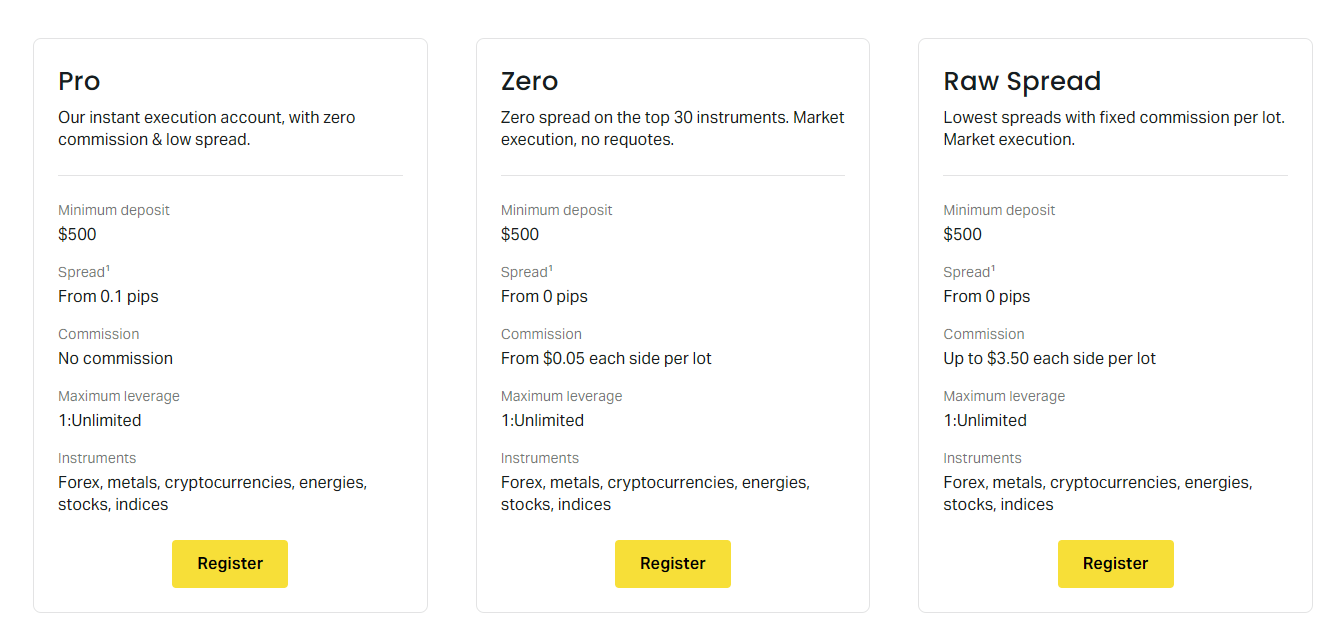
Pro accounts suit traders who prefer commission-free pricing but want tighter spreads than the Standard account offers. The spread markup covers the broker's cost. Raw Spread accounts pass through institutional spreads and charge a fixed commission per lot, typically three dollars per side on forex. Zero accounts take this further by offering zero spreads on the top twenty forex pairs during market hours, with a slightly higher commission. The choice between Raw Spread and Zero depends on your most-traded instruments and average position size. If you trade mostly EURUSD and GBPUSD in standard lots, Zero often works out cheaper. If you trade a diverse basket including crosses and metals, Raw Spread may be more predictable.
Scroll horizontally to see all columns
| Feature | Pro | Raw Spread | Zero |
|---|---|---|---|
| Minimum Deposit | $200 | $200 | $200 |
| Spread on EURUSD | From 0.1 pips | From 0.0 pips | 0.0 pips (top 20 pairs) |
| Commission | None | $3 per side per lot | $3.5 per side per lot |
| Leverage | Unlimited < $1k | Unlimited < $1k | Unlimited < $1k |
| Best For | Swing traders | High-frequency diverse | Major pair scalpers |
Professional accounts also support the full instrument range. Leverage tiers mirror the Standard accounts: unlimited below one thousand dollars, then stepping down at higher equity thresholds. Stop-out level is zero percent across all account types, meaning positions close automatically when margin reaches zero. This is more aggressive than brokers who stop out at twenty or fifty percent margin. Traders must monitor margin closely, especially when using high leverage on volatile instruments like cryptocurrencies or exotic pairs.
Zero and Raw Spread Account Minimums
The Zero account markets itself on zero spreads for the most liquid forex pairs. The commission is slightly higher than Raw Spread to compensate. For a trader depositing exactly two hundred dollars, the Zero account makes sense only if you trade the specified major pairs in sufficient volume. A 0.01 lot round trip on EURUSD costs seven dollars in commission on Zero versus six dollars on Raw Spread. At that position size, the spread savings of 0.1 pips (one dollar) do not offset the extra commission dollar. You need to trade at least 0.05 lots per round trip for Zero to break even. That requires a larger account to withstand normal drawdown.
Raw Spread offers more consistent pricing across all instruments. The commission is the same whether you trade EURUSD or XAUUSD. Spreads on gold and indices are raw, meaning you see institutional bid-ask without markup. For a diversified trader, this transparency simplifies cost calculation. The two-hundred-dollar minimum is a soft guideline. Some regions allow local payment methods with lower minimums, but the economic logic holds: commission-based accounts need enough capital to absorb per-trade costs without eroding equity.
Traders sometimes ask whether they can open a Professional account with less than two hundred dollars and upgrade later. The platform allows it. You can deposit fifty dollars into a Raw Spread account, trade micro-lots, and add funds when ready. The account type does not lock you into a minimum balance. However, the commission structure means each trade costs a fixed amount regardless of account size. A fifty-dollar account paying six dollars per round trip on a 0.01 lot loses twelve percent of equity to commissions alone after ten trades. That math rarely works in your favor.
Regional Deposit Variations
Exness operates globally and supports dozens of local payment methods. The one-dollar global minimum applies to electronic methods like Visa, Mastercard, Skrill, Neteller, WebMoney, and Perfect Money. Local bank transfers in countries such as Nigeria, Kenya, South Africa, India, Pakistan, Indonesia, Vietnam, Thailand, and Brazil often have higher minimums set by the payment processor or the local banking network. These minimums typically range from five to twenty dollars equivalent in local currency. The Exness Personal Area shows the exact minimum for each method after you select your country of residence.
Currency conversion happens at the payment processor's rate, not at Exness rates. If you deposit South African rand via a local gateway, the gateway converts ZAR to USD at their spread. Exness receives USD and credits your account in USD. The same applies to Indian rupees, Pakistani rupees, Nigerian naira, and other non-USD currencies. Traders should compare the total cost including conversion spread, not just the nominal minimum. A method with a five-dollar minimum but a three-percent conversion spread costs more than a ten-dollar minimum with a half-percent spread.
Scroll horizontally to see all columns
| Region | Local Method | Typical Minimum (Local) | Approx USD Equivalent |
|---|---|---|---|
| South Africa | Ozow / Bank Transfer | ZAR 100 | $5.50 |
| Nigeria | Local Bank Transfer | NGN 5,000 | $6.50 |
| India | UPI / NetBanking | INR 500 | $6.00 |
| Pakistan | Local Bank / Easypaisa | PKR 1,500 | $5.50 |
| Indonesia | Local Bank / VA | IDR 100,000 | $6.50 |
| Brazil | PIX / Boleto | BRL 30 | $6.00 |
These figures are indicative and change as payment partners update their terms. Always check the deposit screen in your Personal Area for current minimums. Exness does not charge deposit fees for any method. The only costs are external: payment processor fees, bank wire charges, or currency conversion spreads. Withdrawals follow the same rails. If you deposit via a local method, you must withdraw via the same method up to the deposited amount. Profits can be withdrawn to any verified method in your name.
Payment Methods and Their Limits
Exness supports over one hundred payment methods globally. The available options depend on your registered country and account verification level. Fully verified accounts unlock higher limits and faster processing. Unverified accounts face lower per-transaction and daily limits. Most electronic methods process deposits instantly. Bank wires take one to three business days. Cryptocurrency deposits (USDT, USDC, BTC, ETH) require blockchain confirmations and typically credit within thirty minutes. The minimum crypto deposit is usually ten dollars equivalent, higher than fiat electronic methods.
Card deposits (Visa, Mastercard, Maestro) are instant and support the one-dollar minimum in most regions. Some issuing banks block transactions to forex brokers or classify them as cash advances with fees. If your card is declined, try an e-wallet or local bank transfer. E-wallets like Skrill, Neteller, WebMoney, and Perfect Money offer instant deposits with one-dollar minimums. They also provide a layer of privacy since your bank statement shows only the e-wallet transaction. Withdrawals to e-wallets are usually instant after Exness processes them, which takes minutes during business hours.
- Visa / Mastercard: instant, $1 min, card must be in your name
- Skrill / Neteller: instant, $1 min, account email must match Exness email
- WebMoney / Perfect Money: instant, $1 min, verified wallet required
- Local bank transfer: 1-24 hours, minimum varies by country
- USDT / USDC (TRC20, ERC20): ~30 min, $10 min, network fee applies
- Bitcoin / Ethereum: ~30 min, $10 min, blockchain fee varies
- Internal transfer: instant, no min, between your own Exness accounts
Maximum deposit limits also vary. Unverified accounts may be capped at two thousand dollars daily. Fully verified accounts can deposit up to one hundred thousand dollars per transaction on most methods. There is no aggregate limit on total deposits. High-volume traders should complete full verification (identity, address, and source of funds) early to avoid delays when scaling up. Exness complies with AML regulations and may request source-of-funds documentation for large or frequent deposits. This is standard across regulated brokers.
How to Make Your First Deposit
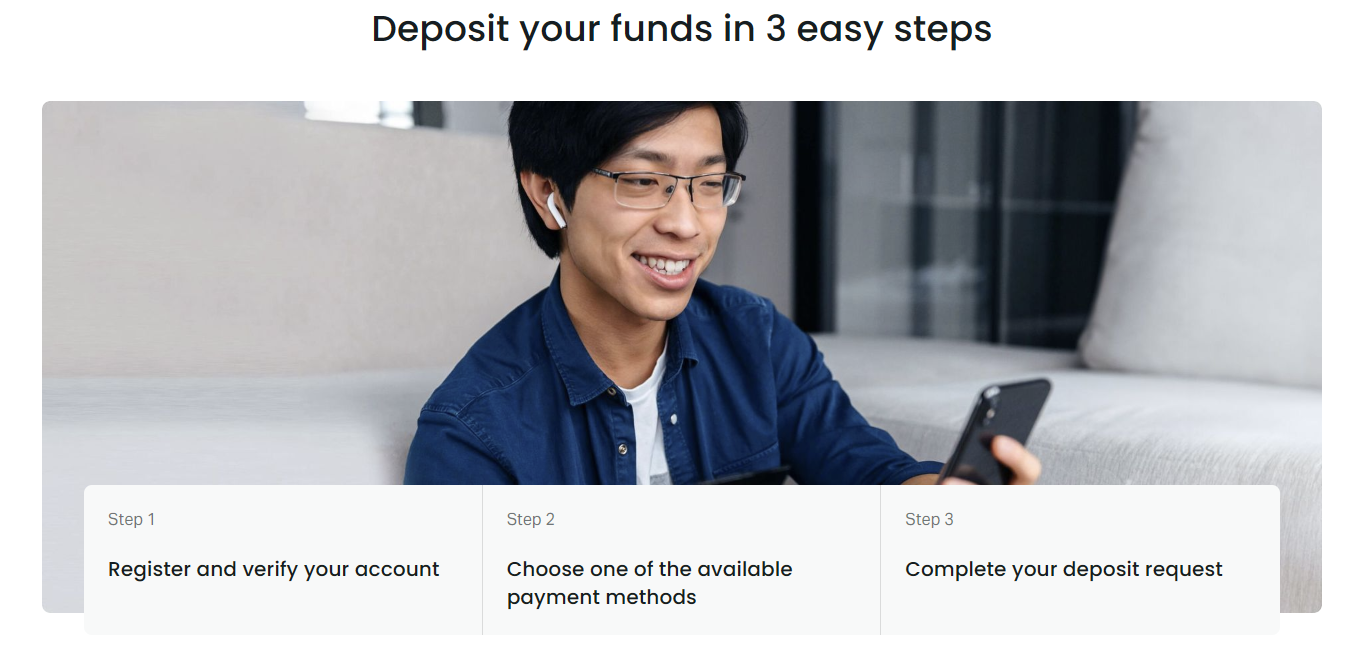
The deposit process starts in the Exness Personal Area after you register and verify your email. Click Deposit, choose your payment method, enter the amount, and confirm. You will be redirected to the payment provider's page to authorize the transaction. For cards, this means entering card details and completing 3D Secure authentication. For e-wallets, you log into the wallet and approve. For local bank transfers, you receive beneficiary details and a unique reference code that must be included in the transfer description. Exness matches deposits by reference code, so omitting it delays crediting.
First-time depositors should start with a small amount to confirm the payment rail works end-to-end. Deposit ten dollars via your preferred method, verify it appears in your trading account, then test a small withdrawal back to the same method. This round-trip test confirms your payment details are correct and the withdrawal path functions. It also familiarizes you with processing times. Once confident, you can deposit your intended trading capital. Exness does not penalize multiple deposits. You can fund your account as often as needed.
- Log into Personal Area and click Deposit
- Select payment method from available options
- Enter amount (respect method minimum)
- Confirm and complete payment provider authorization
- Wait for funds to appear in trading account (instant for most methods)
- Verify balance in MetaTrader or Exness Terminal
- Test with a small trade or withdrawal if first time
If a deposit does not appear within the expected timeframe, check the transaction history in Personal Area. Pending status means the payment is processing. Failed status means the provider rejected it. Common rejection reasons: insufficient funds, card not enabled for international transactions, name mismatch between Exness account and payment method, or bank security block. Contact Exness support via live chat with the transaction ID if the status is unclear. Support operates twenty-four hours a day, seven days a week, and typically resolves deposit queries within minutes.
Minimum Deposit vs Recommended Starting Capital
The minimum deposit is a technical threshold. The recommended starting capital is a practical one. For a Standard Cent account, fifty to one hundred dollars gives you enough margin to trade multiple cent lots, withstand normal drawdown, and apply basic risk management (one to two percent per trade). For a Standard account, two hundred to five hundred dollars allows micro-lot trading with reasonable position sizing. For Professional accounts, one thousand to two thousand dollars makes commission costs proportionally small and provides buffer for the wider leverage tiers that kick in above one thousand dollars equity.
Traders who fund only the minimum often treat the account as a lottery ticket. They over-leverage, ignore stop losses, and blow the account in a few trades. This is not a broker problem. It is a capital adequacy problem. Exness provides unlimited leverage below one thousand dollars precisely so small accounts can access meaningful position sizes. The responsibility to use that leverage conservatively rests with the trader. A one-hundred-dollar account at 1:2000 leverage can open two standard lots on EURUSD. That same account at 1:100 leverage can open only 0.1 lots. The leverage availability does not mandate its use.
A minimum deposit gets you in the door. Adequate capital keeps you in the game long enough to learn.
If your total risk capital is fifty dollars, use a Standard Cent account. Trade cent lots. Risk one dollar per trade (two percent). Aim for consistency over three months before adding funds. If you have five hundred dollars, a Standard account works fine. Trade micro-lots. Risk ten dollars per trade. If you have two thousand dollars, evaluate whether Raw Spread or Zero reduces your total trading cost enough to justify the commission structure. The account type should follow the capital, not the other way around.
Social Trading and Copy Trading Minimums
Exness Social Trading lets investors copy strategy providers automatically. The minimum investment per strategy is ten dollars. Strategy providers must maintain a minimum equity of five hundred dollars in their strategy account to remain visible to investors. This threshold filters out micro-accounts that cannot demonstrate meaningful track records. Investors can allocate as little as ten dollars across multiple strategies, diversifying even with a small total deposit. The copied trades execute proportionally in the investor's account based on the allocation ratio.
Social trading does not require a separate account. You use your existing Exness trading account (Standard, Standard Cent, or Professional) and allocate a portion of its equity to copy strategies. The minimum deposit for the main account still applies. If you open a Standard Cent account with ten dollars, you can invest that ten dollars into one strategy. Returns and losses mirror the provider's performance minus a performance fee (typically twenty to thirty percent of profit, charged only on profitable periods). There are no management fees during drawdown.
Copy trading minimums are low enough that a two-hundred-dollar deposit can be split across ten to twenty strategies. This diversification reduces single-strategy risk. However, each copied trade incurs the spread and commission of your account type. A Standard Cent investor copying a provider who trades 0.01 lots will see cent-lot executions. The cost structure matches your account, not the provider's. This transparency helps investors calculate net returns accurately.
Final Assessment of Exness Minimum Deposit
Exness minimum deposit requirements are among the lowest in the industry for electronic payment methods. The one-dollar threshold on Standard and Standard Cent accounts removes almost all financial barriers to live trading. Professional accounts suggest two hundred dollars, which aligns with the economic reality of commission-based pricing. Regional payment methods introduce variation, but the Personal Area displays exact minimums before you commit. The broker charges no deposit fees, processes most methods instantly, and allows internal transfers between your own accounts at no cost.
The practical takeaway: match your account type to your actual capital, not to the minimum. A cent account with one hundred dollars beats a standard account with ten dollars for learning. A Raw Spread account with two thousand dollars beats a Pro account with two hundred dollars if you trade enough volume to offset commissions. Social trading lets you start with ten dollars per strategy, but the main account still needs adequate equity for the copied positions. Exness provides the infrastructure. Capital adequacy and risk management remain your decisions.
Frequently Asked Questions
What is the absolute minimum deposit to open an Exness account?
One dollar for Standard and Standard Cent accounts using electronic payment methods like cards or e-wallets. Professional accounts show a $200 guideline but accept lower amounts.
Does Exness charge any deposit fees?
No. Exness does not charge deposit fees for any payment method. Your payment provider or bank may apply their own fees or currency conversion spreads.
Can I deposit less than $200 into a Raw Spread or Zero account?
Yes, the platform accepts lower deposits if your payment method allows it. However, per-lot commissions make these accounts expensive to trade with small balances.
What is the minimum deposit for Exness in South Africa using ZAR?
Local methods like Ozow typically require around ZAR 100 (approximately $5.50). Exact minimums display in the Personal Area after selecting your country.
Is there a minimum deposit for Exness social trading?
The minimum investment per strategy is $10. Your main trading account must meet its own account-type minimum (e.g., $1 for Standard Cent).
Can I change account types after depositing?
You cannot convert an existing account type. You open a new account of the desired type in the same Personal Area and transfer funds internally at no cost.
What happens if I deposit below the recommended starting capital?
The account functions normally, but you have less margin buffer. Over-leveraging a small account often leads to quick stop-outs. Use cent accounts for very small deposits.
Are cryptocurrency deposits subject to the same minimums?
Crypto deposits (USDT, USDC, BTC, ETH) typically have a $10 minimum equivalent due to blockchain network fees. Processing takes about 30 minutes for confirmations.