
Forex & CFD Trading
Exness Stock Trading: Platforms, Costs, and How to Start
Learn what stocks Exness offers, how pricing works, and which account fits your strategy.

Senior Forex Trader & Market Analyst
Daniel Chen is an experienced forex trader and financial market analyst with over 15 years of experience in currency trading. He specializes in technical analysis, risk management, and developing practical trading strategies to help traders make informed decisions.
Exness offers stock trading through contracts for difference (CFDs), letting you speculate on price movements without owning the underlying shares. The broker provides access to major U.S. and European equities across its MetaTrader 4, MetaTrader 5, proprietary web terminal, and mobile app. This guide covers the available instruments, trading conditions, platform choices, account types, and the practical steps to open your first position.
Contents
- 1. Available Stocks and Market Coverage
- 2. Trading Conditions: Spreads, Commissions, and Leverage
- 3. Platforms: MT4, MT5, Web Terminal, and Mobile App
- 4. Account Types and Which One Fits Stock Trading
- 5. How to Open Your First Stock Trade on Exness
- 6. Trading Hours and Session Nuances
- 7. Risk Management Tools on Exness
- 8. Fees Beyond Spreads and Commissions
- 9. Stock CFDs vs. Real Shares: What You Give Up
- 10. Execution Quality and Order Types
- 11. Analytical Tools and Research
- 12. Mobile Trading Experience for Stocks
- 13. Regulatory Entities and Client Protections
- 14. Common Pitfalls and How to Avoid Them
- 15. Final Assessment of Exness Stock Trading
Stock CFDs on Exness trade with leverage up to 1:20 for major equities, variable spreads that start from 0.3 pips on the most liquid names, and zero commission on Standard accounts. Raw Spread and Zero accounts charge a per-lot commission but deliver tighter spreads. Trading hours follow the underlying exchange schedule, with pre-market and after-hours sessions available for key U.S. stocks. Overnight financing (swap) applies to positions held past the daily rollover.
Available Stocks and Market Coverage
Exness lists over 100 stock CFDs, concentrated on large-cap U.S. companies such as Apple, Microsoft, Amazon, Tesla, Nvidia, and Meta, plus a selection of European blue chips including ASML, LVMH, Siemens, and SAP. The exact count varies by regulatory entity; the Seychelles and Cyprus arms typically carry the broadest catalog. You will not find small-cap or penny stocks, and the list leans heavily toward technology, consumer discretionary, and financial sectors.
- U.S. large-cap: AAPL, MSFT, AMZN, TSLA, NVDA, META, GOOGL, NFLX, JPM, V
- European large-cap: ASML, LVMH, SAP, SIE, AIR, BNP, ENEL, IBE
- Sector concentration: technology, consumer, financials, industrials
- No direct access to Asian, Australian, or emerging-market equities
The instrument list is searchable inside each platform. Symbols follow the format "AAPL" or "AAPL.us" depending on the terminal. Dividend adjustments are applied automatically on ex-dividend dates — long positions receive the net dividend, short positions are charged. Corporate actions such as stock splits are handled by the platform without manual intervention.
Liquidity is sourced from Tier-1 banks and non-bank market makers. During regular U.S. session hours (13:30–20:00 UTC), spreads on names like AAPL and MSFT often sit below 1 pip. Outside those hours, spreads widen noticeably — sometimes 3–5× the daytime level. If you trade Asian or European sessions, factor this into your cost calculations.
Trading Conditions: Spreads, Commissions, and Leverage
Exness structures stock CFD costs differently across its three main account families. Standard and Standard Cent accounts embed all costs into the spread — no separate commission. Raw Spread and Zero accounts charge a round-turn commission per lot but offer spreads that can approach zero on the most liquid names. Pro accounts sit between the two, with low spreads and no commission but higher minimum deposits.
Scroll horizontally to see all columns
| Account | Typical Spread (AAPL) | Commission (per lot round-turn) | Max Leverage | Min Deposit |
|---|---|---|---|---|
| Standard | ~0.8–1.2 pips | None | 1:20 | $1 |
| Standard Cent | ~0.8–1.2 pips | None | 1:20 | $1 |
| Pro | ~0.4–0.7 pips | None | 1:20 | $200 |
| Raw Spread | ~0.0–0.3 pips | $3.50 per side | 1:20 | $200 |
| Zero | ~0.0–0.2 pips | $3.50 per side | 1:20 | $200 |
Leverage is capped at 1:20 for all stock CFDs regardless of account type, in line with ESMA and other major regulator limits for retail clients. Professional clients who qualify can access up to 1:50 on select equities. Margin requirements update in real time; the platform displays used and free margin in the terminal's trade tab.
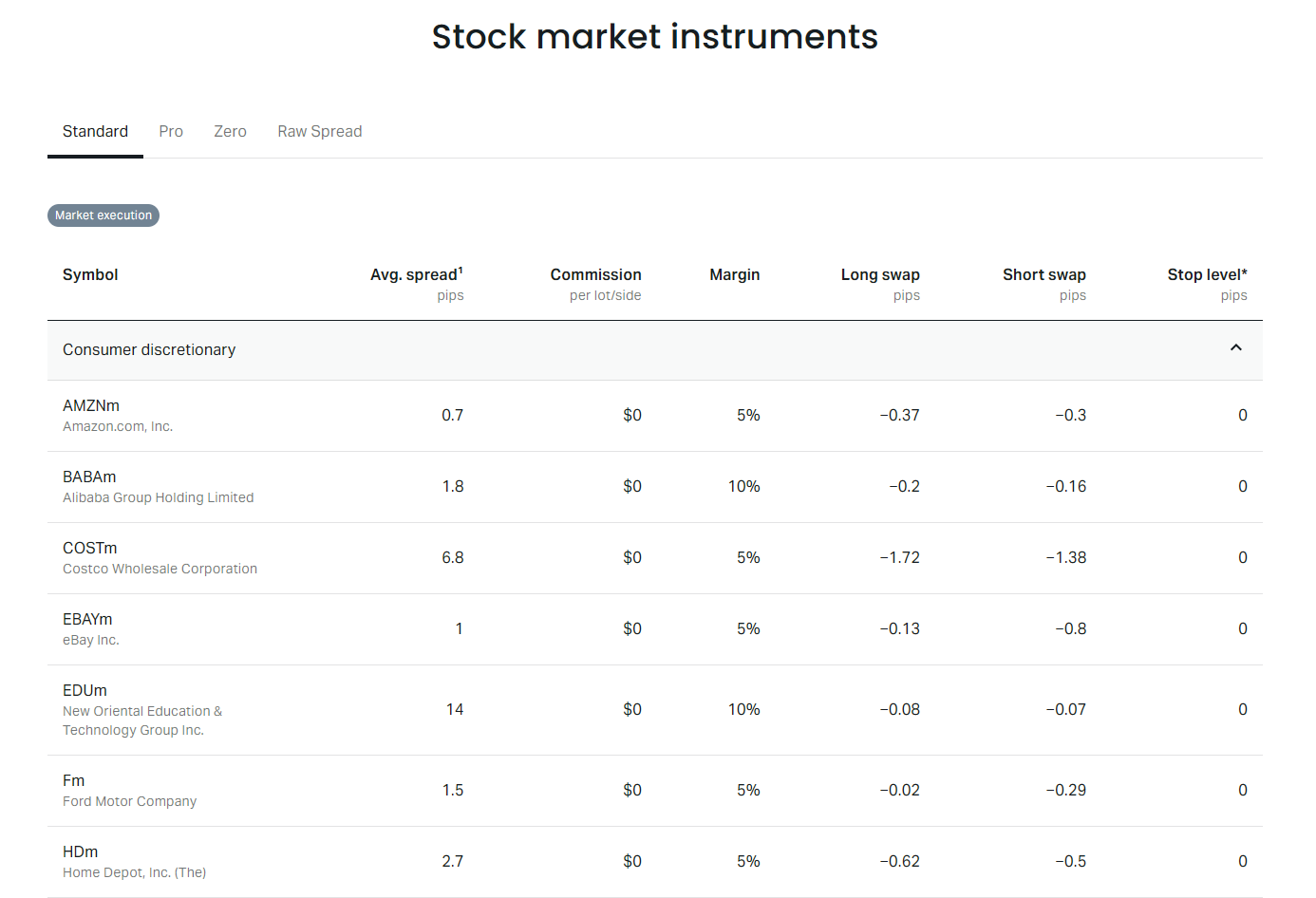
Overnight financing (swap) is charged daily at 22:00 UTC. Long positions pay the benchmark rate plus a markup; short positions receive the benchmark minus a markup. For U.S. stocks, the benchmark is typically SOFR or the Fed funds rate equivalent. Swap rates are visible in the platform's symbol specification window and on the Exness website. Weekend rollover applies a triple charge on Wednesday night to cover Saturday and Sunday.
Platforms: MT4, MT5, Web Terminal, and Mobile App
Exness supports stock CFDs on four platforms. MetaTrader 5 is the most complete for equities — it handles the full symbol list, offers depth of market (Level 2), and supports netting and hedging modes. MetaTrader 4 carries a reduced stock catalog and lacks native depth of market. The proprietary web terminal runs in any modern browser with no installation and mirrors most MT5 features. The Exness mobile app (iOS and Android) provides full trading, charting, and account management on the go.
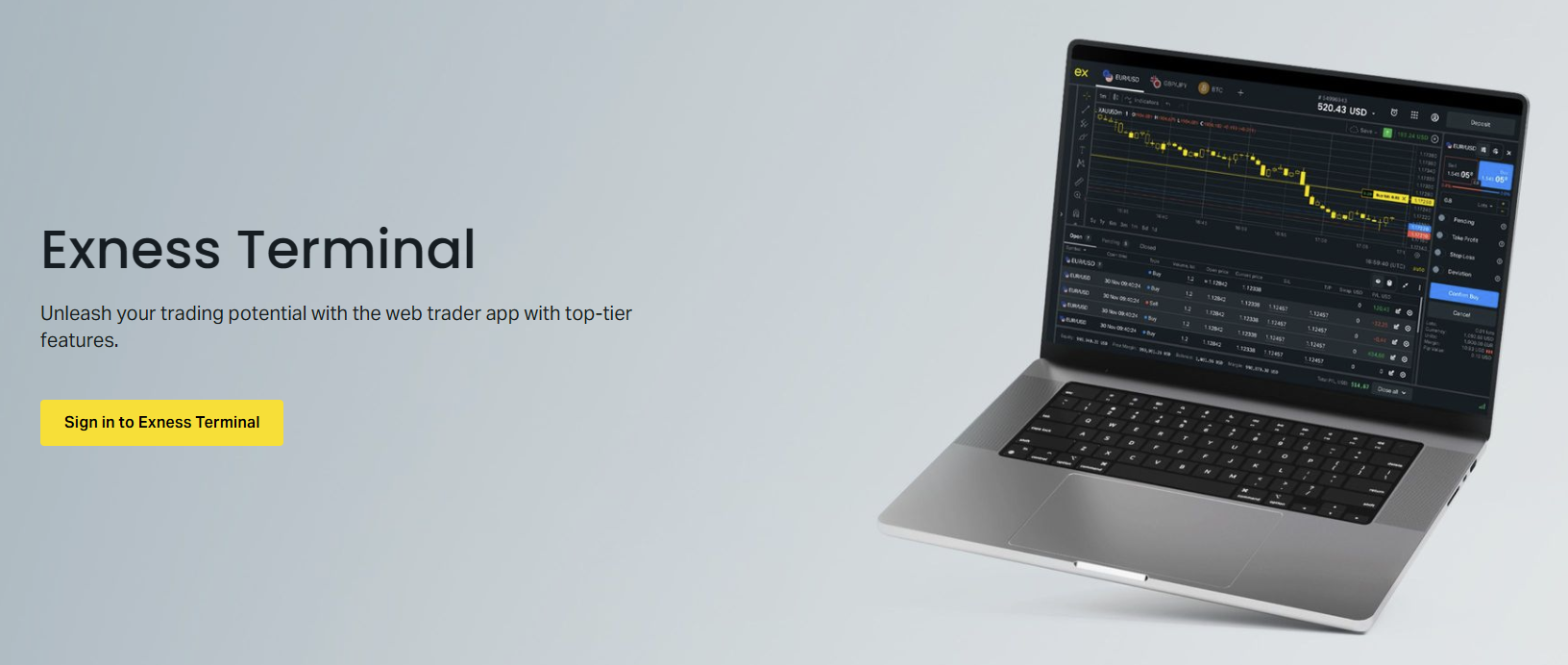
The web terminal includes TradingView-powered charts, one-click trading from the chart, and a customizable watchlist. It loads faster than MT5 for quick checks but lacks expert advisors and custom indicators. MT5 on desktop remains the choice for algorithmic traders and those who rely on custom tools. The mobile app syncs watchlists and chart templates across devices, so a layout built on desktop appears on your phone automatically.
- MT5: full stock list, depth of market, EAs, custom indicators, hedging/netting
- MT4: limited stock list, no depth of market, EAs, hedging only
- Web Terminal: full stock list, TradingView charts, no EAs, no custom indicators
- Mobile App: full stock list, TradingView charts, push notifications, biometric login
Account Types and Which One Fits Stock Trading
Choosing an account comes down to trade frequency, position size, and whether you prefer all-in pricing or raw spreads with commission. Standard and Standard Cent are the simplest — no commission math, instant execution, and a $1 minimum deposit. Cent accounts denominate balance in cents, which helps beginners manage risk in smaller increments. Pro accounts suit traders who want low spreads without commission but can meet the $200 minimum. Raw Spread and Zero target high-volume traders; the commission adds up quickly on small positions but saves money on larger ones.
Scroll horizontally to see all columns
| Trader Profile | Recommended Account | Reason |
|---|---|---|
| Beginner, small positions, learning | Standard Cent | Cent denomination reduces nominal risk |
| Casual trader, few trades per week | Standard | No commission, simple cost structure |
| Active day trader, multiple positions daily | Raw Spread | Tight spreads offset commission at volume |
| Scalper or high-frequency EA user | Zero | Lowest spreads, stable execution |
| Swing trader holding days to weeks | Pro or Standard | No commission drag on longer holds |
All accounts support stock CFDs. Islamic (swap-free) versions exist for Standard, Pro, Raw Spread, and Zero — they replace overnight financing with a fixed daily administration fee. The fee varies by instrument and is disclosed in the client area. Professional clients can apply for higher leverage and access the same account types with different margin rules.
How to Open Your First Stock Trade on Exness
The process takes a few minutes if you already have a verified account. Log into your Personal Area, create a trading account if needed, fund it, then open the platform of your choice. In the market watch or symbol search, type the ticker (e.g., AAPL). Double-click the symbol or right-click and select "New Order." Choose volume in lots — one lot equals 100 shares for most U.S. stocks. Set stop loss and take profit if desired, then click Buy or Sell by Market.
- Register and verify identity in Personal Area (KYC required)
- Create a trading account — select type, leverage, base currency
- Deposit via card, crypto, e-wallet, or bank transfer
- Download MT5 or open Web Terminal from Personal Area
- Search symbol (AAPL, TSLA, MSFT, etc.)
- Set volume: 1 lot = 100 shares for U.S. stocks
- Add stop loss and take profit (optional but recommended)
- Execute market order or place pending order
Pending orders (buy limit, sell limit, buy stop, sell stop) work the same way as forex. Exness also offers trailing stops on MT5 and the web terminal — the stop follows price at a fixed distance once the trade moves in your favor. Partial close is available: right-click the position and select "Close Partially" to reduce exposure while letting the remainder run.
Trading Hours and Session Nuances
Stock CFDs follow the underlying exchange hours. U.S. stocks trade 13:30–20:00 UTC (9:30 AM–4:00 PM Eastern). Pre-market runs 12:00–13:30 UTC and after-hours 20:00–00:00 UTC, but liquidity is thinner and spreads wider. European stocks generally trade 07:00–15:30 UTC. The platform displays the current session status next to each symbol — a green dot means the market is open, gray means closed.
Corporate earnings reports often release before the open or after the close. If you hold positions through these events, expect gaps and slippage. Exness executes at the first available price after a gap; stop losses are not guaranteed. Consider reducing size or closing ahead of known catalysts unless your strategy specifically targets earnings volatility.
Risk Management Tools on Exness
Exness provides several built-in risk controls. Negative balance protection ensures you cannot lose more than your account equity — the broker absorbs any deficit. Margin call triggers at 60% margin level; stop out executes at 0% (positions close automatically). You can set custom margin call alerts in the Personal Area. The trading calculator (web and app) lets you simulate margin, pip value, and swap before entering a trade.
Position sizing is the most effective risk lever. With 1:20 leverage, a 1-lot AAPL position (100 shares) at $180 requires $900 margin. A 5% move against you wipes out $900 — half the margin. Many traders limit risk to 1–2% of equity per trade. On a $5,000 account, that means $50–$100 risk, which translates to roughly 0.05–0.1 lots on AAPL with a $10–$20 stop distance. The calculator makes this arithmetic instant.
Fees Beyond Spreads and Commissions
Deposit and withdrawal fees depend on the payment method. Most e-wallets (Skrill, Neteller, Perfect Money) and crypto deposits are free and instant. Card deposits are free but may incur issuer fees. Bank transfers can take 1–3 business days and may carry intermediary bank charges. Withdrawals follow the same method as deposits where possible. Exness does not charge inactivity fees, and there are no platform or data fees.
Scroll horizontally to see all columns
| Method | Deposit Time | Withdrawal Time | Exness Fee |
|---|---|---|---|
| Visa / Mastercard | Instant | 1–3 business days | None |
| Skrill / Neteller | Instant | Instant | None |
| Perfect Money | Instant | Instant | None |
| Crypto (USDT, BTC, ETH) | Instant (1–3 confirmations) | Instant | None |
| Bank Transfer | 1–3 business days | 1–5 business days | None (bank fees may apply) |
Currency conversion applies if your account base currency differs from the instrument's quote currency. Exness converts at the prevailing rate with a small markup (typically 0.5–1%). Holding a USD-denominated account avoids this for U.S. stocks. For European stocks quoted in EUR, a EUR-based account saves conversion costs.
Stock CFDs vs. Real Shares: What You Give Up
Trading stock CFDs on Exness means you never own the underlying shares. You cannot vote at shareholder meetings, you do not receive physical dividends (only cash adjustments), and you cannot transfer positions to another broker. There is no shareholder perks program. On the other hand, you gain leverage, the ability to short without borrowing, lower capital requirements, and access to a single platform for forex, indices, commodities, and crypto alongside equities.
- No voting rights or corporate actions participation
- Dividend adjustments are cash-only, net of withholding tax
- Short selling available without locate or borrow fees
- Leverage up to 1:20 (retail) or 1:50 (pro)
- No custody fees or settlement delays
- Positions cannot be transferred out — must close and reopen elsewhere
Tax treatment differs by jurisdiction. In many countries, CFD profits are taxed as ordinary income or capital gains, but the rules vary. Some jurisdictions treat CFDs as gambling (tax-free), others as derivatives with specific reporting. Exness does not provide tax advice and does not issue consolidated tax statements. You are responsible for tracking your own P&L and consulting a local tax professional.
Execution Quality and Order Types
Exness operates a hybrid execution model. Market orders fill at the best available price from liquidity providers. Limit and stop orders rest on the broker's order book until triggered. The broker publishes quarterly execution statistics showing average fill speed, slippage distribution, and requote rates. For major U.S. stocks during regular hours, median fill time is under 20 milliseconds with minimal slippage. During high-volatility events (earnings, Fed announcements), slippage can reach several ticks.
Requotes are rare on liquid names but can occur during fast markets if the requested price is no longer available. The platform will prompt you to accept the new price or cancel. You can disable requote prompts in MT5 settings to auto-reject, which effectively turns market orders into fill-or-kill. The web terminal does not currently offer this toggle.
Analytical Tools and Research
Exness integrates TradingView charts across its web terminal and mobile app, providing 100+ indicators, drawing tools, and multiple chart types. MT5 adds its own indicator library and supports custom MQL5 indicators. The Economic Calendar (web and app) flags earnings dates, dividend ex-dates, and macro events. Trading Central signals appear in the terminal for major stocks, offering technical levels and directional bias. Market news from FXStreet streams in the platform and Personal Area.
Fundamental data is limited. You get basic company info (sector, market cap, description) but no financial statements, analyst ratings, or earnings estimates inside the platform. For deeper research, most traders use external sources — Yahoo Finance, SEC filings, or paid terminals — and execute on Exness. The broker's blog and education section publish occasional stock-specific articles, but they are not a substitute for dedicated equity research.
Mobile Trading Experience for Stocks
The Exness mobile app (iOS and Android) delivers the full stock CFD catalog with TradingView charts, one-tap trading, and push notifications for price alerts, margin calls, and order fills. The watchlist syncs with desktop. Biometric login (Face ID, fingerprint) secures access. You can deposit, withdraw, and manage verification documents from the app. Chart templates and drawings sync via cloud — a trendline drawn on desktop appears on mobile automatically.
The mobile app is genuinely usable for active management, not just monitoring. One-tap close and modify orders work reliably even on modest connections.
Screen real estate is the main limitation. Complex multi-timeframe analysis is cramped on a phone; a tablet or desktop is better for planning. The app includes a compact order ticket that slides up from the bottom — tap the bid or ask on the chart to pre-fill direction. Landscape mode expands the chart but hides the watchlist. For serious day trading, most users keep a desktop or web terminal open and use mobile for alerts and emergency exits.
Regulatory Entities and Client Protections
Exness operates through several licensed entities. Exness (Cy) Ltd is regulated by CySEC (Cyprus) and serves EEA clients under MiFID II. Exness B.V. is authorized by the FSA (Seychelles) for international clients. Exness (UK) Ltd holds FCA authorization for UK residents. Exness ZA (PTY) Ltd is licensed by the FSCA (South Africa). The entity you onboard with determines your leverage caps, negative balance protection scope, and compensation scheme eligibility. CySEC and FCA clients benefit from investor compensation funds (up to €20,000 and £85,000 respectively).
Client funds are segregated from operational funds at Tier-1 banks. Exness publishes quarterly audit reports from Deloitte confirming segregation and capital adequacy. The broker does not offer guaranteed stop losses — stops execute at the next available price. Professional clients can opt out of negative balance protection in exchange for higher leverage, but this is not available to retail clients under any entity.
Common Pitfalls and How to Avoid Them
New stock CFD traders on Exness often stumble on the same issues. Trading U.S. stocks during Asian hours with 5-pip spreads turns small profits into losses. Holding positions through earnings without adjusting size leads to gap risk. Forgetting swap charges on multi-day swings erodes returns. Using maximum leverage on a small account triggers stop-outs on normal intraday volatility. And switching between MT4 and MT5 without realizing the stock catalog differs causes missing-symbol errors.
- Check session time before entering — avoid off-hours spreads
- Reduce size or close before earnings unless trading the event
- Factor swap into hold-time calculations
- Risk 1–2% per trade, not 10–20%
- Use MT5 or web terminal for full stock list; MT4 is limited
- Set price alerts for key levels instead of watching charts constantly
Another overlooked detail: dividend adjustments on short positions. If you are short a stock on the ex-dividend date, the dividend amount is debited from your account. This can be significant for high-yield names. The economic calendar flags ex-dividend dates — check it before holding shorts overnight around those dates.
Frequently Asked Questions
What stocks can I trade on Exness?
Over 100 large-cap U.S. and European stock CFDs including Apple, Microsoft, Tesla, Nvidia, ASML, and LVMH. Small-cap and emerging-market equities are not available.
What is the maximum leverage for stock CFDs?
1:20 for retail clients on all account types. Professional clients who qualify can access up to 1:50 on select equities.
Does Exness charge commission on stock trades?
Standard and Pro accounts have zero commission — costs are in the spread. Raw Spread and Zero accounts charge $3.50 per side per lot with tighter spreads.
Can I short sell stocks on Exness?
Yes. Short positions are available on all stock CFDs without locate requirements or borrow fees. Dividend adjustments are charged to short holders on ex-dividend dates.
Which platform is best for stock trading on Exness?
MetaTrader 5 offers the full symbol list, depth of market, and algorithmic support. The web terminal is best for browser-based access with TradingView charts. MT4 has a reduced stock catalog.
Are dividends paid on stock CFDs?
Cash adjustments apply. Long positions receive the net dividend (after withholding tax). Short positions are debited the gross dividend amount.
What are the trading hours for U.S. stocks?
Main session 13:30–20:00 UTC. Pre-market 12:00–13:30 UTC and after-hours 20:00–00:00 UTC with wider spreads and lower liquidity.
Is there a minimum deposit to trade stocks?
Standard and Standard Cent accounts require $1. Pro, Raw Spread, and Zero require $200.
Final Assessment of Exness Stock Trading
Exness delivers a competent stock CFD offering for traders who want equities alongside forex, indices, and crypto on one platform. The catalog covers the names most retail traders actually watch — large-cap U.S. tech and European blue chips — and the pricing is competitive during primary exchange hours. The multi-platform approach (MT5, web terminal, mobile) works well, and the account structure lets you match cost style to trading frequency. The main gaps are the limited universe (no small caps, no Asian equities), off-hours spread widening, and the absence of deep fundamental research tools. If your strategy focuses on liquid large-cap names during regular sessions, Exness is a solid choice. If you need broad global equity coverage or institutional-grade research, you will need a dedicated stock broker alongside or instead.