

Forex Trading
Exness Leverage Explained: Limits, Rules, and Practical Use
A detailed look at leverage tiers, eligibility, and risk considerations for Exness traders.

Senior Forex Trader & Market Analyst
Daniel Chen is an experienced forex trader and financial market analyst with over 15 years of experience in currency trading. He specializes in technical analysis, risk management, and developing practical trading strategies to help traders make informed decisions.
Leverage is one of the first settings a trader encounters when opening an Exness account, yet it remains one of the most misunderstood. The broker advertises ratios up to 1:2000 on certain accounts and promotes an unlimited leverage feature that sounds almost too good to be true. In practice, the numbers you see on the website are only the starting point. Regulatory restrictions, account equity thresholds, instrument-specific caps, and automatic margin adjustments during news events all shape what you can actually use at any given moment.
Contents
- 1. What Exness Leverage Means for Your Trading
- 2. Standard Leverage Tiers Across Account Types
- 3. Unlimited Leverage: Eligibility and Conditions
- 4. How Margin Requirements Change with Leverage
- 5. Leverage Restrictions During High Volatility
- 6. Instrument-Specific Leverage Limits
- 7. Calculating Position Size with Exness Leverage
- 8. Risk Management When Using High Leverage
- 9. Comparing Exness Leverage to Other Brokers
- 10. Final Assessment of Exness Leverage Options
This article breaks down how Exness leverage works across its account types, what the unlimited leverage offer actually requires, how margin calculations change when you scale position size, and where the hidden limits tend to catch traders off guard. The goal is not to repeat marketing copy but to give you a clear picture of the mechanics so you can decide what level of leverage fits your strategy and risk tolerance.
If you have traded with other brokers, you will notice that Exness structures leverage differently than the typical fixed-tier model. Instead of locking you into a single maximum based on your account type, Exness applies dynamic leverage that steps down as your equity grows. This means a trader with $500 and a trader with $50,000 on the same account type may face different effective maximums. Understanding those steps is essential for position sizing and for avoiding unexpected margin calls.
What Exness Leverage Means for Your Trading
At its core, leverage on Exness lets you control a larger position with a smaller amount of capital. A 1:500 ratio means every dollar in your account can control $500 of notional value. The margin required to open a position is the notional value divided by the leverage. So a standard lot of EURUSD at 1.1000 with 1:500 leverage requires $220 in margin (100,000 × 1.1000 ÷ 500). The same position at 1:2000 requires only $55. The lower margin requirement frees up capital for other trades or provides a larger buffer against adverse price moves, but it also means a smaller price move can wipe out your equity.
Exness offers several account types: Standard, Standard Cent, Pro, Raw Spread, and Zero. Each has a advertised maximum leverage, but the actual maximum you can use at any moment depends on your account equity and the instrument you are trading. The Standard and Standard Cent accounts show a maximum of 1:2000. Pro, Raw Spread, and Zero accounts show 1:2000 as well, though the typical default for new clients is often set lower. The unlimited leverage feature is a separate program with its own eligibility rules, which we will cover in detail.
It is important to distinguish between the leverage setting you choose in your Personal Area and the effective leverage applied to a specific trade. You can set your account leverage to 1:2000, but if you open a position on XAUUSD when your equity exceeds $1,000, the platform will automatically apply a lower leverage tier for that instrument. The setting in your profile acts as a ceiling, not a guarantee.
Standard Leverage Tiers Across Account Types
Exness uses a dynamic leverage model that reduces the maximum available leverage as your account equity increases. The tiers are published on the Exness website and apply to most forex pairs. For equity up to $999, the maximum is 1:2000. From $1,000 to $4,999, it drops to 1:1000. From $5,000 to $29,999, it becomes 1:500. From $30,000 to $99,999, it is 1:200. Above $100,000, the maximum is 1:100. These thresholds apply per account, not across your entire Personal Area. If you have multiple accounts, each one is evaluated independently.
The Standard Cent account follows the same equity tiers but with a lower ceiling of 1:1000 for the lowest equity band. This is because cent accounts use a different contract size (1 cent lot = 1,000 units instead of 100,000), and the leverage structure is calibrated accordingly. Pro, Raw Spread, and Zero accounts share the same tiers as Standard. The key takeaway is that as your account grows, your maximum leverage automatically decreases. You cannot override this by changing the leverage setting in your profile; the platform will ignore settings that exceed the equity-based cap.
Scroll horizontally to see all columns
| Account Equity (USD) | Maximum Leverage | Applicable Accounts |
|---|---|---|
| 0 – 999 | 1:2000 | Standard, Pro, Raw Spread, Zero |
| 1,000 – 4,999 | 1:1000 | Standard, Pro, Raw Spread, Zero |
| 5,000 – 29,999 | 1:500 | Standard, Pro, Raw Spread, Zero |
| 30,000 – 99,999 | 1:200 | Standard, Pro, Raw Spread, Zero |
| 100,000+ | 1:100 | Standard, Pro, Raw Spread, Zero |
| 0 – 999 | 1:1000 | Standard Cent |
| 1,000 – 4,999 | 1:500 | Standard Cent |
| 5,000 – 29,999 | 1:200 | Standard Cent |
| 30,000 – 99,999 | 1:100 | Standard Cent |
| 100,000+ | 1:50 | Standard Cent |
These tiers apply to major and minor forex pairs. Exotic pairs, metals, energies, indices, stocks, and cryptocurrencies have their own fixed maximums that are often lower than the forex tiers. For example, XAUUSD typically caps at 1:400 regardless of equity, while some crypto pairs may be limited to 1:10 or 1:20. The platform enforces these instrument caps in real time, so even if your equity qualifies for 1:2000, you cannot use it on gold.
The dynamic leverage system is designed to protect both the broker and the trader. Higher equity means larger potential losses in absolute terms, so reducing leverage at higher equity bands limits systemic risk. For traders, it means you need to adjust your position sizing as your account grows. A strategy that works with 1:2000 on a $500 account will require different lot sizes at 1:500 on a $10,000 account to maintain the same risk profile.
Unlimited Leverage: Eligibility and Conditions
The unlimited leverage feature is Exness's most talked-about offering. It allows eligible clients to trade with no margin requirement on forex pairs, effectively removing the leverage ceiling. However, the term "unlimited" applies only to forex majors and minors. Metals, energies, indices, stocks, and crypto remain subject to their standard fixed caps. The feature is not available to all clients by default. You must meet specific criteria and apply for it through your Personal Area.
To qualify for unlimited leverage, your account must have a minimum equity of $1,000 at the time of application. You must also have completed at least 10 round-trip trades (open and close) with a total volume of at least 5 lots on that account. These requirements are verified automatically when you submit the request. If approved, the unlimited leverage status applies to that specific account only. Other accounts in your Personal Area retain their standard dynamic leverage tiers.
There are important caveats. Unlimited leverage does not mean zero margin across the board. The margin requirement for forex positions becomes zero, but you still need sufficient free margin to cover floating losses. If your equity drops below the maintenance margin level, the stop-out mechanism still triggers. Additionally, Exness reserves the right to disable unlimited leverage during periods of extreme volatility, such as major economic announcements or geopolitical events. When this happens, the account reverts to the standard dynamic leverage tiers until conditions normalize.
Traders often ask whether unlimited leverage is worth pursuing. The answer depends on your trading style. Scalpers and high-frequency traders who open many small positions benefit most because they can deploy capital across more concurrent trades without margin constraints. Swing traders holding positions for days may find the benefit marginal, since they typically use lower leverage anyway. The real risk is psychological: zero margin can encourage over-leveraging, turning a manageable drawdown into a stop-out because there is no margin buffer to absorb temporary adverse moves.
How Margin Requirements Change with Leverage
Margin is the collateral Exness holds to keep your positions open. It is calculated as notional value divided by leverage. When leverage changes — either because you adjusted your profile setting, your equity crossed a tier threshold, or you switched instruments — the margin requirement for new positions changes immediately. Existing positions retain the margin rate at the time they were opened, but any additional volume on the same symbol uses the current rate.
This creates a situation where a trader with multiple positions on the same pair may have different effective leverage across those positions. For example, you open 1 lot EURUSD at 1:2000 when your equity is $800. Later your equity grows to $2,000, and the maximum leverage drops to 1:1000. You open another 1 lot EURUSD. The first lot still uses 1:2000 margin ($55), while the second uses 1:1000 margin ($110). The platform aggregates these for margin reporting, but the distinction matters if you partially close positions.
Scroll horizontally to see all columns
| Leverage | Margin for 1 Lot EURUSD @ 1.1000 | Margin for 0.1 Lot XAUUSD @ 2000 | Margin for 1 Lot US30 @ 35000 |
|---|---|---|---|
| 1:2000 | $55 | $100 | $1,750 |
| 1:1000 | $110 | $200 | $3,500 |
| 1:500 | $220 | $400 | $7,000 |
| 1:200 | $550 | $1,000 | $17,500 |
| 1:100 | $1,100 | $2,000 | $35,000 |
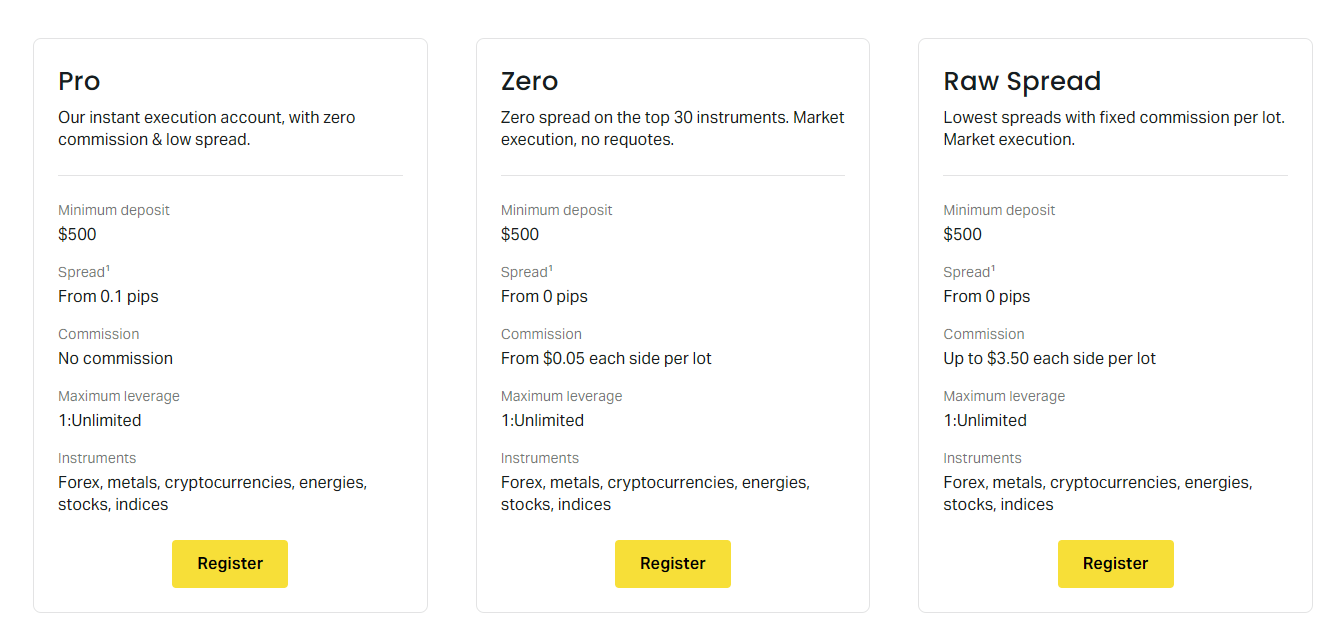
The table above assumes the instrument allows the listed leverage. In reality, XAUUSD caps at 1:400 and US30 at 1:200 on most accounts, so the actual margin for those instruments would be higher than shown for the 1:2000 and 1:1000 rows. Always check the contract specifications in your trading terminal for the current maximum leverage per symbol. The Exness trading calculator on their website and in the Personal Area is a reliable tool for checking exact margin requirements before you enter a trade.
Free margin is your equity minus used margin. It determines how much room you have to open new positions or absorb floating losses. When free margin approaches zero, you risk a margin call (notification) and eventually a stop-out (forced closure). Exness uses a stop-out level of 0% for most accounts, meaning positions are closed when margin level (equity ÷ used margin × 100%) hits 0%. This is more aggressive than brokers who stop out at 20% or 50%, giving you more room but also allowing losses to accumulate deeper before intervention.
Leverage Restrictions During High Volatility
Exness applies temporary leverage reductions during major news events and periods of extreme market volatility. This is a risk management measure to protect both clients and the broker from gap risk and liquidity shortages. The restrictions typically begin 15 minutes before a high-impact economic release (such as NFP, CPI, FOMC decisions, or central bank rate announcements) and last for 15 minutes after the release. During this window, maximum leverage on affected forex pairs may be reduced to 1:200 or lower, regardless of your account equity or unlimited leverage status.
The specific pairs affected depend on the event. For US NFP, all USD pairs are usually restricted. For ECB decisions, EUR pairs are targeted. Exness publishes a schedule of upcoming leverage changes in the Economic Calendar section of their website and in the Personal Area. The calendar shows the event time, affected instruments, and the temporary maximum leverage. It is your responsibility to check this calendar if you hold positions over news events. The platform does not send individual notifications for every leverage change.
If you have open positions when a restriction takes effect, your used margin will increase because the effective leverage on those positions drops. This can trigger a margin call or stop-out if your free margin was already thin. The safest approach is to either reduce position size before high-impact news or ensure you have ample free margin to absorb the margin increase. Some traders close all positions 30 minutes before major releases and re-enter after the volatility subsides.
Instrument-Specific Leverage Limits
Forex pairs are the only instruments that follow the dynamic equity-based leverage tiers. Every other asset class has fixed maximum leverage that does not change with your account equity. These caps are set by Exness based on liquidity, volatility, and regulatory guidelines. Knowing them is essential for position sizing, especially if you trade a diversified portfolio.
Scroll horizontally to see all columns
| Instrument Class | Typical Maximum Leverage | Notes |
|---|---|---|
| Forex Majors/Minors | Dynamic (up to 1:2000) | Equity-based tiers apply |
| Forex Exotics | 1:200 | Fixed regardless of equity |
| Gold (XAUUSD) | 1:400 | Fixed, lower during news |
| Silver (XAGUSD) | 1:200 | Fixed |
| Other Metals | 1:100 – 1:200 | Varies by symbol |
| Energies (Oil, Gas) | 1:100 – 1:200 | Fixed |
| Indices | 1:100 – 1:200 | Varies by index |
| Stocks | 1:20 – 1:50 | Fixed, regulatory limits |
| Cryptocurrencies | 1:10 – 1:20 | Fixed, high volatility |
These limits are enforced at the platform level. You cannot request higher leverage on indices or crypto, even with unlimited leverage enabled on your account. The unlimited feature explicitly excludes non-forex instruments. If you attempt to open a position exceeding the instrument cap, the order will be rejected with a margin error. The contract specifications in MT4, MT5, and the Exness Web Terminal show the exact maximum leverage for each symbol.
A practical implication is that a trader with a $500 account using 1:2000 on EURUSD may only use 1:20 on Bitcoin. This means the margin for a $10,000 BTCUSD position is $500 (1:20), while the same notional value in EURUSD would require only $5 (1:2000). The capital efficiency difference is massive. If you allocate capital across asset classes, you must size positions based on the most restrictive instrument in your portfolio, not the forex maximum.
Calculating Position Size with Exness Leverage
Position sizing is where leverage theory meets practice. The formula is straightforward: position size (in lots) = (account equity × risk percentage) ÷ (stop loss in pips × pip value per lot). Leverage does not appear directly in this formula, but it constrains the maximum position size you can open given your available margin. If your calculated position size requires more margin than you have free, you must either reduce the position, widen the stop loss (increasing risk), or add funds.
Let's work through an example. You have a $2,000 Standard account. Your equity places you in the 1:1000 tier. You want to risk 2% ($40) on a EURUSD trade with a 20-pip stop loss. Pip value for 1 lot EURUSD is $10. The position size is $40 ÷ (20 × $10) = 0.2 lots. Margin required at 1:1000 for 0.2 lots EURUSD @ 1.1000 is 20,000 × 1.1000 ÷ 1000 = $22. Your free margin is $2,000 (assuming no other positions), so the trade fits easily. Now suppose you want to risk the same $40 on XAUUSD with a 200-pip (2000-point) stop loss. Pip value for 1 lot XAUUSD is $10 per 100 points, so $1 per pip. Position size = $40 ÷ (200 × $1) = 0.2 lots. Margin at 1:400 for 0.2 lots XAUUSD @ 2000 = 20,000 × 2000 ÷ 400 = $100,000? Wait, that's wrong. Let me recalculate: 0.2 lots = 20 ounces. Notional = 20 × 2000 = $40,000. Margin at 1:400 = $40,000 ÷ 400 = $100. Still fits, but uses more margin relative to the forex trade.
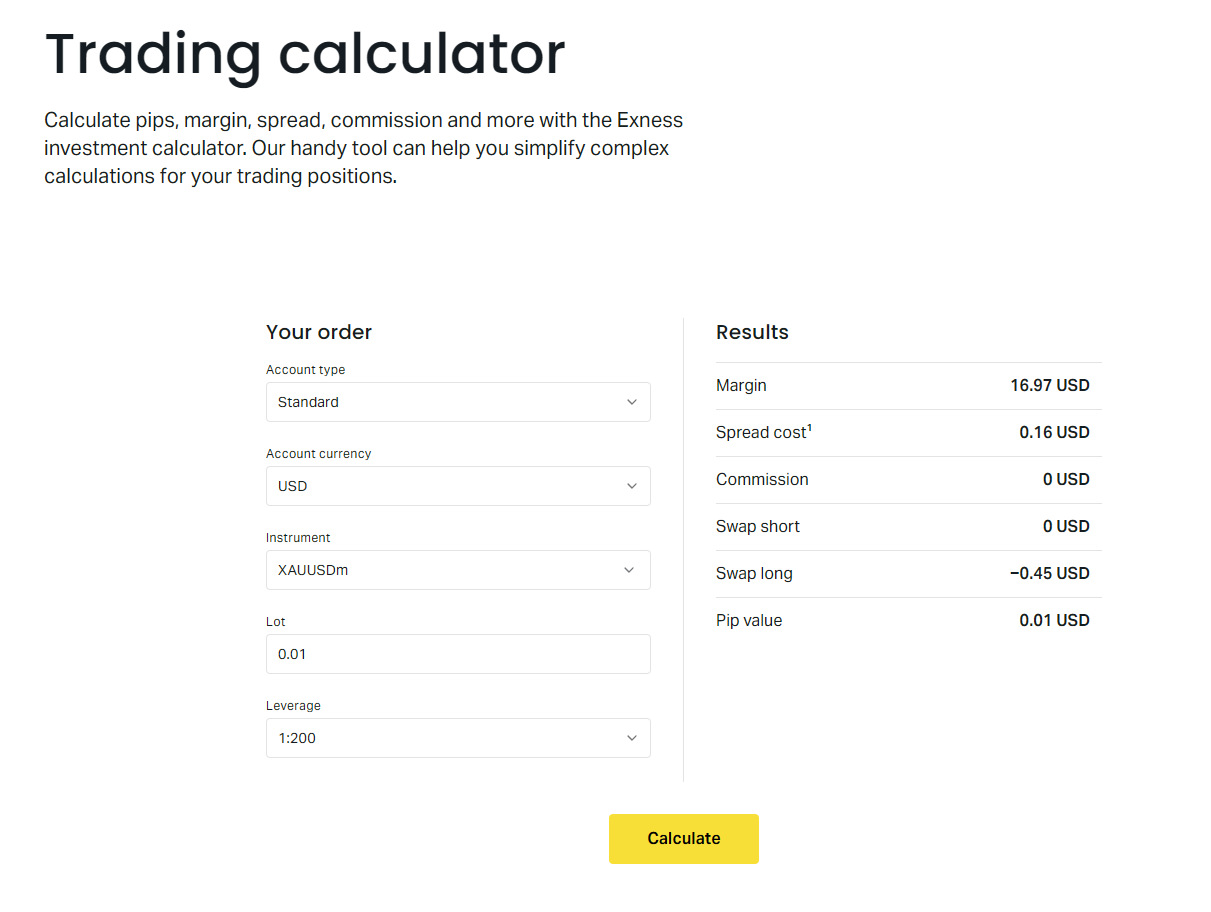
The Exness trading calculator automates this. You enter your account currency, leverage, symbol, volume, and entry/exit prices, and it returns required margin, pip value, and swap costs. It is available in the Personal Area and on the Exness website. I recommend using it for every trade until the math becomes intuitive. The calculator also shows the margin level after the trade opens, which helps you avoid accidental over-leveraging.
One nuance: the calculator uses the current maximum leverage for the symbol based on your account equity. If you are near a tier boundary, the result may change after your next deposit or withdrawal. Always verify the leverage tier in your Personal Area before sizing a large position. The tier is displayed next to your account number and updates in real time as equity changes.
Risk Management When Using High Leverage
High leverage does not force you to take high risk, but it makes it easier to do so unintentionally. The primary risk is not the leverage ratio itself but the position size it enables. A trader with $1,000 at 1:2000 can open 4 lots of EURUSD (margin $220), leaving $780 free margin. A 20-pip move against the position equals $800 loss — nearly the entire account. At 1:100, the same trader could only open 0.2 lots (margin $220), and a 20-pip move loses $40. The leverage allowed the larger position; the trader chose to use it.
Effective risk management with Exness leverage starts with defining your risk per trade in dollar terms, not lot size. Decide the maximum percentage of equity you are willing to lose on a single trade (commonly 1–2%). Calculate the position size that corresponds to that risk given your stop loss distance. Then check if the required margin fits within your free margin at the current leverage tier. If it does not, you have three options: reduce position size, widen stop loss (which changes the risk/reward), or deposit more funds. Do not increase leverage to make the trade fit — the leverage tier is fixed by your equity.
Another risk specific to Exness is the 0% stop-out level. Most brokers stop out at 20–50% margin level, which forces closure before losses exceed equity. Exness allows margin level to reach 0%, meaning you can lose more than your used margin if prices gap against you. In practice, the platform closes positions one by one starting with the largest loss, but during extreme gaps (weekend gaps, flash crashes), the executed price may be far below the stop-out trigger. This is not unique to Exness, but the 0% level gives less warning. Maintain a margin level above 200% if you want a comfortable buffer.
Comparing Exness Leverage to Other Brokers
Exness's leverage offering is among the highest in the industry for retail clients. Many regulated brokers cap leverage at 1:30 (EU/UK/Australia) or 1:50 (US) due to regulatory mandates. Exness operates under multiple licenses, including CySEC (EU), FCA (UK), FSCA (South Africa), and others. The high leverage tiers (1:2000, unlimited) are typically available only under the offshore entity (Exness VG Ltd, registered in Seychelles) or for clients who qualify as professional/elective professional under certain jurisdictions. Retail clients under CySEC or FCA are restricted to 1:30 regardless of the account type.
This jurisdictional split is critical. When you register, Exness assigns you to an entity based on your country of residence. A trader in Germany gets the CySEC entity with 1:30 max leverage. A trader in South Africa may get the FSCA entity with higher limits. A trader in an unrestricted jurisdiction gets the Seychelles entity with 1:2000 and unlimited leverage eligibility. You cannot choose your entity; it is determined by compliance. The leverage you see in marketing materials applies only to the offshore entity.
Scroll horizontally to see all columns
| Entity / Jurisdiction | Retail Max Leverage | Professional Max Leverage | Unlimited Leverage |
|---|---|---|---|
| Exness (CySEC) – EU | 1:30 | 1:500 | Not available |
| Exness (FCA) – UK | 1:30 | 1:500 | Not available |
| Exness (FSCA) – South Africa | 1:200 | 1:2000 | Available |
| Exness (VG Ltd) – Seychelles | 1:2000 | 1:2000 | Available |
If you are comparing brokers solely on maximum leverage, Exness's offshore entity wins on paper. But leverage is only one dimension. Spreads, commissions, execution quality, withdrawal speed, and regulatory protection matter equally or more. A broker offering 1:30 with tight spreads and strong regulation may be preferable to 1:2000 with wider spreads and weaker oversight. The unlimited leverage feature is unique to Exness among major brokers, but it comes with the trade-offs discussed earlier: jurisdictional limitations, news restrictions, and psychological risk.
Final Assessment of Exness Leverage Options
Exness leverage is a toolkit, not a single number. The dynamic tier system means your effective maximum changes as your account grows. The unlimited leverage program removes margin on forex for qualified traders but introduces new risks and restrictions. Instrument caps limit diversification benefits at high leverage. News-driven reductions can catch unprepared positions. And your regulatory entity determines whether you have access to the highest tiers at all.
For a new trader with a small account under the offshore entity, 1:2000 provides flexibility to learn position sizing without committing large capital. For a growing account, the step-down tiers force discipline — you cannot simply keep scaling position size with the same leverage. For professionals who qualify, unlimited leverage enables capital-efficient multi-pair strategies but demands rigorous risk controls. The broker provides the calculator, the calendar, and the contract specs. The rest is up to you.
If you are evaluating Exness primarily for leverage, verify your assigned entity first. Check the Economic Calendar for upcoming restrictions. Test the trading calculator with your intended position sizes. And remember that the highest leverage is rarely the optimal leverage for consistent results. The best leverage is the one that lets you execute your strategy without fear of a margin call from normal market noise.
Frequently Asked Questions
What is the maximum leverage Exness offers?
Exness offers up to 1:2000 on Standard, Pro, Raw Spread, and Zero accounts for clients under the offshore entity. Unlimited leverage (zero margin on forex) is available for eligible accounts with $1,000 equity and 10 closed trades of 5 lots total volume. Regulatory entities in EU, UK, and Australia cap retail leverage at 1:30.
How does Exness dynamic leverage work?
Maximum leverage decreases as account equity increases. Tiers: 0–$999 equity = 1:2000; $1,000–$4,999 = 1:1000; $5,000–$29,999 = 1:500; $30,000–$99,999 = 1:200; $100,000+ = 1:100. Standard Cent has lower caps. The platform enforces this automatically regardless of your profile leverage setting.
Can I use unlimited leverage on gold or crypto?
No. Unlimited leverage applies only to forex majors and minors. Gold (XAUUSD) is capped at 1:400, silver at 1:200, indices at 1:100–1:200, stocks at 1:20–1:50, and cryptocurrencies at 1:10–1:20. These limits are fixed and do not change with equity or unlimited leverage status.
Does Exness reduce leverage during news events?
Yes. During high-impact economic releases, Exness temporarily reduces maximum leverage on affected pairs, often to 1:200. This starts 15 minutes before and ends 15 minutes after the event. Unlimited leverage is also suspended during these windows. Check the Economic Calendar for scheduled restrictions.
What is the stop-out level at Exness?
Exness uses a 0% stop-out level for most accounts. Positions are closed automatically when margin level (equity ÷ used margin × 100%) reaches 0%. This allows deeper drawdowns before forced closure compared to brokers with 20–50% stop-out levels, but also means losses can exceed used margin during price gaps.
How do I check my current leverage tier?
Log into your Personal Area. The current maximum leverage for your account is displayed next to your account number and updates in real time as equity changes. You can also see the tier thresholds in the account settings section.
Can I change my regulatory entity to get higher leverage?
No. Your entity is assigned based on your country of residence and regulatory requirements during registration. You cannot manually switch entities. If you move to a different country, you would need to contact support and provide proof of residence for a potential entity transfer, subject to compliance approval.