
Forex & CFD Trading
Exness Indices Trading: Complete Guide to Index CFDs
Everything you need to know about trading index CFDs on Exness, from available markets to trading conditions and platforms.

Senior Forex Trader & Market Analyst
Daniel Chen is an experienced forex trader and financial market analyst with over 15 years of experience in currency trading. He specializes in technical analysis, risk management, and developing practical trading strategies to help traders make informed decisions.
Exness offers one of the broader index CFD selections among retail brokers. You can trade more than a dozen major global indices covering the United States, Europe, Asia, and Australia. The lineup includes the NASDAQ 100, S&P 500, Dow Jones Industrial Average, DAX 40, FTSE 100, Nikkei 225, and several others. Each index is available as a contract for difference, meaning you speculate on price movement without owning the underlying basket of stocks.
Contents
- 1. Major Global Indices Available on Exness
- 2. Exness NASDAQ Symbol and US Tech 100 Details
- 3. S&P 500 and Dow Jones Trading Conditions
- 4. European and Asian Index Coverage
- 5. Trading Platforms for Index CFDs
- 6. Account Types and Index Access
- 7. Synthetic Indices and Volatility 75 — Not Available
- 8. Risk Management Tools for Index Traders
- 9. How to Start Trading Indices on Exness
- 10. Trading Costs: Spreads, Commissions, and Swaps
- 11. Execution Quality and Slippage
- 12. Key Takeaways on Exness Indices Trading
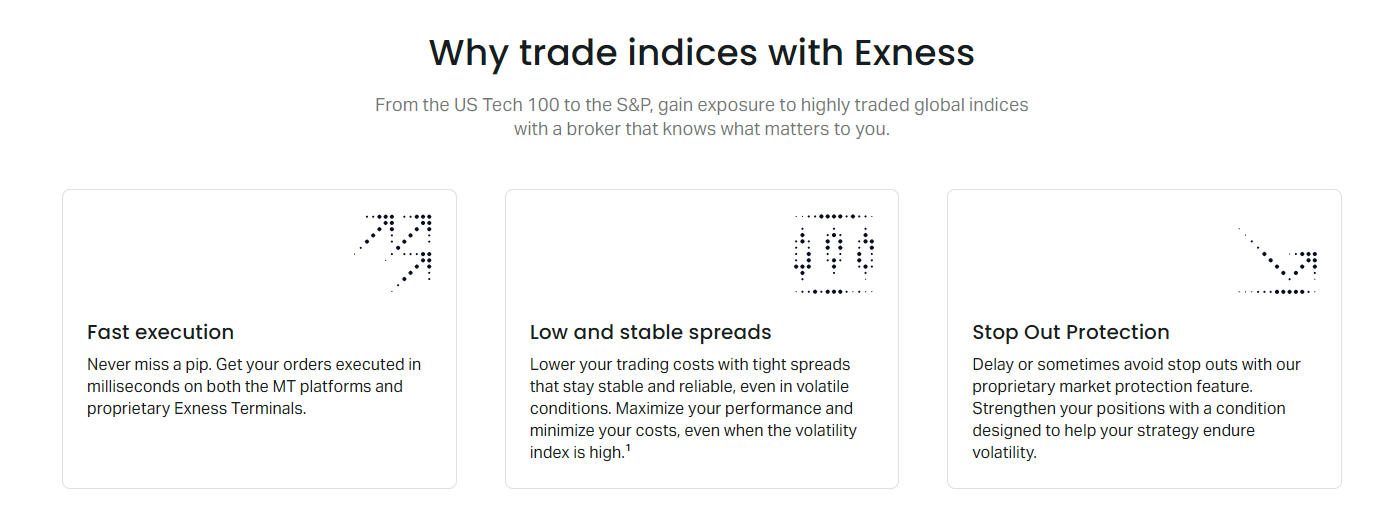
The broker markets its index offering around three pillars: low spreads, high leverage up to 1:2000 on certain account types, and near-instant execution. Those claims hold up in practice for the most part, though the actual spread you see depends heavily on the account type you choose and the time of day. Professional accounts such as Raw Spread and Zero typically show the tightest pricing, while Standard accounts carry wider spreads but no commission.
A common question among traders is whether Exness provides synthetic indices or the Volatility 75 Index. The short answer is no. Exness does not offer synthetic indices, volatility indices, or any proprietary derived products. The index menu consists entirely of real-world benchmarks tied to actual stock exchanges. If you are looking for 24/7 synthetic markets, you will need a different broker.
Major Global Indices Available on Exness
The index roster covers the most liquid benchmarks across four regions. US indices include the NASDAQ 100 (often labeled USTEC or NAS100), S&P 500 (US500), and Dow Jones 30 (US30). European coverage spans the German DAX 40 (DE40), UK FTSE 100 (UK100), French CAC 40 (FR40), Spanish IBEX 35 (ES35), and the Euro Stoxx 50 (EU50). Asian markets feature the Nikkei 225 (JP225), Hang Seng (HK50), and Australia 200 (AU200). Each symbol follows a consistent naming convention that combines the country code with the index number.
- USTEC / NAS100 — NASDAQ 100 (US tech-heavy benchmark)
- US500 — S&P 500 (broad US large-cap measure)
- US30 — Dow Jones Industrial Average (30 blue-chip stocks)
- DE40 — DAX 40 (German blue-chip index)
- UK100 — FTSE 100 (UK large-cap index)
- FR40 — CAC 40 (French benchmark)
- ES35 — IBEX 35 (Spanish benchmark)
- EU50 — Euro Stoxx 50 (eurozone large-cap index)
- JP225 — Nikkei 225 (Japanese price-weighted index)
- HK50 — Hang Seng Index (Hong Kong large-cap)
- AU200 — ASX 200 (Australian benchmark)
All of these trade as CFDs with variable spreads. The minimum lot size is 0.01 lots across all account types, which translates to a relatively small notional exposure per tick. This makes position sizing flexible even for smaller accounts. Margin requirements vary by index and account type, but major US and European indices generally require between 0.5% and 1% margin on Professional accounts, and 1% to 2% on Standard accounts.
One practical detail: the exact symbol name can differ slightly between MetaTrader 4, MetaTrader 5, and the Exness Web Terminal. On MT4 you will often see USTEC for the NASDAQ 100, while MT5 and the web terminal may display NAS100 or US Tech 100. The underlying market is identical; only the ticker label changes. Always verify the contract specification in your platform before placing a trade.
Exness NASDAQ Symbol and US Tech 100 Details
The NASDAQ 100 is the most popular index on the platform. On Exness it appears as USTEC on MT4 and NAS100 or US Tech 100 on MT5 and the Web Terminal. The contract tracks the Nasdaq-100 Index (NDX), which comprises the 100 largest non-financial companies listed on the Nasdaq stock exchange. Technology giants such as Apple, Microsoft, Amazon, Nvidia, and Meta dominate the weighting.
Trading hours for USTEC follow the underlying exchange with a pre-market and after-hours session. The core session runs from 13:30 to 20:00 UTC (09:30 to 16:00 Eastern). Exness extends pricing into the pre-market from 09:00 UTC and after-hours until 22:00 UTC, though spreads widen significantly outside the core session. Liquidity thins out after 20:00 UTC, so slippage risk increases if you hold positions into the extended hours.
Scroll horizontally to see all columns
| Parameter | Value |
|---|---|
| Symbol (MT4) | USTEC |
| Symbol (MT5/Web) | NAS100 / US Tech 100 |
| Underlying | Nasdaq-100 Index (NDX) |
| Contract Size | 1 lot = 1 index point |
| Min Lot | 0.01 |
| Max Leverage (Pro) | 1:2000 |
| Max Leverage (Standard) | 1:200 |
| Trading Hours (UTC) | 09:00–22:00 (core 13:30–20:00) |
Spreads on USTEC can drop below 1.0 points on Raw Spread and Zero accounts during the US session. Standard accounts typically show 2.5 to 4.0 points. The commission on Raw Spread is $3.5 per side per lot, while Zero account charges $0 commission but builds a small markup into the spread. For a day trader scalping the NASDAQ, the Raw Spread account usually works out cheaper after factoring in commission.
S&P 500 and Dow Jones Trading Conditions
The S&P 500 (US500) and Dow Jones 30 (US30) round out the major US trio. US500 tracks the S&P 500 Index (SPX), a market-cap-weighted basket of 500 large-cap US stocks. US30 tracks the Dow Jones Industrial Average, a price-weighted index of 30 blue-chip names. Both trade during the same extended hours as USTEC.
Spread behavior differs slightly. US500 often shows tighter spreads than US30 because the S&P 500 futures market is deeper. On a Raw Spread account during the New York session, US500 can trade at 0.4 to 0.6 points, while US30 sits around 1.0 to 1.5 points. Standard accounts see roughly 1.5 to 2.5 points on US500 and 3.0 to 5.0 points on US30.
The S&P 500 CFD is generally the most cost-effective US index for high-frequency strategies due to deeper futures liquidity.
Margin requirements for US500 and US30 are similar to USTEC. Professional accounts can access 1:2000 leverage (0.05% margin), though Exness applies dynamic leverage tiers based on total position size. Once your aggregate notional exposure across all indices exceeds certain thresholds, leverage steps down automatically. This is a risk control measure, not a penalty.
European and Asian Index Coverage
European indices trade during the London session, roughly 07:00 to 15:30 UTC. The DAX 40 (DE40) is the most actively traded European CFD on Exness, with Raw Spread accounts often seeing 0.8 to 1.2 points during peak hours. FTSE 100 (UK100) and CAC 40 (FR40) follow similar patterns. The Euro Stoxx 50 (EU50) offers broad eurozone exposure but typically carries slightly wider spreads due to lower futures volume.
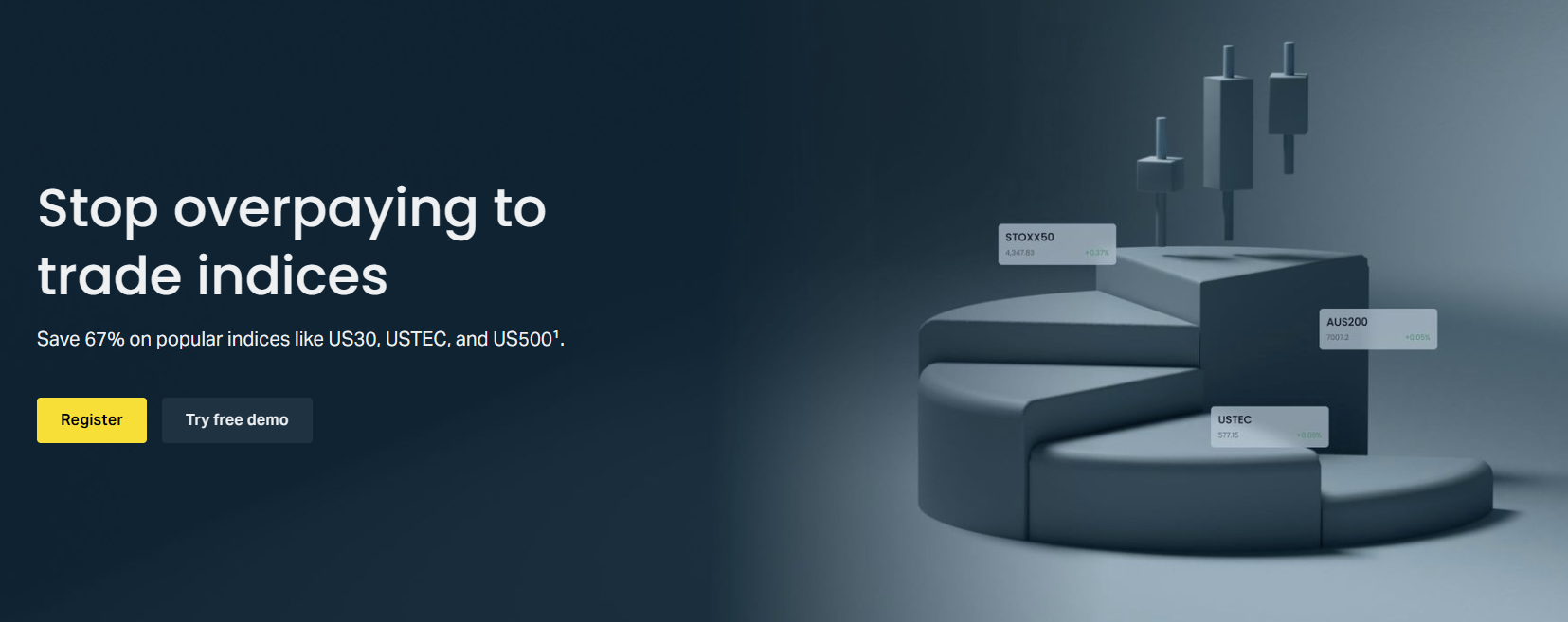
Asian indices have two distinct trading windows. The Nikkei 225 (JP225) trades during the Tokyo session (00:00–06:00 UTC) and again during a daytime auction session. The Hang Seng (HK50) follows Hong Kong exchange hours (01:30–08:00 UTC with a lunch break). Australia 200 (AU200) trades 00:00–06:00 UTC. Spreads on Asian indices are generally wider than US or European counterparts, often 3 to 8 points on Standard accounts and 1.5 to 4 points on Raw Spread.
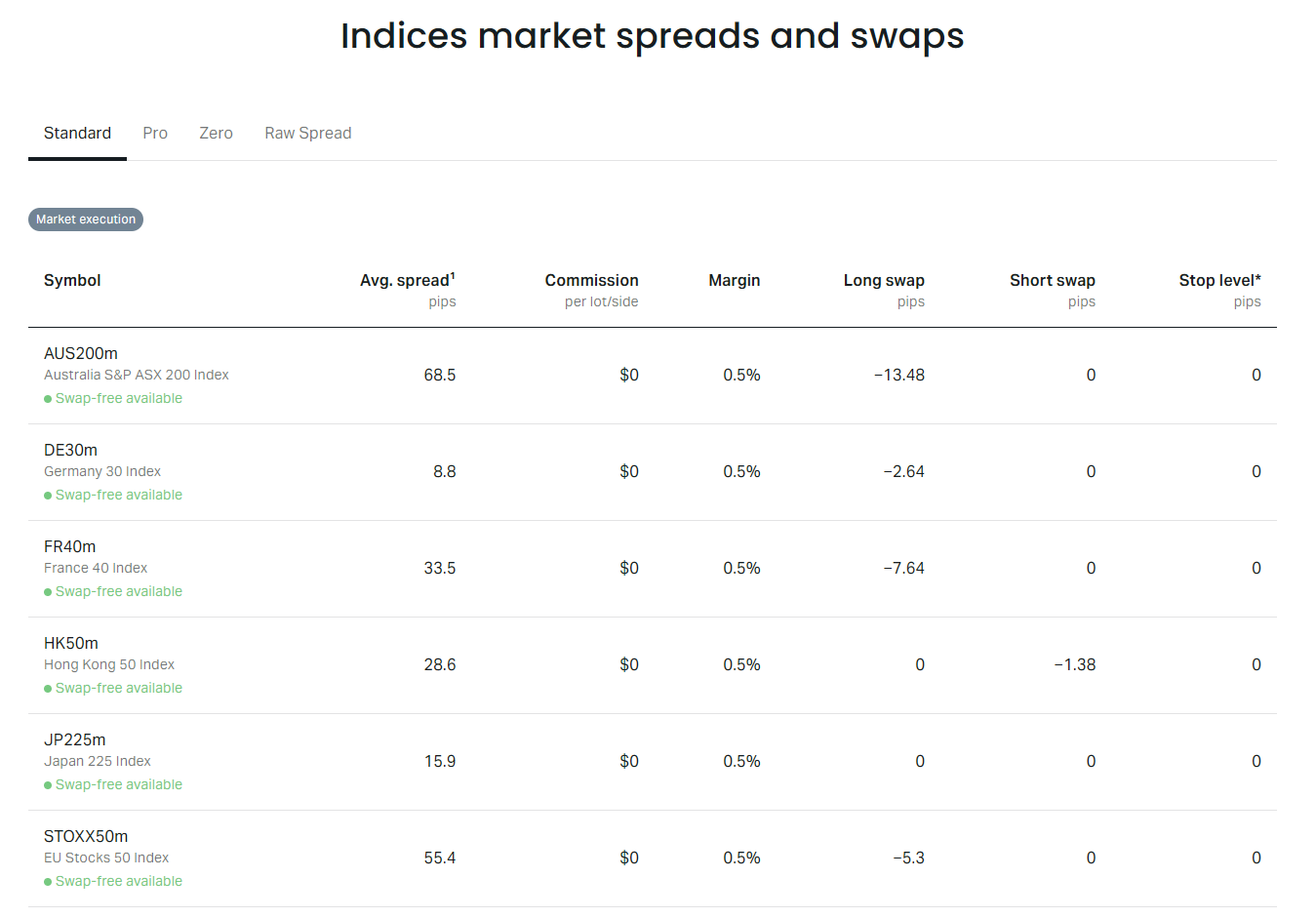
Swap rates (overnight financing) apply to all index CFDs held past 21:00 UTC. Long positions generally pay a financing charge, while short positions may receive a credit or pay a smaller charge depending on the interest rate differential. The exact swap value is published in the contract specification and updates daily. For indices, swaps are usually modest compared to forex pairs, but they accumulate over weeks.
Scroll horizontally to see all columns
| Index | Standard Account | Raw Spread Account |
|---|---|---|
| DE40 (DAX 40) | 2.5–4.0 | 0.8–1.5 |
| UK100 (FTSE 100) | 2.0–3.5 | 0.6–1.2 |
| FR40 (CAC 40) | 2.5–4.0 | 1.0–1.8 |
| EU50 (Euro Stoxx 50) | 3.0–5.0 | 1.2–2.0 |
| JP225 (Nikkei 225) | 5.0–10.0 | 2.0–5.0 |
| HK50 (Hang Seng) | 6.0–12.0 | 3.0–6.0 |
| AU200 (ASX 200) | 4.0–8.0 | 1.5–3.5 |
Trading Platforms for Index CFDs
Exness supports index trading on MetaTrader 4, MetaTrader 5, the proprietary Exness Web Terminal, and the Exness Trade mobile app. All platforms connect to the same pricing engine, so spreads and execution speed are consistent. The choice comes down to workflow preference and feature set.
MetaTrader 4 remains the most popular choice for index traders who rely on custom indicators and expert advisors. The MT4 marketplace has thousands of index-specific tools, from session highlighters to volatility bands. However, MT4 only supports hedging mode and lacks native depth-of-market data. MetaTrader 5 adds netting mode, more timeframes, an economic calendar, and a built-in depth-of-market window — useful for seeing liquidity levels on index futures.
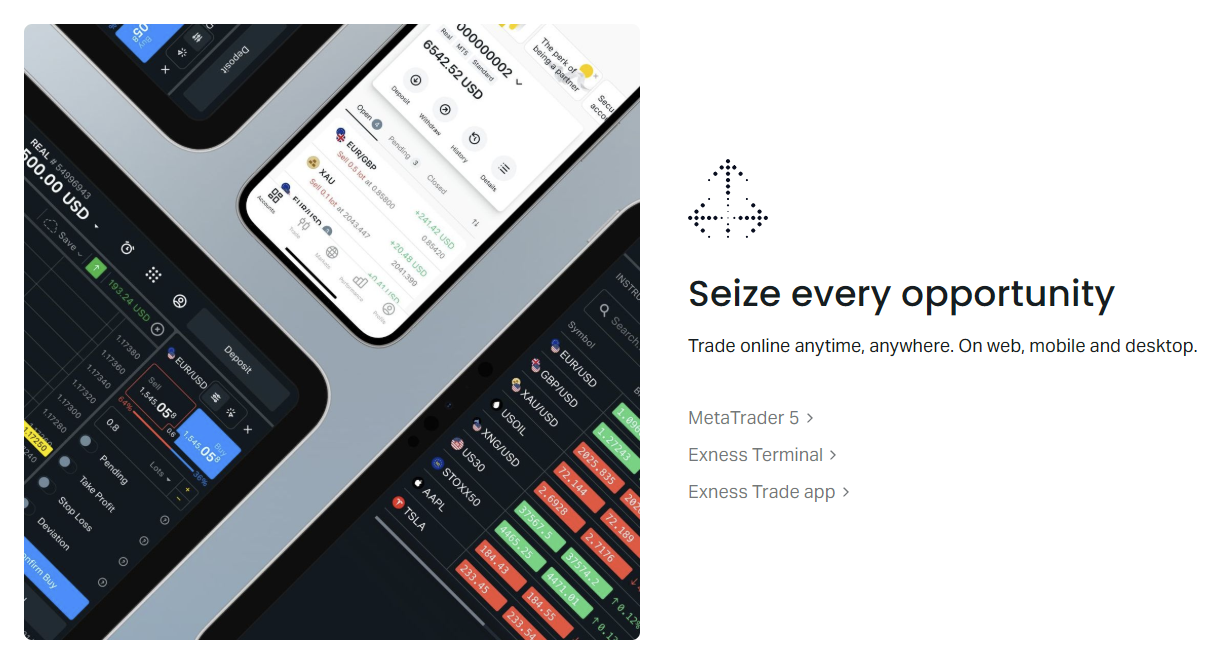
The Exness Web Terminal runs in any modern browser with no installation. It offers a clean charting package, one-click trading, and direct access to the same liquidity pool. It lacks the extensive third-party indicator ecosystem of MetaTrader but covers the essentials: multiple chart types, drawing tools, and basic technical indicators. The Exness Trade app mirrors the web terminal on iOS and Android, adding push notifications and biometric login.
Account Types and Index Access
All Exness account types offer the full index catalog. The difference lies in pricing structure and leverage caps. Standard and Standard Cent accounts use spread-only pricing with no commission. Leverage on indices caps at 1:200 for these accounts. Raw Spread and Zero accounts are designed for Professional clients (or those who qualify) and offer leverage up to 1:2000 on major indices.
Raw Spread charges a round-turn commission of $3.5 per lot per side on indices. Zero account charges $0 commission but the spread includes a small markup. In practice, the all-in cost on major US indices is nearly identical between Raw Spread and Zero. The Standard account costs more per trade but has no commission math to track. For a trader doing 20–30 index lots per month, Raw Spread usually saves money.
Scroll horizontally to see all columns
| Account | Pricing | Max Leverage (Indices) | Commission (Round Turn) |
|---|---|---|---|
| Standard | Spread only | 1:200 | $0 |
| Standard Cent | Spread only | 1:200 | $0 |
| Raw Spread | Raw spread + commission | 1:2000 | $3.5 per lot per side |
| Zero | Spread with markup | 1:2000 | $0 |
| Pro | Raw spread + commission | 1:2000 | $3.5 per lot per side |
The Standard Cent account deserves a mention for new index traders. It denominates balance in cents, so a $10 deposit shows as 1,000 cents. Position sizes are 100x smaller (1 cent lot = 0.01 standard lot). This lets you trade live index CFDs with real market risk but tiny notional exposure. It is a legitimate stepping stone between demo and full-size live trading.
Synthetic Indices and Volatility 75 — Not Available
Searches for 'does exness have volatility 75 index' or 'does exness have synthetic indices' return a clear no. Exness does not offer synthetic indices, volatility indices (VIX, Volatility 10/25/50/75/100), or any proprietary derived products. The index menu is limited to real-world exchange-traded benchmarks.
This is a deliberate business choice. Synthetic indices are typically offered by brokers who act as the sole counterparty and control the pricing engine. Exness operates on an agency/execution model for indices, routing orders to liquidity providers that hedge in the underlying futures market. Adding synthetic products would require a different risk infrastructure and regulatory approach.
If your strategy depends on 24/7 synthetic volatility products, Exness is not the right broker. Look at brokers specializing in derived indices instead.
The closest alternative on Exness for volatility exposure is trading the VIX futures CFD when available, or using options on index CFDs (not currently offered). Some traders approximate volatility plays by trading the NASDAQ 100 during earnings season or Fed announcements, when realized volatility spikes. But this is not a substitute for a pure volatility index.
Risk Management Tools for Index Traders
Exness provides several built-in risk controls that are particularly relevant for index CFDs, where leverage can amplify moves quickly. Stop-out level is set at 0% margin on most accounts, meaning positions are closed only when equity hits zero. This gives maximum room but also maximum risk. Margin call occurs at 100% margin level (equity equals used margin).
The platform supports standard stop-loss and take-profit orders, plus trailing stops on MT4 and MT5. The Web Terminal and mobile app allow setting stops at order entry or modifying them on open positions. There is no guaranteed stop-loss feature — slippage can occur during gaps, especially on index open after weekends or major news events.
- Stop-loss and take-profit on all platforms
- Trailing stop on MT4/MT5 (server-side)
- Margin call at 100% margin level
- Stop-out at 0% margin level
- Negative balance protection (retail clients)
- Leverage tiers that reduce max leverage as exposure grows
Negative balance protection applies to retail clients under EU and UK regulation. If your account goes negative due to a gap or flash crash, Exness absorbs the loss and resets the balance to zero. Professional clients and clients under certain offshore entities do not receive this protection. Check your entity registration before relying on it.
How to Start Trading Indices on Exness
Opening an index trading account takes a few minutes. Register on the Exness website, verify email and phone, then complete the KYC questionnaire (identity, address, trading experience). Most verifications finish within an hour. Once approved, you can deposit via card, bank transfer, or various e-wallets. Minimum deposit is $10 for Standard and Standard Cent accounts; Professional accounts require $200 minimum.
After funding, download your preferred platform. Log in with your account credentials. In Market Watch (MT4/MT5) or the symbol search (Web Terminal/app), type the index name — USTEC, US500, DE40, etc. Drag the symbol to a chart. Set your lot size, stop-loss, and take-profit, then click Buy or Sell. The trade executes at the next available price.
Demo accounts are available with virtual funds and identical pricing. Use them to test platform behavior, spread dynamics during news, and your own strategy without risk. Demo conditions match live conditions closely, though execution speed may differ slightly under heavy load. Treat demo as a platform familiarization tool, not a profitability predictor.
Trading Costs: Spreads, Commissions, and Swaps
The all-in cost of trading an index CFD on Exness has three components: spread, commission (if applicable), and swap (if held overnight). For a day trader closing all positions before 21:00 UTC, only spread and commission matter. For swing traders holding days or weeks, swaps become a meaningful drag or credit.
On a Raw Spread account trading 1 lot of USTEC during the US session: spread ~0.8 points ($0.80), commission $3.50 per side = $7.00 round turn. Total cost ~$7.80 per lot round trip. On a Standard account: spread ~3.0 points ($3.00), no commission. Total cost ~$3.00 per lot round trip. The crossover point where Raw Spread becomes cheaper is roughly 2.3 lots round turn per trade. Above that volume, Raw Spread wins.
Scroll horizontally to see all columns
| Account Type | Spread Cost | Commission | Total Cost |
|---|---|---|---|
| Standard | $3.00 | $0.00 | $3.00 |
| Raw Spread | $0.80 | $7.00 | $7.80 |
| Zero | $1.50 | $0.00 | $1.50 |
| Pro | $0.80 | $7.00 | $7.80 |
Swap rates for long USTEC positions are typically around -$0.50 to -$1.00 per lot per night. Short positions may receive a small credit or pay a reduced charge. Over a two-week swing trade, swaps can add $10–$15 per lot to the cost basis. Factor this into your risk-reward calculation.
Execution Quality and Slippage
Exness advertises execution speeds under 0.1 seconds for most orders. In practice, market orders on major indices during liquid hours fill at or near the quoted price. Slippage of 0.1–0.3 points on USTEC is common during normal conditions. During high-impact news (NFP, CPI, FOMC), slippage can widen to 1–3 points or more, and spreads may triple temporarily.
Limit orders and stop-limit orders provide price protection but carry fill risk. If the market gaps through your limit price, the order may not fill at all. This is standard exchange behavior, not a broker deficiency. The Web Terminal and mobile app show a slippage tolerance setting for market orders, defaulting to 3 points. You can tighten this if you prefer rejection over bad fills.
Execution is reliable during normal hours. The real test is news events — expect wider spreads and potential slippage regardless of broker.
Key Takeaways on Exness Indices Trading
Exness delivers a solid index CFD offering with competitive pricing on major benchmarks, multiple platform choices, and flexible account structures. The NASDAQ 100, S&P 500, and Dow Jones are all available with tight spreads on Professional accounts. European and Asian indices round out the catalog for global diversification. The absence of synthetic indices and volatility products is a genuine limitation for certain strategies, but for traders focused on real-world benchmarks, the coverage is sufficient.
Cost structure favors high-volume traders on Raw Spread or Zero accounts, while Standard accounts work fine for lower frequency or smaller size. Leverage up to 1:2000 is available but should be used with caution — dynamic leverage tiers kick in as exposure grows. Execution is reliable during normal sessions; plan for wider spreads and slippage around major news. Weekend gap risk is real and negative balance protection varies by regulatory entity.
- 11+ major global indices available as CFDs
- NASDAQ 100 (USTEC/NAS100), S&P 500 (US500), Dow Jones (US30) lead the US lineup
- No synthetic indices, no Volatility 75 Index
- Raw Spread/Zero accounts offer tightest all-in cost for active traders
- Leverage up to 1:2000 on Professional accounts, 1:200 on Standard
- MT4, MT5, Web Terminal, and mobile app all support index trading
- Negative balance protection for retail clients under EU/UK regulation
Frequently Asked Questions
What is the Exness NASDAQ symbol on MT4 and MT5?
On MT4 the symbol is USTEC. On MT5 and the Web Terminal it appears as NAS100 or US Tech 100. Both represent the same Nasdaq-100 CFD.
Does Exness have the Volatility 75 Index or synthetic indices?
No. Exness does not offer synthetic indices, volatility indices (including Volatility 75), or any proprietary derived products. Only real-world exchange-traded benchmarks are available.
What leverage can I use for index trading on Exness?
Professional accounts (Raw Spread, Zero, Pro) offer up to 1:2000 leverage on major indices. Standard and Standard Cent accounts cap at 1:200. Dynamic leverage tiers reduce maximum leverage as your total notional exposure increases.
Which account type is cheapest for day trading the NASDAQ 100?
For traders executing more than roughly 2.3 lots round turn per trade, Raw Spread or Zero accounts are cheaper all-in. Standard accounts cost less per trade at very small sizes but have wider spreads.
What are the trading hours for US indices on Exness?
Core session runs 13:30–20:00 UTC (09:30–16:00 Eastern). Exness provides extended pricing from 09:00–22:00 UTC, but spreads widen significantly outside core hours.
Does Exness offer negative balance protection for index trading?
Yes, for retail clients registered under EU (CySEC) or UK (FCA) entities. Professional clients and clients under offshore entities do not receive this protection.
Can I trade indices on the Exness mobile app?
Yes. The Exness Trade app for iOS and Android provides full index CFD trading with charting, order management, and push notifications.