

Forex Broker Fees
Exness Fees: Complete Breakdown of Trading Costs
Understand every cost component before you trade with Exness.

Senior Forex Trader & Market Analyst
Daniel Chen is an experienced forex trader and financial market analyst with over 15 years of experience in currency trading. He specializes in technical analysis, risk management, and developing practical trading strategies to help traders make informed decisions.
Trading costs determine whether a strategy survives long term. Exness publishes its fee structure openly, but the details spread across account types, instruments, and market conditions. This guide assembles every fee category into one reference so you can calculate the real cost of each trade before you enter it.
Contents
- 1. Spread Structure Across Account Types
- 2. Commission Details for Raw Spread and Zero Accounts
- 3. Swap and Overnight Financing Rates
- 4. Deposit and Withdrawal Fees
- 5. Account Type Fee Comparison
- 6. Instrument-Specific Fee Variations
- 7. Calculating Total Cost Per Trade
- 8. Fee Comparison With Other Major Brokers
- 9. Hidden Costs and Common Misunderstandings
- 10. Strategies to Minimize Trading Costs
- 11. Regulatory and Regional Fee Differences
- 12. Final Assessment of Exness Fees
Exness offers four main account families: Standard, Standard Cent, Pro, and the two commission-based accounts — Raw Spread and Zero. Each family uses a different mix of spreads and commissions. The broker also charges overnight swap fees on positions held past the daily rollover, and it applies specific rules for deposits, withdrawals, and currency conversions. No hidden ticket fees or platform fees exist.
The sections below break down each cost type, show how they differ by account and asset class, and explain where the numbers come from. All figures reflect the broker's public specifications as of the latest update; always verify the live trading conditions page for the exact values at the moment you trade.
Spread Structure Across Account Types
Spreads are the primary cost on Standard and Standard Cent accounts. Exness quotes variable spreads that widen during low liquidity and tighten during peak sessions. The broker does not add a fixed markup on these accounts; the spread you see is the raw market spread plus the broker's compensation. On major pairs like EURUSD, typical spreads start from 0.3 pips on Standard and 0.3 pips on Standard Cent, though the cent account displays prices in cents rather than dollars.
Pro accounts also use spread-only pricing but with tighter baseline spreads. EURUSD often starts from 0.1 pips. The trade-off is a higher minimum deposit and larger minimum trade size. Raw Spread and Zero accounts replace most of the spread with a fixed commission per lot. Raw Spread shows near-zero spreads on majors and charges $3.5 per side per lot ($7 round turn). Zero account fixes spreads at 0.0 pips on the top 30 instruments and charges $3.5 per side per lot on those instruments, while other instruments carry a small spread plus the same commission.
Spread values fluctuate. During the Asian session, EURUSD on a Standard account may show 0.8 pips while the London-New York overlap brings it down to 0.3 pips. Exness publishes average spread data for each instrument on its website, calculated over a rolling period. Those averages are useful for backtesting but do not guarantee the spread you will see at any specific second.
Commission Details for Raw Spread and Zero Accounts
Commission-based accounts appeal to scalpers and high-frequency traders who need predictable per-trade costs. On Raw Spread, the commission is $3.5 per lot per side on all instruments. A round turn on one standard lot of EURUSD costs $7 regardless of the spread width at that moment. Zero account applies the same $3.5 per side commission on its designated zero-spread instruments — currently 30 forex pairs and metals. Other instruments on Zero follow Raw Spread logic: a small spread plus the commission.
Commissions are charged at position opening and again at closing. They appear as separate line items in the trade history and in the daily account statement. No volume rebates or tiered commission schedules exist for retail clients. The broker's partner program offers rebates to introducing brokers, but those payments go to the IB, not directly to the trader unless a specific cashback arrangement exists.
Swap and Overnight Financing Rates
Swap fees apply when a position remains open past the server's rollover time (22:00 UTC). Exness calculates swaps based on the interest rate differential between the two currencies in a forex pair, plus a broker markup. The markup varies by account type: Standard and Pro accounts carry a higher markup than Raw Spread and Zero. Swap rates can be positive (you receive credit) or negative (you pay). Most major pairs currently carry negative swaps on both long and short sides due to global rate environments.
Triple swap applies on Wednesday rollover to account for the weekend. Exness also offers swap-free accounts for clients who cannot receive or pay interest for religious reasons. These accounts replace the swap with a fixed daily administration fee after a grace period (typically 3-7 days depending on the instrument). The fee schedule for swap-free accounts is published separately and differs from standard swap rates.
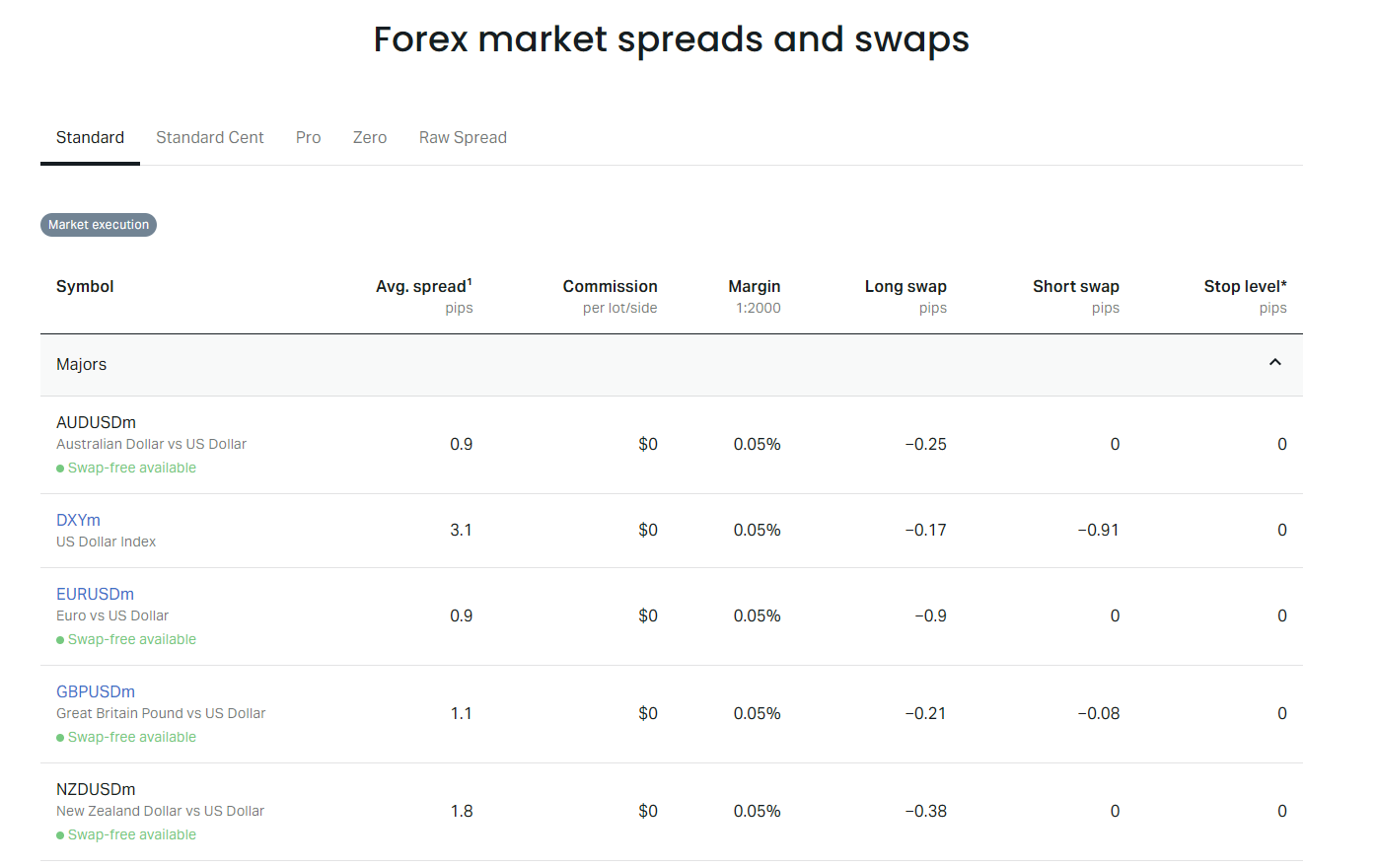
Swap rates update daily and are visible in the trading platform's market watch window. You can also check the Exness website's contract specifications page for each instrument. For metals, energies, and indices, swaps are calculated in points rather than pips and reflect the underlying futures curve or funding rate. Crypto swaps are notably higher due to volatility and funding costs in the underlying markets.
Deposit and Withdrawal Fees
Exness does not charge fees for deposits or withdrawals on most payment methods. The broker absorbs processor fees for bank cards, electronic wallets (Skrill, Neteller, WebMoney, Perfect Money), and local payment systems in supported regions. Bank wire withdrawals may incur intermediary bank charges that Exness cannot control; these typically range from $15 to $30 and are deducted by the correspondent banks, not by Exness.
Cryptocurrency deposits and withdrawals (USDT, USDC, BTC, ETH) are processed on-chain. Network fees (gas) are paid by the sender and vary with blockchain congestion. Exness does not add a markup. Minimum withdrawal amounts apply per method and are listed in the personal area. Withdrawals must return to the same source used for deposit where possible, following anti-money-laundering regulations.
Account Type Fee Comparison
Choosing the right account type is the single biggest lever on trading costs. The table below summarizes the core fee differences. Minimum deposits, leverage limits, and instrument availability also vary but are not repeated here.
Scroll horizontally to see all columns
| Account Type | Pricing Model | Typical EURUSD Spread | Commission (per lot/side) | Swap Markup |
|---|---|---|---|---|
| Standard | Spread only | 0.3 - 1.0 pips | None | Standard |
| Standard Cent | Spread only | 0.3 - 1.0 pips (cent) | None | Standard |
| Pro | Spread only | 0.1 - 0.5 pips | None | Reduced |
| Raw Spread | Spread + Commission | 0.0 - 0.2 pips | $3.50 | Low |
| Zero | Fixed 0.0 spread + Commission | 0.0 pips (top 30) | $3.50 | Low |
The spread ranges above represent typical values during liquid hours. News events, rollover, and weekend gaps can widen spreads significantly on all account types. Commission accounts protect against spread widening but lock in the per-lot cost. For a trader executing 50 lots per month on EURUSD, Raw Spread costs roughly $350 in commissions plus minimal spread. The same volume on Standard at 0.6 pip average spread costs about $300 in spread. The crossover point depends on your actual spread experience.
Instrument-Specific Fee Variations
Forex majors carry the tightest spreads and lowest commissions. Cross pairs (EURGBP, GBPJPY) and exotic pairs (USDTRY, USDZAR) have wider spreads and higher swap magnitudes. On Raw Spread and Zero, the commission stays $3.5 per side but the spread component increases. Metals (XAUUSD, XAGUSD) follow forex-like pricing on Pro and Raw Spread accounts. Zero account includes gold and silver in its zero-spread list.
Indices, energies, and stocks use contract-for-difference pricing. Spreads are quoted in points (index points, cents per barrel, dollars per share). Commissions on Raw Spread and Zero apply per lot as defined in the contract specification — for example, one lot of US30 (Dow Jones) is $5 per point, and the commission remains $3.5 per side. Crypto spreads are the widest due to underlying exchange fragmentation; BTCUSD spreads can exceed 50 pips (0.5%) during low liquidity.
Stock CFDs carry an additional consideration: dividend adjustments. Long positions receive a credit (minus withholding tax) on ex-dividend dates; short positions pay a debit. These are not fees but cash flow events that affect strategy P&L. Exness publishes the dividend calendar in the trading platform and on its website.
Calculating Total Cost Per Trade
Total cost = spread cost + commission (if any) + swap (if held overnight) + conversion cost (if currency mismatch). For a day trade on EURUSD Standard account: 0.6 pip spread on 1 lot = $6. No commission. No swap. Total $6. Same trade on Raw Spread: 0.1 pip spread ($1) + $7 commission = $8. The Standard account wins for this single trade. But if you trade 20 times a day, the commission account's spread stability may reduce slippage and requotes, indirectly saving money.
For swing trades held several days, swap dominates. A long EURUSD position paying -0.8 pips per day swap on 1 lot costs $8 per night. Over five nights that is $40, dwarfing the entry spread. Check the swap direction before holding positions past rollover. Some pairs pay positive swap on one side; those can offset costs if the trade direction aligns.
Fee Comparison With Other Major Brokers
Exness positions itself as a low-cost broker. On Standard accounts, its average EURUSD spread of 0.6-0.8 pips is competitive with IC Markets Standard (0.6-0.8), Pepperstone Standard (0.6-0.9), and XM Standard (0.8-1.2). On commission accounts, the $7 round turn per lot matches IC Markets Raw Spread ($7), undercuts Pepperstone Razor ($7 round turn but higher minimum deposit), and beats FP Markets Raw ($6-7 depending on volume). Zero account's fixed 0.0 spread on 30 instruments is a differentiator; most competitors offer near-zero but not fixed zero.
Swap rates are broadly similar across brokers because they derive from the same interbank rates. Markup differences of 0.1-0.3 pips per day exist but rarely change the broker choice unless you hold large positions for weeks. Deposit and withdrawal fee policies are also similar: most top brokers absorb processor fees for electronic methods and pass through bank wire charges.
The cheapest broker on paper is not always the cheapest in practice. Execution quality, slippage, and platform stability affect realized costs more than a 0.1 pip spread difference.
Hidden Costs and Common Misunderstandings
Traders often overlook three costs. First, slippage: market orders during news can fill several pips away from the quoted price. Exness uses market execution with no requotes, so slippage is real and asymmetric — it tends to work against you. Limit orders avoid negative slippage but risk non-execution. Second, inactivity fees: Exness does not charge an inactivity fee, which is a genuine advantage over brokers that charge $10-50 per month after 6-12 months of no trading. Third, currency conversion on profits: if you withdraw in a different currency than your account base, the conversion spread applies again on the way out.
Another misunderstanding involves the Zero account's 'zero spread' claim. It applies only to the top 30 instruments and only during normal market hours. During the daily maintenance window (23:55-00:05 server time) and during extreme volatility, spreads on Zero account instruments can widen. The commission remains charged. Read the contract specifications for the exact instrument list and conditions.
Strategies to Minimize Trading Costs
Match account type to trading style. Scalpers and high-frequency systems benefit from Raw Spread or Zero because the fixed commission caps cost per trade. Swing traders and position traders often do better on Pro or Standard where no commission compounds on large position sizes held for days. If you trade multiple asset classes, consider holding separate accounts: Raw Spread for forex majors, Pro for indices and commodities where commission per lot represents a higher percentage of notional value.
Trade during peak liquidity. The London-New York overlap (13:00-17:00 UTC) offers the tightest spreads on majors. Avoid the Asian session for EURUSD and GBPUSD if spread sensitivity is high. Use limit orders to enter at predefined prices, eliminating negative slippage. For exits, consider a mix: limit orders for profit targets, stop orders for protection. Stop orders become market orders when triggered and can slip.
Monitor swap calendars. If you plan to hold a position over Wednesday, factor in triple swap. Some traders close intraday on Wednesday and reopen Thursday to avoid it, but that incurs two extra spreads/commissions. Do the math: if triple swap costs $24 and two round turns cost $16, closing and reopening saves $8. If the market gaps against you during the closure, the saving evaporates.
Regulatory and Regional Fee Differences
Exness operates under multiple licenses: CySEC (EU), FCA (UK), FSCA (South Africa), FSA (Seychelles), and others. Leverage limits and margin requirements differ by regulator, which indirectly affects fees because higher leverage allows larger positions with the same capital, amplifying absolute spread and commission costs. EU and UK retail clients are capped at 1:30 on majors; professional clients and clients under the Seychelles entity can access up to 1:2000. The fee schedule (spreads, commissions, swaps) is identical across entities; only leverage and margin rules change.
Some regions have restricted payment methods. For example, certain e-wallets are unavailable in the EU due to regulatory changes. This may force a bank wire withdrawal with its associated intermediary fees. Check the personal area for your specific country's available methods before funding.
Regulatory jurisdiction changes your leverage, not your spread. The cost per pip stays the same; the position size you can afford changes.
Frequently Asked Questions
Does Exness charge a fee for opening an account?
No. Account opening is free. There are no setup fees, monthly maintenance fees, or platform fees.
What is the commission on Raw Spread account per lot?
$3.5 per side per lot, which equals $7 round turn for a full standard lot on any instrument.
Are swap fees charged on weekends?
Triple swap is applied on Wednesday rollover to cover Saturday and Sunday. No separate weekend swap exists.
Does Exness charge for deposits via Visa or Mastercard?
No. Exness covers the processor fee. The full deposit amount appears in your trading account.
Can I avoid swap fees entirely?
Swap-free accounts are available for eligible clients. They replace swaps with a fixed daily administration fee after a grace period.
Is the Zero account spread really zero all the time?
Only on 30 designated instruments during normal market hours. Spreads widen during maintenance windows and extreme volatility.
How do I check the current spread for an instrument?
Open the Market Watch in MT4/MT5 or the Exness Web Terminal. Right-click and select 'Spread' to display live spread in points.
Are there volume discounts on commissions?
No. Retail commission rates are fixed regardless of volume. Institutional clients may negotiate custom terms.
Final Assessment of Exness Fees
Exness delivers a transparent, competitive fee structure with no hidden charges. The spread-only accounts suit discretionary traders who prefer simplicity. The commission accounts give algorithmic and high-volume traders cost certainty. Swap rates are industry-standard. Deposit and withdrawal processing is free for electronic methods. The main decision point is account selection: match your trading frequency, position size, and hold time to the pricing model. Test both a spread-only and a commission account on demo with your actual strategy before committing real capital. The difference in realized cost often comes down to execution quality during your specific trading hours, not the headline spread number.