
Trading Guides
Exness Nasdaq Trading: Platform Access and Trading Conditions
Complete guide to trading US tech indices on Exness platforms

Senior Forex Trader & Market Analyst
Daniel Chen is an experienced forex trader and financial market analyst with over 15 years of experience in currency trading. He specializes in technical analysis, risk management, and developing practical trading strategies to help traders make informed decisions.
Exness offers access to the Nasdaq 100 index through CFD contracts, letting traders speculate on the performance of the largest non-financial companies listed on the Nasdaq stock exchange. The instrument appears as USTEC or NAS100 depending on the platform, and it tracks the index price without requiring ownership of the underlying shares. This makes it accessible for traders who want exposure to major technology stocks like Apple, Microsoft, Amazon, and Nvidia through a single position.
Contents
- 1. What Is the Nasdaq 100 and Why Trade It
- 2. Exness Nasdaq Trading Conditions
- 3. Trading Platforms for Nasdaq on Exness
- 4. Account Types and Their Impact on Index Trading
- 5. Leverage, Margin, and Position Sizing
- 6. Trading Hours, Sessions, and Liquidity Patterns
- 7. Risk Management Tools on Exness Platforms
- 8. Costs Breakdown: Spreads, Commissions, and Swaps
- 9. How to Start Trading Nasdaq on Exness
- 10. Final Assessment of Exness Nasdaq Trading
The broker provides this market across all its account types — Standard, Standard Cent, Pro, Raw Spread, and Zero — with varying spread and commission structures. Execution is handled through market execution model, meaning orders fill at the best available price without requotes. For traders who rely on speed, Exness also offers a free VPS service for accounts meeting minimum equity and volume thresholds, which can help reduce latency when trading during high-volatility sessions like the US market open.
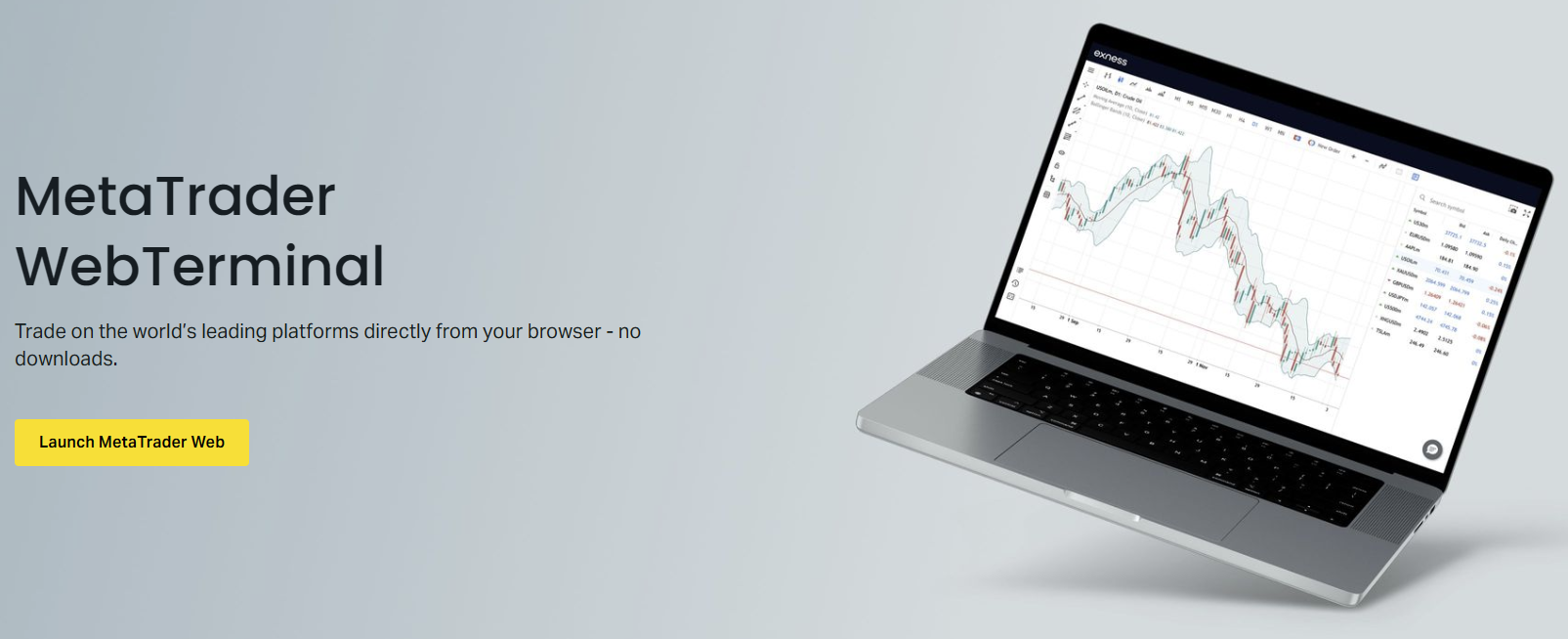
Platform choice matters when trading indices. The Exness Web Terminal runs in a browser with no installation required, while MetaTrader 4 and MetaTrader 5 offer deeper customization, algorithmic trading support, and a wider range of built-in indicators. The mobile apps for both MT4 and MT5 let you manage Nasdaq positions on the go, and the Exness Trade app adds a streamlined interface with integrated analytics. Each platform displays real-time pricing, charting tools, and one-click trading for quick entries and exits.
Trading hours for the Nasdaq 100 CFD follow the underlying exchange schedule with extended hours. The main session runs from 9:30 AM to 4:00 PM Eastern Time, Monday through Friday. Exness also provides pre-market and after-hours pricing, though spreads typically widen outside the core session. Liquidity is highest during the overlap of the London and New York sessions, which is when most institutional volume occurs and when spreads tend to be tightest.
What Is the Nasdaq 100 and Why Trade It
The Nasdaq 100 index tracks the 100 largest non-financial companies listed on the Nasdaq stock exchange by market capitalization. Technology companies dominate the weighting, with the top holdings typically including Apple, Microsoft, Amazon, Nvidia, Meta, Tesla, and Alphabet. Because of this concentration, the index acts as a barometer for the US technology sector and often moves sharply on earnings reports, macroeconomic data, and Federal Reserve policy shifts.
Trading the index as a CFD offers several practical advantages over buying individual stocks or ETFs. You can go long or short with equal ease, use leverage to control larger positions with less capital, and avoid the complexity of managing a basket of individual shares. The CFD also trades nearly 24 hours a day during the trading week, whereas the cash index only trades during exchange hours. For active traders, this extended access means you can react to news out of Asia or Europe before the US session opens.
Volatility is a defining characteristic of the Nasdaq 100. Daily moves of 1–2% are common, and during earnings season or major macro events, swings of 3–5% in a single session happen regularly. This creates opportunities for day traders and swing traders alike, but it also means risk management is non-negotiable. Position sizing, stop-loss placement, and awareness of correlation with other tech-heavy instruments like the S&P 500 or individual FAANG stocks all matter when building a trading plan around this index.
- Single instrument gives exposure to 100 large-cap stocks
- Heavy technology weighting amplifies sector-specific moves
- Nearly 24/5 trading with pre-market and after-hours sessions
- Long and short positions available with same margin requirements
- No dividend adjustments on short positions for index CFDs
Exness Nasdaq Trading Conditions
The trading conditions for Nasdaq 100 on Exness vary by account type. On Standard and Standard Cent accounts, the spread is floating and includes the broker's markup — typically starting around 1.5–2.0 points during peak hours. No commission is charged on these accounts; the cost is embedded in the spread. Pro accounts offer tighter raw spreads starting from 0.0 points with a commission of $3.5 per lot per side. Raw Spread and Zero accounts follow a similar model with commission-based pricing and spreads that can reach zero during high liquidity.
Contract specifications are consistent across account types. One standard lot represents $1 per index point, so a move from 18,000 to 18,010 yields $10 per lot. The minimum trade size is 0.01 lots (10 cents per point), and the maximum is 200 lots per position. Margin requirements depend on the leverage setting of your account. At 1:200 leverage, the margin for one lot at 18,000 is roughly $90. At 1:500, it drops to about $36. Exness offers leverage up to 1:2000 on certain accounts, but indices typically cap at 1:200 or 1:400 depending on the regulatory entity.
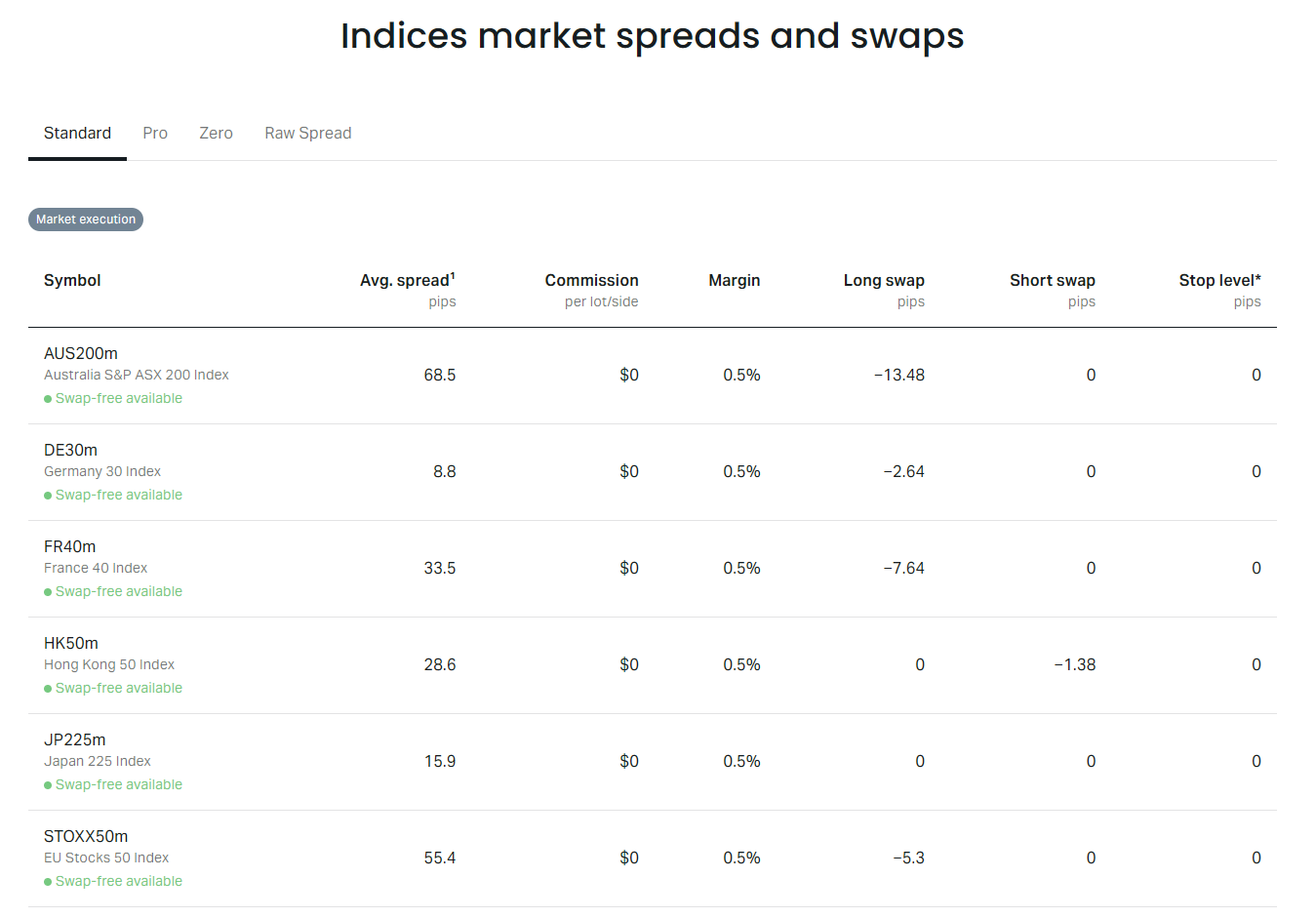
Swap rates apply to positions held overnight. For the Nasdaq 100, the long swap is typically negative (you pay) and the short swap can be positive or negative depending on interest rate differentials and the broker's markup. Exact values update daily and are visible in the platform's contract specifications window. During triple-swap Wednesdays, the charge or credit is tripled to account for the weekend rollover. Traders holding positions for weeks should factor this into their cost calculations.
Scroll horizontally to see all columns
| Parameter | Value |
|---|---|
| Symbol | USTEC / NAS100 |
| Contract Size | $1 per index point per lot |
| Min Lot Size | 0.01 lots |
| Max Lot Size | 200 lots per position |
| Trading Hours | Mon–Fri 00:05–23:55 server time |
| Execution Model | Market execution |
| Leverage (max) | 1:200 (indices) |
Trading Platforms for Nasdaq on Exness
Exness supports four main platforms for trading the Nasdaq 100, each with distinct strengths. The Exness Web Terminal is the most accessible — it loads in any modern browser, requires no download, and syncs with your account instantly. Charts are responsive, drawing tools are adequate for technical analysis, and one-click trading works reliably. It's a solid choice for traders who switch devices frequently or cannot install software on work computers.
MetaTrader 4 remains popular for its simplicity and vast ecosystem of custom indicators and expert advisors. The Exness MT4 build includes additional instruments like indices and crypto that aren't in the standard MetaQuotes distribution. Execution speed is comparable to MT5, but the platform lacks native depth-of-market and has fewer timeframes. For discretionary traders using price action or basic indicators, MT4 is still perfectly capable.
MetaTrader 5 adds more timeframes, a built-in economic calendar, depth-of-market, and support for netting and hedging modes. The strategy tester is multi-threaded and handles multi-currency backtests, which matters if you're developing automated systems for indices. Exness MT5 also includes the full suite of trading signals and the MQL5 marketplace. For algorithmic traders or those who want more analytical tools, MT5 is the stronger choice.
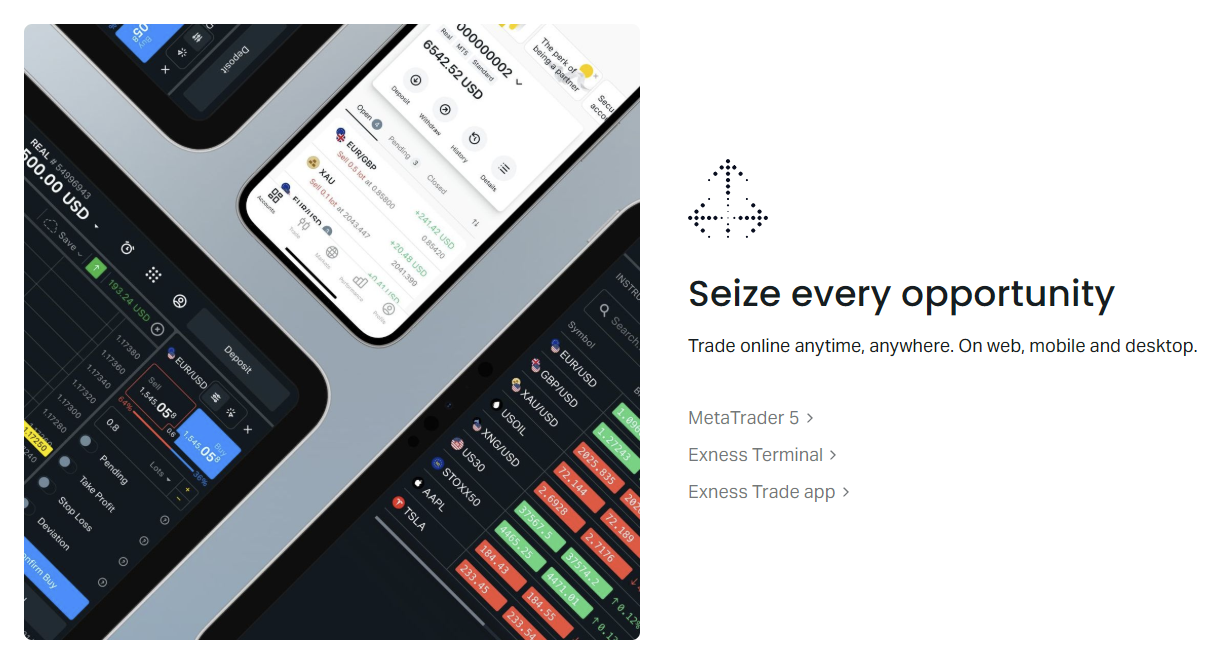
The Exness Trade mobile app deserves separate mention. It's a proprietary platform designed for mobile-first use, with a clean interface, integrated news feed, and trading calculator. You can open, modify, and close Nasdaq positions with a few taps, and the app pushes price alerts and margin calls in real time. It's not a full replacement for MT4/MT5 if you need custom indicators, but for monitoring and executing trades on the move, it's often faster and more intuitive.
Account Types and Their Impact on Index Trading
Choosing the right account type affects your total cost of trading the Nasdaq 100 more than most traders realize. Standard and Standard Cent accounts use spread-only pricing. The spread on USTEC during the New York session typically ranges from 1.5 to 3.0 points. On a 0.1 lot position, that's $1.50–$3.00 per round trip. For a day trader taking 5–10 trades daily, this adds up. The advantage is simplicity — no commission line items, no confusion about per-lot fees.
Pro, Raw Spread, and Zero accounts switch to raw spreads plus commission. The raw spread on Nasdaq can drop to 0.0–0.5 points during peak liquidity. Commission is $3.5 per lot per side on Pro and Raw Spread, and $0.2 per lot per side on Zero (with a higher minimum deposit). On a 0.1 lot trade with a 0.2 point spread and $3.5 commission, the round-trip cost is roughly $0.70 spread + $7.00 commission = $7.70. That's higher than the Standard account for small sizes, but the commission scales linearly while the spread markup on Standard accounts does not.
For larger positions, commission-based accounts become cheaper. At 1 lot, Standard might cost $20–$30 in spread while Pro costs $7–$10 total. At 10 lots, the difference widens significantly. The Zero account with its $0.2 commission is the cheapest for high-volume traders, but it requires a $1,000 minimum deposit and is only available under certain regulatory entities. Most retail traders will find the Pro account a practical balance — low spreads, reasonable commission, and a $200 minimum deposit.
Scroll horizontally to see all columns
| Account | Spread Model | Commission (per lot/side) | Min Deposit | Best For |
|---|---|---|---|---|
| Standard | Floating with markup | None | $10 | Small accounts, simplicity |
| Standard Cent | Floating with markup | None | $10 | Micro position sizing |
| Pro | Raw spread | $3.5 | $200 | Active traders, EA users |
| Raw Spread | Raw spread | $3.5 | $500 | High-frequency strategies |
| Zero | Raw spread | $0.2 | $1,000 | High-volume professionals |
Leverage, Margin, and Position Sizing
Leverage on indices at Exness is capped at 1:200 for most regulatory entities, regardless of the account's maximum leverage setting. This means for every $1 of margin, you control $200 of notional value. At a Nasdaq price of 18,000, one lot ($18,000 notional) requires $90 margin at 1:200. At 1:400 (available under some entities), the same position needs $45. The broker also offers dynamic leverage that reduces maximum leverage as position size grows — a risk management feature that kicks in automatically.
Margin calls and stop-outs follow standard rules. A margin call triggers when equity falls to 100% of used margin. The stop-out level is 0% for most entities, meaning positions close automatically when equity hits zero. However, some regulatory frameworks enforce a 50% stop-out. You can check your specific entity's rules in the personal area. The key takeaway: with 1:200 leverage, a 0.5% adverse move wipes out your margin on a fully leveraged position. Prudent traders rarely use more than 1:10 to 1:20 effective leverage on volatile indices.
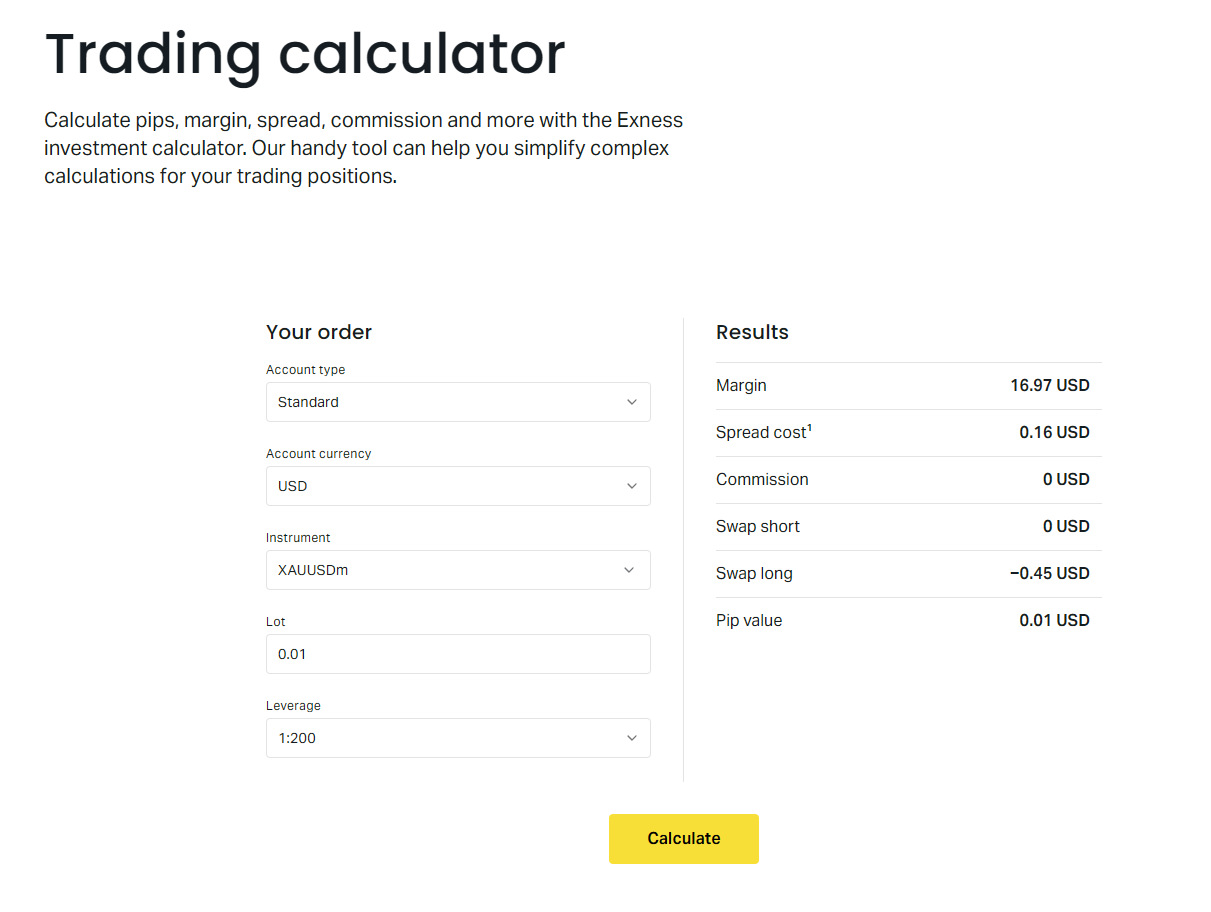
Position sizing should account for the Nasdaq's average true range (ATR). On a typical day, the 14-period ATR on the daily chart might be 200–300 points. At $1 per point per lot, a 0.1 lot position swings $20–$30 daily. If your risk tolerance is $100 per trade, a 2 ATR stop (400–600 points) on 0.1 lots fits. On 1 lot, the same stop risks $400–$600. The trading calculator in the Exness personal area and mobile app automates this math — input entry, stop, lot size, and it shows margin, pip value, and potential profit/loss.
One practical tip: the Nasdaq 100 often gaps at the open. A stop-loss placed at a technical level may execute significantly worse if the market gaps through it. This is slippage, not broker manipulation, and it's more common on indices than forex. Using guaranteed stop-loss orders (if available under your entity) or reducing position size ahead of known catalysts like CPI releases or Fed meetings can mitigate this risk.
Trading Hours, Sessions, and Liquidity Patterns
The Nasdaq 100 CFD on Exness trades nearly 24 hours a day, Monday through Friday, but liquidity is not uniform. The session breaks down into three main phases: Asian (00:00–08:00 ET), European (08:00–13:30 ET), and US (13:30–21:00 ET). The US session — specifically the first two hours after the 9:30 AM open and the last hour before the 4:00 PM close — accounts for the vast majority of volume. Spreads are tightest here, often 0.5–1.5 points on raw spread accounts.
Pre-market (4:00–9:30 AM ET) and after-hours (4:00–8:00 PM ET) trading is available but with wider spreads and lower depth. Exness provides pricing during these windows, but you may see spreads of 3–10 points or more. Orders placed in thin liquidity can experience significant slippage. Most day traders avoid these windows unless trading a specific catalyst like an earnings release. Swing traders holding positions overnight should be aware that stops can trigger on wide spreads during low-liquidity periods.
The Sunday open (Monday 00:05 server time) and Friday close (23:55 server time) also see wider spreads. Weekend gaps are common — the index can open 100–300 points away from Friday's close if major news breaks over the weekend. Exness does not charge swap for the weekend on indices (triple swap Wednesday covers it), but the gap risk remains. Traders who don't want weekend exposure typically close positions before Friday's US close.
- Tightest spreads: 9:30–11:30 AM ET and 3:00–4:00 PM ET
- Pre-market and after-hours: wider spreads, lower depth
- Asian session: thin liquidity, wider spreads, range-bound price action
- European open (8:00 AM ET): often sets tone for US session
- Friday close to Sunday open: gap risk, no trading available
Risk Management Tools on Exness Platforms
Every Exness platform includes standard risk management features: stop-loss, take-profit, and trailing stop. On MT4 and MT5, you can set these at order entry or modify them on open positions. The Web Terminal and mobile app offer the same functionality with a more visual interface — drag the SL/TP lines on the chart to adjust. Trailing stops activate only when the platform is running (MT4/MT5) or continuously on the server side (Web Terminal and mobile app).
Negative balance protection is applied automatically. If a sudden move drives your account equity below zero, Exness absorbs the loss and resets the balance to zero. This is a regulatory requirement for most entities and a genuine safety net during flash crashes or extreme gaps. However, it does not prevent margin calls or stop-outs — it only ensures you never owe the broker money beyond your deposit.
The margin calculator and trading calculator deserve regular use. Before entering a Nasdaq trade, input your planned entry, stop-loss, and position size. The calculator shows required margin, point value, swap estimate, and potential profit/loss at target. This prevents the common mistake of over-leveraging because the notional value of indices feels abstract compared to forex pairs. A 1 lot Nasdaq position at 18,000 is $18,000 exposure — equivalent to 1.8 standard lots of EURUSD at 1.0000.
Costs Breakdown: Spreads, Commissions, and Swaps
Total trading cost on the Nasdaq 100 has three components: spread (or commission + raw spread), swap, and potential slippage. On a Standard account with a 2.0 point average spread, a round trip on 0.1 lots costs $2.00. On a Pro account with 0.3 point raw spread and $3.5 commission per side, the same trade costs $0.30 + $7.00 = $7.30. The crossover point where Pro becomes cheaper is around 0.3–0.4 lots depending on exact spreads. For traders doing 1+ lots per trade, commission-based accounts are almost always cheaper.
Swap rates for USTEC are published daily in the contract specifications. As of recent data, long swaps run around -$0.50 to -$1.50 per lot per night, while short swaps range from +$0.20 to -$0.80. These fluctuate with US interest rates and the broker's markup. Holding a 1 lot long position for a week costs roughly $3.50–$10.50 in swaps. For swing traders holding weeks, this is a meaningful drag. Day traders who close before 23:59 server time pay zero swap.
Slippage is the hidden cost. During high-impact news (NFP, CPI, FOMC), the Nasdaq can move 50–100 points in seconds. A stop-loss placed 20 points away might fill 30–50 points worse. This isn't a broker fee, but it's a real cost of trading volatile instruments. Using limit orders for entries, avoiding market orders during red-folder news, and reducing size ahead of known events are the only reliable mitigations. Exness does not guarantee stop-loss execution at the requested price under market execution.
Scroll horizontally to see all columns
| Account Type | Spread Cost | Commission | Total Cost |
|---|---|---|---|
| Standard (2.0 pts avg) | $2.00 | $0.00 | $2.00 |
| Pro (0.3 pts + $3.5) | $0.30 | $7.00 | $7.30 |
| Raw Spread (0.2 pts + $3.5) | $0.20 | $7.00 | $7.20 |
| Zero (0.1 pts + $0.2) | $0.10 | $0.40 | $0.50 |
How to Start Trading Nasdaq on Exness
Opening an account takes a few minutes. Register with email, set a password, and verify your email address. The personal area opens immediately. Before trading live, you must complete KYC — upload a government-issued ID (passport, driver's license, or national ID) and proof of address (utility bill or bank statement dated within 3 months). Verification usually completes within a few hours, sometimes minutes. Until verified, you can deposit but not withdraw.
Fund your account through the deposit section. Exness supports bank cards, wire transfers, and a wide range of electronic payment systems (Skrill, Neteller, WebMoney, Perfect Money, and various local methods depending on your country). Most methods are instant and fee-free on the Exness side. Minimum deposit is $10 for Standard and Standard Cent, $200 for Pro, $500 for Raw Spread, and $1,000 for Zero. Choose the account type that matches your intended volume and strategy.
Download your platform. For MT4 or MT5, use the download links in the personal area — these are Exness-branded builds with the full instrument list pre-configured. For Web Terminal, click "Trade" in the personal area and it launches instantly. For mobile, search "Exness Trade" or "MetaTrader 4/5" in your app store. Log in with your account number and trading password (set separately from your personal area password). The Nasdaq 100 appears as USTEC in Market Watch — drag it to a chart to start analyzing.
- Register and verify email
- Complete KYC (ID + proof of address)
- Deposit via preferred method
- Download platform or use Web Terminal
- Log in with trading credentials
- Find USTEC/NAS100 in Market Watch
- Test on demo first if new to indices
The demo account is identical to live in pricing and execution. Open one from the personal area to practice without risk. It's the best way to learn the platform, test position sizing, and experience Nasdaq volatility without losing money. Demo accounts expire after 30 days of inactivity but can be reopened anytime. Many traders keep a demo alongside their live account for strategy testing.
Final Assessment of Exness Nasdaq Trading
Exness delivers a competent Nasdaq 100 offering with tight spreads on commission accounts, reliable market execution, and platform flexibility that covers browser, desktop, and mobile. The raw spread accounts (Pro, Raw Spread, Zero) are the correct choice for anyone trading more than a few lots per month — the math favors commission-based pricing at scale. Standard accounts work for small positions and traders who prefer simplicity over optimization.
The 1:200 leverage cap on indices is appropriate for the instrument's volatility. Traders needing higher leverage will find it restricted, which is a regulatory safeguard, not a broker limitation. The free VPS for qualifying accounts is a genuine advantage for algorithmic traders and those running EAs during the US session. Execution quality is consistent with other top-tier brokers — no requotes, minimal slippage in normal conditions, and transparent pricing.
Areas for improvement include the lack of guaranteed stop-losses (available at some competitors) and the limited range of index CFDs beyond the major US three (Nasdaq, S&P 500, Dow Jones). European and Asian indices are not offered. For traders focused specifically on the Nasdaq 100, this doesn't matter. For those building a diversified index portfolio, it's a constraint. The swap rates are competitive but not industry-leading — long holders should compare.
Exness hits the fundamentals well: pricing, execution, platform choice. The Nasdaq 100 offering is solid for serious traders who understand the costs.
Frequently Asked Questions
What is the minimum deposit to trade Nasdaq on Exness?
$10 for Standard and Standard Cent accounts, $200 for Pro, $500 for Raw Spread, and $1,000 for Zero account.
Does Exness offer guaranteed stop-losses on Nasdaq?
No, Exness does not currently offer guaranteed stop-loss orders on any instrument. Stops execute at the best available price under market execution.
What are the trading hours for Nasdaq 100 on Exness?
Monday 00:05 to Friday 23:55 server time, with pre-market and after-hours pricing. Core liquidity is during US session 9:30 AM–4:00 PM ET.
Which platform is best for algorithmic Nasdaq trading on Exness?
MetaTrader 5 with the free VPS (for qualifying accounts) offers the best environment for EAs — multi-threaded tester, depth of market, and low-latency execution.
How are swap charges calculated for Nasdaq positions held overnight?
Swaps are charged daily at 23:59 server time. Long positions typically pay negative swap; short positions may receive or pay depending on rates. Triple swap applies Wednesday to Friday rollover.
Can I trade Nasdaq on Exness from a restricted country?
Exness does not onboard residents of certain jurisdictions including the USA, Iran, North Korea, and others. Check the website's regulatory page for the current list.
What is the contract size for one lot of Nasdaq on Exness?
One standard lot equals $1 per index point. A move from 18,000 to 18,010 yields $10 profit or loss per lot.