

Forex Broker Guides
Exness Account Types: Complete Guide to Choosing the Right Account
Detailed breakdown of every Exness trading account to match your strategy and experience level.

Senior Forex Trader & Market Analyst
Daniel Chen is an experienced forex trader and financial market analyst with over 15 years of experience in currency trading. He specializes in technical analysis, risk management, and developing practical trading strategies to help traders make informed decisions.
Exness offers one of the most straightforward account lineups in the forex industry. Instead of overwhelming traders with dozens of variations, the broker organizes everything into two main families: Standard accounts for newer traders and Professional accounts for those who need tighter pricing and different cost structures. Understanding where each account fits can save you money and frustration, especially when you start comparing spreads, commissions, and minimum deposits across the lineup.
Contents
- 1. Standard Accounts: Simple Pricing for Most Traders
- 2. Professional Accounts: Pro, Zero, and Raw Spread Compared
- 3. Exness Zero Account: Deep Dive on the Flat Commission Model
- 4. Exness Raw Spread Account: Variable Commission by Instrument
- 5. Exness Pro Account: Zero Commission on Forex and Metals
- 6. Standard vs Professional: Which Family Fits Your Volume
- 7. Islamic and Swap-Free Account Options
- 8. Demo Account: Testing Without Risk
- 9. Opening an Exness Account: Step by Step
- 10. Minimum Deposits and Funding Methods
- 11. Leverage, Margin, and Stop Out Rules
- 12. Platform Access Across Account Types
- 13. Choosing Based on Trading Style
- 14. Common Mistakes When Selecting an Account
- 15. Final Assessment of Exness Account Types
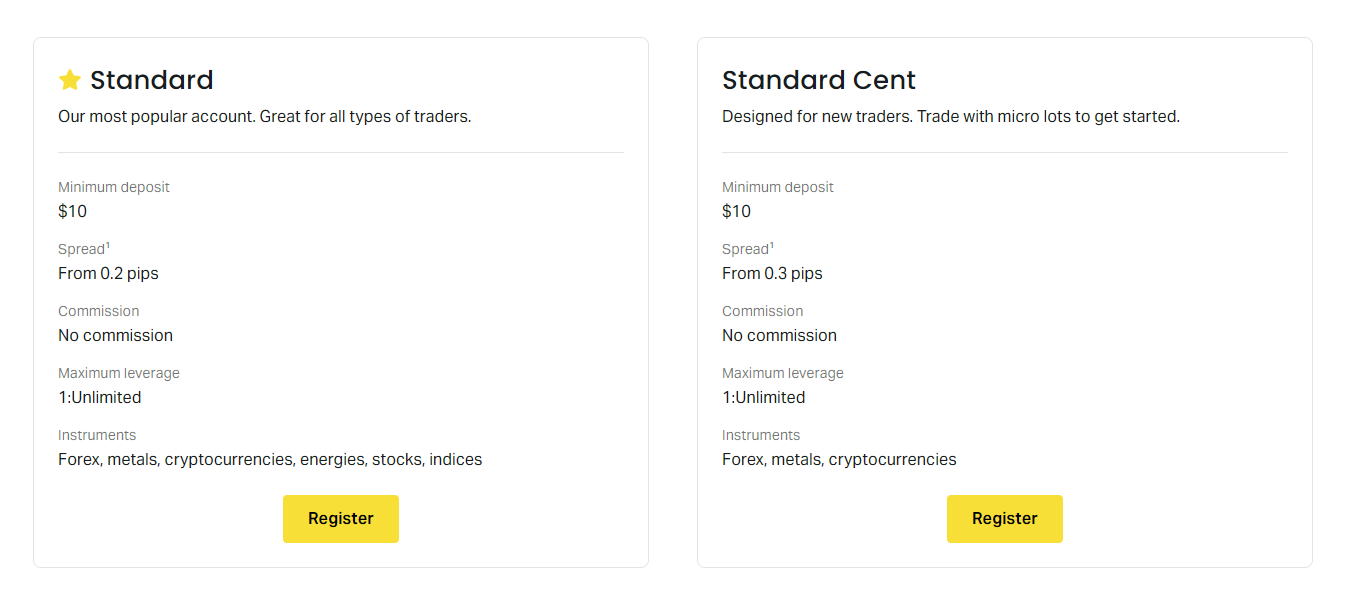
The Standard family includes the Standard account and the Standard Cent account. Both use market execution with no commissions, making the cost structure easy to grasp. The Professional family splits into three distinct options: Pro, Zero, and Raw Spread. Each Professional account charges a commission per lot but delivers significantly tighter spreads. The right choice depends on your typical trade size, preferred instruments, and whether you want to calculate costs as a spread markup or a separate commission line item.
Many traders overlook the Standard Cent account because it sounds like a beginner product. In practice, it serves a specific purpose: letting you trade micro-lots with real money while keeping position sizes tiny. This matters when you're testing a new strategy or transitioning from demo to live trading. The psychological difference between risking ten cents per pip and ten dollars per pip is real, and the Cent account bridges that gap without requiring a separate broker.
Exness also provides an Islamic swap-free option across most account types, a demo account that mirrors live conditions, and a straightforward account opening process through the Personal Area. The sections below walk through each account type in detail, compare the Professional variants side by side, and highlight the practical differences that affect your bottom line.
Standard Accounts: Simple Pricing for Most Traders
The Standard account is the default choice for many Exness clients. It requires a minimum deposit of just one dollar in most regions, offers market execution, and charges no commission. Instead, the broker builds its compensation into the spread. Typical EURUSD spreads start around 0.3 pips during liquid hours, though they can widen during news events or low-liquidity periods. For a trader placing a few positions a day on major pairs, this all-in pricing is easy to track.
The Standard Cent account mirrors the Standard account in every way except the account currency denomination. Your balance displays in cents rather than dollars, so a $10 deposit shows as 1,000 cents. The minimum trade size is 0.01 cent lots, which equals 1,000 units of base currency compared to 100,000 units for a standard lot. This lets you risk very small amounts per trade while experiencing real execution, slippage, and swap charges.
Both Standard accounts support the full range of Exness instruments: forex pairs, metals, energies, indices, stocks, and cryptocurrencies. Leverage is dynamic and can reach 1:2000 on forex for accounts under $1,000 equity, though higher leverage tiers reduce as equity grows. There are no restrictions on scalping, hedging, or expert advisors. The main limitation is that spreads on Standard accounts will always be wider than on Professional accounts during normal market conditions.
Professional Accounts: Pro, Zero, and Raw Spread Compared
The Professional family targets traders who understand that separating commissions from spreads often reduces total trading costs at higher volumes. All three Professional accounts require a $200 minimum deposit and offer market execution with no requotes. The differences lie in how spreads and commissions are structured for specific instrument groups.
The Pro account sits in the middle. It charges no commission on forex and metals but applies a commission on other instrument groups. Spreads on major forex pairs start from 0.1 pips. This account suits traders who focus primarily on currency pairs and want tight spreads without a per-lot fee on every forex trade. The commission structure kicks in for indices, energies, stocks, and crypto, so check the specific rates if you diversify across asset classes.
The Zero account lives up to its name on the top 30 forex pairs: spreads start at 0.0 pips during liquid hours, and a fixed commission of $3.50 per side per lot applies. That means a round-turn cost of $7 per standard lot on EURUSD, GBPUSD, USDJPY, and similar majors. For high-volume traders, this transparency often beats the Pro account's slightly wider spreads. The commission is the same regardless of which major pair you trade.
The Raw Spread account takes a different approach. Spreads are also near zero on majors, but the commission varies by instrument. On EURUSD it's typically $3.50 per side per lot, matching the Zero account. On other pairs and asset classes, the commission adjusts to reflect the underlying liquidity. This account appeals to traders who want the raw market spread plus a known markup, and who trade a mix of instruments where a flat commission might not be optimal.
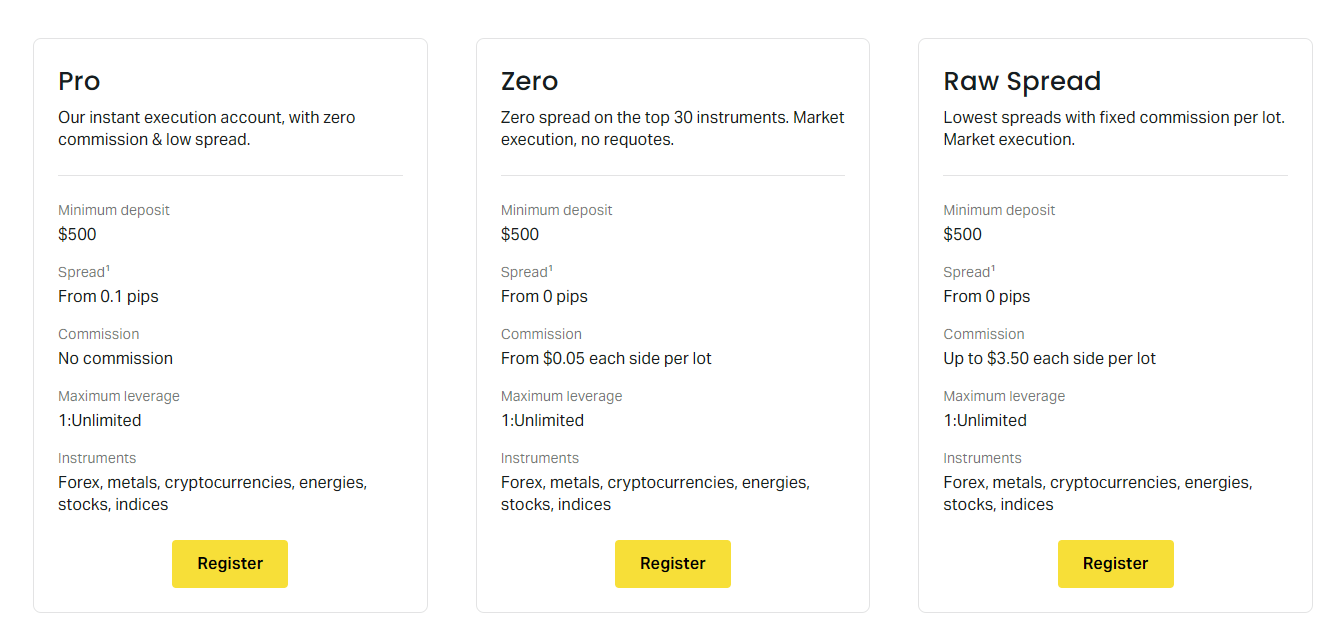
A practical way to decide: if you trade mostly the top forex majors and want predictable costs, the Zero account's flat commission simplifies planning. If you trade a broader mix including minors, exotics, indices, or commodities, the Raw Spread account's variable commission may align better with actual market conditions. The Pro account works when your volume is high enough to benefit from tight spreads but you prefer zero commission on forex and metals specifically.
Scroll horizontally to see all columns
| Account | EURUSD Spread | Commission (per side/lot) | Best For |
|---|---|---|---|
| Pro | From 0.1 pips | Zero on forex/metals | Forex-focused traders |
| Zero | From 0.0 pips | $3.50 fixed on top 30 pairs | High-volume major pair traders |
| Raw Spread | From 0.0 pips | Variable by instrument | Multi-asset traders |
Exness Zero Account: Deep Dive on the Flat Commission Model
The Zero account gets the most attention among Professional options because its pricing is easiest to explain: zero spread on the top 30 forex pairs, $3.50 per side per lot commission. That translates to $7 round-turn per standard lot. For context, a typical Standard account spread of 0.3 pips on EURUSD costs $3 per lot. So the Zero account becomes cheaper once the Standard spread exceeds 0.7 pips, which happens regularly during Asian session hours or around news releases.
The commission applies per side, meaning you pay $3.50 when opening and $3.50 when closing. On a 0.1 lot trade, that's $0.70 total. On a 10 lot position, it's $70. The math scales linearly, which makes position sizing decisions straightforward. There are no hidden markups, no spread widening during news (beyond what the liquidity providers show), and no minimum trade size beyond the standard 0.01 lots.
One detail that catches some traders off guard: the zero spread guarantee only covers the top 30 forex pairs. On other instruments — minor pairs, exotics, metals, indices, energies, stocks, crypto — spreads are low but not zero, and the same $3.50 commission applies. If your strategy involves GBPJPY or XAUUSD heavily, check the typical spreads on those specific instruments before committing to the Zero account.
Exness Raw Spread Account: Variable Commission by Instrument
The Raw Spread account often confuses traders because it looks similar to the Zero account at first glance. Both offer near-zero spreads on majors. The difference is structural: Raw Spread passes through the raw interbank spread and adds a commission that varies by instrument. On EURUSD the commission matches the Zero account at $3.50 per side. On GBPUSD it might be $4.50. On XAUUSD it could be $5.00. The commission reflects the cost of hedging that specific instrument.
This variable commission model aligns the broker's incentives with yours. When liquidity is deep and hedging is cheap, you pay less. When an instrument is expensive to hedge, the commission rises. The spreads you see are the actual market spreads from Exness's liquidity providers, with no markup. For traders who run multi-asset portfolios, this can result in lower total costs than a flat commission that overcharges on liquid instruments to subsidize illiquid ones.
The trade-off is complexity. You need to check the commission schedule for each instrument you trade regularly. Exness publishes this in the contract specifications and the Personal Area. If you only trade EURUSD and GBPUSD, the Zero account's flat rate is easier to manage. If you rotate between forex, gold, indices, and crypto based on volatility, Raw Spread often wins on net cost.
Raw Spread feels like the account Exness built for their own prop traders. Transparent, instrument-specific, no surprises.
Exness Pro Account: Zero Commission on Forex and Metals
The Pro account occupies a sweet spot for traders who want professional-grade spreads on forex and metals without paying a commission on every trade. Spreads start from 0.1 pips on EURUSD, which is only marginally wider than the Zero and Raw Spread accounts during peak liquidity. The commission is zero on forex pairs and metals — including gold and silver — but applies to indices, energies, stocks, and cryptocurrencies.
This structure benefits traders whose primary focus is currency pairs and precious metals. You get spreads close to the raw market without the per-lot fee eating into small profits on quick scalps. For a trader doing 50-100 lots per month on EURUSD and XAUUSD, the Pro account can be cheaper than Zero simply because there's no commission on those specific instruments. The slightly wider spread is often less than the $7 round-turn commission would have been.
The catch appears when you diversify. If you regularly trade US30, USOIL, AAPL, or BTCUSD, the commission on those instruments adds up. The Pro account's commission rates for non-forex/metal instruments are published in the contract specifications and tend to be higher than Raw Spread's variable rates for the same assets. Match the account to your actual trading mix, not the one you imagine you'll trade.
Standard vs Professional: Which Family Fits Your Volume
The decision between Standard and Professional accounts ultimately comes down to monthly trading volume and position sizing. A rough breakpoint: if you trade more than 50 lots per month on major pairs, the Professional accounts usually save money despite the $200 minimum deposit. Below that threshold, the Standard account's simplicity and $1 minimum deposit often make more sense.
Let's look at the math. On EURUSD, a Standard account might average 0.5 pips spread during your trading hours. That's $5 per lot round-turn. The Zero account charges $7 per lot round-turn but the spread is near zero. So the Standard account is actually cheaper per lot at 0.5 pips. But if the average spread widens to 0.8 pips — common during Asian session or news — the Standard cost becomes $8 per lot, and Zero wins. The Raw Spread and Pro accounts fall somewhere in between depending on the exact spread and commission combination.
Position size matters too. A trader doing 0.1 lots per trade needs 500 trades to reach 50 lots monthly. That's a high-frequency approach. A swing trader doing 2 lots per trade only needs 25 trades. The Professional accounts scale better with size because the commission is fixed per lot while the spread cost scales with the spread width. At very large sizes, the commission model becomes predictably cheaper.
Scroll horizontally to see all columns
| Monthly Volume | Typical Standard Cost | Typical Zero Cost | Recommendation |
|---|---|---|---|
| 10 lots | $50-80 | $70 | Standard |
| 50 lots | $250-400 | $350 | Borderline |
| 100 lots | $500-800 | $700 | Professional |
| 500 lots | $2,500-4,000 | $3,500 | Professional |
Islamic and Swap-Free Account Options
Exness offers swap-free (Islamic) accounts across most account types. These accounts comply with Sharia law by eliminating overnight swap charges on all instruments. Instead of swaps, Exness applies a fixed administration fee on positions held overnight, which varies by instrument and is disclosed upfront. The fee structure replaces the variable swap rate, giving you certainty on holding costs.
To open a swap-free account, you select the option during account creation in the Personal Area or request conversion of an existing account through support. The account type — Standard, Pro, Zero, or Raw Spread — retains its original spread and commission structure. Only the overnight financing mechanism changes. This is useful not just for religious compliance but for any strategy that holds positions for weeks or months where swap accumulation would distort returns.
One limitation: some exotic pairs and certain CFDs may not be available in swap-free mode, or the administration fee may be significantly higher than the standard swap would have been. Check the specific instrument specifications before building a long-term position around swap-free availability. The fee schedule is available in the trading platform's contract specifications and the Exness website.
Demo Account: Testing Without Risk
Exness provides a demo account that replicates live trading conditions across all account types. You can open a demo for Standard, Standard Cent, Pro, Zero, or Raw Spread from the Personal Area. The demo uses the same price feed, execution model, spreads, and commissions as the live environment. This matters because some brokers widen demo spreads or use different liquidity pools, giving a false impression of costs.
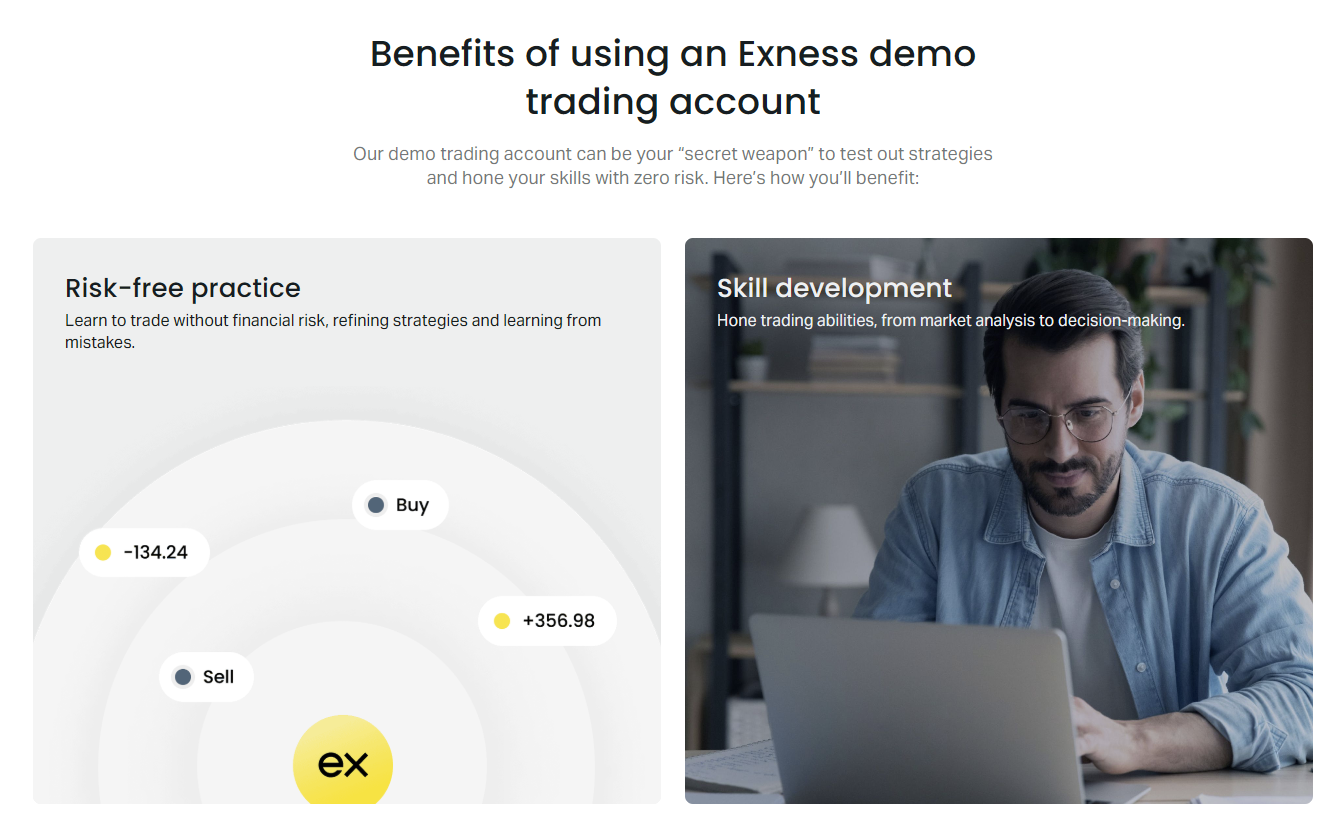
The default virtual balance is $10,000, but you can adjust it to match your planned live deposit. This helps you test position sizing realistically. If you plan to start with $500, set the demo to $500. The psychological experience of seeing a $50 drawdown on a $500 account differs from the same drawdown on $10,000. Exness also allows multiple simultaneous demo accounts, so you can test different account types side by side.
Demo accounts expire after 30 days of inactivity but can be renewed or recreated instantly. There's no limit on how many demo accounts you can open over time. Use this to test expert advisors, new strategies, or simply to learn the platform before committing real money. The transition from demo to live is seamless — the same Personal Area manages both, and you can fund a live account with one click once you're ready.
Opening an Exness Account: Step by Step
Account registration happens through the Exness website or mobile app. You provide an email, create a password, and select your country of residence. This creates your Personal Area, the dashboard for managing all your trading accounts, deposits, withdrawals, and verification. From there, you can open additional trading accounts of any type with a few clicks.
The first account you open requires identity verification (KYC) before you can deposit and trade. You'll upload a government-issued ID and proof of address. Exness typically completes verification within a few hours, though it can take up to 24 hours during peak periods. Subsequent accounts under the same Personal Area don't require re-verification. This is a significant convenience if you want to run a Standard Cent account for testing alongside a Zero account for live trading.
- Register email and password on Exness website or app
- Complete KYC with ID and proof of address
- Open desired account type from Personal Area
- Select account currency (USD, EUR, others available)
- Set leverage preference (adjustable later)
- Deposit funds via preferred payment method
- Download MT4, MT5, or use Web Terminal
Account currency choice affects conversion fees. If you deposit USD but open a EUR-denominated account, Exness converts at their internal rate. Most traders choose USD to avoid this. Leverage is set per account and can be changed later in the Personal Area, though reducing leverage on an account with open positions may trigger margin calls. Start with the leverage you're comfortable managing.
Minimum Deposits and Funding Methods
Minimum deposits vary by account type and region. Standard and Standard Cent accounts accept deposits from $1 in most countries. Professional accounts (Pro, Zero, Raw Spread) require $200 minimum. These minimums apply to the first deposit into each specific account. You can hold multiple accounts with different balances — a $50 Standard Cent account for testing and a $5,000 Zero account for live trading, for example.
Exness supports a wide range of funding methods: bank cards (Visa, Mastercard), electronic wallets (Skrill, Neteller, WebMoney, Perfect Money), bank wire transfers, and various local payment systems depending on your country. Most electronic methods are instant and free. Bank wires can take 1-3 business days and may incur intermediary bank fees. Withdrawals return to the same method used for deposit, following anti-money laundering regulations.
A notable feature: Exness processes withdrawals automatically 24/7 for most electronic methods, including weekends. Bank wire withdrawals follow banking hours. There's no withdrawal fee from Exness on most methods, though payment processors may charge their own fees. The minimum withdrawal amount is typically $1 for electronic methods and higher for bank wires. This instant withdrawal capability is a genuine differentiator — many brokers take 1-3 business days even for e-wallets.
Scroll horizontally to see all columns
| Account Type | Minimum Deposit | Typical Funding Time |
|---|---|---|
| Standard | $1 | Instant (cards, e-wallets) |
| Standard Cent | $1 | Instant (cards, e-wallets) |
| Pro | $200 | Instant (cards, e-wallets) |
| Zero | $200 | Instant (cards, e-wallets) |
| Raw Spread | $200 | Instant (cards, e-wallets) |
Leverage, Margin, and Stop Out Rules
Exness uses dynamic leverage that adjusts based on account equity. For balances under $1,000, maximum leverage reaches 1:2000 on forex. Between $1,000 and $5,000 it's 1:1000. Between $5,000 and $30,000 it's 1:500. Above $30,000 it steps down further. This applies to all account types. You can manually set a lower leverage cap in the Personal Area if you prefer stricter risk control.
Margin requirements follow the leverage tiers. At 1:2000 leverage, a 1 lot EURUSD position requires $50 margin. At 1:500, it requires $200. The stop out level is 0% across all account types, meaning Exness will close positions automatically when margin level hits zero. There's no margin call warning level — the platform shows your margin level in real time, and it's your responsibility to monitor it. This zero stop out gives maximum room but demands discipline.
Professional accounts don't receive higher leverage than Standard accounts at the same equity tier. The leverage schedule is account-agnostic. This is worth noting because some brokers offer higher leverage on professional accounts. Exness treats leverage as a risk management tool tied to account size, not account type. The difference between account types remains spreads, commissions, and minimum deposits.
Platform Access Across Account Types
Every Exness account type works on MetaTrader 4, MetaTrader 5, the Exness Web Terminal, and the Exness mobile app. There are no platform restrictions based on account type. The Web Terminal is particularly convenient for Standard and Standard Cent accounts because it requires no download and works well for position sizes under 1 lot. MT4 and MT5 offer the full ecosystem of indicators, expert advisors, and custom tools.
The Exness mobile app provides account management, deposits, withdrawals, and trading from a single interface. It supports both MT4 and MT5 accounts. For traders who switch between account types, the app shows all accounts under your Personal Area with real-time balances and P&L. You can move funds between accounts instantly in the Personal Area, which is useful when rebalancing between a test account and a live account.
VPS hosting is available for all account types, free for clients who meet a minimum trading volume threshold (typically 5 lots per month). The VPS runs MT4/MT5 with low latency to Exness servers, which matters for expert advisors and high-frequency strategies. The free VPS requirement is achievable on any account type, so a Standard Cent trader running an EA can qualify just as easily as a Zero account trader.
Platform parity across account types means you can test on Standard Cent with the exact same tools you'll use on Zero. No relearning curves.
Choosing Based on Trading Style
Scalpers and high-frequency traders benefit most from the Zero or Raw Spread accounts. The near-zero spreads on majors reduce the cost per trade to essentially the commission, which is fixed and predictable. When you're targeting 2-5 pips per trade, a 0.3 pip spread on a Standard account consumes 10-15% of your profit target. On Zero, that cost drops to near zero, leaving only the $7 round-turn commission.
Day traders holding positions for hours rather than minutes face a different calculation. Swap costs start to matter. The Standard account's wider spreads are a one-time cost at entry. Swaps accumulate every night. On major pairs, swaps are often small or even positive depending on interest rate differentials. On exotics and some crosses, swaps can be significant. The Professional accounts don't change swap rates — swaps are instrument-specific, not account-specific.
Swing traders and position traders holding for days or weeks should prioritize swap rates over spread differences. The account type choice becomes secondary to instrument selection. A Standard account on a pair with positive swap can outperform a Zero account on a pair with negative swap over a two-week hold. Check the swap rates for your intended instruments in the platform's contract specifications before deciding.
- Scalpers: Zero or Raw Spread for lowest per-trade cost
- Day traders: Zero/Raw Spread if high frequency, Standard if lower frequency
- Swing traders: Focus on swap rates, account type secondary
- Position traders: Swap-free option worth considering for long holds
- Algorithm/EA traders: Raw Spread for transparent costs, VPS eligible on all types
- Beginners: Standard Cent for real-money micro-sizing
Common Mistakes When Selecting an Account
A frequent error is choosing the Zero account because 'zero spread sounds best' without calculating the commission impact on your typical trade size. On a 0.01 lot trade, the $7 round-turn commission equals 0.7 pips. If the Standard spread is 0.5 pips, you're paying more on Zero. The Zero account only wins when your per-trade commission is less than the spread difference — which requires larger position sizes or wider Standard spreads.
Another mistake: opening a Professional account with the minimum $200 deposit and then trading 0.01 lots. The $200 minimum exists because the commission model assumes sufficient volume to offset the per-lot fees. At micro-lot sizes, you're paying Professional account costs without Professional account volume. Start with Standard or Standard Cent, build the account, then migrate when your monthly volume justifies it.
Traders also overlook instrument coverage. The Zero account's zero spread only covers 30 forex pairs. If you trade gold, the spread is low but not zero, and the $3.50 commission still applies. The Raw Spread account's variable commission on gold might be lower. The Pro account charges zero commission on gold but has a 0.1+ pip spread. Map your actual instrument list to the account specifications before deciding.
Frequently Asked Questions
Can I have multiple Exness account types at the same time?
Yes. You can open multiple trading accounts of different types under one Personal Area. Many traders run a Standard Cent account for testing alongside a Zero or Pro account for live trading.
What is the difference between Exness Zero and Raw Spread accounts?
Zero account has a fixed $3.50 per side commission on the top 30 forex pairs with 0.0 pip spreads. Raw Spread has variable commissions by instrument with raw market spreads. Zero is simpler for major pair traders; Raw Spread suits multi-asset portfolios.
Is there a minimum deposit for Exness Standard Cent account?
The Standard Cent account minimum deposit is $1 in most regions, same as the Standard account. Your balance displays in cents (1,000 cents = $10).
Can I switch from Standard to Zero account later?
You cannot convert an existing account type. You open a new account of the desired type in your Personal Area and transfer funds between accounts instantly. No re-verification is needed for additional accounts.
Does Exness charge swap fees on Islamic accounts?
Islamic (swap-free) accounts replace variable swaps with a fixed administration fee per instrument per night. The fee schedule is published in contract specifications. Some instruments may have higher fees than standard swaps.
What leverage does Exness offer on Professional accounts?
Professional accounts use the same dynamic leverage schedule as Standard accounts: up to 1:2000 under $1,000 equity, stepping down at higher equity tiers. You can set a lower manual leverage cap.
Are demo accounts identical to live accounts on Exness?
Exness demo accounts use the same price feed, spreads, commissions, and execution model as live accounts. The main difference is virtual funds. Demo accounts expire after 30 days of inactivity but can be recreated.
Final Assessment of Exness Account Types
Exness has built an account lineup that covers the full spectrum from absolute beginner to institutional-scale trader without unnecessary complexity. The Standard and Standard Cent accounts deliver on their promise: low barrier to entry, no commission math, full platform access. The Professional trio — Pro, Zero, Raw Spread — offers genuine choice rather than marketing fluff. Each has a distinct cost structure that aligns with different trading profiles.
The Zero account's flat commission on 30 majors is the easiest to model and likely the best fit for high-volume forex specialists. The Raw Spread account's variable commission rewards traders who understand their instrument mix and want costs tied to actual liquidity. The Pro account's zero commission on forex and metals fills a real gap for traders focused on those markets. None of these is universally superior; they're tools for different jobs.
If you're starting out, open a Standard Cent account with $50-100. Trade real micro-lots, learn the platform, experience live execution. When your monthly volume consistently exceeds 50 lots on majors and you're comfortable with the $200 minimum, test a Zero or Raw Spread demo alongside your live account. Compare actual costs over 20-30 trades. The data will tell you more than any comparison table.
The best account is the one that matches your current volume and instrument mix — not the one with the lowest advertised spread.