
Trading Instruments
Exness Commodities Trading: Markets, Conditions, and Platform Access
A practical guide to commodity CFDs on Exness including costs, execution, and account options.

Senior Forex Trader & Market Analyst
Daniel Chen is an experienced forex trader and financial market analyst with over 15 years of experience in currency trading. He specializes in technical analysis, risk management, and developing practical trading strategies to help traders make informed decisions.
Exness offers commodity CFDs across precious metals, energies, and soft commodities through its standard and professional account types. The broker connects traders to global markets with pricing sourced from major liquidity providers, and the cost structure varies depending on the account chosen. This article breaks down what is available, how pricing works, which platforms support commodity trading, and what to watch for when sizing positions.
Contents
- 1. Available Commodity Instruments on Exness
- 2. Spreads, Commissions, and Swap Rates
- 3. Leverage and Margin Requirements
- 4. Account Types and Commodity Trading Conditions
- 5. Platforms Supporting Commodity CFDs
- 6. Trading Hours and Session Overlaps
- 7. Risk Management for Commodity Positions
- 8. Fundamental Drivers for Key Commodities
- 9. Technical Analysis Considerations
- 10. Deposit, Withdrawal, and Funding for Commodity Traders
- 11. Regulatory Entities and Client Protections
- 12. Common Commodity Trading Mistakes on Exness
- 13. Comparing Exness Commodity Offering to Alternatives
- 14. Final Assessment of Exness Commodities Trading
Commodity CFDs let you speculate on price movements without taking physical delivery. On Exness, the most actively traded instruments are gold (XAUUSD), silver (XAGUSD), Brent crude (UKOIL), WTI crude (USOIL), and natural gas (XNGUSD). Each has its own contract specification, margin requirement, and trading hours. Understanding these details before placing a trade helps avoid unexpected margin calls or swap charges.
The broker does not charge separate commissions on Standard and Standard Cent accounts for commodities; the cost is built into the spread. Raw Spread and Zero accounts apply a per-lot commission on top of a tighter raw spread. Professional accounts also offer lower spreads with commission. Choosing between these models depends on trade frequency, position size, and whether you prefer all-in pricing or a transparent commission structure.
Available Commodity Instruments on Exness
Exness groups commodities into metals and energies. Metals include gold, silver, platinum, and palladium quoted against the US dollar. Energies cover Brent crude, WTI crude, and natural gas. Some regions also see soft commodities such as cocoa, coffee, cotton, and sugar, though availability depends on the regulatory entity serving your account. The full list is visible in the Market Watch window of MetaTrader 4, MetaTrader 5, and the Exness Web Terminal.
- Gold (XAUUSD) — most liquid, tightest spreads, 24/5 trading with a daily break
- Silver (XAGUSD) — higher volatility, wider spreads than gold, same session hours
- Platinum (XPTUSD) and Palladium (XPDUSD) — lower liquidity, wider spreads, limited sessions
- Brent Crude (UKOIL) — international benchmark, cash CFD with daily rollover
- WTI Crude (USOIL) — US benchmark, similar structure to Brent
- Natural Gas (XNGUSD) — seasonal volatility, distinct trading hours tied to NYMEX
Each instrument has a contract size. For gold, one standard lot equals 100 troy ounces. For silver, one lot equals 5,000 troy ounces. Oil contracts are typically 1,000 barrels per lot. Natural gas is 10,000 MMBtu per lot. These sizes determine the notional value of a position and the margin required. Exness also offers mini and micro lots on certain accounts, allowing finer position sizing.
Trading hours follow the underlying exchange sessions with a daily maintenance break. Metals trade nearly 24 hours a day, five days a week, pausing for about an hour each day. Energy CFDs track the CME and ICE sessions, so they close daily for a longer window. The exact schedule appears in the contract specification panel inside the platform. Holding a position through the daily break incurs swap charges, which can be positive or negative depending on the instrument and direction.
Spreads, Commissions, and Swap Rates
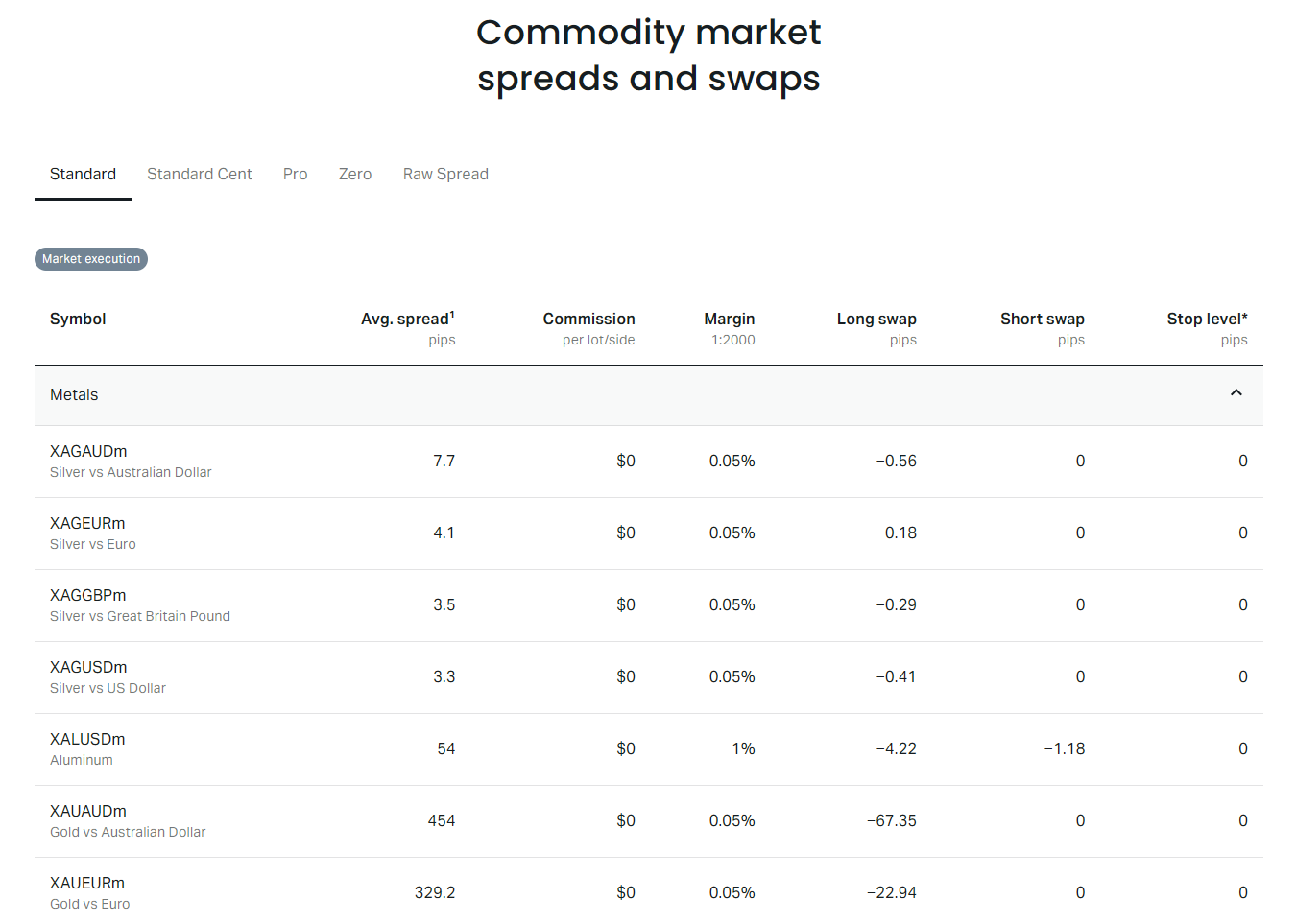
Spreads on commodities are variable. During high-liquidity periods such as the London–New York overlap, gold spreads on Raw Spread accounts can start from 0.1 pips with a $3.50 per side commission per lot. On Standard accounts, the same instrument might show 1.5–2.0 pips with no commission. Silver typically runs 2–3 times the gold spread. Oil spreads widen around inventory reports and OPEC announcements. Natural gas spreads expand sharply during weather-driven volatility.
Scroll horizontally to see all columns
| Instrument | Standard Spread | Raw Spread + Commission | Zero Spread + Commission |
|---|---|---|---|
| Gold (XAUUSD) | ~1.5 pips | ~0.1 pips + $3.50/lot/side | 0.0 pips + $5.00/lot/side |
| Silver (XAGUSD) | ~3.0 pips | ~0.5 pips + $3.50/lot/side | 0.0 pips + $5.00/lot/side |
| Brent Crude (UKOIL) | ~4.0 pips | ~1.0 pips + $3.50/lot/side | 0.0 pips + $5.00/lot/side |
| WTI Crude (USOIL) | ~4.0 pips | ~1.0 pips + $3.50/lot/side | 0.0 pips + $5.00/lot/side |
| Natural Gas (XNGUSD) | ~6.0 pips | ~2.0 pips + $3.50/lot/side | 0.0 pips + $5.00/lot/side |
Swap rates (overnight financing) differ by instrument and account type. Gold swaps are often negative for long positions and positive for shorts, reflecting the cost of carry. Oil swaps incorporate the futures curve contango or backwardation. Exness publishes daily swap values in the platform and on its website. Islamic accounts swap-free status applies to commodities as well, though an administration fee may replace the swap after a certain holding period.
Leverage and Margin Requirements
Exness offers dynamic leverage on commodities. For most retail clients under FCA, CySEC, or ASIC regulation, maximum leverage on gold and silver is capped at 1:20 (5% margin). Major energy CFDs such as Brent and WTI are typically 1:10 (10% margin). Natural gas and minor metals may have lower limits. Professional clients and accounts under certain offshore entities can access higher leverage, sometimes up to 1:200 on gold, but this increases liquidation risk substantially.
Margin is calculated as notional value divided by leverage. A one-lot gold position at $2,000 per ounce has a notional value of $200,000. At 1:20 leverage, the required margin is $10,000. At 1:100, it drops to $2,000. The platform displays free margin, margin level, and stop-out thresholds in real time. Exness uses a 0% stop-out level on most accounts, meaning positions close automatically when margin level hits zero. This gives more room than brokers with 20% or 50% stop-outs, but it also means losses can exceed the account balance if slippage occurs during a gap.
- Gold and silver: up to 1:20 retail, higher for professional
- Brent and WTI crude: up to 1:10 retail
- Natural gas: often 1:10 or lower
- Platinum and palladium: typically 1:10
- Margin requirement updates automatically with price
The broker also provides a margin calculator in the Personal Area and on the website. Enter the instrument, lot size, leverage, and account currency to see the exact margin needed. This tool is useful when planning position size relative to account equity. Remember that margin requirements can change if the broker adjusts leverage tiers during periods of extreme volatility, such as around major economic releases or geopolitical events.
Account Types and Commodity Trading Conditions
Exness offers Standard, Standard Cent, Raw Spread, Zero, and Pro accounts. All support commodity CFDs, but the cost structure and minimum deposits differ. Standard and Standard Cent use spread-only pricing with no commission. Raw Spread and Zero charge commission per lot but offer tighter raw spreads. Pro accounts sit between them with low spreads and a moderate commission. The choice affects total trading cost, especially for high-frequency or large-volume commodity strategies.
Scroll horizontally to see all columns
| Account | Min Deposit | Commodity Commission | Typical Gold Spread | Best For |
|---|---|---|---|---|
| Standard | $1 | None (in spread) | ~1.5 pips | Beginners, low volume |
| Standard Cent | $1 | None (in spread) | ~1.5 pips | Micro lot testing |
| Raw Spread | $100 | $3.50/lot/side | ~0.1 pips | Scalpers, high volume |
| Zero | $200 | $5.00/lot/side | 0.0 pips | Algorithmic, precise cost |
| Pro | $200 | $2.50/lot/side | ~0.5 pips | Balanced cost/volume |
Standard Cent accounts denominate balance in cents, so a $10 deposit shows as 1,000 cents. This allows trading micro lots (0.01 standard lot) with meaningful position granularity. Commodity contract sizes remain the same; only the account denomination changes. Raw Spread and Zero accounts require higher minimums but reduce the all-in cost per round turn on gold to roughly $7–$10 per lot, compared to $15–$20 on Standard. For a trader doing 50 lots a month, that difference compounds.
The account type decision often matters more than the broker choice itself. A $5 per lot difference across 100 lots a month is $500 — real money that stays in the account.
Platforms Supporting Commodity CFDs
Commodity CFDs are available on MetaTrader 4, MetaTrader 5, the Exness Web Terminal, and the Exness mobile app. MT4 remains popular for its lightweight footprint and extensive custom indicator library. MT5 adds more timeframes, a built-in economic calendar, and depth of market. The Web Terminal runs in a browser with no installation and supports one-click trading, charting, and basic analysis. The mobile app mirrors Web Terminal functionality with push notifications and biometric login.
Execution quality is consistent across platforms because they connect to the same pricing engine. Market execution is the default for commodities on all account types; there is no dealing desk intervention. Slippage can occur during news events or low liquidity, but Exness publishes execution statistics quarterly showing fill rates and slippage distribution. The Web Terminal and mobile app also support pending orders, stop loss, and take profit placement directly on the chart.
Trading Hours and Session Overlaps
Commodity trading hours on Exness follow the underlying futures exchanges. Metals trade from Monday 01:00 server time to Friday 23:55, with a daily break from 23:55 to 01:00 (times vary slightly by instrument). Energies have a longer daily break: Brent and WTI close from 23:55 to 03:00 server time. Natural gas follows NYMEX hours, closing daily for about an hour and fully closed on weekends. The server time is GMT+0 in winter, GMT+1 in summer (DST).
The most liquid window for gold and silver is the London–New York overlap, roughly 13:00–17:00 GMT. Spreads tighten, depth increases, and slippage decreases. Oil sees peak volume during the same window plus the post-settlement period after 14:30 GMT when the CME pit session ends. Natural gas volume spikes around the EIA storage report (Thursday 14:30 GMT) and during extreme weather forecasts. Trading outside these windows means wider spreads and higher risk of partial fills.
- Metals: 24/5 with 1-hour daily break
- Brent/WTI: 23-hour sessions, 1-hour break
- Natural gas: follows NYMEX, weekend closed
- Best liquidity: London–NY overlap 13:00–17:00 GMT
- Avoid: Asian session for oil, pre-break for metals
Risk Management for Commodity Positions
Commodities can gap sharply on supply news, geopolitical events, or unexpected inventory data. Gold may move $20–$30 in seconds on a surprise CPI print. Oil can gap $2–$3 on OPEC+ decisions. Natural gas regularly moves 5–10% on weather model updates. Standard stop-loss orders execute at the next available price, which may be far from the intended level during a gap. Exness offers negative balance protection, so losses cannot exceed the account balance, but the equity drawdown before stop-out can still be severe.
Position sizing is the primary defense. A common rule is risking no more than 1–2% of account equity per trade. For a $10,000 account, that means a $100–$200 risk budget. If gold's average true range (ATR) is $15 and you place a stop 1.5 ATR away ($22.50), the maximum lot size is about 0.44 lots ($100 / $22.50 / $100 per lot per dollar). The Exness trading calculator in the Personal Area automates this math. Enter entry, stop, account size, and risk percentage to get the exact lot size.
A stop loss placed at a technical level without considering volatility is a guess. Size the position so the stop represents a defined risk amount, not a hope.
Fundamental Drivers for Key Commodities
Gold reacts to real yields, dollar strength, and central bank buying. When US 10-year TIPS yields rise, gold tends to fall. A weaker dollar supports gold priced in USD. Central bank purchases — especially from China, India, and Turkey — provide a long-term bid. Silver has an industrial component (solar, electronics) making it more sensitive to manufacturing PMIs. Platinum and palladium depend heavily on automotive catalyst demand, which is shifting with EV adoption.
Oil prices balance OPEC+ supply decisions, global demand forecasts, inventory data (EIA weekly, API weekly), and geopolitical risk premiums. Brent tends to trade at a premium to WTI reflecting shipping costs and quality differences. Natural gas is driven by US storage levels, LNG export capacity, and heating/cooling degree days. Hurricane season in the Gulf of Mexico adds a seasonal risk premium from June to November.
Scroll horizontally to see all columns
| Commodity | Key Drivers | High-Impact Events |
|---|---|---|
| Gold (XAUUSD) | Real yields, USD, central bank demand | FOMC, CPI, NFP, central bank meetings |
| Silver (XAGUSD) | Gold correlation, industrial demand | Manufacturing PMI, solar capacity data |
| Brent Crude (UKOIL) | OPEC+ policy, global demand, inventories | OPEC meetings, EIA/API reports, geopolitics |
| WTI Crude (USOIL) | US production, Cushing inventories, refinery runs | EIA weekly, API weekly, hurricane season |
| Natural Gas (XNGUSD) | Storage, weather, LNG exports, production | EIA storage (Thu), weather models, freeze events |
Exness provides an economic calendar integrated into MT5 and the Web Terminal, plus a separate web version. Filter for 'High' impact events on USD, energy, and metals. The calendar shows consensus, previous, and actual values with color coding. Setting alerts for key releases helps avoid being caught in a spread widening event. Some traders flatten commodity positions 15–30 minutes before major data and re-enter after the initial reaction.
Technical Analysis Considerations
Commodities respect technical levels but with caveats. Gold often clusters around round numbers ($1,800, $1,900, $2,000) and key moving averages (50, 100, 200-day). Silver tends to overshoot gold's moves in both directions — a 1% gold move may produce a 2–3% silver move. Oil respects trend channels and Fibonacci retracements during trending markets but chops violently in ranges. Natural gas is notoriously mean-reverting within seasonal bands; breakouts often fail without a weather catalyst.
Volume data is not available for spot CFDs the way it is for futures. The platforms show tick volume (price changes), which correlates loosely with real volume but can mislead during low-liquidity periods. Open interest is not displayed. Traders who need genuine volume and open interest often analyze the corresponding CME futures charts alongside the CFD chart. Exness charts support multiple timeframes and custom indicators on MT4/MT5; the Web Terminal offers a smaller but functional set.
- Gold: watch 50/200-day MA, round numbers, RSI divergence
- Silver: higher beta to gold, wider Bollinger Bands
- Oil: trend channels, $5–$10 psychological levels
- Natural gas: seasonal range, weather-driven breakouts
- Use futures charts for volume and open interest context
The Exness Web Terminal includes Trading Central signals for commodities, showing automated pattern recognition (triangles, wedges, channels) and key levels. These are not trade recommendations but can highlight structures you might miss. The mobile app pushes signal notifications if enabled. Treat them as a screening layer, not a signal service. Always verify against your own analysis and risk parameters.
Deposit, Withdrawal, and Funding for Commodity Traders
Funding methods vary by region but generally include bank wire, credit/debit cards, e-wallets (Skrill, Neteller, WebMoney, Perfect Money), and local payment systems. Exness processes withdrawals automatically 24/7 for most methods, with card and e-wallet payouts often completing in minutes. Bank wires take 1–3 business days. There are no deposit or withdrawal fees from Exness, though payment providers may charge their own. The minimum deposit is $1 for Standard and Standard Cent; $100 for Raw Spread; $200 for Zero and Pro.
Commodity traders using higher leverage should monitor free margin closely after deposits and withdrawals. A withdrawal reduces equity and can trigger stop-out if open positions lack sufficient margin. The Personal Area shows a withdrawal preview with the resulting margin level. Exness also offers internal transfers between accounts in the same Personal Area, which is instant and free. This lets you move funds from a low-leverage holding account to a higher-leverage trading account without external processing time.
Regulatory Entities and Client Protections
Exness operates through several regulated entities: Exness (Cy) Ltd (CySEC), Exness B.V. (Curaçao), Exness (SC) Ltd (Seychelles FSA), Exness (VG) Ltd (BVI FSC), and Exness ZA (Pty) Ltd (FSCA South Africa). The entity serving your account determines leverage caps, negative balance protection scope, and compensation scheme eligibility. CySEC and FCA clients receive up to €20,000/£85,000 investor compensation. FSCA clients have different protections. Offshore entities offer higher leverage but no compensation fund.
Commodity trading conditions — spreads, swaps, execution — are largely consistent across entities. The main differences are leverage limits and client categorization. Professional client status (opt-in) unlocks higher leverage but waives certain protections. Retail clients under CySEC/FCA/ASIC are capped at 1:20 for gold, 1:10 for oil. The onboarding questionnaire assesses experience, portfolio size, and trading frequency to determine professional eligibility. Most commodity traders remain retail unless they meet two of three quantitative criteria.
Higher leverage from an offshore entity looks attractive until a 2% adverse move wipes 40% of the account. The protection trade-off is real.
Common Commodity Trading Mistakes on Exness
Overleveraging gold is the most frequent error. Traders see 1:200 available (on eligible accounts) and size positions as if the market moves in a straight line. A $20 move against a 5-lot position at 1:200 leverage consumes the entire margin. Another mistake is ignoring swap on multi-day holds. A long gold position held for two weeks can accumulate $50–$100 in negative swap per lot, turning a small profit into a loss. Third, trading natural gas without checking the weather forecast calendar leads to avoidable volatility exposure.
- Sizing by maximum leverage instead of risk percentage
- Holding commodities through weekends without checking swap
- Trading oil inventory days without a plan for widened spreads
- Using tick volume as a proxy for real futures volume
- Entering natural gas positions before EIA storage without a stop
A practical habit: before each session, check the economic calendar for high-impact events affecting your open commodity positions. Note the expected volatility window. Adjust stops or reduce size if the event risk exceeds your risk budget. After the event, reassess. This routine takes five minutes and prevents the most common account-damaging surprises.
Comparing Exness Commodity Offering to Alternatives
Compared to brokers like IC Markets, Pepperstone, or XM, Exness commodity spreads on Raw Spread and Zero accounts are competitive, often 0.1–0.2 pips tighter on gold. The commission structure is similar ($3.50–$5.00 per lot per side). Exness stands out for instant withdrawals on most methods, 0% stop-out level, and no requotes on market execution. Some competitors offer tighter spreads on oil during Asian session but with dealing desk execution. Exness maintains market execution across all sessions.
Platform choice is a differentiator. Exness provides MT4, MT5, Web Terminal, and a native mobile app — all with full commodity access. Some brokers limit Web Terminal features or lack a proprietary app. The Exness Personal Area integrates the trading calculator, economic calendar, and account analytics in one place. For algorithmic traders, MT5 on Exness supports hedging mode and custom symbols, though the VPS offering is basic compared to specialized providers.
Scroll horizontally to see all columns
| Metric | Exness Raw Spread | IC Markets Raw Spread | Pepperstone Razor | XM Zero |
|---|---|---|---|---|
| Gold Spread (typical) | 0.1 pips | 0.1 pips | 0.1 pips | 0.1 pips |
| Gold Commission (round turn) | $7.00/lot | $7.00/lot | $7.00/lot | $7.00/lot |
| Oil Spread (typical) | 1.0 pips | 1.0 pips | 1.0 pips | 1.2 pips |
| Stop-Out Level | 0% | 50% | 50% | 20% |
| Withdrawal Speed (e-wallet) | Instant | 1–24 hrs | 1–24 hrs | 24 hrs |
The 0% stop-out is a double-edged sword. It allows positions to survive deeper drawdowns, but it also means the account can go negative if a gap blows through all margin before the system closes positions. Exness covers negative balances for retail clients under regulated entities, but the process takes time. Traders should not rely on the 0% stop-out as a risk management tool; it is a backstop, not a strategy.
Frequently Asked Questions
What commodities can I trade on Exness?
Exness offers gold, silver, platinum, palladium, Brent crude, WTI crude, and natural gas as CFDs. Some regions also provide soft commodities like cocoa, coffee, cotton, and sugar.
What is the minimum deposit to trade commodities on Exness?
Standard and Standard Cent accounts require $1. Raw Spread requires $100. Zero and Pro accounts require $200.
Does Exness charge commission on gold trading?
Standard and Standard Cent accounts include the cost in the spread with no separate commission. Raw Spread, Zero, and Pro accounts charge a per-lot commission ($3.50–$5.00 per side) on top of a raw spread.
What leverage is available for gold on Exness?
Retail clients under CySEC, FCA, or ASIC regulation are capped at 1:20. Professional clients and accounts under offshore entities can access up to 1:200 on gold.
Are commodity swaps charged on Exness?
Yes, overnight positions incur swap charges (positive or negative) based on the instrument and direction. Islamic accounts are swap-free but may have an administration fee after a holding period.
Can I trade commodities on the Exness mobile app?
Yes, the Exness mobile app provides full access to all commodity CFDs with charting, one-click trading, alerts, and account management.
What are the trading hours for oil on Exness?
Brent and WTI crude trade 23 hours a day with a one-hour daily break, typically 23:55–03:00 server time. Hours follow the underlying futures exchange sessions.
Final Assessment of Exness Commodities Trading
Exness delivers a competent commodity CFD offering with tight spreads on professional accounts, reliable market execution, and a platform suite that covers desktop, web, and mobile. The 0% stop-out and instant withdrawals are genuine operational advantages for active traders. The main considerations are leverage caps for regulated retail clients, swap costs on multi-day holds, and the need to manage position size relative to commodity volatility. For traders who understand these mechanics, Exness provides the tools to execute a commodity strategy without platform friction or funding delays.