
Forex Trading
Exness Kenya: Trading Platform Access and Features for Kenyan Users
What Kenyan traders need to know about Exness account setup, trading tools, and customer support.

Senior Forex Trader & Market Analyst
Daniel Chen is an experienced forex trader and financial market analyst with over 15 years of experience in currency trading. He specializes in technical analysis, risk management, and developing practical trading strategies to help traders make informed decisions.
Exness has grown into one of the most recognized online brokers globally, and its services are accessible to traders in Kenya. The broker offers a range of account types, trading platforms, and analytical tools that cater to both beginners and experienced market participants. Kenyan users can register, verify their accounts, and start trading forex, metals, energies, indices, stocks, and cryptocurrencies through the same infrastructure used by clients in other regions. This article examines what Exness provides for Kenyan traders, from account opening to platform choices, deposit and withdrawal methods, customer support, and regulatory considerations.
Contents
- 1. Exness Availability in Kenya
- 2. Account Types for Kenyan Traders
- 2.1. Standard and Standard Cent Accounts
- 2.2. Professional Accounts: Raw Spread and Zero
- 3. Trading Platforms Accessible from Kenya
- 3.1. MetaTrader 4 and MetaTrader 5
- 3.2. Exness Web Terminal and Mobile App
- 4. Deposit and Withdrawal Options for Kenya
- 5. Customer Support and Local Contacts
- 6. Regulation and Fund Safety
- 7. Trading Instruments Available
- 8. Exness Partner Program in Kenya
- 9. Key Considerations for Kenyan Traders
- 10. Final Assessment of Exness for Kenyan Traders
The Kenyan forex market has expanded rapidly over the past decade, driven by increased internet penetration, mobile money adoption, and a growing interest in online trading. Exness entered this space by offering a low-barrier entry point: minimal deposit requirements, instant withdrawal processing for many payment systems, and a suite of platforms that run on desktop, web, and mobile. While the broker does not maintain a physical office in Nairobi, its digital-first model means Kenyan traders can access the full product range without geographic restrictions. The following sections break down each component of the Exness offering as it applies to users in Kenya.
Before diving into specifics, it is worth noting that Exness operates under multiple regulatory licenses globally, including authorizations from the FCA in the UK, CySEC in Cyprus, and the FSCA in South Africa. Kenyan clients typically onboard through the entity regulated by the Seychelles Financial Services Authority (FSA) or the South African FSCA, depending on the registration flow. The broker does not hold a license from the Capital Markets Authority (CMA) of Kenya, which means local regulatory protections such as the Investor Compensation Fund do not apply. Traders should factor this into their risk assessment when deciding whether to keep significant capital with the broker.
Account registration is straightforward. Prospective clients visit the Exness website or download the mobile app, provide an email address, create a password, and complete a short questionnaire about trading experience and financial knowledge. Identity verification follows, requiring a government-issued ID (Kenyan national ID or passport) and proof of address (utility bill or bank statement not older than three months). The verification process usually completes within a few hours, after which the trader can fund the account and begin trading. Exness Kenya login credentials are the same across all platforms: the Personal Area, MetaTrader 4, MetaTrader 5, the Web Terminal, and the mobile app.
Exness Availability in Kenya
Exness accepts clients from Kenya without requiring a local introducing broker or intermediary. The website and app are accessible from Kenyan IP addresses, and the registration form includes Kenya in the country dropdown. There are no Kenya-specific restrictions on leverage, instrument access, or account types. The broker supports English and Swahili is not currently offered as an interface language, but English is widely used in Kenya's financial sector. Customer support is available in English 24/7 via live chat, email, and a callback request form. Phone support numbers listed on the global contact page are international; there is no dedicated Kenyan toll-free line at the time of writing.
- No local office or physical presence in Nairobi or other Kenyan cities.
- Full product suite available: forex, metals, energies, indices, stocks, crypto.
- Leverage up to 1:2000 on certain accounts, subject to margin requirements.
- No deposit fees charged by Exness; payment provider fees may apply.
- Withdrawal processing is automated and often instant for electronic methods.
The absence of a CMA license does not make Exness illegal for Kenyan residents. Many international brokers operate in Kenya under offshore licenses, and the CMA has not issued a blanket prohibition. However, traders should be aware that dispute resolution would follow the regulator of the onboarding entity (FSA or FSCA) rather than Kenyan law. This distinction matters if a complaint escalates beyond the broker's internal process.
Account Types for Kenyan Traders
Exness offers two broad categories: Standard accounts and Professional accounts. Each category contains variants tailored to different trading styles and capital levels. All account types are available to Kenyan clients without restriction. The table below summarizes the key differences.
Scroll horizontally to see all columns
| Account | Min Deposit | Spreads From | Commission | Max Leverage | Best For |
|---|---|---|---|---|---|
| Standard | $1 | 0.3 pips | None | 1:2000 | Beginners, low capital |
| Standard Cent | $1 | 0.3 pips | None | 1:2000 | Micro lot testing |
| Pro | $200 | 0.1 pips | None | 1:2000 | Experienced, no commission |
| Raw Spread | $200 | 0.0 pips | $3.5 per lot/side | 1:2000 | Scalpers, low spread priority |
| Zero | $200 | 0.0 pips | $0.2 per lot/side (varies) | 1:2000 | High volume, fixed commission |
Standard and Standard Cent Accounts
The Standard account is the most popular entry point. It requires only a $1 minimum deposit, offers floating spreads from 0.3 pips on major pairs, and charges no commission. The Standard Cent account mirrors the Standard conditions but denominates the balance in cents, allowing traders to open positions as small as 0.01 cent lots (equivalent to 0.0001 standard lots). This is useful for Kenyan traders who want to test strategies with real money while risking only a few shillings per trade. Both accounts support the full range of instruments and the maximum leverage of 1:2000, though Exness applies dynamic leverage caps based on equity and instrument.
Professional Accounts: Raw Spread and Zero
Professional accounts target traders who execute larger volumes or require tighter spreads. The Raw Spread account offers spreads from 0.0 pips with a commission of $3.5 per lot per side (round turn $7). The Zero account also starts at 0.0 pips but charges a lower commission that varies by instrument (typically $0.2 per lot per side on majors). Both require a $200 minimum deposit. For Kenyan traders depositing via M-Pesa or bank transfer, the $200 threshold translates to roughly KES 26,000 at current rates, which is accessible for serious retail traders. The Pro account sits between Standard and Raw Spread: no commission, spreads from 0.1 pips, and a $200 minimum.
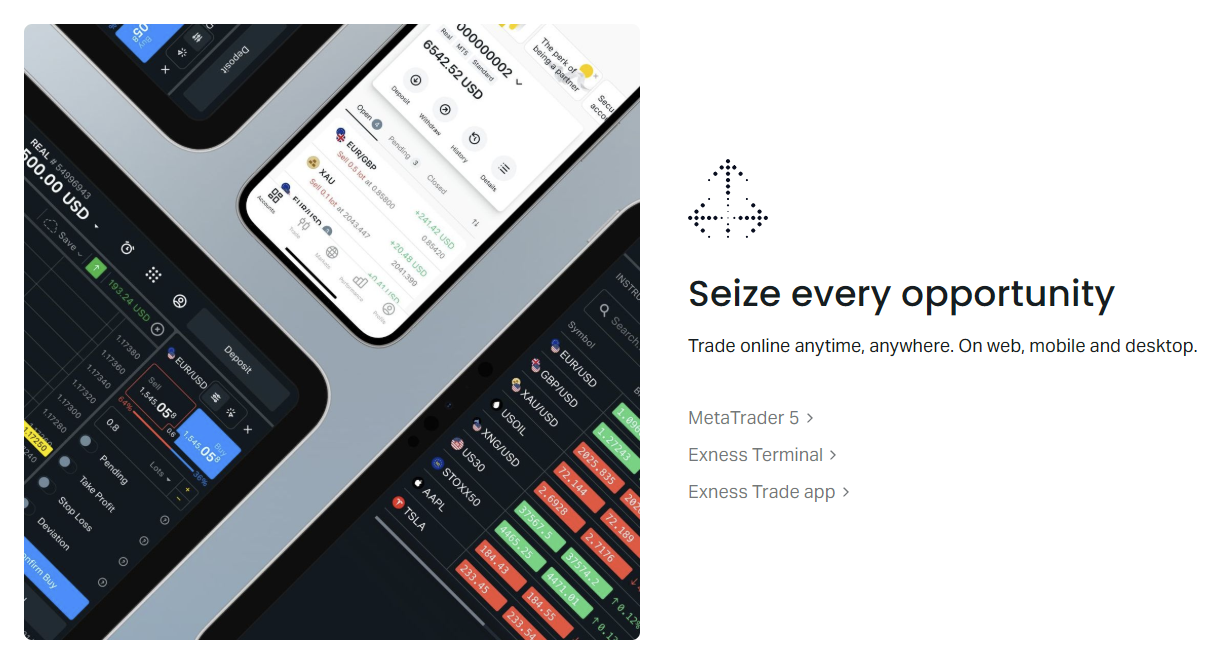
The image above illustrates the platform ecosystem available to Exness clients. Kenyan traders can choose the environment that matches their workflow, whether they prefer the depth of MetaTrader on desktop, the convenience of a browser-based terminal, or the mobility of the native app.
Trading Platforms Accessible from Kenya
Exness supports MetaTrader 4, MetaTrader 5, a proprietary Web Terminal, and a mobile app for iOS and Android. All platforms connect to the same pricing engine and execution model. The Web Terminal requires no installation and works on any modern browser, which is handy for traders using shared or work computers. The mobile app replicates most desktop features, including charting, order management, and account funding. MetaTrader 4 remains the most widely used platform globally, while MetaTrader 5 adds more timeframes, an economic calendar, and a built-in depth of market view.
MetaTrader 4 and MetaTrader 5
Both MT4 and MT5 are available for Windows, macOS, and Linux (via Wine). Exness provides direct download links in the Personal Area. The broker's servers are labeled Exness-MT4 and Exness-MT5; Kenyan traders should select the server corresponding to their account type (e.g., Exness-MT4 Trial for demo, Exness-MT4 Real for live). The platforms support expert advisors, custom indicators, and one-click trading. Exness does not restrict the use of EAs or hedging on any account type. Mobile versions of MT4 and MT5 can be downloaded from the App Store and Google Play; they sync with the desktop terminal via the same login credentials.
Exness Web Terminal and Mobile App
The Web Terminal is a browser-based platform that loads instantly after logging into the Personal Area. It offers 21 timeframes, 30+ indicators, and a clean interface that many traders find faster than MT4 for quick analysis. The Exness mobile app (distinct from MT4/MT5 mobile) integrates account management, deposits, withdrawals, and trading in a single interface. It includes Trading Central signals, an economic calendar, and push notifications for price alerts and margin calls. For Kenyan traders who rely on mobile data, the app is optimized for low bandwidth and works well on 3G/4G connections.
The mobile app screenshot above highlights the integrated experience: a trader can analyze a chart, open a position, and request a withdrawal without leaving the app. This is particularly valuable in Kenya where mobile-first internet usage is the norm.
Deposit and Withdrawal Options for Kenya
Exness supports a wide range of payment methods globally, but availability varies by country. For Kenya, the most relevant options include bank wire transfers, credit/debit cards (Visa, Mastercard), and electronic payment systems such as Neteller, Skrill, Perfect Money, and WebMoney. M-Pesa is not directly integrated as a deposit method on the Exness platform at the time of writing. However, Kenyan traders can fund their accounts via third-party exchangers that accept M-Pesa and credit the Exness account via one of the supported e-wallets. This adds a layer of cost and counterparty risk, so many traders prefer using a Visa or Mastercard linked to their Kenyan bank account for direct deposits.
Scroll horizontally to see all columns
| Method | Deposit Time | Withdrawal Time | Fees (Exness) | Min Deposit | Min Withdrawal |
|---|---|---|---|---|---|
| Visa/Mastercard | Instant | 1-3 business days | None | $1 | $3 |
| Bank Wire | 1-3 business days | 1-5 business days | None | $10 | $10 |
| Neteller | Instant | Instant | None | $1 | $1 |
| Skrill | Instant | Instant | None | $1 | $1 |
| Perfect Money | Instant | Instant | None | $1 | $1 |
Exness does not charge deposit or withdrawal fees for any of the above methods. However, payment providers may impose their own fees, and currency conversion spreads apply if the account currency differs from the payment method currency. Most Kenyan traders keep their accounts in USD to avoid conversion costs. Withdrawal requests are processed automatically 24/7, and the majority of electronic withdrawals complete within minutes. Card withdrawals are refunded to the original card and can take several business days to appear on the statement, depending on the issuing bank.
Customer Support and Local Contacts
Exness provides 24/7 customer support via live chat, email, and a callback request form. The live chat is accessible from the website and the Personal Area; response times are typically under a minute during peak hours. Email support replies within a few hours. There is no dedicated Kenyan phone number, but the global support numbers (Cyprus, UK, South Africa) accept international calls. The broker also maintains a comprehensive help center with articles on account verification, platform setup, trading conditions, and payment methods. For Kenyan traders, the most common support topics are verification document requirements, deposit/withdrawal troubleshooting, and leverage adjustments.
The lack of a local phone line is not unusual for offshore brokers serving Kenya. Live chat in English is usually sufficient for resolving technical and account issues quickly.
Exness Kenya contacts listed on third-party websites often refer to introducing brokers or affiliate partners, not official Exness representatives. Traders should only share account credentials or personal documents through the official Exness website or app. The broker never asks for passwords via email or chat. If you encounter a person claiming to be an Exness agent requesting login details, it is a scam.
Regulation and Fund Safety
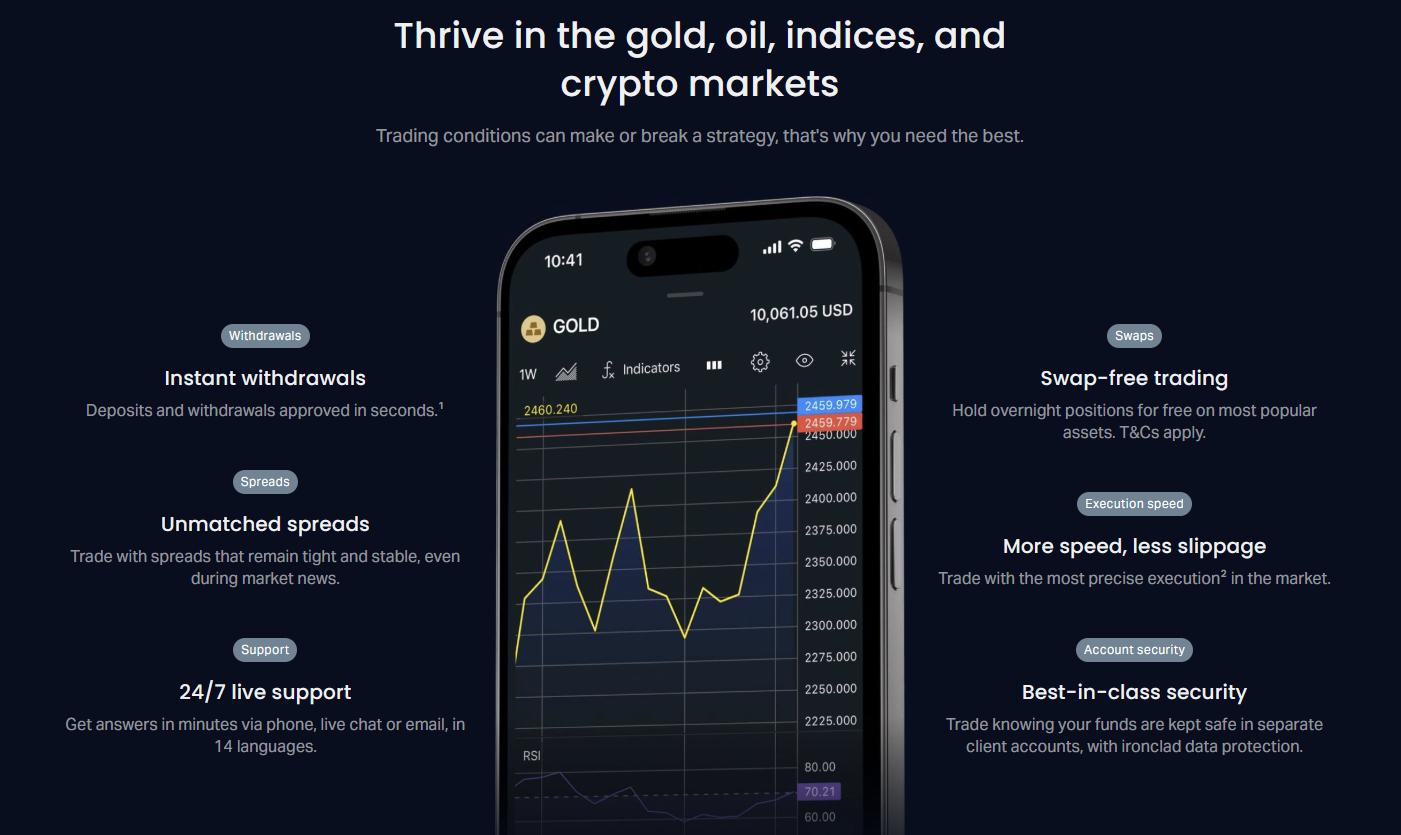
Exness operates through several legal entities. Kenyan clients typically contract with Exness (SC) Ltd, registered in Seychelles and regulated by the Financial Services Authority (license SD025), or Exness ZA (PTY) Ltd, regulated by the Financial Sector Conduct Authority in South Africa (FSP 51024). The Seychelles entity offers higher leverage (up to 1:2000) but does not participate in a compensation scheme. The South African entity caps leverage at 1:2000 for professionals and 1:30 for retail clients under FSCA rules, and client funds are held in segregated accounts with top-tier banks. Exness publishes quarterly financial reports and undergoes regular audits by Deloitte, which adds a layer of transparency.
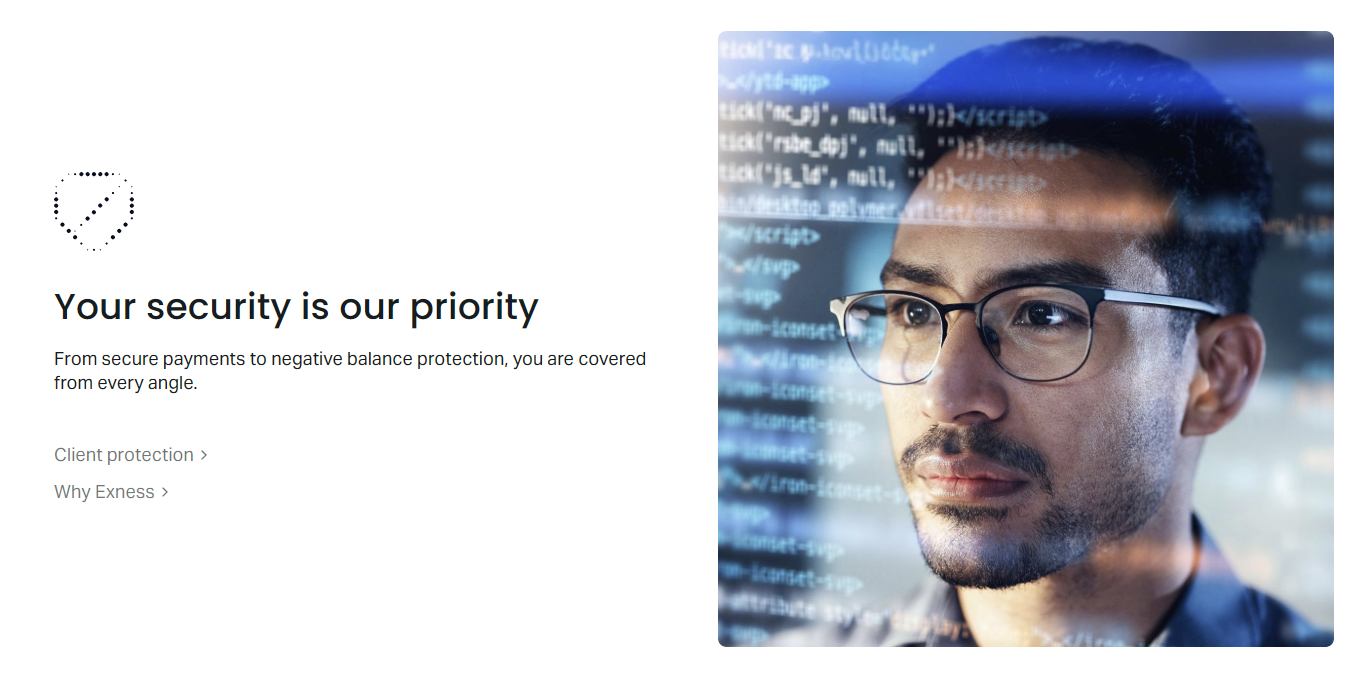
The security infographic above outlines the broker's approach to client fund protection. Segregated accounts mean client money is kept separate from the company's operational funds. Negative balance protection ensures traders cannot lose more than their deposited capital. The broker also employs two-factor authentication (2FA) for the Personal Area, which Kenyan traders should enable immediately after registration.
Trading Instruments Available
Exness offers over 200 instruments across several asset classes. Forex majors, minors, and exotics cover 100+ currency pairs. Metals include gold (XAUUSD), silver (XAGUSD), platinum, and palladium. Energies cover US crude (WTI), UK crude (Brent), and natural gas. Indices include 15+ global equity indices such as US30, US500, USTEC, UK100, GER40, and JPN225. Stocks CFDs cover 100+ large-cap companies from US, EU, and UK exchanges. Cryptocurrencies include BTCUSD, ETHUSD, LTCUSD, and several altcoin pairs, available 24/7. All instruments are accessible from Kenya on all account types, though margin requirements and trading hours vary.
- Forex: 100+ pairs, spreads from 0.0 pips on Raw Spread/Zero accounts.
- Gold: XAUUSD is the most traded instrument, tight spreads, high liquidity.
- Indices: Cash indices with no expiry, swap-free on swap-free accounts.
- Stocks: CFDs only, no voting rights or dividends, long positions receive dividend adjustments.
- Crypto: 24/7 trading, wider spreads on weekends, leverage up to 1:400.
Exness Partner Program in Kenya
Exness runs an Introducing Broker (IB) and affiliate program that is open to Kenyan residents. Partners earn commissions based on the trading volume of referred clients. The program offers tiered rebates, marketing materials, a dedicated partner portal, and weekly payouts. Kenyan affiliates often promote Exness through social media, trading education websites, and local forex communities. The broker does not require a minimum number of referrals to start earning, but higher tiers unlock better commission rates and priority support. Partners can withdraw earnings via the same payment methods available to traders.
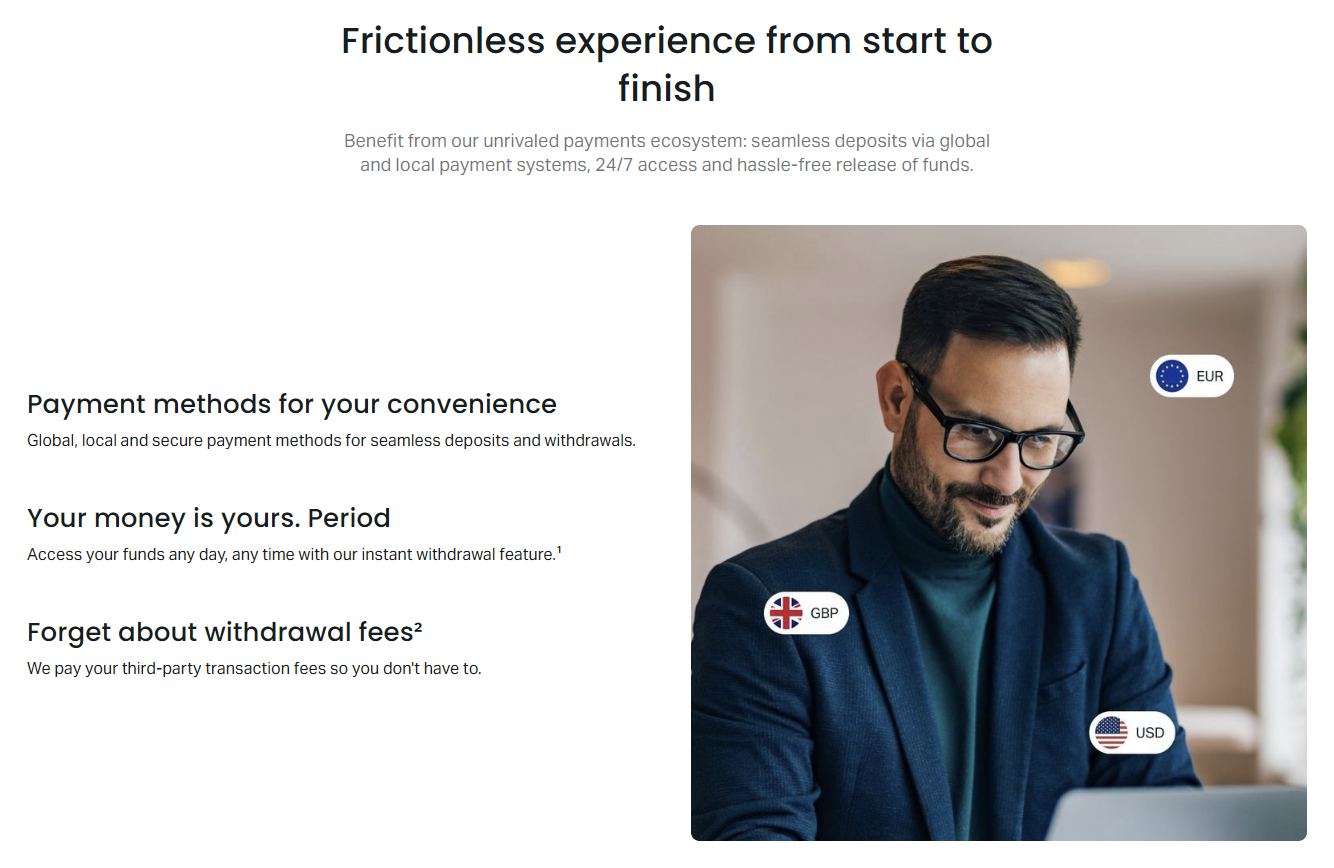
The payment methods image above also reflects the options available for partner commission withdrawals. Kenyan IBs typically use Neteller, Skrill, or bank wire for receiving payouts.
Key Considerations for Kenyan Traders
Trading forex and CFDs carries a high level of risk. Leverage amplifies both gains and losses. Kenyan traders should only risk capital they can afford to lose and should use stop-loss orders on every position. The Kenyan shilling (KES) is not offered as an account currency; most traders use USD. This means deposit and withdrawal amounts fluctuate with the USD/KES exchange rate. Tax obligations on trading profits fall under Kenyan income tax law; traders should consult a tax professional to understand their reporting requirements. Exness does not provide tax advice or issue tax certificates for Kenyan authorities.
Final Assessment of Exness for Kenyan Traders
Exness delivers a competent, low-cost trading environment that is fully accessible from Kenya. The broker's strengths include instant electronic withdrawals, a wide choice of platforms, tight spreads on professional accounts, and 24/7 support in English. The main drawbacks for Kenyan users are the lack of a CMA license, no direct M-Pesa integration, and no local phone support. Traders who prioritize regulatory protection under Kenyan law may prefer a CMA-licensed broker, though those typically offer higher spreads, lower leverage, and slower withdrawals. For traders comfortable with an offshore-regulated broker, Exness provides a reliable technical infrastructure and transparent pricing. The decision ultimately depends on whether the trader values maximum leverage and instant withdrawals over local regulatory recourse.
Frequently Asked Questions
Is Exness legal in Kenya?
Exness accepts Kenyan clients and operates under offshore licenses (Seychelles FSA, South Africa FSCA). It does not hold a Capital Markets Authority license, so local investor compensation protections do not apply.
How do I deposit money to Exness from Kenya?
You can deposit via Visa/Mastercard, bank wire, Neteller, Skrill, Perfect Money, or WebMoney. M-Pesa is not directly supported; some traders use third-party exchangers that accept M-Pesa and fund an e-wallet.
What is the minimum deposit for Exness in Kenya?
The Standard and Standard Cent accounts require a minimum deposit of $1. Professional accounts (Pro, Raw Spread, Zero) require $200.
Can I use MetaTrader 4 on my phone in Kenya?
Yes. Download MT4 or MT5 from the App Store or Google Play, then log in with your Exness credentials. The Exness mobile app is also available and includes integrated funding and analytics.
How long do withdrawals take for Kenyan traders?
Electronic withdrawals (Neteller, Skrill, Perfect Money) are usually instant, completing within minutes. Card withdrawals take 1-3 business days. Bank wires take 1-5 business days.
Does Exness offer a swap-free Islamic account for Kenyan Muslims?
Yes. Exness provides swap-free accounts for clients who qualify under Islamic finance principles. The swap-free status applies to all instruments on eligible accounts.
What leverage can I get on Exness from Kenya?
Up to 1:2000 on Standard, Standard Cent, Pro, Raw Spread, and Zero accounts under the Seychelles entity. The South African FSCA entity caps retail leverage at 1:30 and professional at 1:2000.
Where can I find Exness Kenya contacts for support?
Use the live chat on the Exness website or in the Personal Area. Email support is available 24/7. There is no dedicated Kenyan phone number; global support lines are international.