

Forex Trading Guides
Exness USDJPY Trading: Conditions, Platforms, and Strategy
A practical guide to trading the dollar-yen pair on Exness, covering costs, tools, and platform choices.

Senior Forex Trader & Market Analyst
Daniel Chen is an experienced forex trader and financial market analyst with over 15 years of experience in currency trading. He specializes in technical analysis, risk management, and developing practical trading strategies to help traders make informed decisions.
USDJPY is one of the most liquid currency pairs in the forex market, representing the exchange rate between the US dollar and the Japanese yen. It attracts day traders, swing traders, and algorithmic strategies alike because of its tight spreads, predictable reactions to risk sentiment, and deep order flow during both Asian and New York sessions. Exness offers this pair across all its account types with conditions that suit a range of trading styles.
Contents
- 1. Why USDJPY Draws Consistent Volume
- 2. Exness Account Types for USDJPY
- 3. Spreads, Swaps, and the Real Cost of Holding USDJPY
- 4. Execution Model and Order Types
- 5. Platform Choices: MT4, MT5, Web Terminal, and Mobile
- 6. Leverage, Margin, and Position Sizing on USDJPY
- 7. Trading Hours and Session Characteristics
- 8. Analysis Tools: Calendar, Signals, and Calculator
- 9. Risk Management Specific to USDJPY
- 10. Deposits, Withdrawals, and Account Funding
- 11. Regulation and Fund Safety
- 12. Practical Workflow: From Analysis to Execution
- 13. Common Pitfalls When Trading USDJPY on Exness
- 14. Comparing Exness to Other Brokers for USDJPY
- 15. Final Assessment of Exness USDJPY Trading
This guide walks through the practical details of trading USDJPY on Exness: spreads and commissions by account type, execution model, platform options, trading hours, and the tools available for analysis and risk management. It also covers the nuances that matter when you're actually placing trades — not just the marketing bullet points.
If you're already familiar with forex basics, you can skip ahead to the account comparison or platform sections. If you're newer to the pair, the next few paragraphs explain why USDJPY behaves the way it does and what that means for your trading decisions on Exness.
Why USDJPY Draws Consistent Volume
The dollar-yen pair sits at the intersection of two major economies with divergent monetary policies. The Federal Reserve and the Bank of Japan often move in opposite directions, creating sustained trends that technical traders can follow. Japan's status as a major creditor nation also means the yen acts as a funding currency — borrowed cheaply to buy higher-yielding assets. When risk appetite drops, those trades unwind and the yen strengthens. This dynamic gives USDJPY a clear risk-on/risk-off correlation that many other majors lack.
Liquidity peaks during the Tokyo-London overlap (07:00–09:00 UTC) and the London-New York overlap (12:00–16:00 UTC). Spreads tighten naturally in these windows. Outside them, especially during the late New York afternoon and early Asian session, you'll see wider spreads and thinner depth — something to factor into stop placement and position sizing.
USDJPY doesn't just follow interest rate differentials; it reflects global risk appetite in real time. That makes it a barometer as much as a trading vehicle.
Exness Account Types for USDJPY
Exness offers five main account categories, each with different cost structures for USDJPY. The choice comes down to whether you prefer all-inclusive spreads or raw spreads with a commission, and whether your volume qualifies for professional-tier pricing.
Scroll horizontally to see all columns
| Account | Typical Spread | Commission | Min Deposit | Best For |
|---|---|---|---|---|
| Standard | ~1.0–1.2 pips | None | $1 | Beginners, low volume |
| Standard Cent | ~1.0–1.2 pips | None | $1 | Micro lot practice |
| Pro | ~0.4–0.6 pips | None | $200 | Active retail traders |
| Raw Spread | ~0.0–0.2 pips | $3.50 per side/lot | $200 | Scalpers, high frequency |
| Zero | ~0.0–0.2 pips | $3.50 per side/lot | $200 | Zero spread preference |
The Standard and Standard Cent accounts wrap all costs into the spread. No commission line item appears on your statement, which simplifies accounting but means you pay a wider spread on every trade. The Pro account narrows the spread significantly without adding commission, making it a sweet spot for traders who execute several times a day but don't run high-frequency strategies.
Raw Spread and Zero accounts both offer near-zero spreads on USDJPY during peak hours, with a round-turn commission of $7 per standard lot. The difference is largely semantic — Zero emphasizes the spread figure in marketing, while Raw Spread is the more descriptive name. If you trade more than roughly 15 lots per month, the commission model usually works out cheaper than the Pro account's wider spread.
Spreads, Swaps, and the Real Cost of Holding USDJPY
Spreads on USDJPY at Exness are variable and tend to range between 0.0 and 1.5 pips depending on account type, time of day, and market volatility. During major news events — Fed decisions, BoJ policy meetings, US CPI releases — spreads can widen to 3–5 pips even on Raw Spread accounts. The platform displays live spreads in the Market Watch window, so you can verify conditions before entering.
Swap rates matter if you hold positions past 22:00 UTC (server time). USDJPY typically carries a positive swap for long USD positions because US interest rates have been higher than Japan's for years. As of the current rate environment, long USDJPY earns roughly $8–$12 per lot per night, while short positions pay a similar amount. Exness publishes swap rates in the contract specifications and updates them daily. Islamic accounts are swap-free by design but may carry an administration fee after a certain holding period.
Scroll horizontally to see all columns
| Position | Swap Points | Approx USD/Lot/Night |
|---|---|---|
| Long USDJPY | +12 to +18 | +$8 to +$12 |
| Short USDJPY | -15 to -22 | -$10 to -$15 |
These figures fluctuate with central bank policy changes. Always check the current rates in your terminal before planning a multi-day hold. The swap calculator in the Exness Personal Area and the web terminal both show exact values for your account currency and position size.
Execution Model and Order Types
Exness uses market execution for all account types. There is no dealing desk, no requotes, and no partial fills on standard market orders. When you click buy or sell, the order is filled at the best available price from the liquidity pool at that millisecond. During normal conditions, slippage on USDJPY is typically within 0.1–0.3 pips. During high-impact news, it can exceed 1–2 pips — a normal characteristic of market execution, not a broker deficiency.
Pending orders (buy limit, sell limit, buy stop, sell stop) sit on the Exness order book until triggered. They convert to market orders at the trigger price and execute at the next available price. This means a buy stop placed above resistance can fill worse than your price if the market gaps through your level. The platform does not guarantee pending order fill prices.
Platform Choices: MT4, MT5, Web Terminal, and Mobile
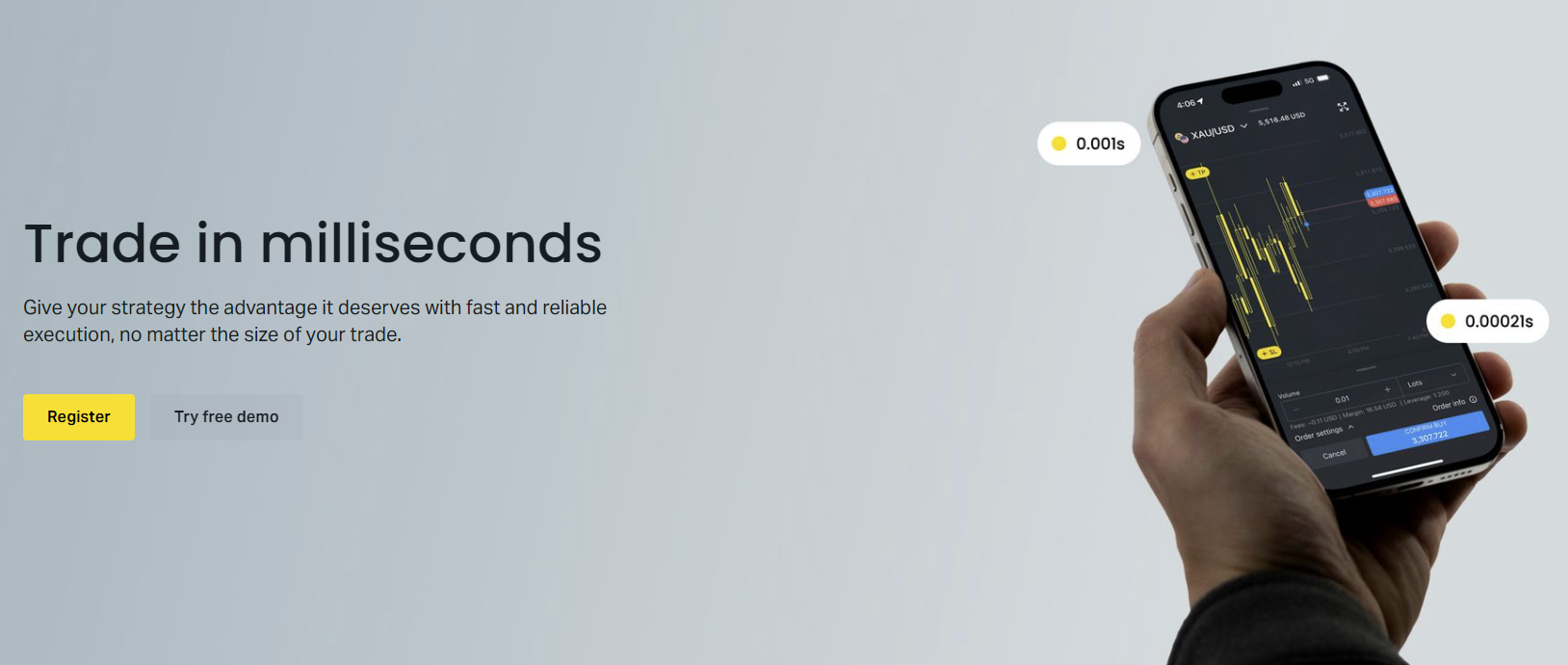
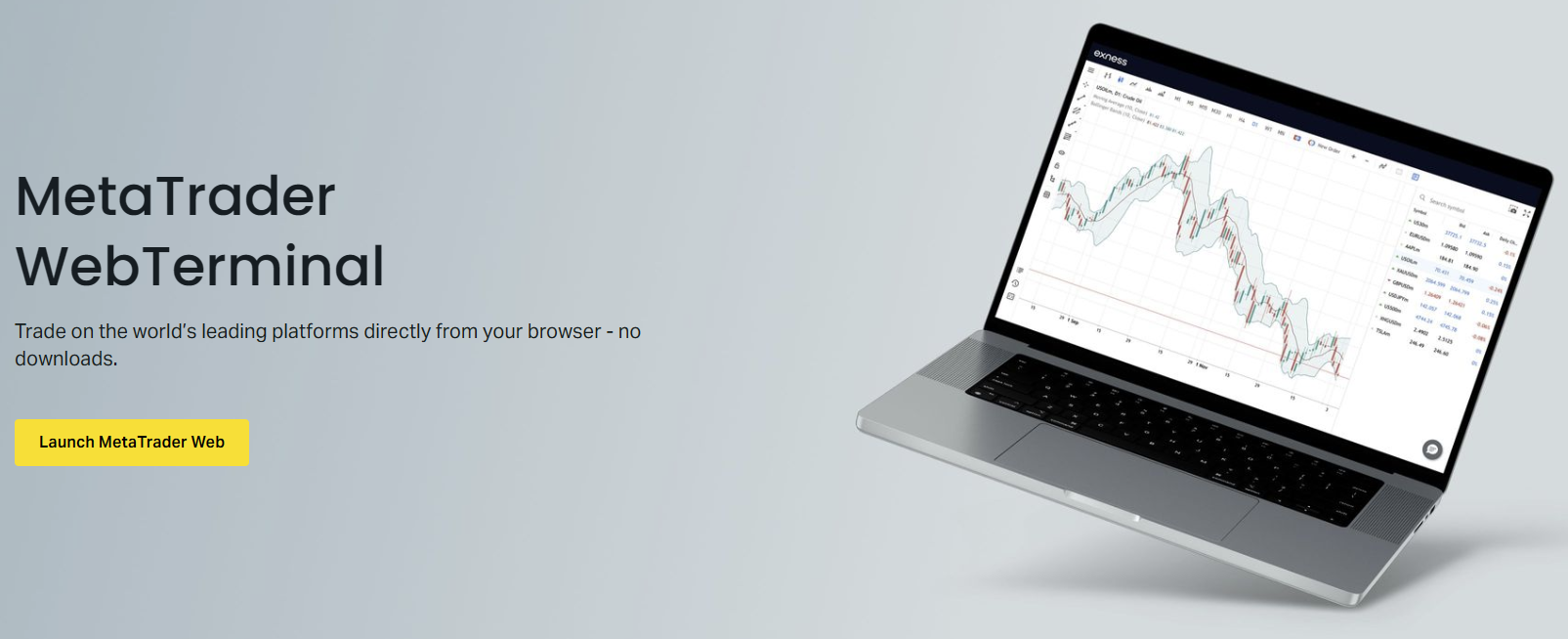
Exness supports four main trading interfaces for USDJPY. MetaTrader 4 remains the most popular for its vast ecosystem of custom indicators and expert advisors. MetaTrader 5 adds more timeframes, a built-in economic calendar, depth of market, and netting/hedging account options. The Exness Web Terminal runs in any browser with no installation and includes TradingView charts. Mobile apps for iOS and Android mirror the desktop functionality for both MT4 and MT5.
For USDJPY specifically, the choice often comes down to charting preferences. MT4's 9 timeframes cover most needs. MT5's 21 timeframes help if you trade multiple horizons — say, a 4-hour trend filter with 15-minute entries. The Web Terminal's TradingView integration gives you 12 chart types, 90+ drawing tools, and multi-chart layouts without leaving the browser. All platforms show the same pricing and execution; the difference is workflow.
- MT4: Largest EA/indicator library, 9 timeframes, hedging only
- MT5: 21 timeframes, depth of market, netting/hedging, built-in calendar
- Web Terminal: No install, TradingView charts, full account management
- Mobile Apps: Full MT4/MT5 feature parity, push notifications, biometric login
Leverage, Margin, and Position Sizing on USDJPY
Exness offers dynamic leverage up to 1:2000 on USDJPY for accounts with equity below $2,000. Above that threshold, leverage steps down: 1:2000 up to $2K, 1:1000 up to $5K, 1:500 up to $30K, 1:200 up to $100K, and 1:100 above $100K. Professional clients can request fixed 1:400 leverage regardless of equity. The margin requirement for a 1-lot USDJPY position at 1:500 leverage is roughly $200 (100,000 / 500).
High leverage is a tool, not a mandate. A 0.1-lot position on a $500 account at 1:500 uses $20 margin — 4% of equity. That leaves room for normal USDJPY intraday swings of 30–50 pips without hitting margin call. The stop-out level at Exness is 0% for most accounts, meaning positions close automatically when margin hits zero. There's no margin call warning; the system liquidates to prevent negative balance.
Trading Hours and Session Characteristics
USDJPY trades 24 hours a day, five days a week on Exness, from Monday 00:05 server time to Friday 23:55 server time (EET/EEST). The pair's behavior shifts distinctly across sessions. The Asian session (00:00–08:00 UTC) often ranges as Tokyo participants digest overnight moves. The London open (08:00 UTC) brings volume and direction. The New York open (13:00 UTC) adds US data flows and equity market correlation. The late New York afternoon (20:00–23:00 UTC) thins out, widening spreads.
Exness does not charge overnight financing for positions closed before the daily rollover at 22:00 UTC. If you day-trade USDJPY and close before that cutoff, you avoid swap entirely. Swing traders should factor the positive carry on long USDJPY into their hold calculations — it can offset several pips of adverse movement over a week.
Scroll horizontally to see all columns
| Session | UTC Range | Typical Spread | Volume Profile |
|---|---|---|---|
| Asian | 00:00–08:00 | 0.8–1.5 pips | Range-bound, lower volume |
| London | 08:00–13:00 | 0.3–0.8 pips | Trending, high volume |
| New York | 13:00–20:00 | 0.2–0.6 pips | High volume, data-driven |
| Late NY | 20:00–23:00 | 1.0–2.0 pips | Thin, wider spreads |
Analysis Tools: Calendar, Signals, and Calculator
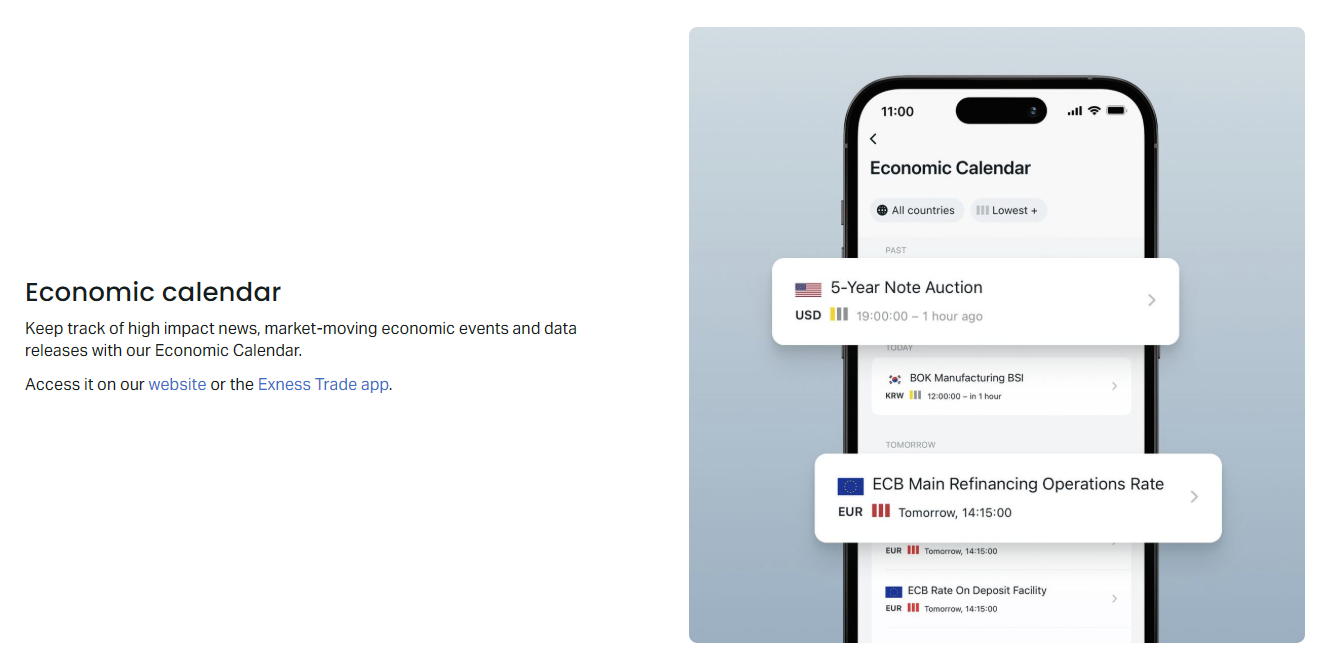
Exness integrates several tools directly into its ecosystem. The economic calendar (powered by FXStreet) filters events by currency, impact, and time. For USDJPY, you'll want Fed rate decisions, FOMC minutes, US CPI/PCE, non-farm payrolls, ISM PMIs, and BoJ policy meetings. The calendar shows forecast, previous, and actual values with color-coded impact ratings.
Trading Central signals appear in the Web Terminal and MT4/MT5 via plugin. They provide technical levels, pattern recognition, and short-term bias for USDJPY among other instruments. Treat them as a second opinion, not a signal service. The trading calculator in the Personal Area and Web Terminal computes margin, pip value, swap, and profit/loss for any position size — essential for precise risk management before you click trade.
Risk Management Specific to USDJPY
USDJPY's tendency to trend for extended periods rewards trailing stops but punishes fixed stops placed too tight. A 15-pip stop on a 1-hour chart often gets hit by normal noise. Many traders use ATR-based stops (1.5–2x ATR(14)) or structure-based stops below recent swing lows/highs. The pair also correlates positively with US equities and negatively with gold — useful context when you have multiple positions.
Position sizing should account for the yen's lower pip value. One pip on 1 lot of USDJPY equals 1,000 JPY, roughly $6.50–$7.00 depending on the rate. This is smaller than EURUSD ($10/pip) but larger than GBPJPY (~$6.50/pip). Adjust your lot size so that a 1% account risk translates to a stop distance that respects the pair's volatility.
Deposits, Withdrawals, and Account Funding
Exness supports instant deposits via cards, e-wallets (Skrill, Neteller, WebMoney, Perfect Money), and local bank transfers in many regions. Minimum deposit is $1 for Standard and Standard Cent accounts, $200 for Pro, Raw Spread, and Zero. Withdrawals process back to the original deposit method first. Card refunds can take 3–10 business days depending on the issuer. E-wallet withdrawals are typically instant after internal approval. Bank wire withdrawals take 1–3 business days.
There are no deposit or withdrawal fees from Exness's side. Payment processors may charge their own fees. The Personal Area shows all available methods for your registered country. Verification (KYC) is required before first withdrawal — submit ID and proof of address. The process usually completes within a few hours during business days.
The $1 minimum deposit on Standard accounts lowers the barrier to live trading, but it also means many accounts are undercapitalized for the leverage offered. Fund enough to withstand normal drawdowns.
Regulation and Fund Safety
Exness operates through multiple entities: Exness (SC) Ltd in Seychelles (FSA), Exness B.V. in Curaçao (CBCS), Exness (VG) Ltd in the British Virgin Islands (FSC), and Exness ZA (Pty) Ltd in South Africa (FSCA). The entity serving you depends on your country of residence. Retail clients generally fall under the Seychelles or Curaçao entities. Segregated accounts hold client funds separate from operational funds. Negative balance protection applies to all retail accounts — you cannot lose more than your deposit.
There is no investor compensation scheme equivalent to the UK's FSCS or Cyprus's ICF for the offshore entities. This means if Exness becomes insolvent, recovery depends on the segregation and the regulator's resolution process. The South African entity (FSCA) offers stronger regulatory oversight but only serves residents of South Africa and select African countries.
Practical Workflow: From Analysis to Execution
A typical USDJPY session on Exness might start with the economic calendar — check for high-impact USD or JPY events in the next 24 hours. Open the Web Terminal or MT5, pull up a 4-hour chart for trend context, drop to 15-minute for entries. Use the calculator to size the position: account equity × 1% risk ÷ stop distance in pips ÷ pip value = lots. Place the trade with a stop loss and take profit. Monitor the position; if the trade moves 1R in your favor, move stop to breakeven or trail with a 1-hour ATR.
If news hits while you're in a position, you have three choices: close manually, widen the stop to accommodate volatility, or accept the risk of a stop-out. Exness's market execution means stops are not guaranteed — a gap can fill beyond your level. The only guaranteed protection is closing before the event.
- Check calendar for USD/JPY high-impact events
- Analyze 4H trend, 15M entry structure
- Calculate position size for 1% risk
- Enter with stop loss and take profit
- Manage: breakeven at 1R, trail at 2R
- Close or reduce before scheduled news
Common Pitfalls When Trading USDJPY on Exness
Overleveraging tops the list. The availability of 1:2000 leverage tempts new traders to size positions that a 20-pip move liquidates. Another pitfall is ignoring swap on short USDJPY positions held for weeks — the negative carry compounds. Some traders also forget that spreads widen at 22:00 UTC rollover for a few minutes; placing orders exactly at that moment can result in worse fills. Finally, relying solely on Trading Central signals without understanding the underlying technical context leads to mechanical losses when market regime shifts.
The tools Exness provides — calculator, calendar, signals — are only as good as the discipline applying them. A calculator doesn't prevent revenge trading.
Comparing Exness to Other Brokers for USDJPY
On raw spreads and commission, Exness sits competitively with IC Markets, Pepperstone, and FP Markets. Its advantage is the combination of near-zero spreads, instant withdrawals (on e-wallets), and no minimum deposit on Standard accounts. The disadvantage is the offshore regulatory structure for most clients and the dynamic leverage step-downs that reduce buying power as you grow. If you prioritize FCA or ASIC regulation, you'll accept slightly wider spreads or higher commissions elsewhere.
Scroll horizontally to see all columns
| Broker | Raw Spread | Commission/Lot | Regulation | Min Deposit |
|---|---|---|---|---|
| Exness | 0.0–0.2 pips | $3.50/side | FSA/CBCS/FSCA | $1 / $200 |
| IC Markets | 0.0–0.2 pips | $3.50/side | ASIC/CySEC/FSA | $200 |
| Pepperstone | 0.0–0.2 pips | $3.50/side | ASIC/FCA/CySEC | $200 |
| FP Markets | 0.0–0.2 pips | $3.00/side | ASIC/CySEC | $100 |
These figures change. Verify current conditions on each broker's website before opening an account. The regulatory difference is the most durable differentiator — it affects leverage caps, negative balance protection guarantees, and dispute resolution.
Frequently Asked Questions
What is the minimum deposit to trade USDJPY on Exness?
$1 for Standard and Standard Cent accounts. $200 for Pro, Raw Spread, and Zero accounts.
Does Exness charge swap on USDJPY?
Yes. Long USDJPY typically earns positive swap; short pays negative swap. Islamic accounts are swap-free but may have administration fees after a holding period.
What leverage is available for USDJPY?
Up to 1:2000 dynamically based on equity. Above $2,000 equity, leverage steps down to 1:1000, then 1:500, 1:200, and 1:100 at higher tiers.
Can I trade USDJPY on the Exness Web Terminal?
Yes. The Web Terminal offers full USDJPY trading with TradingView charts, all order types, and account management.
Are there deposit or withdrawal fees?
Exness charges no fees. Payment processors may apply their own charges. Withdrawals return to the original deposit method first.
How fast are USDJPY withdrawals on Exness?
E-wallet withdrawals are typically instant after approval. Card refunds take 3–10 business days. Bank wires take 1–3 business days.
Is USDJPY available 24/7?
USDJPY trades 24/5, Monday 00:05 to Friday 23:55 server time (EET/EEST). Closed weekends.
Final Assessment of Exness USDJPY Trading
Exness delivers competitive USDJPY conditions: tight variable spreads, market execution with minimal slippage under normal conditions, multiple platform choices, and instant e-wallet withdrawals. The account structure lets you start with $1 or scale to raw-spread commission pricing as volume grows. The trade-offs are the offshore regulatory framework for most clients, dynamic leverage that decreases with equity, and no guaranteed stop-loss protection. For traders who understand these constraints and size positions accordingly, Exness is a practical venue for USDJPY. For those who need top-tier regulatory oversight or guaranteed stops, a broker under FCA or ASIC may be worth the slightly higher all-in cost.