

Forex Trading Accounts
Exness Cent Account: Features, Trading Conditions, and Setup Guide
Learn how the Exness cent account works, its trading conditions, and whether it suits your strategy.

Senior Forex Trader & Market Analyst
Daniel Chen is an experienced forex trader and financial market analyst with over 15 years of experience in currency trading. He specializes in technical analysis, risk management, and developing practical trading strategies to help traders make informed decisions.
The Exness cent account exists for traders who want real market exposure without committing large sums. It denominates balances in cents rather than dollars, so a $10 deposit shows as 1,000 cents in the terminal. This scaling makes position sizing intuitive for beginners and lets experienced traders test strategies with minimal capital at risk.
Contents
- 1. What Is an Exness Cent Account
- 2. How Cent Accounts Differ from Standard Accounts
- 3. Trading Conditions on the Exness Cent Account
- 4. Spreads, Commissions, and Fees
- 5. Leverage and Margin Requirements
- 6. Available Instruments for Cent Account Trading
- 7. Platform Compatibility: MT4, MT5, and Web Terminal
- 8. Opening and Verifying a Cent Account
- 9. Deposit and Withdrawal Methods
- 10. Risk Management Considerations
- 11. Comparing Cent Account with Other Exness Account Types
- 12. Final Assessment of Exness Cent Account
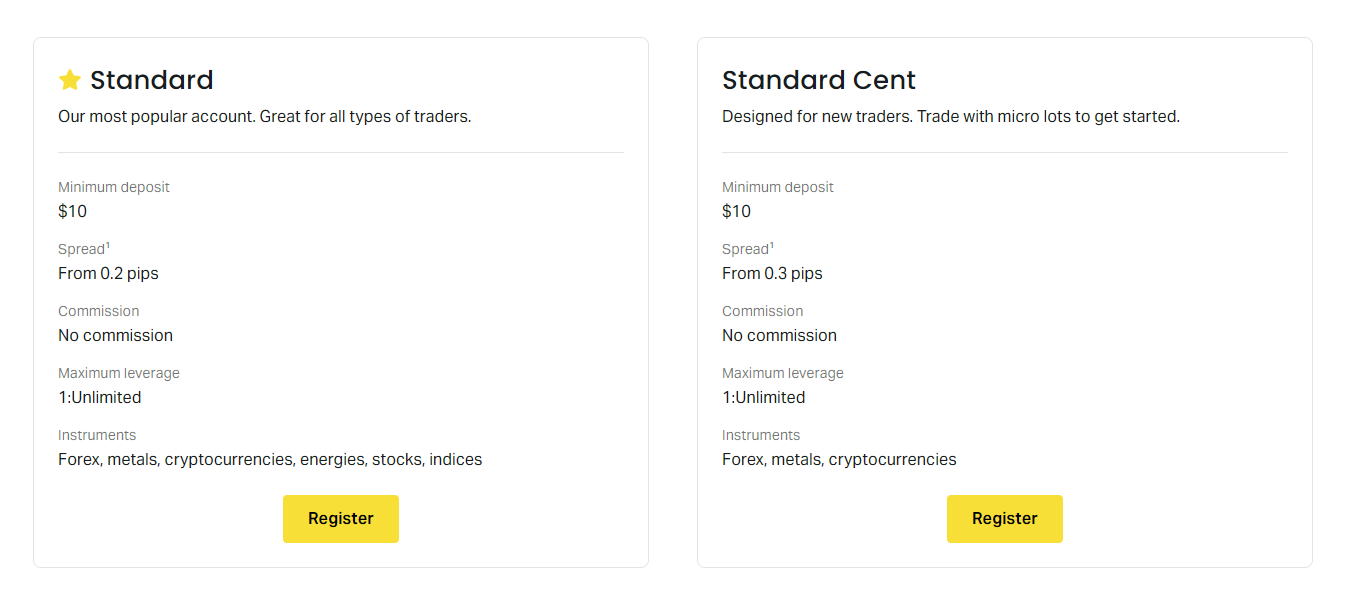
Exness offers the cent account under its Standard category, meaning no commission on trades and spreads that start from 0.3 pips on major pairs. The account supports both MetaTrader 4 and MetaTrader 5, plus the Exness Web Terminal and mobile apps. Maximum leverage reaches 1:2000 for eligible clients, though regulatory restrictions may lower this in certain jurisdictions.
What Is an Exness Cent Account
A cent account functions like any other forex trading account except for the base currency unit. Instead of dollars, euros, or pounds, the account currency is cents. One dollar equals 100 cents. When you deposit $10, the platform displays 1,000 USC (US cents). A standard lot on a cent account represents 1,000 units of base currency rather than 100,000, so the pip value scales down by a factor of 100 compared to a standard dollar account.
This structure serves two purposes. First, it lowers the psychological barrier for new traders. Seeing a balance of 5,000 cents feels more substantial than $50, even though the value is identical. Second, it enables precise risk management. You can trade 0.01 lots (10 units of base currency) and risk a few cents per trade, which is impossible on a standard account where the minimum lot size often translates to $0.10 per pip.
The Exness cent account carries the Standard Cent label. It sits alongside the Standard account in the broker's lineup. Both share the same execution model — market execution with no requotes — and both offer access to the full instrument catalog: forex pairs, metals, energies, indices, stocks, and cryptocurrencies. The key differences lie in contract specifications, which we'll examine in detail.
How Cent Accounts Differ from Standard Accounts
The most visible difference is the account currency. A Standard account uses USD, EUR, or other major currencies. The Standard Cent account uses USC or EURC. This affects every number you see: balance, equity, margin, profit, and loss. A $100 profit appears as 10,000 cents. Margin requirements display in cents. The trading terminal handles the conversion automatically, so you place orders in lots as usual.
Contract specifications also differ. On a Standard account, one lot equals 100,000 units of base currency. On a Standard Cent account, one lot equals 1,000 units. This means the minimum trade size of 0.01 lots represents 10 units on a cent account versus 1,000 units on a standard account. The pip value for EURUSD on a 0.01 lot trade is $0.001 (0.1 cents) on a cent account compared to $0.10 on a standard account.
- Account currency: USC or EURC instead of USD or EUR
- One lot = 1,000 units of base currency (vs 100,000 on Standard)
- Minimum lot size: 0.01 lots (10 units) on both account types
- Pip value scaled down by factor of 100
- Maximum leverage: 1:2000 on both (subject to regulation)
- Spreads: identical starting from 0.3 pips on majors
- Commission: zero on both Standard and Standard Cent
- Instruments: full catalog available on both
Margin calculations follow the same formula but produce smaller numbers because the notional value of each lot is lower. This means you can open more positions simultaneously with the same dollar deposit. For example, $100 on a Standard Cent account provides margin for roughly 100 micro-lots on EURUSD at 1:2000 leverage, whereas the same $100 on a Standard account supports only one micro-lot at that leverage.
Trading Conditions on the Exness Cent Account
Exness publishes live spread data for all account types. The Standard Cent account shows typical spreads of 0.3 pips on EURUSD during liquid hours, widening to 1-2 pips during Asian session or news events. GBPUSD averages 0.5 pips, USDJPY 0.4 pips. Cross pairs like EURGBP run 0.8-1.2 pips. Exotic pairs carry wider spreads, often 15-50 pips, reflecting lower liquidity.
Execution follows the market execution model. Orders fill at the best available price with no requotes. Slippage can occur during high volatility, but Exness maintains a no-requotes policy. The broker reports average execution speeds under 25 milliseconds on its servers. VPS hosting is available for traders running expert advisors who need consistent low latency.
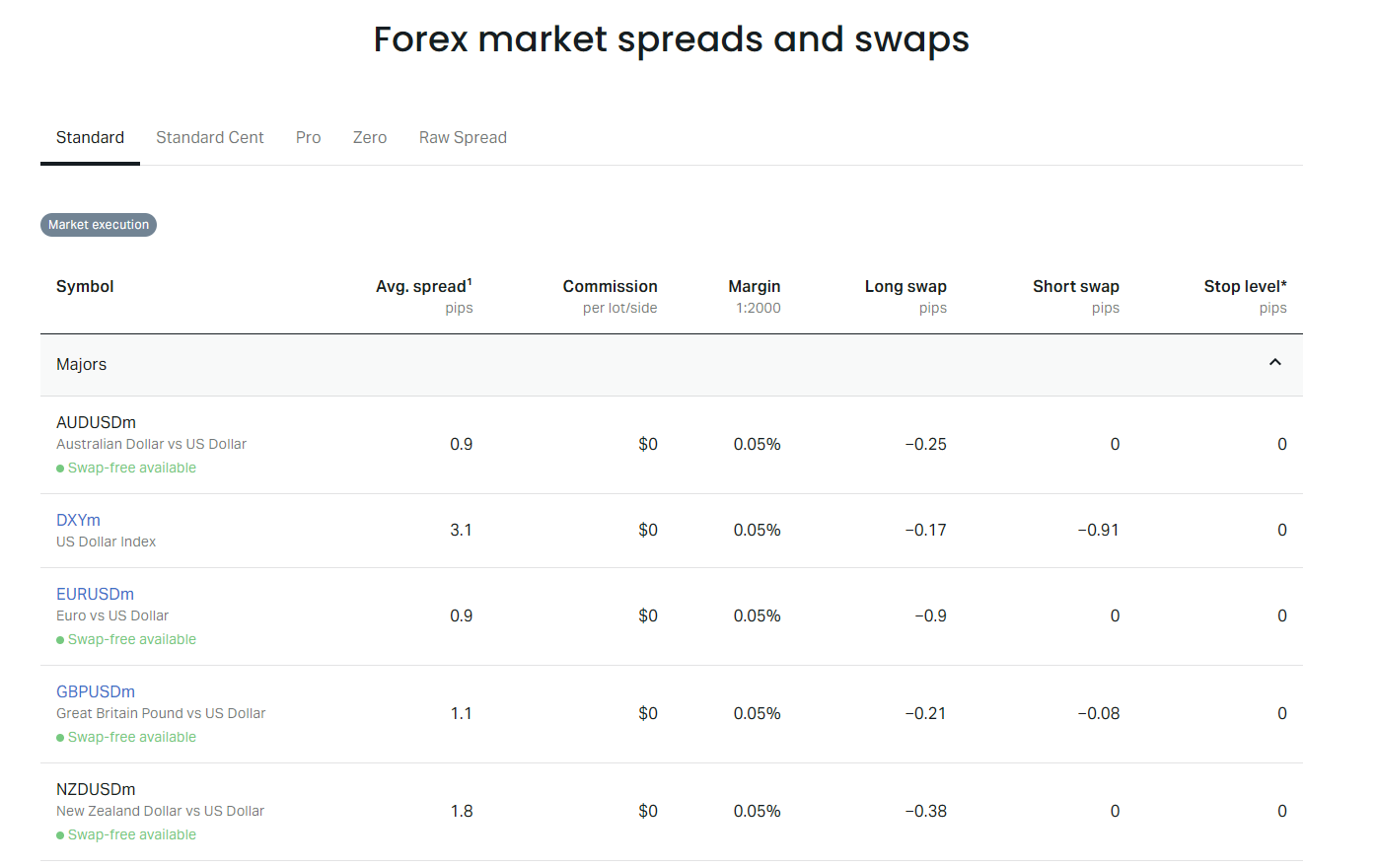
Swap rates apply to positions held overnight. Long and short swap values differ per instrument and update daily. On major forex pairs, swaps typically range from -$0.50 to +$0.20 per standard lot per night. On a cent account, these values divide by 100, making carry costs negligible for small positions. Wednesday night carries triple swap to account for weekend rollover.
Spreads, Commissions, and Fees
The Standard Cent account charges no commission. All costs embed in the spread. This simplifies cost calculation — you see the spread, you know the round-trip cost. For a 0.01 lot EURUSD trade with a 0.3 pip spread, the cost is 0.03 cents (0.0003 USD). Compare this to the Raw Spread or Zero accounts, which charge $3.50 per side per standard lot but offer spreads from 0.0 pips.
Deposit and withdrawal fees depend on the payment method. Exness itself charges zero fees for most methods. Bank wire transfers may incur intermediary bank charges. Cryptocurrency withdrawals carry network fees. Electronic payment systems like Neteller, Skrill, or Perfect Money process instantly with no Exness fee. Always verify current fee schedules in your Personal Area before transacting.
Scroll horizontally to see all columns
| Account Type | Commission (per side) | Typical EURUSD Spread | Cost per 0.01 Lot EURUSD |
|---|---|---|---|
| Standard Cent | $0 | 0.3 pips | 0.03 cents |
| Standard | $0 | 0.3 pips | $0.03 |
| Raw Spread | $3.50 per lot | 0.0-0.1 pips | $0.35 + spread |
| Zero | $3.50 per lot | 0.0 pips | $0.35 |
| Pro | $0 | 0.1 pips | $0.01 |
The table illustrates why cent accounts suit small balances. The absolute cost per trade is minuscule. A trader with $50 can execute hundreds of trades before spread costs meaningfully erode capital. On a Raw Spread account, the $7 round-trip commission per standard lot makes small positions uneconomical — you'd need to trade at least 0.1 lots to justify the commission, which requires more margin.
Leverage and Margin Requirements
Exness offers dynamic leverage up to 1:2000 on the Standard Cent account for equity below $1,000. As account equity grows, maximum leverage steps down: 1:2000 under $1,000, 1:1000 up to $5,000, 1:500 up to $30,000, and 1:200 above that. These thresholds apply to the dollar-equivalent value of your cent balance. Regulatory caps may override these limits — EU clients see 1:30 maximum, UK clients 1:30, Australian clients 1:30.
Margin requirement equals notional value divided by leverage. For a 0.01 lot EURUSD position (1,000 EUR notional on cent account) at 1:2000 leverage, required margin is 0.5 EUR (50 cents). At 1:30 leverage, the same position requires 33.33 EUR (3,333 cents). The difference dramatically affects how many concurrent positions a small account can sustain.
Stop out level sits at 0% margin level on Exness. This means the platform closes losing positions only when equity reaches zero. Most brokers stop out at 20-50% margin level. The 0% threshold gives trades more room to breathe but also means you can lose the entire account balance if the market moves sharply against you. Negative balance protection ensures you never owe more than your deposit.
Available Instruments for Cent Account Trading
The Standard Cent account grants access to Exness's full instrument catalog. This includes over 100 forex pairs (majors, minors, exotics), spot metals (gold, silver, platinum, palladium), energies (US oil, UK oil, natural gas), indices (US30, US500, USTEC, EU50, UK100, JP225, and more), stocks (major US and EU equities), and cryptocurrencies (BTC, ETH, LTC, XRP, BCH, ADA, DOT, LINK, UNI, and others).
Contract specifications vary by asset class. Forex pairs use the 1,000-units-per-lot standard. Metals: one lot of gold (XAUUSD) equals 100 ounces on cent account versus 100 ounces on standard — wait, that's the same. Actually, Exness standardizes gold at 100 ounces per lot across all account types. The difference appears in margin currency and pip value. Silver: 5,000 ounces per lot. Energies and indices have their own contract sizes listed in the specification sheets.
- Forex: 100+ pairs, lot = 1,000 base currency units
- Gold (XAUUSD): 100 oz per lot, margin in account currency
- Silver (XAGUSD): 5,000 oz per lot
- Energies: variable contract sizes (e.g., USOIL 1,000 barrels)
- Indices: contract value per point varies by index
- Stocks: 1 lot = 1 share, commission-free
- Cryptocurrencies: 1 lot = 1 coin (BTC, ETH) or 100 coins (altcoins)
Cryptocurrency trading on cent accounts deserves attention. Bitcoin spreads run 200-500 cents (equivalent to $20-$50 per coin) during normal conditions. With 1:2000 leverage, a 0.01 lot BTC position (0.01 BTC) requires roughly $1.50 margin at current prices. This makes crypto accessible on tiny accounts, but the spread cost relative to position size remains high. Traders should calculate whether the spread eats too much of expected profit.
Platform Compatibility: MT4, MT5, and Web Terminal
The Exness cent account works on every platform the broker supports. MetaTrader 4 remains popular for its vast library of custom indicators and expert advisors. MetaTrader 5 adds more timeframes, an economic calendar, depth of market, and netting/hedging options. Both desktop versions run on Windows and macOS (via Wine or native MT5 build). Mobile apps for iOS and Android provide full trading functionality including charting, order management, and account monitoring.
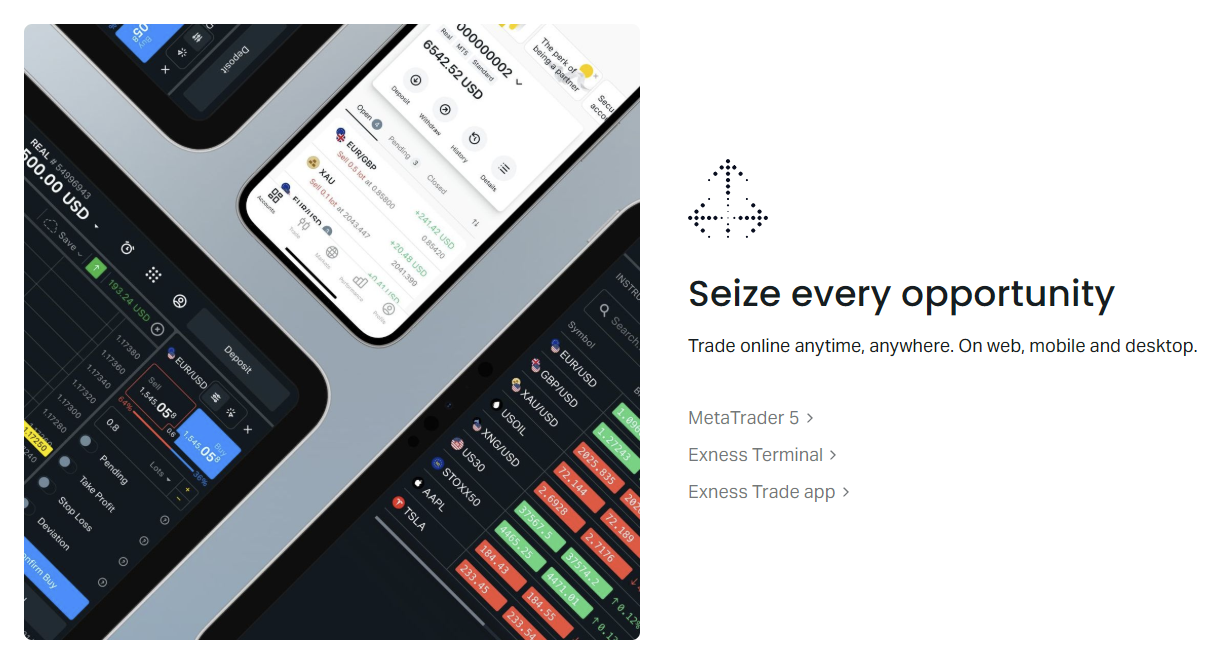
The Exness Web Terminal requires no installation. It runs in any modern browser and syncs with your MT4/MT5 credentials. Features include one-click trading, multiple chart layouts, technical indicators, and direct access to Exness analytical tools like Trading Central signals and the economic calendar. The Web Terminal suits traders who switch devices frequently or cannot install software on work computers.
Account switching within platforms works seamlessly. You can have a Standard Cent account, a Standard account, and a Pro account all visible in the same MT5 navigator. Drag and drop charts between accounts. Expert advisors run independently per account. This flexibility lets you test a strategy on the cent account, then replicate it on a larger standard account without reconfiguring the EA.
Opening and Verifying a Cent Account
Registration starts at the Exness website or through the mobile app. You provide email, country of residence, and create a password. The Personal Area opens immediately. From there, click 'Open New Account,' select 'Standard Cent,' choose USC or EURC as currency, set leverage preference, and create a trading password. The account number appears instantly. You can download platforms or launch Web Terminal right away.
Verification follows KYC requirements. Exness requires proof of identity (passport, national ID, or driver's license) and proof of address (utility bill, bank statement, or government letter dated within three months). Documents upload through the Personal Area. Review typically completes within a few hours. Unverified accounts can deposit and trade but face withdrawal limits — usually $2,000 lifetime cap until verification finishes.
- Register with email and password
- Open Standard Cent account in Personal Area
- Choose USC or EURC currency
- Set leverage (default 1:2000 where permitted)
- Create trading password (different from login password)
- Upload ID and address documents for verification
- Wait for approval — usually under 24 hours
- Full withdrawal access granted after verification
Demo accounts mirror live cent account conditions exactly. Exness offers unlimited demo accounts with virtual funds up to $100,000 (displayed as 10,000,000 cents). Demo servers replicate live pricing and execution. Use demos to practice platform navigation, test EAs, or refine strategies before risking real money. Demo accounts expire after 30 days of inactivity but can be recreated instantly.
Deposit and Withdrawal Methods
Exness supports a wide range of funding methods. Availability varies by country. Common options include bank cards (Visa, Mastercard), bank wire transfers, electronic wallets (Neteller, Skrill, Perfect Money, WebMoney), cryptocurrency (BTC, USDT, USDC, ETH, and others), and local payment systems (Pix in Brazil, UPI in India, various Southeast Asian and African methods). Minimum deposit for Standard Cent is $1 (100 cents) for most electronic methods. Bank wires may require higher minimums.
Deposits process instantly for electronic methods and cards. Bank wires take 1-3 business days. Cryptocurrency deposits credit after network confirmations (typically 10-60 minutes). Exness charges no deposit fees. Withdrawal fees also zero from Exness side, though blockchain networks charge miner fees for crypto withdrawals. Card refunds process to the original card. E-wallet withdrawals return to the same wallet. Bank withdrawals go to the verified bank account.
Instant withdrawal is a hallmark of Exness. Most electronic withdrawals complete within minutes, 24/7, including weekends. Bank wires take 1-5 business days. The Exness app and Personal Area show real-time status. No manual approval needed for amounts within your verified limits. Large withdrawals may trigger additional security checks but rarely delay beyond a few hours.
Risk Management Considerations
Cent accounts encourage experimentation, but risk management principles remain identical to any account. Position sizing should reflect account equity and risk tolerance. A common guideline: risk 1-2% of equity per trade. On a 10,000 cent ($100) account, 1% risk equals 100 cents ($1). With a 20-pip stop loss on EURUSD, a 0.01 lot position risks 2 cents. You could trade 50 micro-lots (0.50 lots) to hit the $1 risk limit.
The psychological trap of cent accounts is treating cents as meaningless. Losing 5,000 cents feels different than losing $50, but the financial impact is identical. Traders who disregard cent-account losses often carry that habit to larger accounts. Treat every cent as a dollar for discipline purposes. Track performance in dollar-equivalent terms, not raw cent numbers.
A cent account teaches position sizing and emotional control at a price tuition that won't ruin you. The lessons transfer directly to standard accounts — if you take them seriously.
Stop loss and take profit orders function normally. Exness guarantees stop loss execution at the requested price for pending orders during normal conditions. Market gaps can cause slippage on stop losses, but negative balance protection caps losses at account equity. Trailing stops run on the server side for MT5 and Web Terminal; MT4 trailing stops require the terminal to stay open.
Comparing Cent Account with Other Exness Account Types
Choosing between Exness account types depends on capital, strategy, and cost sensitivity. The Standard Cent account targets micro-capital traders and strategy testers. The Standard account suits traders with $100+ who want identical conditions but dollar-denominated balances. The Pro account offers tighter spreads (from 0.1 pips) with no commission, requiring $200 minimum deposit. Raw Spread and Zero accounts target high-volume traders who prefer commission-based pricing with near-zero spreads.
Scroll horizontally to see all columns
| Feature | Standard Cent | Standard | Pro | Raw Spread | Zero |
|---|---|---|---|---|---|
| Min Deposit | $1 | $1 | $200 | $200 | $200 |
| Account Currency | USC, EURC | USD, EUR, etc. | USD, EUR, etc. | USD, EUR, etc. | USD, EUR, etc. |
| Lot Size | 1,000 units | 100,000 units | 100,000 units | 100,000 units | 100,000 units |
| Commission | None | None | None | $3.50/side/lot | $3.50/side/lot |
| EURUSD Spread | From 0.3 pips | From 0.3 pips | From 0.1 pips | From 0.0 pips | From 0.0 pips |
| Max Leverage | 1:2000 | 1:2000 | 1:2000 | 1:2000 | 1:2000 |
| Best For | Micro accounts, testing | General retail | Active traders | Scalpers, high volume | Scalpers, high volume |
The Pro account often gets overlooked. With a $200 minimum, it delivers Raw Spread-like tightness without commissions. For a trader graduating from a cent account, Pro represents a logical step up — dollar denomination, standard lot sizes, and spreads that beat the Standard account by 0.2 pips on majors. The $200 barrier is low enough for serious beginners but high enough to filter out purely experimental accounts.
Final Assessment of Exness Cent Account
The Exness Standard Cent account fills a specific niche well. It provides real-market trading with genuine execution, full instrument access, and platform parity with larger accounts — all for a $1 minimum deposit. The cent denomination simplifies risk math for small balances. No commissions and competitive spreads keep costs low. Instant withdrawals and 24/7 support match the experience of premium account holders.
Limitations exist. The 1,000-units-per-lot contract size means you cannot scale positions smoothly from cent to standard accounts — a 0.10 lot on cent equals 0.001 lots on standard, not 0.01. Traders moving up must recalculate position sizing. Spreads, while tight, remain wider than Pro/Raw/Zero accounts. High leverage availability tempts over-leveraging. Regulatory restrictions in major jurisdictions cap leverage at 1:30, reducing the margin advantage.
For anyone asking does Exness have a cent account — yes, and it's a fully featured product, not a stripped-down demo. The conditions mirror the Standard account in every way that matters for execution quality. If your deposit fits the micro tier and you want real trading without the psychological weight of dollar-denominated micro-lots, the Standard Cent account delivers. Graduate to a Standard or Pro account once consistent profitability justifies the larger minimum deposit and standard lot scaling.
Frequently Asked Questions
What is the minimum deposit for Exness Standard Cent account?
The minimum deposit is $1 (100 cents) for most electronic payment methods. Bank wire transfers may have higher minimums depending on the bank.
Can I switch from a cent account to a standard account later?
You cannot convert an existing account. You open a new Standard account in your Personal Area and transfer funds internally. Both accounts coexist in the same platform.
Does the cent account have different spreads than the Standard account?
No. Both Standard Cent and Standard accounts share identical spread structures starting from 0.3 pips on major forex pairs.
What leverage is available on the Exness cent account?
Up to 1:2000 for equity under $1,000, stepping down at higher equity tiers. Regulatory caps apply — EU, UK, and Australia clients see 1:30 maximum.
Are there any instruments restricted on the cent account?
No. The Standard Cent account accesses the full Exness catalog: forex, metals, energies, indices, stocks, and cryptocurrencies.
How do I calculate pip value on a cent account?
Pip value equals standard pip value divided by 100. For EURUSD, 0.01 lot pip value is $0.001 (0.1 cents) on cent account versus $0.10 on standard account.
Does Exness charge commission on the cent account?
No commission. The Standard Cent account is commission-free with all costs included in the spread, same as the Standard account.
Can I use expert advisors on the cent account?
Yes. EAs run on MT4, MT5, and VPS hosting exactly as on other account types. The cent account is popular for EA testing due to low capital requirements.