
Forex Partnerships
Exness Partner Program: Commission Structure and Partner Benefits
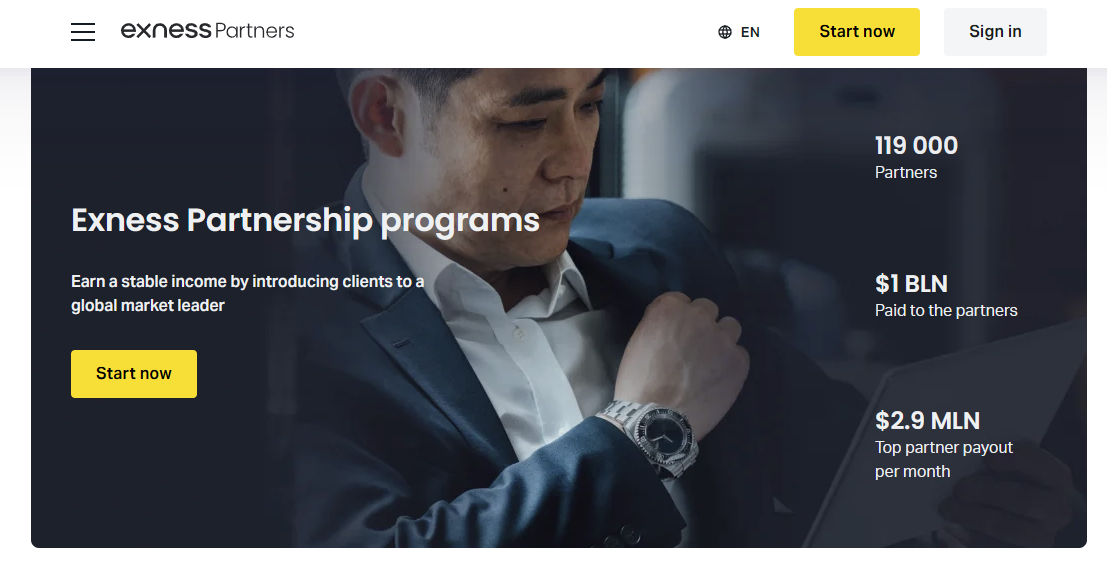
A detailed look at partner commissions, tracking tools, and the Premier program for high-volume partners.

Senior Forex Trader & Market Analyst
Daniel Chen is an experienced forex trader and financial market analyst with over 15 years of experience in currency trading. He specializes in technical analysis, risk management, and developing practical trading strategies to help traders make informed decisions.
The Exness Partner Program operates as a multi-tiered system designed for introducing brokers, affiliates, and money managers who want to earn commissions by referring traders to the platform. Unlike many broker partnership schemes that offer a single flat rate, Exness structures its program around trading volume, partner classification, and the specific instruments traded by referred clients. This approach means earnings can vary significantly depending on how you operate and the type of traders you attract.
Contents
- 1. Partner Classifications and Entry Requirements
- 2. Revenue-Share Model and Commission Calculation
- 3. CPA Model and Qualification Criteria
- 4. Premier Program Tiers and Benefits
- 5. Partner Personal Area and Tracking Tools
- 6. Marketing Resources and Compliance Requirements
- 7. Commission Payouts and Withdrawal Mechanics
- 8. Sub-Partner Networks and Team Structures
- 9. API Access and Technical Integration
- 10. Regional Considerations and Localized Support
- 11. Common Pitfalls and How to Avoid Them
- 12. Comparison with Other Broker Partner Programs
- 13. Getting Started: Registration to First Commission
- 14. Advanced Strategies for Scaling Partner Revenue
- 15. Final Assessment of Exness Partner Program
Partners gain access to a dedicated personal area where they can track referrals, monitor commission accruals in real time, and generate custom tracking links. The platform supports both CPA and revenue-share models, though the revenue-share model remains the primary structure for most introducing brokers. Understanding the distinction between these models, and knowing which one aligns with your traffic source, is the first step toward building a sustainable partnership.
Exness does not publicly publish a single commission table that covers every scenario. Instead, rates are negotiated based on expected volume, geographic region, and partner tier. This opacity can frustrate newcomers who want to compare programs side by side, but it also creates room for high-performing partners to secure better terms. The sections below break down what is known about the standard structure, the Premier program for top-tier partners, and the practical tools available in the partner personal area.
Partner Classifications and Entry Requirements
Exness categorizes partners into three main tracks: Standard Partners, Premier Partners, and Institutional Partners. Standard Partners include most affiliates and introducing brokers who sign up through the public registration flow. There is no minimum deposit or trading volume requirement to join at this level, which makes the program accessible to content creators, educators, and small-scale referrers. However, the default commission rates at this tier are the baseline rates, and access to dedicated support is limited to ticket-based channels.
Premier Partners represent the next tier. Entry is by invitation or application review, typically requiring a demonstrated track record of referring active traders who generate consistent monthly volume. Premier Partners receive higher revenue-share percentages, priority support with a dedicated account manager, access to exclusive marketing materials, and the ability to negotiate custom CPA deals for specific campaigns. The Premier program also includes a sub-tier structure — Silver, Gold, and Platinum — each with progressively better terms.
Institutional Partners are a separate category aimed at fund managers, white-label operators, and companies with existing client bases. These partnerships involve contractual agreements, compliance reviews, and technical integration work that goes beyond the standard affiliate dashboard. They are not relevant for most individual affiliates or small IBs, but they exist for completeness.
Revenue-Share Model and Commission Calculation
The core of the Exness Partner Program is a revenue-share model where partners earn a percentage of the spread or commission paid by their referred clients. The percentage varies by instrument class. Forex majors typically carry the lowest partner percentage because the raw spreads are tight and the broker's margin is thin. Exotic pairs, metals, energies, indices, and cryptocurrencies often yield higher partner percentages because the broker's markup on these instruments is larger.
Commissions are calculated on the net revenue Exness retains after paying liquidity providers and covering operational costs. This means the partner's cut is a slice of the broker's net income, not a slice of the gross spread. For a Standard Partner, the typical revenue share on forex majors falls in the 20–30% range of net revenue. On gold (XAUUSD), it can reach 35–40%. On cryptocurrencies, it may exceed 40% depending on the specific coin and market conditions.
It is important to understand that these percentages apply to net revenue, not the raw spread. If a client trades EURUSD with a 0.1 pip spread and Exness nets 0.05 pips after liquidity costs, a 25% revenue share yields 0.0125 pips per lot to the partner. On a standard lot (100,000 units), that equals $1.25 per round turn. The same math applied to gold with a wider spread and higher net revenue can produce $5–$8 per lot. Volume matters, but instrument mix matters more.
Scroll horizontally to see all columns
| Instrument Class | Standard Partner Share | Premier Partner Share |
|---|---|---|
| Forex Majors | 20–30% of net revenue | 30–40% of net revenue |
| Forex Minors/Exotics | 25–35% of net revenue | 35–45% of net revenue |
| Gold (XAUUSD) | 35–40% of net revenue | 40–50% of net revenue |
| Other Metals | 30–38% of net revenue | 38–48% of net revenue |
| Energies (Oil, Gas) | 30–38% of net revenue | 38–48% of net revenue |
| Indices | 25–35% of net revenue | 35–45% of net revenue |
| Cryptocurrencies | 40–50% of net revenue | 45–55% of net revenue |
| Stocks/Equities CFDs | 20–30% of net revenue | 30–40% of net revenue |
CPA Model and Qualification Criteria
The Cost Per Acquisition (CPA) model is available primarily to Premier Partners and select Standard Partners who apply for it. Under CPA, the partner receives a fixed payment for each referred client who meets specific qualification criteria. The standard criteria include a minimum first-time deposit (often $500 or equivalent), a minimum trading volume within a defined period (for example, 5 lots within 30 days), and the client must not be an existing Exness user.
CPA rates vary by region and are negotiated individually. In Tier-1 markets (Western Europe, Australia, Japan, Singapore), CPA can range from $300 to $600 per qualified client. In emerging markets, rates are typically lower, often $100–$250. The trade-off is clear: CPA provides immediate cash flow but caps upside if the client becomes a high-volume trader. Revenue share sacrifices immediate payout for long-term upside.
Partners running paid traffic campaigns often prefer CPA because it simplifies ROI calculation. Content-driven partners with organic traffic usually favor revenue share because their referrals tend to trade for months or years. Exness does not allow partners to switch models freely; a formal request and review are required, and the decision is binding for a minimum period.
Premier Program Tiers and Benefits
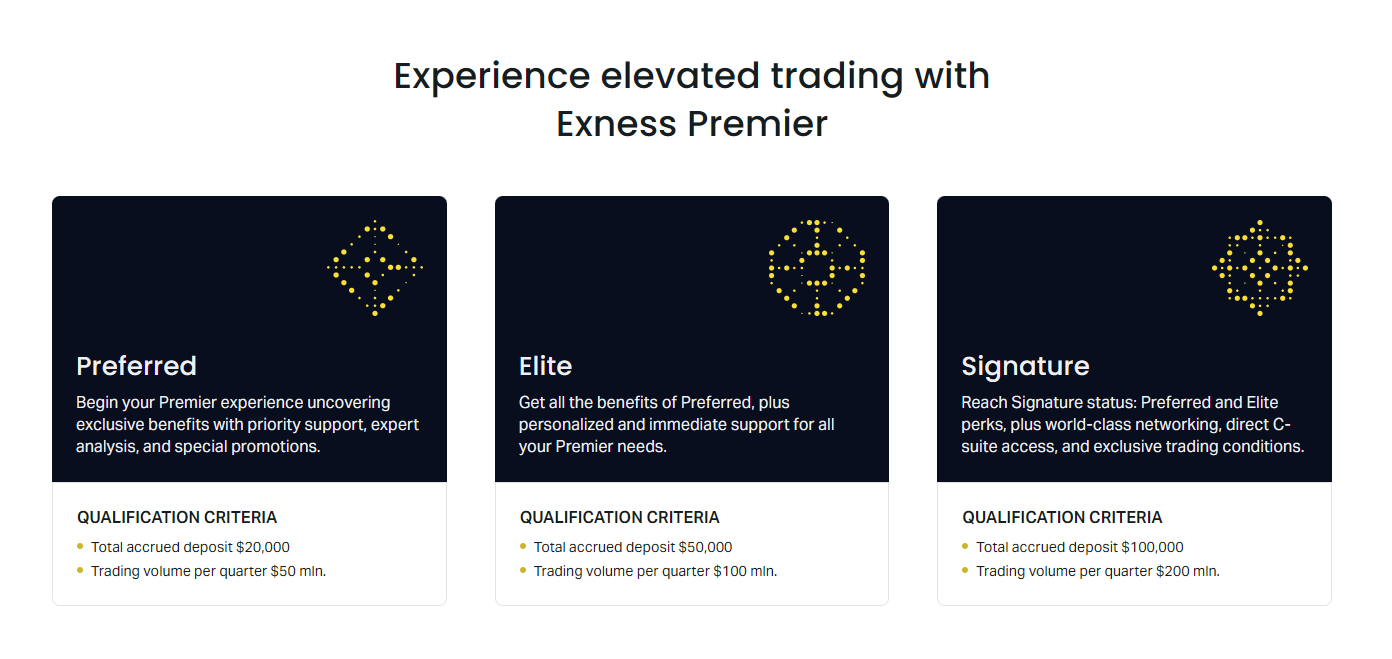
The Premier program uses three sub-tiers: Silver, Gold, and Platinum. Progression is based on the total monthly net revenue generated by a partner's referred clients. Silver typically requires $5,000–$10,000 in monthly partner revenue. Gold requires $25,000–$50,000. Platinum requires $100,000 or more. These thresholds are not published officially and can shift based on regional performance and partner mix.
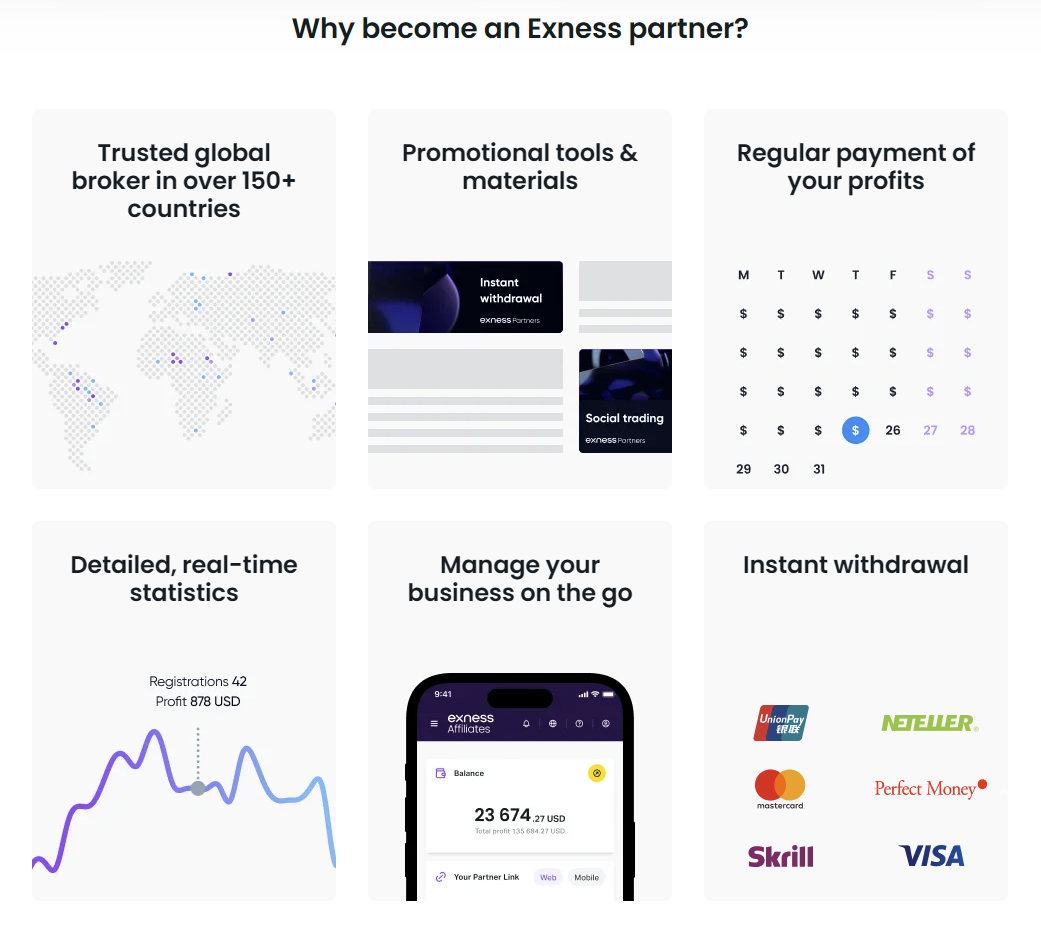
Each tier unlocks incremental benefits. Silver partners gain a dedicated account manager, faster withdrawal processing for partner commissions, and access to a broader library of marketing assets including co-branded landing pages. Gold partners receive higher revenue-share percentages across all instrument classes, priority technical support for API integration, and the ability to create sub-partner accounts for team structures. Platinum partners unlock custom contract terms, revenue-share rates that can exceed the published maximums, and direct access to Exness product and compliance teams for strategic planning.
Premier status is reviewed quarterly. A partner who falls below the threshold for two consecutive quarters may be downgraded. This creates pressure to maintain consistent referral quality, not just volume. Partners who rely on a few large traders face concentration risk — if one whale stops trading, the partner's tier and income can drop sharply.
Partner Personal Area and Tracking Tools
The partner personal area is the operational hub. After completing the exness partner login, partners see a dashboard with real-time metrics: active referrals, pending commissions, confirmed commissions, withdrawal history, and conversion funnels. The interface supports custom date ranges, export to CSV, and filtering by instrument, account type, and client country. This granularity matters when optimizing campaigns — you can see exactly which traffic sources produce traders who trade gold versus those who trade forex majors.
Tracking links are generated with a unique partner code appended to the registration URL. The code persists across devices and sessions for 30 days by default, though Exness offers extended cookie windows for Premier Partners. The system also supports postback URLs for affiliates running their own tracking platforms (Voluum, Binom, Keitaro, etc.). Postbacks fire on registration, first deposit, and qualified trading activity, enabling full-funnel attribution.
Sub-partner management is available for partners who build teams. A master partner can create sub-accounts, set custom revenue-share splits for each sub-partner, and view aggregated or individual performance. This feature is used by IB networks, signal providers who share commissions with affiliates, and agencies managing multiple client accounts. The master partner remains responsible for compliance across the entire tree.
Marketing Resources and Compliance Requirements
Exness provides a library of marketing assets: banners in standard IAB sizes, landing page templates, email sequences, video tutorials, and social media creatives. Assets are organized by language, region, and product focus (mobile app, web terminal, specific instruments). Premier Partners can request custom creatives from the Exness design team, typically with a 5–10 business day turnaround.
Compliance is strict. Partners must not guarantee profits, imply risk-free trading, use misleading performance claims, or target prohibited jurisdictions. Exness maintains a list of restricted countries where onboarding is blocked (including the US, Iran, North Korea, and others). Partners are responsible for geo-filtering their traffic. Violations can result in commission clawbacks, account suspension, or permanent termination.
The partner agreement includes a clause requiring partners to disclose their commercial relationship with Exness in accordance with local advertising laws. In practice, this means adding "Affiliate link" or "Sponsored" disclosures on content pages, video descriptions, and social posts. Exness does not review every piece of content but conducts periodic audits. Non-compliance discovered during an audit triggers a warning; repeated violations lead to termination.
The compliance burden falls entirely on the partner. Exness provides guidelines but does not pre-approve content. Treat the guidelines as a floor, not a ceiling — your local regulator may require stricter disclosures.
Commission Payouts and Withdrawal Mechanics
Partner commissions are calculated daily and credited to the partner's internal wallet within the personal area. Withdrawals can be initiated at any time with no minimum amount for most methods. Supported withdrawal methods include bank wire, credit/debit card, Skrill, Neteller, WebMoney, Perfect Money, and various local payment systems depending on the partner's country of residence. Crypto withdrawals (USDT, BTC, ETH) are also available and typically process within a few hours.
There is a holding period for new partners. Commissions from referrals registered in the first 30 days of a partner's account may be held for up to 60 days before becoming withdrawable. This anti-fraud measure prevents partners from self-referring or using stolen identities to generate fake commissions. After the initial period, withdrawals are processed on business days with standard processing times: instant for e-wallets and crypto, 1–3 business days for cards, 3–5 business days for bank wires.
Tax documentation is the partner's responsibility. Exness does not withhold taxes on partner commissions. Partners receive an annual statement of earnings for their own tax reporting. Premier Partners with corporate structures can request invoices formatted for their jurisdiction. Individual partners should consult a tax professional — commission income is typically treated as self-employment or business income in most countries.
Scroll horizontally to see all columns
| Method | Minimum | Processing Time | Fees |
|---|---|---|---|
| Bank Wire | $10 | 3–5 business days | Varies by bank |
| Credit/Debit Card | $10 | 1–3 business days | Usually free |
| Skrill / Neteller | $1 | Instant | Free |
| WebMoney | $1 | Instant | Free |
| Perfect Money | $1 | Instant | Free |
| USDT (TRC20/ERC20) | $10 | Up to 2 hours | Network fee only |
| BTC / ETH | $10 | Up to 2 hours | Network fee only |
| Local Payment Systems | Varies | Instant–24 hours | Usually free |
Sub-Partner Networks and Team Structures
The sub-partner feature allows a master partner to onboard other partners under their account, creating a multi-level structure. The master partner sets a revenue-share split for each sub-partner — for example, the master keeps 10% of net revenue and passes 90% to the sub-partner, or any other arrangement. The sub-partner sees only their own dashboard and cannot view the master's other sub-partners or overall earnings.
This structure is used in three common scenarios. First, IB networks where a lead IB recruits regional IBs and takes an override. Second, signal providers or educators who share commissions with affiliates who promote their signals. Third, agencies managing partner accounts for multiple clients — each client gets a sub-account, and the agency consolidates reporting. Exness does not limit the depth of the tree, but practical management becomes difficult beyond two levels.
Commissions flow upward automatically. The master partner receives their override in real time alongside the sub-partner's earnings. Both parties can withdraw independently. The master partner is liable for compliance violations by any sub-partner in their tree. This liability clause is enforced — if a sub-partner runs non-compliant ads, Exness can claw back commissions from the master partner and suspend the entire tree.
API Access and Technical Integration
Partners with development resources can use the Exness Partner API to automate reporting, build custom dashboards, and integrate partner data into their own CRM or analytics stack. The API provides endpoints for referral lists, commission history, withdrawal status, and marketing asset retrieval. Authentication uses API keys generated in the personal area, with IP whitelisting available for added security.
API access is granted by default to Premier Partners. Standard Partners can request access by describing their use case — Exness reviews requests to prevent scraping or excessive load. Rate limits are generous (100 requests per minute) but enforced. The API returns data in JSON format with pagination for large datasets. Webhooks are not currently supported; partners must poll for updates.
Common integration patterns include: daily commission sync to internal accounting software, real-time referral tracking for custom landing pages, automated alerting when a high-value client drops below activity thresholds, and building partner-facing portals for sub-partner networks. The API documentation includes code samples in Python, Node.js, and PHP.
Regional Considerations and Localized Support
Exness operates globally but tailors partner terms by region. In Southeast Asia (Thailand, Vietnam, Indonesia, Malaysia), the partner team provides localized marketing materials, local payment method integration, and support in local languages. CPA rates in these markets are competitive because trader acquisition costs are lower and lifetime values can be high. Partners based in these regions often negotiate volume bonuses on top of standard revenue share.
In Africa (Nigeria, Kenya, South Africa, Egypt), Exness has invested heavily in local payment gateways and mobile money integration. Partner commissions in these regions are paid in USD but can be withdrawn via local methods. The partner team runs regional contests with cash prizes and trips for top performers. These contests are not advertised globally — they are communicated directly to partners in the region.
Latin America (Brazil, Mexico, Colombia, Argentina) follows a similar pattern with localized support and payment methods. The key difference is regulatory: some countries require partners to register as financial promoters or obtain specific licenses. Exness provides guidance but does not handle registration for partners. Partners operating in regulated Latin American markets should engage local counsel.
Scroll horizontally to see all columns
| Region | Local Support | Payment Methods | Special Programs |
|---|---|---|---|
| Southeast Asia | Dedicated managers, local language | Local bank, e-wallets, mobile money | Volume bonuses, regional contests |
| Africa | Regional team, local language | Mobile money, local bank, crypto | Quarterly contests, trips, cash prizes |
| Latin America | Spanish/Portuguese support | Local bank, PIX, SPEI, crypto | Regulatory guidance, localized assets |
| MENA | Arabic support, Islamic accounts | Local bank, crypto, e-wallets | Swap-free focus, regional events |
| CIS / Eastern Europe | Russian/Ukrainian/Polish support | Local bank, cards, crypto | High CPA rates, IB conferences |
Common Pitfalls and How to Avoid Them
New partners often make the same mistakes. The first is expecting immediate high earnings without understanding the revenue-share math. A partner who refers 10 traders depositing $100 each and trading micro lots on EURUSD will earn pennies. The program rewards volume and instrument diversity, not just headcount. Partners who focus on attracting traders interested in gold, indices, or crypto — instruments with wider spreads and higher broker margins — see significantly better returns per referred client.
The second mistake is neglecting compliance until a warning arrives. Partners who run aggressive ad copy ("guaranteed profits," "risk-free trading," "double your money") get flagged by Exness compliance or by platform moderators (Google, Meta, TikTok). The resulting account suspension cuts off all future commissions, including those from previously referred active traders. Building compliant funnels from day one avoids this.
The third mistake is relying on a single traffic source. Partners who depend entirely on one YouTube channel, one Telegram group, or one paid campaign are vulnerable to algorithm changes, platform bans, or creative fatigue. Diversified acquisition — SEO content, email nurture, social media, paid ads, partnerships with educators — creates stability. The partner personal area's source tracking makes it easy to measure each channel's contribution.
The partners who earn consistently are not the ones with the most referrals. They are the ones who understand which referrals trade which instruments, and they optimize for net revenue per referral, not referral count.
Comparison with Other Broker Partner Programs
Compared to IC Markets, Pepperstone, and FP Markets, Exness offers higher revenue-share ceilings for Premier Partners but less transparency at the entry level. IC Markets publishes a clear tiered table (up to 50% of spread) that any partner can reference. Exness requires negotiation, which favors experienced partners who know what to ask for. Pepperstone's program is simpler — flat revenue share with no tiers — but caps at lower percentages. FP Markets offers a hybrid model with both CPA and revenue share clearly defined, but their Premier equivalent is invitation-only with stricter volume thresholds.
Exness stands out for instant withdrawals on partner commissions (no weekly or monthly batch processing), the depth of the personal area analytics, and the sub-partner tree feature which many competitors lack or limit to one level. The trade-off is the opacity of standard rates and the reliance on relationship management for rate improvements. Partners who prefer a set-it-and-forget-it structure with published rates may prefer a competitor. Partners willing to negotiate and scale will find more upside at Exness.
Scroll horizontally to see all columns
| Broker | Published Rates | Tier Structure | Withdrawal Speed | Sub-Partner Support |
|---|---|---|---|---|
| Exness | Negotiated (opaque) | Standard / Premier (3 sub-tiers) | Instant (e-wallet, crypto) | Multi-level trees |
| IC Markets | Up to 50% of spread (published) | 3 published tiers | Monthly batch | Single level only |
| Pepperstone | Flat % (published) | No tiers | Monthly batch | Not supported |
| FP Markets | Hybrid CPA + RevShare (published) | Invitation-only Premier | Weekly batch | Single level only |
| XM | Up to $25/lot (published) | 3 published tiers | Weekly batch | Multi-level (IB only) |
Getting Started: Registration to First Commission
Registration takes about 10 minutes. Visit the partner portal, provide email, password, and basic profile information (name, country, phone). You will receive a verification email. After verifying, you log into the personal area and complete the KYC questionnaire — this is mandatory before commissions become withdrawable. KYC requires a government-issued ID and proof of address (utility bill or bank statement less than 3 months old). Corporate partners also need certificate of incorporation, register of directors, and beneficial owner declaration.
Once KYC is approved (typically 24–48 hours), your partner code is active. Generate your first tracking link in the "Marketing Tools" section. Test it by opening in an incognito window and completing a test registration (use a different email). Verify the referral appears in your dashboard. Then deploy the link in your content, ads, or communications. Commissions begin accruing when the referred client trades on a live account. Demo account activity does not generate commissions.
The first commission withdrawal often triggers an additional compliance review. Exness may request screenshots of your traffic sources, landing pages, or ad creatives. This is standard for new partners and usually resolves within 2–3 business days. Have your documentation ready: traffic source URLs, ad account screenshots, content URLs. After the first successful withdrawal, subsequent withdrawals process without manual review unless flagged by automated systems.
Advanced Strategies for Scaling Partner Revenue
Partners who move beyond the first $1,000/month typically adopt one of three scaling strategies. The content compounding strategy focuses on building an SEO asset library — detailed guides, broker comparisons, instrument-specific tutorials — that ranks for long-tail keywords. Each piece of content includes tracking links naturally. Over 12–18 months, the compounding organic traffic creates a stable referral base with low acquisition cost. This strategy requires patience and editorial discipline but produces the highest long-term margins.
The paid media arbitrage strategy uses CPA or hybrid deals to fund aggressive paid acquisition on Google, Meta, TikTok, or native networks. Partners bid on keywords like "forex broker low spread," "best gold trading platform," or "crypto CFD trading." They optimize landing pages for conversion, use Exness-provided creatives as a base, and iterate rapidly. This strategy requires capital, analytical skills, and tolerance for campaign volatility. It works best for partners who have negotiated CPA rates that exceed their cost per acquisition.
The network building strategy leverages the sub-partner feature. The master partner recruits other affiliates — often educators, signal providers, or community managers — and provides them with training, creatives, and a higher-than-market revenue split. The master partner keeps an override (typically 5–15% of net revenue) on each sub-partner's production. This scales the master partner's reach without linear effort, but it requires management overhead: onboarding, compliance monitoring, payout reconciliation, and relationship maintenance.
No single strategy dominates. The partners earning six figures annually usually combine all three: a content foundation for stability, paid campaigns for acceleration, and a sub-partner network for leverage. The mix shifts over time as the business matures.
Final Assessment of Exness Partner Program
The Exness Partner Program is built for partners who understand the mechanics of forex broker economics and are willing to negotiate. Its strengths — instant withdrawals, deep analytics, multi-level sub-partner support, and high Premier ceilings — reward scale and sophistication. Its weaknesses — opaque standard rates, mandatory negotiation for better terms, and compliance liability cascading up sub-partner trees — penalize passivity. A partner who treats this as a set-and-forget affiliate link will earn little. A partner who studies the instrument-level revenue data, optimizes traffic for high-margin products, and builds a diversified acquisition engine can build a substantial recurring income stream. The program does not hand you success; it provides the infrastructure for you to earn it.
Frequently Asked Questions
How do I access the Exness partner login page?
Visit the Exness partner portal at partners.exness.com and click Login. Use the email and password you created during registration. If you forgot your password, use the reset link on the login page.
What is an Exness partner code and where do I find it?
Your partner code is a unique identifier appended to tracking URLs. Find it in the Marketing Tools section of your partner personal area after KYC approval. It looks like a short alphanumeric string (e.g., "abc123").
How long does the Exness partner cookie last for attribution?
The default cookie window is 30 days. If a user clicks your link and registers within 30 days, you are credited. Premier Partners can request extended windows up to 90 days through their account manager.
Can I switch from revenue share to CPA after joining?
Yes, but only for Premier Partners and by formal request. The switch requires approval and locks you into the new model for a minimum period (typically 90 days). Standard Partners cannot access CPA.
Are there any countries where I cannot refer clients?
Yes. Exness does not onboard clients from the US, Iran, North Korea, Syria, and several other sanctioned jurisdictions. The full restricted list is in the partner agreement. You must geo-filter your traffic to avoid sending users from these countries.
How are partner commissions taxed?
Exness does not withhold taxes. You receive gross commissions and are responsible for reporting and paying taxes according to your country's laws. Exness provides an annual earnings statement. Consult a tax professional for your specific situation.
What happens if my sub-partner violates compliance rules?
As the master partner, you are liable. Exness can claw back commissions from your account, suspend your entire partner tree, and terminate the agreement. Vet sub-partners carefully and monitor their marketing activity.
Is there a minimum withdrawal amount for partner commissions?
Most methods have a $1 minimum (e-wallets, crypto, WebMoney, Perfect Money). Bank wires and cards typically require $10. There is no maximum withdrawal limit.