

Forex Broker Reviews
Exness Crypto Trading: Conditions, Platforms, and What to Expect
Understand the specifics of crypto CFD trading on Exness before you start.

Senior Forex Trader & Market Analyst
Daniel Chen is an experienced forex trader and financial market analyst with over 15 years of experience in currency trading. He specializes in technical analysis, risk management, and developing practical trading strategies to help traders make informed decisions.
Exness offers cryptocurrency trading through contracts for difference (CFDs), meaning you speculate on price movements without owning the underlying coins. The broker lists over a dozen major and minor crypto pairs, mostly quoted against the US dollar. This article breaks down the instruments, trading costs, platforms, account types, and practical steps so you can decide whether Exness fits your crypto trading style.
Contents
- 1. Cryptocurrency Instruments Available on Exness
- 2. Trading Conditions for Crypto CFDs
- 3. Platforms for Crypto Trading
- 4. Account Types and Crypto Trading
- 5. Fees: Spreads, Commissions, and Swaps
- 6. Leverage and Margin Requirements
- 7. Risk Management Tools for Crypto
- 8. How to Start Trading Crypto on Exness
- 9. Exness Crypto Trading vs Other Brokers
- 10. Final Assessment of Exness Crypto Trading
Crypto CFDs on Exness trade 24/7, unlike traditional forex pairs that pause over the weekend. The continuous session matters for strategies that rely on weekend volatility or for traders who cannot monitor markets during standard weekday hours. However, spreads often widen during low-liquidity periods, especially late Sunday evening and early Monday morning UTC.
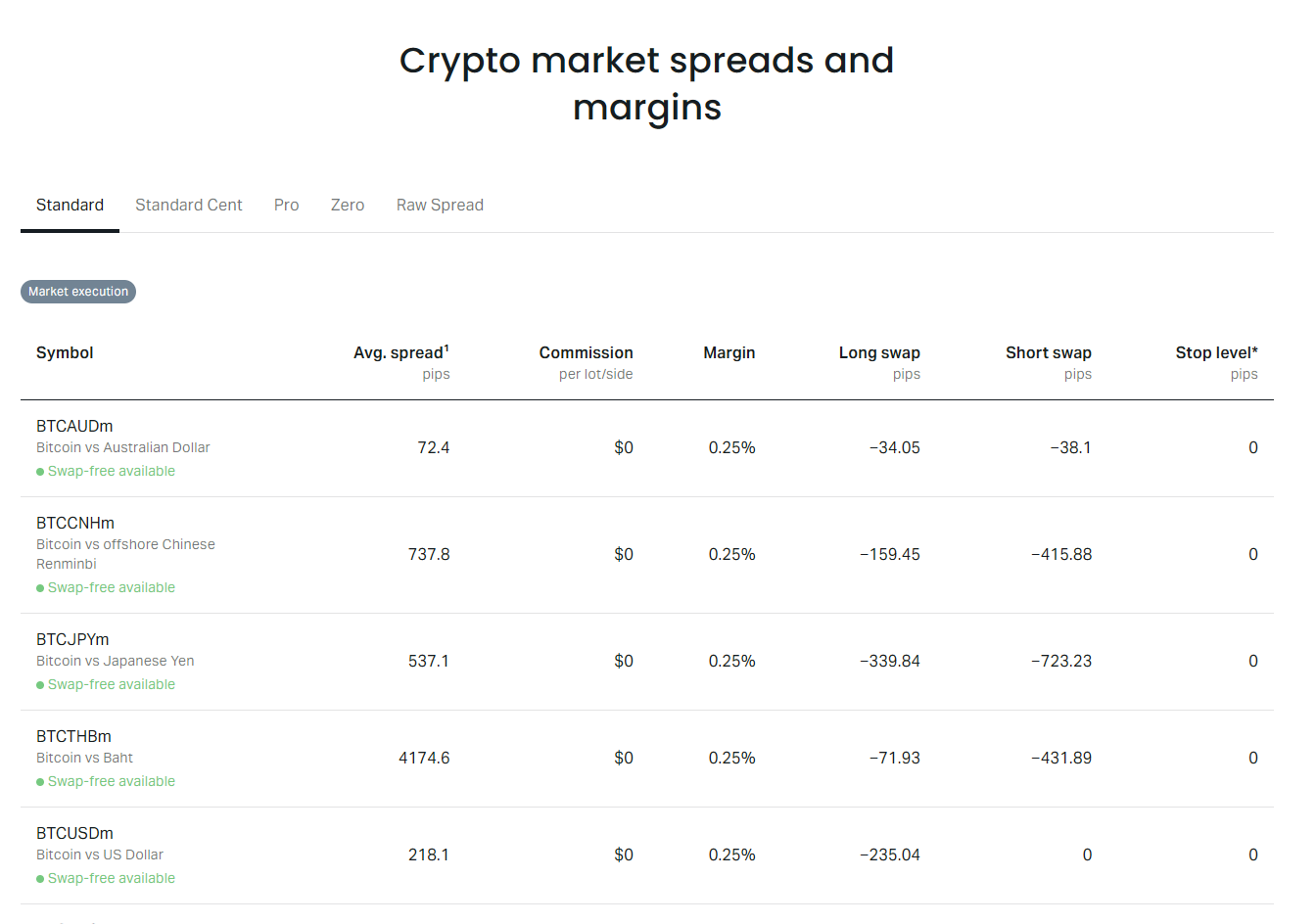
The broker does not charge a separate commission on crypto trades for Standard and Standard Cent accounts; the cost is built into the spread. Professional accounts (Raw Spread, Zero, Pro) apply a round-turn commission per lot, which can lower the effective spread but adds a fixed fee per trade. Swap rates apply to positions held overnight and vary by instrument and account type.
Cryptocurrency Instruments Available on Exness
Exness provides CFDs on the most liquid cryptocurrencies. The list typically includes Bitcoin (BTCUSD), Ethereum (ETHUSD), Litecoin (LTCUSD), Ripple (XRPUSD), Bitcoin Cash (BCHUSD), Cardano (ADAUSD), Dogecoin (DOGEUSD), Polkadot (DOTUSD), Chainlink (LINKUSD), Stellar (XLMUSD), Uniswap (UNIUSD), and Solana (SOLUSD). Availability can differ by regulatory jurisdiction; some regions see a reduced selection.
- BTCUSD — the most heavily traded pair, tightest spreads.
- ETHUSD — second in volume, slightly wider spreads than Bitcoin.
- XRPUSD, LTCUSD, BCHUSD — mid-tier liquidity, moderate spreads.
- ADAUSD, DOGEUSD, DOTUSD, LINKUSD, XLMUSD, UNIUSD, SOLUSD — newer additions, spreads wider and more sensitive to market depth.
Each pair is quoted to two decimal places for Bitcoin and Ethereum, and to four or five decimal places for lower-priced coins. The minimum trade size is 0.01 lots across all account types, which translates to a notional value that depends on the current price. For Bitcoin at $60,000, 0.01 lots equals $600 exposure; for Dogecoin at $0.10, the same 0.01 lots equals $100 exposure.
Trading Conditions for Crypto CFDs
Spreads on crypto CFDs are variable and tend to be wider than major forex pairs. During normal market hours, BTCUSD spreads on a Standard account often sit around 200–400 points (20–40 pips in traditional terms), while Raw Spread and Zero accounts can see spreads near 0–50 points plus commission. ETHUSD typically runs 50–150 points on Standard and 10–30 points on Raw Spread/Zero.
Scroll horizontally to see all columns
| Instrument | Standard | Standard Cent | Raw Spread | Zero | Pro |
|---|---|---|---|---|---|
| BTCUSD | 200–400 | 200–400 | 0–50 | 0–50 | 10–30 |
| ETHUSD | 50–150 | 50–150 | 10–30 | 10–30 | 15–40 |
| XRPUSD | 30–80 | 30–80 | 5–20 | 5–20 | 10–25 |
| LTCUSD | 40–100 | 40–100 | 10–30 | 10–30 | 15–35 |
Leverage for crypto CFDs is capped at 1:200 for most pairs on Professional accounts, and 1:100 on Standard accounts. Some jurisdictions impose lower limits due to local regulation. Margin requirements increase automatically when account equity crosses certain thresholds, a feature Exness calls dynamic margin. This can reduce effective leverage during high volatility.
Swap rates for crypto are generally negative for long positions and can be positive or negative for shorts, depending on the funding rate. Rates are updated daily and displayed in the contract specifications. Holding a Bitcoin long overnight on a Standard account might cost roughly 0.02% of notional value per day, though the exact figure fluctuates with market conditions.
Platforms for Crypto Trading
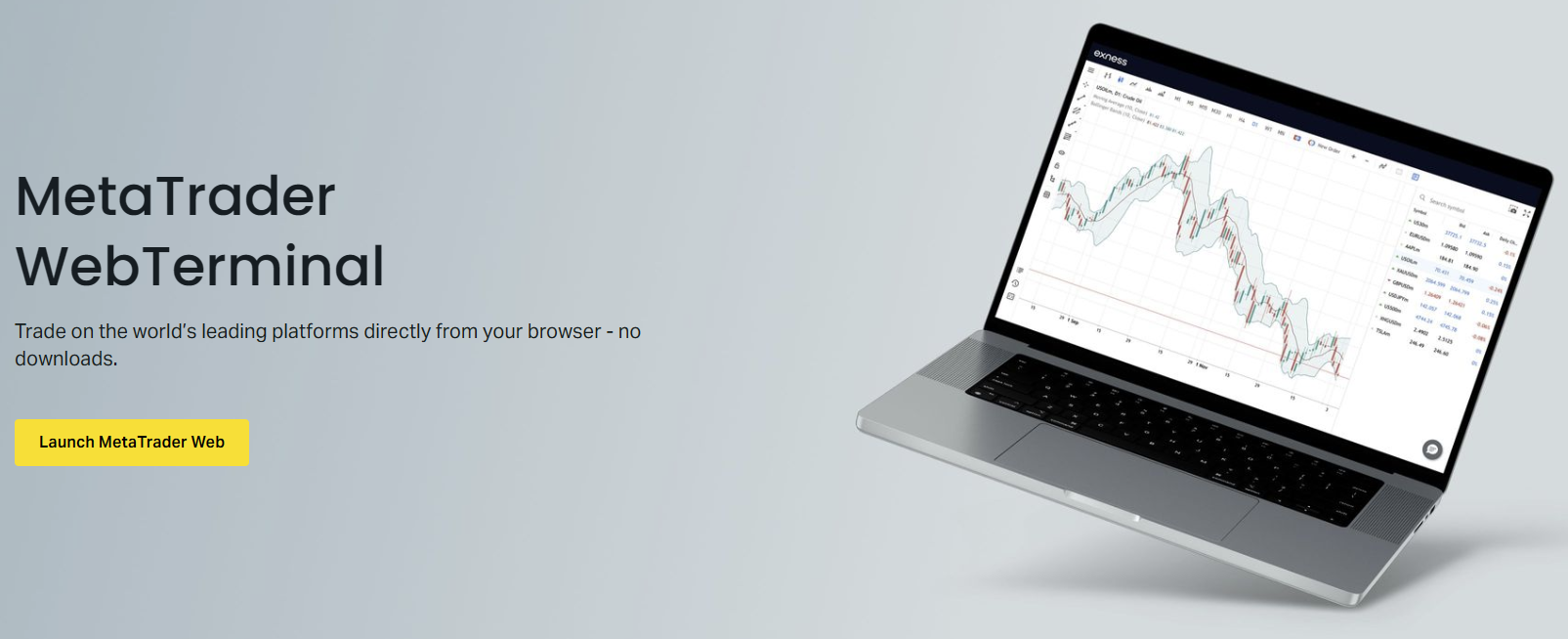
Exness supports crypto CFDs on MetaTrader 4, MetaTrader 5, the proprietary Exness Web Terminal, and the Exness mobile app. All platforms offer the same instrument list and pricing feed. The Web Terminal runs in a browser with no installation, which is convenient for quick access or restricted environments. MT4 and MT5 provide deeper charting tools, custom indicators, and expert advisor support.
- MetaTrader 4 — familiar interface, largest library of third-party EAs, limited to 9 timeframes.
- MetaTrader 5 — more timeframes, built-in economic calendar, depth of market, netting and hedging modes.
- Exness Web Terminal — clean UI, one-click trading, integrated TradingView charts, no download.
- Exness Mobile App — full account management, price alerts, biometric login, charting with indicators.
Execution mode is market execution for all crypto instruments. There is no requote, but slippage can occur during fast moves. Exness publishes execution statistics quarterly, showing average fill speed and slippage distribution. For crypto, the median execution time is typically under 100 milliseconds.
The mobile app mirrors the web terminal's feature set, including deposit and withdrawal, verification, and access to the economic calendar. Push notifications for price alerts and margin calls work reliably on both iOS and Android. The app also supports face ID and fingerprint authentication.
Account Types and Crypto Trading
Exness offers five live account types: Standard, Standard Cent, Raw Spread, Zero, and Pro. All support crypto CFDs. The main differences are spread structure, commission, minimum deposit, and leverage caps. Standard and Standard Cent are commission-free with wider spreads. Raw Spread and Zero charge a commission per lot (typically $3.5 per side per lot on forex, slightly higher on crypto) but offer near-raw spreads. Pro accounts sit in between with low spreads and no commission.
Scroll horizontally to see all columns
| Feature | Standard | Standard Cent | Raw Spread | Zero | Pro |
|---|---|---|---|---|---|
| Min Deposit | $1 | $1 | $200 | $200 | $200 |
| Commission (per lot round turn) | None | None | $7–$10 | $7–$10 | None |
| Typical BTCUSD Spread | 200–400 pts | 200–400 pts | 0–50 pts | 0–50 pts | 10–30 pts |
| Max Leverage (crypto) | 1:100 | 1:100 | 1:200 | 1:200 | 1:200 |
| Currency | USD, EUR, etc. | USC, EURC | USD, EUR, etc. | USD, EUR, etc. | USD, EUR, etc. |
Standard Cent accounts denominate balance in cents, so a $10 deposit shows as 1,000 USC. This lets you trade 0.01 lots with very small notional exposure, useful for testing crypto strategies with real money but minimal risk. Professional accounts require a higher minimum deposit and a suitability questionnaire during registration.
Fees: Spreads, Commissions, and Swaps
The all-in cost of a crypto trade depends on the account type and holding period. For a day trader opening and closing a 1-lot BTCUSD position on a Raw Spread account, the cost might be 30 points spread ($30) plus $7–$10 commission, totaling roughly $37–$40. On a Standard account, the same trade could cost 300 points ($300) with no commission. Swing traders must add swap charges for each night held.
Exness does not charge deposit or withdrawal fees for most payment methods. Third-party processors may apply their own fees. Inactivity fees apply after 12 months of no trading activity: $10 per month for Standard and Standard Cent, $5 per month for Professional accounts. The fee stops once trading resumes or balance reaches zero.
Leverage and Margin Requirements
Maximum leverage for crypto is 1:200 on Professional accounts and 1:100 on Standard accounts. However, Exness applies dynamic margin: when account equity exceeds $1,000, leverage on forex and metals reduces, but crypto leverage remains at the stated maximum. When equity crosses $5,000, crypto leverage may also step down depending on the specific instrument and regulatory regime.
Margin is calculated as notional value divided by leverage. For a 1-lot BTCUSD position at $60,000 with 1:100 leverage, required margin is $600. A 10% price move against you would consume $6,000 of equity, triggering a margin call at 50% margin level and stop-out at 0% on most accounts. The stop-out level is 0% for Standard and Pro, 20% for Raw Spread and Zero.
Dynamic margin protects the broker more than the trader. Know the equity thresholds before scaling positions.
Risk Management Tools for Crypto
Exness provides standard stop-loss and take-profit orders, trailing stops (MT4/MT5 only), and a margin calculator in the personal area. The web terminal and app include a position size calculator that shows required margin, pip value, and potential profit/loss for a given entry, stop, and target. Negative balance protection applies to all retail clients, meaning you cannot lose more than your account balance.
- Stop-loss and take-profit can be set at order entry or modified on open positions.
- Trailing stop activates only when the platform is running (MT4/MT5).
- Margin calculator helps size positions before entering.
- Negative balance protection resets equity to zero if stop-out fails to close in time.
How to Start Trading Crypto on Exness
Opening an account takes a few minutes. Register with email, set a password, and choose your account type. Verification (KYC) is required before withdrawals: upload a government ID and proof of address. Once verified, deposit via card, bank transfer, e-wallet, or crypto (USDT, USDC, BTC, ETH). Minimum deposit is $1 for Standard accounts.
- 1. Register on the Exness website or app.
- 2. Complete email verification.
- 3. Choose account type (Standard recommended for beginners).
- 4. Submit KYC documents in the personal area.
- 5. Deposit funds using a preferred method.
- 6. Download MT4/MT5 or open the Web Terminal.
- 7. Add crypto symbols to Market Watch.
- 8. Place your first trade with a stop-loss.
Demo accounts are available for all platforms with virtual funds up to $10,000. They replicate live pricing and execution but do not simulate slippage or requotes perfectly. Use demo to test platform workflow, not to gauge real-world costs.
Exness Crypto Trading vs Other Brokers
Compared to pure crypto exchanges, Exness offers CFDs with leverage, no wallet management, and instant fiat deposits/withdrawals. Compared to other CFD brokers, Exness stands out for instant withdrawals (most methods), no requotes, and a wide range of account types. Spreads on major crypto pairs are competitive but not the absolute lowest; some niche brokers offer tighter raw spreads but with higher commissions or slower withdrawals.
Scroll horizontally to see all columns
| Feature | Exness (CFD) | Crypto Exchange (Spot) | Typical CFD Broker |
|---|---|---|---|
| Ownership of Asset | No (CFD) | Yes | No (CFD) |
| Leverage | Up to 1:200 | Usually 1:1–1:10 | Up to 1:100 |
| Short Selling | Native | Margin/Futures only | Native |
| Fiat Deposit/Withdrawal | Instant (most methods) | Slow (bank transfer) | 1–3 business days |
| Regulation | Multiple top-tier licenses | Varies widely | Usually one major license |
| Trading Hours | 24/7 | 24/7 | Often 24/5 or limited weekend |
If your goal is to hold actual coins for long-term investment, a spot exchange is more appropriate. If you want to speculate on short-term price moves with leverage and quick fiat access, Exness is a strong contender. The choice between Exness and another CFD broker often comes down to withdrawal speed, platform preference, and whether the specific crypto pairs you trade are offered.
Frequently Asked Questions
Does Exness charge commission on crypto trades?
Standard and Standard Cent accounts have no commission; the cost is in the spread. Raw Spread, Zero, and Pro accounts charge a round-turn commission per lot (typically $7–$10) but offer tighter spreads.
Can I trade crypto on weekends with Exness?
Yes. Crypto CFDs trade 24/7, including weekends. Spreads may widen during low-liquidity periods.
What is the maximum leverage for Bitcoin on Exness?
Up to 1:200 on Professional accounts (Raw Spread, Zero, Pro) and 1:100 on Standard accounts, subject to dynamic margin rules and local regulation.
Are there swap fees for holding crypto positions overnight?
Yes. Swap rates apply daily and vary by instrument and account type. Long positions usually pay negative swaps; shorts can be positive or negative.
Can I deposit and withdraw using cryptocurrency?
Exness supports deposits and withdrawals in USDT, USDC, BTC, and ETH via the personal area. Processing is usually instant after blockchain confirmations.
Is there a minimum trade size for crypto CFDs?
The minimum volume is 0.01 lots for all account types. Notional value depends on the current price of the cryptocurrency.
Does Exness offer negative balance protection for crypto trading?
Yes, negative balance protection applies to all retail clients across all instruments, including crypto CFDs.
Final Assessment of Exness Crypto Trading
Exness delivers a solid crypto CFD package: 24/7 trading, competitive spreads on major pairs, multiple account structures, instant withdrawals, and reliable platforms. The main trade-offs are wider spreads on minor coins, commission on professional accounts, and dynamic margin that can reduce leverage as your account grows. For traders who value fast fiat access, regulatory oversight, and a choice between MT4, MT5, and a capable web terminal, Exness is a practical option. Test the demo first, model your exact costs with the calculator, and verify that your preferred coins are available in your jurisdiction before committing real capital.