

Forex & CFD Trading
Exness Metals Trading: Gold, Silver, and More
Complete guide to trading gold, silver, platinum, and palladium CFDs on Exness platforms.

Senior Forex Trader & Market Analyst
Daniel Chen is an experienced forex trader and financial market analyst with over 15 years of experience in currency trading. He specializes in technical analysis, risk management, and developing practical trading strategies to help traders make informed decisions.
Precious metals have long served as a refuge when currencies wobble and equity markets turn volatile. Exness offers a straightforward way to access gold, silver, platinum, and palladium through CFDs, letting traders speculate on price moves without taking physical delivery. The broker's metals lineup sits alongside forex pairs, indices, energies, and crypto, but it draws particular attention because the spreads on XAUUSD and XAGUSD often rank among the tightest in the industry. This article walks through every metal available, the trading conditions that matter, the platforms you can use, and the practical steps to get started.
Contents
- 1. What Metals Can You Trade on Exness
- 2. Gold Trading: XAUUSD and XAUEUR
- 3. Silver Trading: XAGUSD Details
- 4. Platinum and Palladium Options
- 5. Trading Conditions for Metals
- 6. Spreads, Swaps, and Commissions
- 7. Leverage and Margin Requirements
- 8. Platforms for Metals Trading
- 9. Risk Management for Precious Metals
- 10. How to Start Trading Metals on Exness
- 11. Final Assessment of Exness Metals Trading
Most traders come for gold. It's the most liquid precious metal, trades around the clock five days a week, and reacts predictably to real yields, dollar strength, and geopolitical risk. Silver follows closely, offering higher volatility and an industrial demand component that gold lacks. Platinum and palladium see far less volume, wider spreads, and shorter trading hours, but they can diversify a metals-focused portfolio. Exness lists all four as CFDs against the US dollar, and gold also trades against the euro. The contract specifications differ enough that you need to check lot size, margin, and swap rates before placing a trade.
What Metals Can You Trade on Exness
Exness currently offers four precious metals as CFDs: gold (XAUUSD, XAUEUR), silver (XAGUSD), platinum (XPTUSD), and palladium (XPDUSD). Each symbol represents one troy ounce of the metal priced in the quote currency. Gold against the euro appears as XAUEUR and behaves similarly to XAUUSD but with euro-specific drivers such as ECB policy and EURUSD cross flows. Silver, platinum, and palladium are only quoted against the dollar. The broker does not offer base-metal CFDs like copper or aluminum, nor does it provide futures contracts or options on metals. If you want exposure to the broader complex, you would need to combine metals positions with equity CFDs on mining companies or ETFs available elsewhere.
- XAUUSD — gold vs. US dollar, most liquid, tightest spreads
- XAUEUR — gold vs. euro, useful for euro-denominated accounts
- XAGUSD — silver vs. US dollar, higher volatility, industrial demand factor
- XPTUSD — platinum vs. US dollar, thinner liquidity, wider spreads
- XPDUSD — palladium vs. US dollar, smallest market, highest swap costs
Liquidity drops sharply after gold and silver. Platinum and palladium often show gaps during the Asian session and can widen significantly around major economic releases. Exness applies market execution to all metals, meaning orders fill at the best available price with no requotes. Slippage can occur during news events, especially in the less liquid symbols. The broker does not guarantee stop-loss execution at the exact price for any instrument, metals included.
The contract size for gold and silver is 100 ounces per standard lot. Platinum and palladium use 10 ounces per lot. This means a one-dollar move in gold equals $100 per lot, while a one-dollar move in platinum equals $10 per lot. Minimum trade size is 0.01 lots across all metals, so you can risk as little as $1 per pip on gold or $0.10 per pip on platinum. Maximum position limits vary by account type and are published in the personal area. Professional accounts generally allow larger aggregate exposure than Standard or Standard Cent accounts.
Gold Trading: XAUUSD and XAUEUR
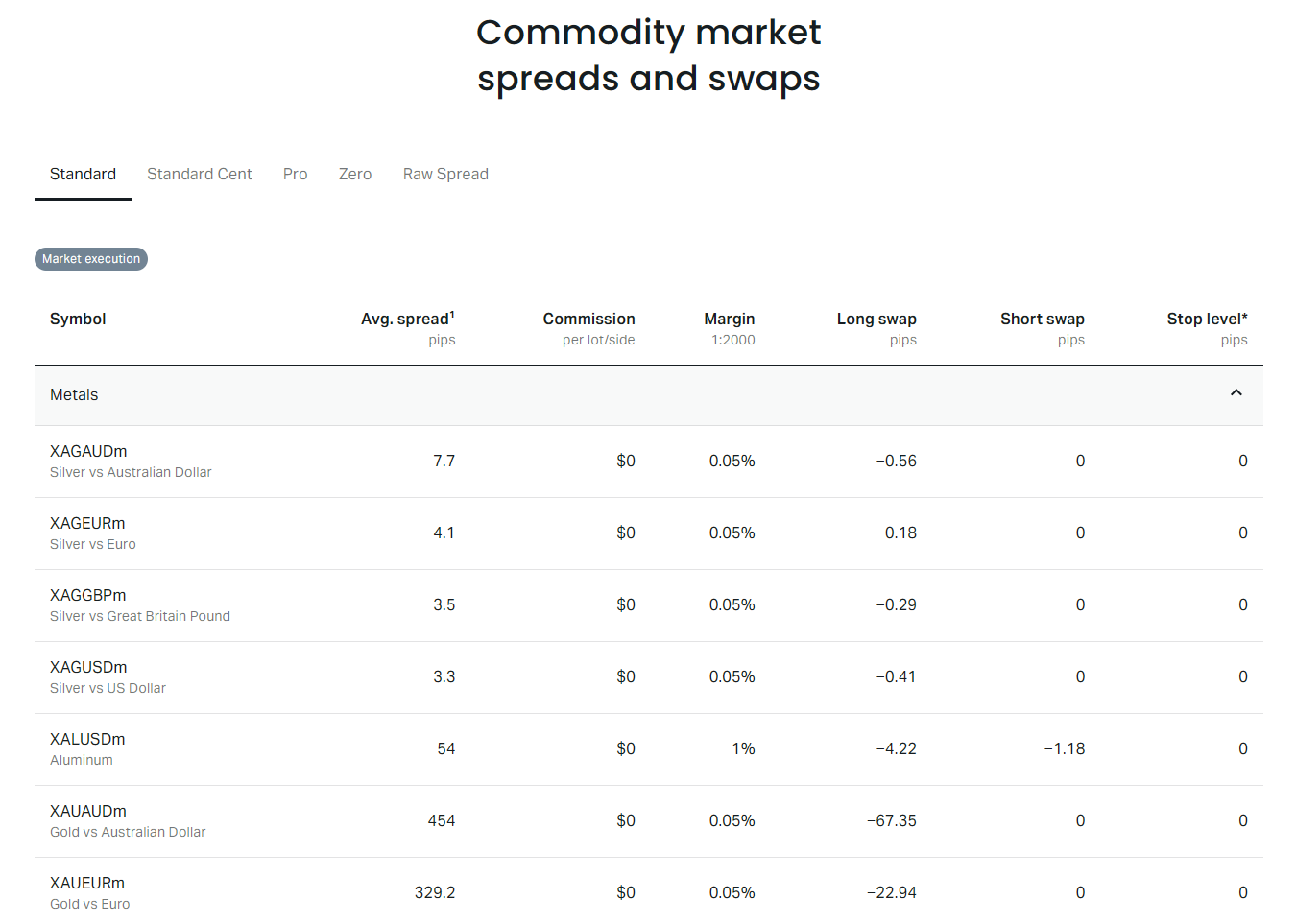
Gold dominates metals volume on Exness. The XAUUSD pair routinely sees spreads starting from 0.1 pips on Raw Spread and Zero accounts, and from around 0.5 pips on Standard accounts. Commission on Raw Spread is $3.5 per side per lot; Zero accounts charge $0.2 per side per lot with a slightly wider raw spread. Standard accounts have no commission but embed the cost in the spread. Swap rates for long gold positions are typically negative because you pay the cost of carry — gold yields nothing while the dollar earns interest. Short gold swaps can be positive or negative depending on the interest-rate differential and the broker's markup.
XAUEUR behaves similarly but with a smaller participant base. Spreads run a fraction wider, and swap rates reflect EURUSD forward points rather than USD-only funding costs. Traders with euro-denominated accounts sometimes prefer XAUEUR to avoid converting profits back to euros, but the liquidity advantage of XAUUSD usually outweighs the conversion cost. During European trading hours, both symbols are tight. After the New York close, XAUUSD remains active thanks to Asian participation, while XAUEUR can thin out noticeably.
Gold responds to real yields, dollar index moves, central bank buying, and risk sentiment. A rising 10-year TIPS yield usually pressures gold. A falling dollar index supports it. Exness provides an economic calendar and Trading Central signals inside the terminal, which can help time entries around CPI, NFP, and FOMC events. The broker also publishes daily market analysis covering gold technical levels, though you should treat it as a reference, not a signal service.
Silver Trading: XAGUSD Details
Silver trades with roughly double the daily range of gold in percentage terms. That attracts day traders and scalpers, but it also means stop losses get hit more often if you size positions the same way. Exness offers XAGUSD with spreads from 1.5 pips on Standard accounts and from 0.3 pips on Raw Spread accounts. Commission structure mirrors gold. The contract size is 5,000 ounces per lot, so a one-cent move equals $50 per lot. Minimum trade size remains 0.01 lots.
Silver's industrial demand — solar panels, electronics, automotive — adds a fundamental layer that gold lacks. When manufacturing PMI data surprises, silver can move independently of gold. The gold-silver ratio (XAUUSD divided by XAGUSD) is a popular metric; extreme readings historically signal mean-reversion opportunities. Exness does not offer a synthetic gold-silver ratio symbol, so you would need to run the calculation externally or trade the spread manually by going long one and short the other with matched notional exposure.
Scroll horizontally to see all columns
| Parameter | Gold (XAUUSD) | Silver (XAGUSD) |
|---|---|---|
| Contract size | 100 oz | 5,000 oz |
| Min lot | 0.01 | 0.01 |
| Typical spread (Standard) | 0.5 pips | 1.5 pips |
| Typical spread (Raw Spread) | 0.1 pips | 0.3 pips |
| Value per pip (1 lot) | $100 | $50 |
Swap rates on silver tend to be more negative on the long side than gold because the cost of carry is higher relative to price. Short silver swaps are occasionally positive. Check the current rates in the terminal before holding positions overnight, especially over weekends when triple swaps apply. Exness publishes swap values in the contract specifications and updates them daily.
Platinum and Palladium Options
Platinum (XPTUSD) and palladium (XPDUSD) are niche even among metals traders. Both are quoted in dollars per troy ounce with a contract size of 10 ounces per lot. A one-dollar move equals $10 per lot. Spreads start around 15 pips on Standard accounts and 5 pips on Raw Spread accounts — significantly wider than gold or silver. Liquidity concentrates during the London session; outside those hours, you may see 20-30 pip spreads and occasional price gaps.
Platinum demand splits between automotive catalysts, jewelry, and industrial uses. Palladium is heavily weighted toward gasoline-engine catalytic converters. Both metals have seen structural demand shifts as electric vehicles reduce catalyst loadings. Supply is concentrated in South Africa (platinum) and Russia (palladium), making them sensitive to geopolitical disruption and mining strikes. Exness does not provide dedicated research on these metals, so you need external sources for fundamental analysis.
Because of the wider spreads, platinum and palladium work better for swing trades held days to weeks rather than intraday scalps. Position sizing should account for the larger notional value per pip of adverse move. A 20-pip stop on platinum equals $200 per lot, compared to $20 on gold. Margin requirements are also higher as a percentage of notional value. Exness sets platinum and palladium margin at 2% (50:1 leverage) on Standard accounts, versus 0.5% (200:1) for gold and 1% (100:1) for silver. Professional accounts can access higher leverage but the margin tier structure still treats these metals as higher risk.
Trading Conditions for Metals
Exness applies market execution across all account types. There is no dealing desk, no requotes, and no price manipulation. Orders fill at the best available price from the broker's liquidity providers. During high volatility — NFP, CPI, central bank speeches — spreads widen and slippage increases. This is normal for any ECN/STP model. The broker does not offer guaranteed stop losses or negative balance protection beyond regulatory requirements. Retail clients under FCA, CySEC, and FSCA jurisdictions receive negative balance protection; professional clients and entities in other jurisdictions may not.
Trading hours for metals follow the CME Globex schedule with a daily break. Gold and silver trade Sunday 22:05 to Friday 21:50 server time (GMT+2/GMT+3 with DST), with a daily halt from 23:50 to 00:05. Platinum and palladium trade Monday 00:05 to Friday 23:50 with the same daily break. Exness server time is GMT+2 in winter, GMT+3 in summer. The daily break coincides with the CME settlement window; charts show a gap during this period. Orders placed during the break queue and execute at market open.
- Gold and silver: 23-hour session, 5 days a week
- Platinum and palladium: 23-hour session, 5 days a week, later open
- Daily break: 23:50–00:05 server time
- Weekend closure: Friday 21:50 to Sunday 22:05 server time
- Holiday hours follow CME schedule, announced in advance
Exness offers instant withdrawals for most payment methods, which matters when you need to pull profits from a winning metals trade. Processing is automated and typically completes within minutes for cards, e-wallets, and crypto. Bank wires take longer. There are no withdrawal fees from Exness, though payment providers may charge their own. Minimum withdrawal is $1 for most methods. This speed is a genuine advantage over brokers that impose 24-48 hour manual reviews.
Spreads, Swaps, and Commissions
The cost structure differs by account type. Standard and Standard Cent accounts are commission-free with all costs embedded in the spread. Raw Spread and Zero accounts charge commission per side per lot but show tighter raw spreads. Pro accounts (available in some regions) blend low spreads with low commissions. The table below summarizes typical conditions during peak liquidity. Actual spreads vary second by second.
Scroll horizontally to see all columns
| Account | Gold Spread | Silver Spread | Commission (per side/lot) |
|---|---|---|---|
| Standard | from 0.5 pips | from 1.5 pips | None |
| Standard Cent | from 0.5 pips | from 1.5 pips | None |
| Raw Spread | from 0.1 pips | from 0.3 pips | $3.5 |
| Zero | from 0.0 pips | from 0.2 pips | $0.2 |
| Pro | from 0.1 pips | from 0.4 pips | $2.0 |
Swap rates deserve attention if you hold positions overnight. Long gold swaps are almost always negative because you pay the funding cost of holding a non-yielding asset. Short gold swaps can be positive when dollar funding costs exceed the broker's markup. Silver swaps follow a similar pattern but with larger negative values on the long side. Platinum and palladium swaps are more negative due to higher borrow costs and lower liquidity. Exness publishes daily swap rates in the terminal and on the website. Triple swaps apply Wednesday-to-Thursday rollover to account for the weekend.
The commission on Raw Spread looks high until you calculate the all-in cost on a 0.1-pip spread versus a 0.5-pip spread with no commission. On gold, the breakeven volume is roughly 2 lots per month.
For a trader doing 10 lots a month on gold, Raw Spread saves about $400 in spread cost versus Standard, minus $70 in commissions — a net $330 gain. The math shifts if you trade smaller size or hold positions for days (where swap dominates). Zero accounts make sense for very high volume where the $0.2 commission adds up less than the slightly wider raw spread. Most retail traders will find Standard or Standard Cent simpler; the spread markup is predictable and there are no commission invoices to reconcile.
Leverage and Margin Requirements
Exness offers dynamic leverage that decreases as position size grows. For gold on Standard accounts, the first $200,000 notional gets 1:2000 leverage (0.05% margin), the next $800,000 gets 1:1000, then 1:500, 1:200, and finally 1:100 above $5 million. Silver follows a similar tiered structure but with lower maximum leverage — typically 1:1000 for the first tier. Platinum and palladium cap at 1:50 (2% margin) regardless of account equity. Professional accounts can access higher tiers but still face metal-specific caps.
This tiered approach means a small account can control a large gold position, but the margin requirement jumps as you add size. A 10-lot gold position ($1 million notional) would use roughly 0.1% margin on the first $200k, 0.1% on the next $800k — about $1,000 total margin. The same notional in platinum would require $20,000 margin at 2%. Stop-out level is 0% on most Exness accounts, meaning positions close automatically when equity hits zero. There is no margin call warning; the platform liquidates at the stop-out level without notification.
Standard Cent accounts use the same leverage tiers but with a 100x smaller lot size (1 cent lot = 1 ounce of gold). This lets beginners test real market conditions with $10–$50 deposits. The margin math is identical, just scaled down. Professional clients who opt out of retail protections can request higher leverage, but Exness still applies internal risk limits per symbol. The broker reserves the right to reduce leverage ahead of high-impact events such as elections or central bank meetings; such changes are announced via email and platform notification.
Platforms for Metals Trading
Every Exness platform supports metals trading. The proprietary Exness Terminal (web and desktop) offers the cleanest experience for metals — one-click trading, depth of market, and integrated Trading Central signals. MetaTrader 4 and MetaTrader 5 are available on Windows, macOS, Linux, iOS, and Android. The Exness mobile app (iOS/Android) includes full metals functionality with charting, indicators, and account management. WebTerminal runs in any browser with no installation. All platforms sync positions and orders in real time.
MT5 adds more timeframes, a built-in economic calendar, and depth of market — useful for seeing liquidity clusters around key gold levels. MT4 remains popular for its vast library of custom indicators and expert advisors. If you run automated strategies on metals, MT4 or MT5 with a VPS is the standard setup. Exness provides a free VPS for clients who trade 5 lots per month or maintain $500 equity; the VPS runs MT4/MT5 with low latency to the broker's London and New York servers.
The Exness Terminal web version loads faster than MT4/MT5 web versions and includes a modern charting library with drawing tools, multiple chart layouts, and direct access to Trading Central technical analysis. It lacks the depth of third-party plugins but covers 95% of what a discretionary metals trader needs. The mobile app mirrors the web terminal's feature set and adds push notifications for price alerts and margin warnings. Social trading and copy trading are separate products (Exness Social Trading app) and do not integrate with the main terminal.
Risk Management for Precious Metals
Metals volatility can spike without warning. Gold has seen 2% intraday moves during CPI surprises; silver routinely exceeds 3%. Platinum and palladium can gap 5% on supply news. Position sizing is the single most important risk control. A common rule: risk no more than 1–2% of account equity per trade. On a $10,000 account, that means a $100–$200 stop loss. With gold at $100 per pip per lot, a 20-pip stop equals $2,000 per lot — too large for a $10k account. You would need 0.05 lots (20-pip stop = $100) or a wider stop with smaller size.
Correlation matters. Gold and silver often move together, so long positions in both double your directional risk. Gold and USDJPY frequently inverse. Platinum and palladium correlate with industrial metals and auto-sector equities. Exness does not provide a correlation matrix in the terminal; you need external tools or a spreadsheet. Diversifying across uncorrelated assets — for example, gold plus a forex carry trade — reduces portfolio drawdown more than adding another metals position.
- Set stop loss before entry, not after
- Use 1–2% equity risk per trade as a ceiling
- Account for correlation: don't double long gold and silver
- Reduce size ahead of CPI, NFP, FOMC, central bank speeches
- Avoid holding platinum/palladium over weekends unless necessary
- Monitor margin level daily; stop-out is at 0% with no warning
Exness offers negative balance protection for retail clients in regulated jurisdictions. This means you cannot lose more than your deposit. Professional clients and clients in unregulated regions do not have this guarantee. The broker also provides a margin calculator in the personal area and on the website — useful for checking required margin before increasing position size. There is no guaranteed stop-loss product; slippage on stop orders can exceed the intended exit price during gaps.
How to Start Trading Metals on Exness
Opening an account takes a few minutes. Visit the Exness website, click Register, enter email and password, then verify email. Complete the profile with personal details, address, and tax residency. Upload ID (passport or national ID) and proof of address (utility bill or bank statement less than 3 months old). Verification usually completes within hours. Once approved, you can deposit via card, bank transfer, e-wallets (Skrill, Neteller, WebMoney, Perfect Money), or crypto (USDT, USDC, BTC, ETH). Minimum deposit is $1 for most methods.
Choose account type during registration or create additional accounts in the personal area. Standard Cent is best for learning; Standard suits most retail traders; Raw Spread and Zero suit high-volume traders. You can run multiple accounts simultaneously — for example, a Standard account for swing trades and a Raw Spread account for scalping gold. Each account has its own login credentials for MT4/MT5. The Exness Terminal and mobile app let you switch between accounts without logging out.
After funding, open the platform, add XAUUSD and XAGUSD to Market Watch, and observe the spread for a few minutes. Place a 0.01-lot buy and sell to confirm execution speed and commission (if applicable). Test the stop-loss and take-profit functionality. Try the one-click trading panel. If you use MT4/MT5, install any custom indicators you rely on. The Exness Terminal requires no installation — just log in at terminal.exness.com. The mobile app downloads from the App Store or Google Play.
Demo accounts are available with virtual funds and real market conditions. They never expire and can be reset anytime. Use a demo to test strategies on metals without risk. Note that demo execution may be slightly better than live during extreme volatility because there is no real liquidity constraint. Treat demo results as indicative, not predictive. When you switch to live, start with the smallest lot size and scale up only after consistent results over at least 50 trades.
Final Assessment of Exness Metals Trading
Exness delivers a competent metals offering with tight spreads on gold and silver, reliable execution, and fast withdrawals. The product range covers the four main precious metals, though base metals and metals futures are absent. Gold and silver conditions are competitive with top-tier brokers; platinum and palladium are tradable but expensive due to wide spreads and high margin. The platform ecosystem — proprietary terminal, MT4, MT5, mobile, web — works seamlessly across devices. Instant withdrawals and 24/7 support (live chat, email, phone) add practical value.
The main drawbacks are the lack of guaranteed stops, no negative balance protection for professional/unregulated clients, and limited research on platinum and palladium. Dynamic leverage helps small accounts but can encourage over-leveraging if you don't understand the tier jumps. Swap costs on long metals positions are a drag for swing traders. For most traders, the sweet spot is Standard or Raw Spread account trading gold and silver during London-New York overlap. If you need platinum or palladium exposure, factor in the wider costs and shorter hours. Exness won't be the only broker you need if you want the full metals complex, but for gold and silver CFDs it holds its own.
Frequently Asked Questions
What precious metals can I trade on Exness?
Exness offers gold (XAUUSD, XAUEUR), silver (XAGUSD), platinum (XPTUSD), and palladium (XPDUSD) as CFDs.
What is the minimum lot size for metals?
The minimum trade size is 0.01 lots for all metals on all account types.
Which account type has the lowest gold spreads?
Raw Spread and Zero accounts show the tightest raw spreads on gold, starting from 0.1 and 0.0 pips respectively, but charge commission per side per lot.
Does Exness offer guaranteed stop losses on metals?
No. Exness does not provide guaranteed stop-loss orders. Stop orders fill at the best available price and can slip during gaps.
What are the trading hours for gold and silver?
Gold and silver trade Sunday 22:05 to Friday 21:50 server time (GMT+2/GMT+3), with a daily break from 23:50 to 00:05.
How do swap rates work on long gold positions?
Long gold swaps are typically negative because you pay the cost of carry. The exact rate updates daily and triple swaps apply Wednesday-to-Thursday.
Can I trade metals on the Exness mobile app?
Yes. The Exness mobile app for iOS and Android supports full metals trading with charting, indicators, and one-click execution.
Is there negative balance protection for metals trading?
Retail clients under FCA, CySEC, and FSCA regulation receive negative balance protection. Professional clients and clients in other jurisdictions may not.