
Trading Instruments
Exness Energies Trading: Oil, Natural Gas, and Energy CFDs
Complete guide to trading energy CFDs including crude oil, Brent, and natural gas on the Exness platform.

Senior Forex Trader & Market Analyst
Daniel Chen is an experienced forex trader and financial market analyst with over 15 years of experience in currency trading. He specializes in technical analysis, risk management, and developing practical trading strategies to help traders make informed decisions.
Energy markets sit at the center of global commerce. Price moves in crude oil and natural gas ripple through transportation, manufacturing, and household budgets. For traders, these same forces create opportunities. Exness offers access to energy CFDs that let you speculate on price direction without taking physical delivery. The product range covers the main benchmarks most traders watch: US crude (WTI), UK crude (Brent), and natural gas (Henry Hub). Each contract tracks the underlying futures market, so pricing reflects real supply and demand dynamics.
Contents
- 1. Energy Instruments Available on Exness
- 2. Trading Hours and Session Overlaps
- 3. Spreads, Commissions, and Swap Rates
- 4. Leverage and Margin Requirements
- 5. Contract Rollover and Expiration Handling
- 6. Platform Features for Energy Traders
- 7. Market Drivers and Analysis Approaches
- 8. Risk Management Specifics for Energy CFDs
- 9. Account Types and Energy Trading Suitability
- 10. Deposits, Withdrawals, and Funding Speed
- 11. Regulatory Framework and Client Protection
- 12. Common Energy Trading Strategies on Exness
- 13. Tax Implications and Record Keeping
- 14. Final Assessment of Exness Energies Trading
Trading energy CFDs differs from buying shares or currency pairs. Contracts expire, overnight financing applies, and margin requirements shift with volatility. Exness handles the mechanics — rollovers, swap calculations, and execution — so you can focus on analysis. The platform provides both MetaTrader 4 and 5, a proprietary web terminal, and mobile apps. All support energy instruments with the same order types and risk tools available on major forex pairs.
This guide walks through the energy products Exness offers, the trading conditions that matter, platform features specific to commodities, and practical considerations for building a strategy. Whether you're hedging fuel costs or trading intraday volatility, the details below help you decide if Exness energy CFDs fit your approach.
Energy Instruments Available on Exness
Exness groups energy CFDs under its commodities category. The three core contracts are US Oil (WTI), UK Oil (Brent), and Natural Gas (NGAS). Each tracks a specific futures exchange: WTI follows NYMEX light sweet crude, Brent follows ICE Brent crude, and Natural Gas follows NYMEX Henry Hub. Contract specifications — tick size, contract value, margin — mirror the underlying futures but are scaled for retail access.
- US Oil (WTI): Tracks West Texas Intermediate crude, the primary US benchmark. Priced in USD per barrel.
- UK Oil (Brent): Tracks North Sea Brent crude, the global pricing reference for two-thirds of internationally traded oil. Priced in USD per barrel.
- Natural Gas (NGAS): Tracks Henry Hub natural gas futures, the North American benchmark. Priced in USD per MMBtu.
All three trade nearly 24 hours a day, five days a week, with a daily break that aligns with the underlying exchange settlement. Exness does not currently offer heating oil, gasoline, or electricity CFDs. Traders wanting broader energy exposure typically combine these three with correlated assets like the Canadian dollar (oil-sensitive) or energy sector equities available through stock CFDs on the same platform.
Trading Hours and Session Overlaps
Energy futures trade on CME Globex and ICE electronic platforms. Exness passes these hours through with a brief daily maintenance window. WTI and Brent run Sunday 23:00 through Friday 21:00 MT4 server time, with a one-hour break each day at 22:00–23:00. Natural Gas follows the same schedule. The overlap between European and US sessions (13:00–17:00 UTC) typically sees the highest volume and tightest spreads. Asian session hours are thinner, especially for natural gas, which is heavily North America–focused.
Scroll horizontally to see all columns
| Instrument | Session Open | Daily Break | Session Close |
|---|---|---|---|
| US Oil (WTI) | Sunday 23:00 | 22:00–23:00 daily | Friday 21:00 |
| UK Oil (Brent) | Sunday 23:00 | 22:00–23:00 daily | Friday 21:00 |
| Natural Gas (NGAS) | Sunday 23:00 | 22:00–23:00 daily | Friday 21:00 |
The daily break coincides with the futures settlement period. During this window, orders cannot be placed or modified. Positions remain open but are not margin-called until the break ends. Weekend gaps can be significant, especially after OPEC announcements, inventory reports, or geopolitical events. Exness does not guarantee stop-loss execution across gaps.
Spreads, Commissions, and Swap Rates
Trading costs on energy CFDs come from three sources: the bid-ask spread, commission (on Raw Spread and Zero accounts), and overnight swap. Exness publishes typical spreads for each account type. On Standard and Standard Cent accounts, spreads are all-in with no commission. On Pro, Raw Spread, and Zero accounts, a round-turn commission applies per lot. Swap rates vary by instrument and account type; they can be positive or negative depending on the interest rate differential between the base currency (USD) and the funding currency.
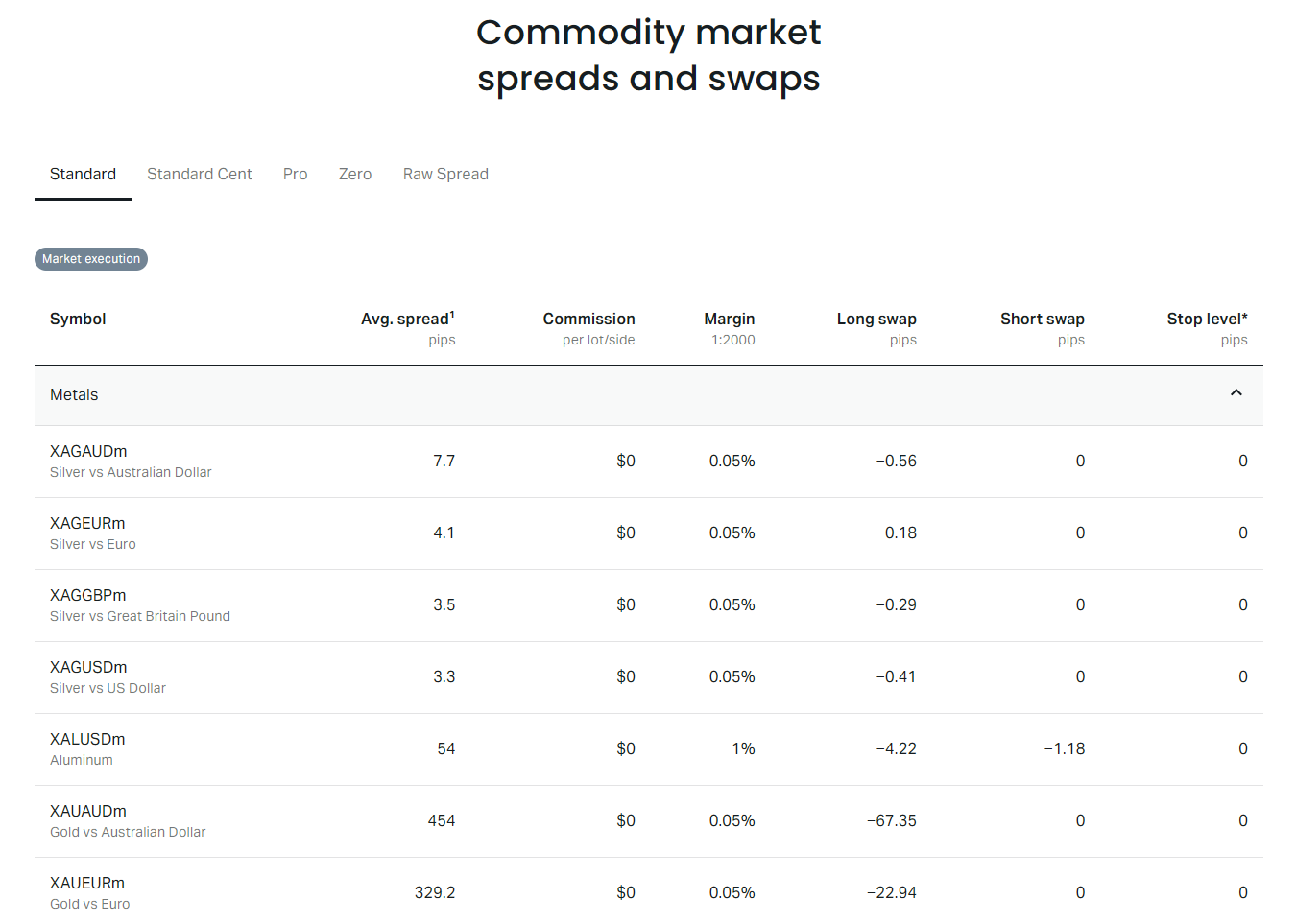
Typical spreads during peak hours: WTI around 0.03–0.05 points on Raw Spread/Zero, 0.3–0.5 on Standard. Brent runs slightly wider. Natural gas spreads are quoted in thousandths (0.001) and typically range 0.003–0.008 on raw accounts. Commission on Raw Spread is $3.50 per side per lot ($7 round turn); Zero account charges $0.20 per side per lot ($0.40 round turn) but with slightly wider spreads. Pro account charges $3.50 per side with spreads similar to Raw Spread.
Leverage and Margin Requirements
Exness offers dynamic leverage on energy CFDs. The maximum depends on account equity and the specific instrument. For most retail clients, energy leverage caps at 1:200 (0.5% margin) on Standard and Pro accounts. Raw Spread and Zero accounts may see lower maximums. As account equity grows, leverage steps down automatically — a regulatory safeguard. Professional clients (qualified under MiFID or equivalent) can access higher leverage up to 1:400 on energies, subject to approval.
Margin is calculated in the account base currency. For a USD account trading one lot of WTI (1,000 barrels), notional value at $75/barrel is $75,000. At 1:200 leverage, required margin is $375. Natural gas lots represent 10,000 MMBtu; at $3/MMBtu, notional is $30,000 per lot, requiring $150 margin at 1:200. Exness provides a margin calculator in the Personal Area and terminal to compute exact requirements before entering a trade.
Scroll horizontally to see all columns
| Parameter | US Oil (WTI) | UK Oil (Brent) | Natural Gas (NGAS) |
|---|---|---|---|
| Lot Size | 1,000 barrels | 1,000 barrels | 10,000 MMBtu |
| Tick Size | 0.01 | 0.01 | 0.001 |
| Tick Value (per lot) | $10 | $10 | $10 |
| Max Leverage (Retail) | 1:200 | 1:200 | 1:200 |
| Min Volume | 0.01 lot | 0.01 lot | 0.01 lot |
| Max Volume per Order | 100 lots | 100 lots | 100 lots |
Contract Rollover and Expiration Handling
Energy futures expire monthly. Exness manages rollover automatically for CFD positions. On the rollover date (typically a few days before the futures expiration), the front-month contract is replaced by the next month. The price difference between the two contracts is settled as a cash adjustment on your account — a credit if the new contract is cheaper (backwardation), a debit if more expensive (contango). No action is required, but the adjustment appears in your swap/rollover column.
Rollover dates are published in the Exness economic calendar and contract specifications. They do not always align with the exchange's last trading day; Exness may roll earlier to maintain liquidity. During the rollover window, spreads may widen temporarily. Traders holding positions across rollover should account for the cash adjustment in their P&L tracking. The adjustment is not a profit or loss from market movement — it reflects the term structure of the futures curve.
Rollover adjustments are the cost of maintaining continuous exposure without physical delivery. They are not a broker fee.
Platform Features for Energy Traders
Exness supports energy CFDs across all its platforms: MT4, MT5, Web Terminal, and mobile apps. Each offers the full instrument list, charting, and order management. The Web Terminal loads in a browser with no installation and includes TradingView charts — useful for quick access on restricted networks. MT5 adds more timeframes, a built-in economic calendar, and depth of market (DOM) for futures-style order flow visibility. Mobile apps mirror desktop functionality with push notifications for price alerts and margin calls.
One-click trading works on energies the same as forex. Trailing stops, OCO orders, and partial close are available. The terminal shows real-time swap rates and margin levels per position. For algorithmic traders, MT4/MT5 Expert Advisors can trade energy symbols without modification — just ensure the symbol name matches (e.g., "XTIUSD" for WTI, "XBRUSD" for Brent, "XNGUSD" for Natural Gas). Exness VPS hosting is free for qualifying accounts and reduces latency for EA execution during volatile energy sessions.
Market Drivers and Analysis Approaches
Energy prices respond to a distinct set of fundamentals. Oil balances hinge on OPEC+ production decisions, non-OPEC supply growth (especially US shale), global demand forecasts from the IEA and OPEC, and inventory data (API weekly, EIA weekly, OECD monthly). Natural gas is more regional: US storage reports (EIA Thursday), weather forecasts driving heating/cooling demand, LNG export capacity, and pipeline constraints. Geopolitics — sanctions, conflicts, shipping disruptions — can override fundamentals for weeks.
- Weekly EIA Petroleum Status Report (Wednesday 10:30 ET) — crude, gasoline, distillate inventories
- Weekly EIA Natural Gas Storage Report (Thursday 10:30 ET) — working gas in storage vs. 5-year average
- Monthly OPEC Monthly Oil Market Report — production, demand forecasts, compliance
- Baker Hughes Rig Count (Friday) — leading indicator for US oil/gas drilling activity
- API Weekly Statistical Bulletin (Tuesday 16:30 ET) — private survey, precedes EIA
Technical analysis applies similarly to other liquid markets. Energy trends often persist longer than forex due to physical supply constraints. Moving averages, trend channels, and volume-profile tools work well. The 50- and 200-day SMAs on daily charts are widely watched by institutional players. Commitment of Traders (COT) reports (Friday 15:30 ET) show speculative vs. commercial positioning — useful for spotting crowded trades. Exness provides Trading Central signals and an economic calendar integrated into MT5 and the web terminal.
Risk Management Specifics for Energy CFDs
Energy volatility exceeds most major forex pairs. A 2% daily move in WTI is routine; 5% happens several times a year. Natural gas can swing 10% in a session on a weather forecast revision. Standard forex position sizing (1–2% risk per trade) still applies, but stop distances must widen to accommodate noise. A 50-pip stop on EURUSD might be 200–300 points (ticks) on WTI. Adjust lot size accordingly so dollar risk stays consistent.
Correlation risk matters. Long WTI and long Brent are effectively the same trade — both track global crude. Long WTI and long CAD/JPY often move together (Canada exports oil). Long natural gas and short DXY (dollar index) can align in winter. Exness does not offer a correlation matrix in-platform; use external tools or calculate rolling correlations in Excel. Diversifying across uncorrelated assets (e.g., energies + gold + equity indices) reduces portfolio drawdown during energy-specific shocks.
Scroll horizontally to see all columns
| Instrument | Average Daily Range | 90th Percentile Range |
|---|---|---|
| WTI Crude | $2.50–3.50 | $5.00–7.00 |
| Brent Crude | $2.50–3.50 | $5.00–7.00 |
| Natural Gas | $0.15–0.25 | $0.40–0.70 |
Account Types and Energy Trading Suitability
Exness offers five live account types. Standard and Standard Cent are spread-only — no commission, wider spreads. Pro, Raw Spread, and Zero charge commission but offer tighter spreads. For energy scalpers and day traders, Raw Spread or Zero typically cost less overall despite the commission, because the spread savings on high-frequency trading exceed the fee. Swing traders holding days to weeks may prefer Standard to avoid commission on fewer trades, but must factor in wider spreads at entry and exit.
Standard Cent accounts denominate balance in cents (1 USD = 100 cents), allowing micro-lots (0.01 lot = 10 barrels WTI). This suits beginners testing energy strategies with minimal capital. However, cent accounts have higher spreads and lower maximum leverage at higher equity tiers. Professional accounts unlock higher leverage (up to 1:400) and no margin step-downs, but require qualifying criteria (portfolio size, trading history, or professional experience). Islamic (swap-free) accounts are available for all types — overnight financing is replaced by a fixed daily administration fee on energies.
Deposits, Withdrawals, and Funding Speed
Funding an Exness account for energy trading uses the same methods as other instruments: bank cards, wire transfer, e-wallets (Skrill, Neteller, WebMoney, Perfect Money), and regional options (local bank transfers, mobile money). Minimum deposit is $1 on Standard/Standard Cent; $200 on Pro/Raw Spread/Zero. Most electronic methods credit instantly. Wire transfers take 1–3 business days. Withdrawals process back to the original deposit method. Exness advertises instant withdrawals for e-wallets and cards; bank wires take 1–5 days. No withdrawal fees are charged by Exness, though payment providers may apply their own.
Energy traders moving size should verify withdrawal limits per method. Card withdrawals are capped at the total deposited via that card (anti-money-laundering rule). Profits above deposited amounts must go to an alternative method (e-wallet or bank wire). Complete KYC (identity + address verification) before requesting large withdrawals to avoid delays. The Personal Area shows real-time withdrawal status and estimated arrival times.
Regulatory Framework and Client Protection
Exness operates through multiple entities regulated by FCA (UK), CySEC (Cyprus), FSCA (South Africa), FSA (Seychelles), and CBCS (Curaçao). The entity serving you depends on your residence. Retail clients under FCA/CySEC/FSCA receive negative balance protection, leverage caps (1:30 forex, 1:20 energies), and segregation of client funds. Professional clients and those under offshore entities (Seychelles, Curaçao) may access higher leverage but lose some protections. Exness is a member of the Financial Commission compensation fund (up to €20,000 per claim) for eligible clients.
Segregated accounts hold client funds separate from company operational funds. Exness publishes audited financial statements and undergoes regular regulatory audits. The platform does not offer deposit insurance beyond the Financial Commission scheme. US residents cannot open accounts. Always confirm which entity regulates your account and what protections apply before depositing.
Regulatory jurisdiction determines your leverage, protection, and recourse. Check the entity before you fund.
Common Energy Trading Strategies on Exness
Traders approach energy CFDs with several recurring strategies. Trend following on daily/weekly charts captures persistent moves driven by supply-demand shifts. Mean reversion works on natural gas during shoulder seasons (spring/fall) when weather risk is low and prices oscillate around storage averages. Spread trading — long WTI vs. short Brent (the WTI-Brent spread) or long near-month vs. short far-month futures (calendar spread) — exploits term structure anomalies. Exness CFDs don't directly support multi-leg spreads, but you can simulate them with offsetting positions on different symbols.
- Breakout trading: Enter on volatility expansion after inventory reports or OPEC meetings
- Range trading: Buy support, sell resistance during low-volatility periods (summer for oil, shoulder months for gas)
- Carry trade: Short contango markets (pay rollover) vs. long backwardation markets (receive rollover) — advanced, requires futures curve analysis
- Correlation hedge: Long oil + short USD/CAD or long energy equities to isolate commodity beta
Algorithmic traders use MT4/MT5 EAs for energy. Common approaches: VWAP reversion on intraday charts, momentum on 4-hour/8-hour timeframes, and statistical arbitrage between WTI and Brent. Exness VPS (free for accounts with $500+ equity and 5+ lots/month) ensures 24/7 EA uptime. Backtest on Exness historical data (available in MT5 Strategy Tester) — spread and swap history differ from other brokers and affect net results.
Tax Implications and Record Keeping
CFD taxation varies by country. In many jurisdictions, CFD profits are taxed as capital gains or ordinary income. Losses may offset gains or be carried forward. Exness provides account statements (PDF/CSV) and trade history exports from the Personal Area and MT4/MT5. These include timestamps, volumes, prices, swaps, commissions, and rollover adjustments — everything needed for tax reporting. Some countries require broker-issued annual tax statements; Exness does not automatically generate these for all jurisdictions. Consult a local tax advisor familiar with derivative instruments.
Rollover adjustments complicate cost basis tracking. Each rollover creates a realized P&L event (the cash adjustment) even though the position remains open. Most tax software does not handle this automatically. Maintain a separate ledger mapping each rollover date, adjustment amount, and resulting cost basis change. Exness trade history shows rollovers as separate line items labeled "rollover" or "dividend adjustment" depending on platform version.
Frequently Asked Questions
What energy CFDs does Exness offer?
Exness offers three energy CFDs: US Oil (WTI), UK Oil (Brent), and Natural Gas (Henry Hub). All track the respective front-month futures contracts.
What are the trading hours for energy CFDs on Exness?
Energy CFDs trade Sunday 23:00 to Friday 21:00 MT4 server time, with a daily break from 22:00–23:00. Hours match the underlying futures exchanges.
How does Exness handle futures contract rollover?
Rollover is automatic. The price difference between expiring and next-month contracts is settled as a cash adjustment (credit or debit) on your account. No position closure or reopening is needed.
What leverage is available for energy CFDs?
Retail clients get up to 1:200 leverage on energies (0.5% margin). Professional clients may qualify for up to 1:400. Leverage steps down automatically as account equity increases.
Which Exness account type is best for trading oil and gas?
Raw Spread or Zero accounts suit high-frequency traders due to tight spreads. Standard or Pro accounts work for swing traders. Standard Cent allows micro-lots for small accounts.
Are swap-free (Islamic) accounts available for energy CFDs?
Yes. All account types offer an Islamic/swap-free option. Overnight financing is replaced by a fixed daily administration fee per lot held.
How do I see current spreads and swaps for energy instruments?
In MT4/MT5, right-click the symbol in Market Watch and select Specification. In the Web Terminal, click the info icon next to the symbol. The Exness website also publishes typical spreads per account type.
Can I trade energy CFDs on the Exness mobile app?
Yes. The Exness Trade app and MT4/MT5 mobile apps support full energy CFD trading, including charting, orders, and position management.
Final Assessment of Exness Energies Trading
Exness delivers a competent energy CFD offering. The three core contracts cover the benchmarks most traders need. Spreads on raw accounts are competitive with industry leaders. Execution quality is solid — the broker publishes execution statistics and offers VPS for algorithmic work. Platform choice (MT4, MT5, web, mobile) covers every preference. Rollover handling is automatic and transparent. The main gaps: no heating oil, gasoline, or electricity contracts; no built-in spread-trading tools; and swap rates that can accumulate quickly on long-term positions. For traders focused on WTI, Brent, and Henry Hub, Exness is a viable choice. For broader energy exposure or complex multi-leg strategies, you'll need supplementary tools or a futures broker. Test on demo first — energy volatility punishes undersized accounts faster than most markets.