
Forex Partnerships
Exness Introducing Broker Program: Complete Guide for Partners
Detailed breakdown of the Exness Introducing Broker partnership model, earnings potential, and platform features for affiliates.

Senior Forex Trader & Market Analyst
Daniel Chen is an experienced forex trader and financial market analyst with over 15 years of experience in currency trading. He specializes in technical analysis, risk management, and developing practical trading strategies to help traders make informed decisions.
The Exness Introducing Broker program lets individuals and companies earn commissions by referring traders to the broker. Unlike a standard affiliate arrangement, an IB typically builds a more direct relationship with referred clients, often providing education, support, or local market knowledge. Exness structures its IB offering around transparent revenue sharing, a dedicated partner portal, and multi-tier partnership options that scale with the volume your referrals generate.
Contents
- 1. What Is the Exness Introducing Broker Program
- 2. How the Exness IB Partnership Model Works
- 3. Commission Structures and Earning Potential
- 4. Partner Portal and Tracking Tools
- 5. Registration and Verification Requirements
- 6. Marketing Materials and Referral Links
- 7. Multi-Level Partnership and Sub-IBs
- 8. Payment Methods and Withdrawal Terms
- 9. Comparing Exness IB with Other Broker Programs
- 10. Practical Tips for Growing Your IB Business
- 11. Common Challenges and How to Address Them
- 12. Regulatory Considerations for IBs
- 13. Final Assessment of Exness Introducing Broker Program
This guide covers how the program works, what you need to join, how commissions are calculated, and what tools Exness provides to help partners grow. It also compares the Exness IB model with similar programs from other brokers so you can decide whether it fits your business.
Exness has operated since 2008 and serves clients in over 130 countries. The broker is regulated by several authorities including the FCA in the UK, CySEC in Cyprus, and the FSCA in South Africa. That regulatory footprint matters for IBs because it affects which clients you can legally refer and what protections those clients receive.
Before diving into the mechanics, it helps to understand the difference between an introducing broker and a pure affiliate. An affiliate typically places tracking links on a website or social channel and earns a one-time or recurring fee per signup. An IB often goes further: they may onboard clients personally, provide ongoing support, and take responsibility for the client experience. Exness accommodates both approaches but the IB track unlocks higher revenue tiers and additional management tools.
What Is the Exness Introducing Broker Program
The Exness IB program is a formal partnership agreement between Exness and a partner who refers new trading clients. Once approved, the partner receives a unique referral link and access to the Partner Area, a dashboard that tracks registrations, deposits, trading volume, and earned commissions in real time. Commissions are paid based on the spread or commission revenue Exness generates from the referred clients' trades.
Exness does not charge partners any fees to join. There are no monthly minimums, no hidden costs, and no requirement to maintain a personal trading account. The program is open to individuals, companies, educators, signal providers, and community managers who can demonstrate a legitimate audience or client base.
The broker classifies partners into tiers based on the monthly trading volume of their referred clients. Higher tiers unlock better revenue shares, priority support, and access to dedicated account managers. The tier structure is public and updates automatically as your clients' volume changes.
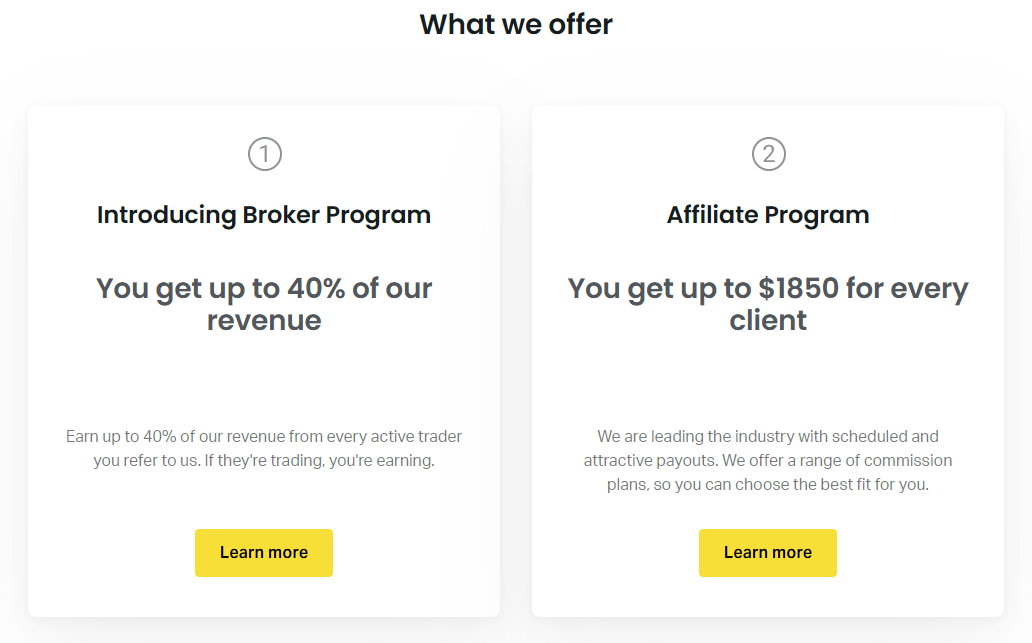
One distinction worth noting: Exness runs both an IB program and an affiliate program. The affiliate track is simpler — place a link, earn a fixed CPA or revenue share. The IB track is built for partners who want deeper integration, multi-level sub-partnerships, and custom reporting. You can start as an affiliate and upgrade to IB status once you meet volume thresholds.
How the Exness IB Partnership Model Works
When a trader clicks your referral link and opens an account, that account is permanently tagged to your partner ID. Every trade the client makes generates spread or commission revenue for Exness. A percentage of that revenue is credited to your partner account daily. The exact percentage depends on your current tier and the account type the client trades on.
Exness offers several account types: Standard, Standard Cent, Pro, Raw Spread, and Zero. Each has a different cost structure for the client, which means the revenue available for sharing differs. For example, Raw Spread and Zero accounts charge a commission per lot on top of a near-zero spread. The IB revenue share on those accounts is calculated from the commission component, not the spread.
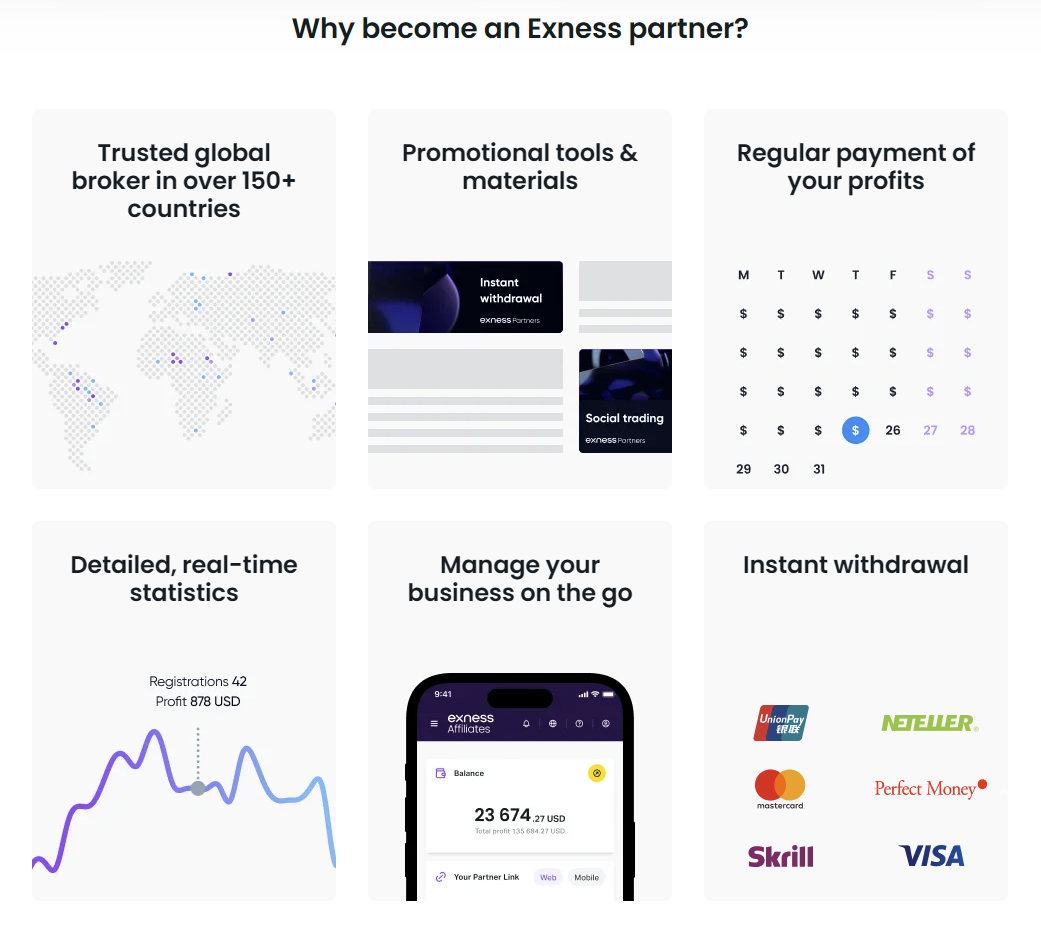
Commissions are accrued in real time and paid out daily. There is no minimum payout threshold — you can withdraw whatever has been credited, even a few dollars. Withdrawal methods mirror the client payment options: bank wire, credit or debit card, and a wide range of e-wallets and local payment systems depending on your country.
The partner portal shows each referred client's account number, registration date, total deposits, total lots traded, and the commission you have earned from that client. You can filter by date range, account type, and country. The data exports to CSV for offline analysis.
- Referral link tags client permanently at first click
- Revenue share calculated daily from spread or commission
- No minimum payout — withdraw any amount anytime
- Portal tracks deposits, lots, and earnings per client
- CSV export available for custom reporting
Commission Structures and Earning Potential
Exness publishes its IB commission rates openly. The base revenue share starts at 30 percent of the spread or commission revenue generated by your referred clients. As your monthly referred volume crosses defined thresholds, the share increases. The highest published tier reaches 60 percent for partners whose clients trade more than 10,000 lots per month.
The tier thresholds are measured in lots traded across all your referred accounts. A lot equals 100,000 units of the base currency in forex. For metals, indices, and crypto, Exness defines lot sizes differently — the partner portal converts everything to a standardized lot equivalent so the tier calculation is consistent.
Scroll horizontally to see all columns
| Monthly Referred Volume (Lots) | Revenue Share Percentage |
|---|---|
| 0 – 500 | 30% |
| 501 – 2,000 | 40% |
| 2,001 – 5,000 | 50% |
| 5,001 – 10,000 | 55% |
| 10,000+ | 60% |
These percentages apply to the net spread or commission revenue after Exness covers its own liquidity and operational costs. The broker does not publish the exact formula for net revenue, but the effective payout per lot on major pairs typically ranges from $4 to $12 depending on the account type and your tier. On Raw Spread and Zero accounts, the commission per lot is fixed — $3.50 per side per lot on Raw Spread, $3.50 per side per lot on Zero — so your share is a clean percentage of that known amount.
It is important to understand that revenue share is not the same as a fixed rebate per lot. If market conditions widen spreads, the revenue pool grows and your share grows with it. If spreads tighten, the pool shrinks. This aligns your incentives with Exness: both parties benefit when clients trade actively in normal market conditions.
Revenue share aligns partner and broker incentives — both earn more when clients trade actively under normal conditions.
Partner Portal and Tracking Tools
The Partner Area is the central hub for managing your IB business. After login, you see a dashboard with today's earnings, month-to-date earnings, total referred clients, active clients (those who traded in the last 30 days), and your current tier. The left navigation breaks down into Reports, Marketing, Clients, Payments, and Settings.
The Reports section lets you build custom views. You can group by client, by account type, by country, by registration date, or by any combination. Each report shows deposits, withdrawals, lots traded, spread revenue, commission revenue, and your net earnings. Reports can be scheduled for daily or weekly email delivery.
The Marketing section hosts your referral links, banners, landing pages, and QR codes. Exness provides creatives in multiple sizes and languages. You can generate a unique link for each campaign — for example, one for your website, one for a Telegram channel, one for an email newsletter — and track each source separately. UTM parameters are supported automatically.
The Clients tab lists every referred account with its status: registered, verified, deposited, trading, or inactive. You can click any client to see their full trading history, open positions, and the exact commission you earned from each trade. This level of transparency is unusual; many brokers only show aggregated totals.
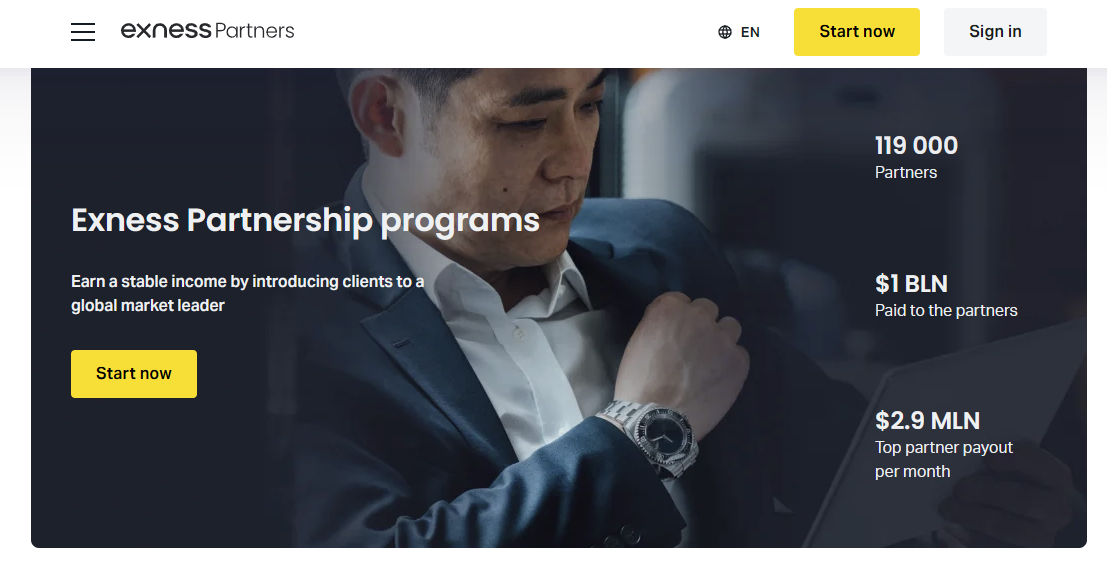
Payments shows your withdrawal history, pending amounts, and available balance. You can add multiple withdrawal methods and set a default. Withdrawals are processed within 24 hours on business days. There are no fees from Exness for withdrawals, though your payment provider may charge its own fee.
- Real-time earnings dashboard with tier progress
- Custom reports with grouping and filtering
- Per-campaign referral links with UTM support
- Client-level trade history and commission breakdown
- Daily withdrawal processing, no Exness fees
Registration and Verification Requirements
To become an Exness IB, you register through the partner portal using an email address. The form asks for basic information: full name or company name, country of residence, phone number, and how you plan to promote Exness. There is no cost to submit the application.
Once submitted, the compliance team reviews your application. They may request additional documents depending on your jurisdiction and the scale of your operation. Typical requests include a government-issued ID, proof of address (utility bill or bank statement less than three months old), and for companies, a certificate of incorporation and proof of beneficial ownership.
Verification usually completes within one to three business days. If your application is approved, you receive immediate access to the Partner Area and your referral links go live. If additional information is needed, the team contacts you by email. Rejections are rare but can happen if the promotional method violates Exness policy — for example, promising guaranteed returns, using misleading advertising, or targeting prohibited jurisdictions.
Exness does not allow IBs to refer clients from certain countries due to regulatory restrictions. The prohibited list includes the United States, Iran, North Korea, and a few others. The partner portal shows the current restricted countries list, and your referral links will automatically block signups from those regions.
Marketing Materials and Referral Links
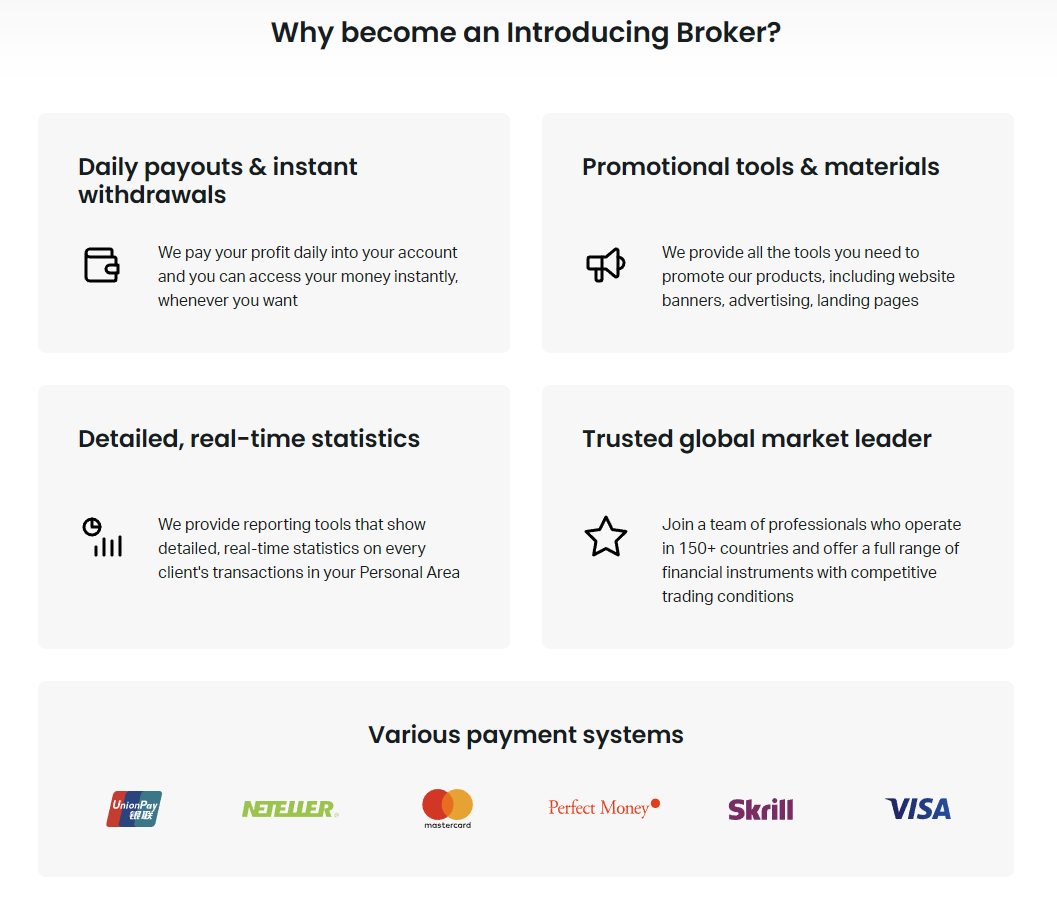
Exness provides a library of marketing assets: static banners in standard IAB sizes, animated HTML5 banners, landing page templates, email templates, social media graphics, and educational content packs. All assets are branded with Exness colors and logos but include your partner ID automatically when downloaded from the portal.
You can also create custom landing pages using the built-in builder. It lets you choose a template, add your headline, select a call-to-action button, and publish to a subdomain like yourname.exness.partner. The page is hosted by Exness, loads fast, and includes the tracking pixel so every visitor is attributed to you.
Referral links follow the format partner.exness.com/yourcode. You can append sub-id parameters to track sources: partner.exness.com/yourcode?source=telegram&campaign=jan2025. The portal aggregates data by sub-id so you can compare channel performance without setting up your own analytics.
Exness updates the creative library quarterly. New banners reflect current promotions — for example, a deposit bonus campaign or a trading competition. Partners receive email notifications when new assets are available. You can also request custom creatives through your account manager once you reach the 2,000-lots tier.
A practical tip: do not rely solely on Exness-provided banners. They are generic by design. Partners who create their own content — blog reviews, video tutorials, comparison tables, or strategy guides — consistently outperform those who only run banner ads. The portal's sub-id tracking makes it easy to test your own creatives against the provided ones.
Multi-Level Partnership and Sub-IBs
A distinctive feature of the Exness IB program is the ability to recruit sub-partners. When you invite another person to become an IB under you, they become your Level 1 sub-partner. Any clients they refer generate commission for them at their tier rate, and you earn an override commission on top — typically 10 percent of the revenue share that sub-partner earns.
This can extend to multiple levels. A Level 2 sub-partner (recruited by your Level 1) generates an override for the Level 1 partner and a smaller override for you. The exact percentages decrease at each level. The portal shows a genealogy tree so you can see your entire downline, each partner's tier, their monthly volume, and the overrides you have earned from each level.
Multi-level partnerships are optional. You can operate as a single-tier IB and never recruit sub-partners. But for partners who build teams — for example, educators who train other affiliates, or community leaders who onboard local representatives — the override structure can add a meaningful passive income stream.
Scroll horizontally to see all columns
| Level | Override on Sub-Partner Revenue Share |
|---|---|
| Level 1 (direct recruit) | 10% |
| Level 2 | 5% |
| Level 3 | 2% |
Overrides are paid from Exness's share, not deducted from the sub-partner's earnings. The sub-partner receives their full tier rate regardless of whether they have an upline. This avoids the conflict where a partner might hesitate to recruit because it would reduce their own take.
Payment Methods and Withdrawal Terms
Exness supports a wide range of withdrawal methods for partners. The exact list depends on your country of residence. Common options include bank wire transfer, Visa and Mastercard, Skrill, Neteller, WebMoney, Perfect Money, and various local payment systems such as Pix in Brazil, UPI in India, and local bank transfers in Nigeria, Kenya, Vietnam, and Indonesia.
Withdrawals are processed daily on business days. Requests submitted before the cutoff (typically 13:00 UTC) are paid the same day. There is no minimum withdrawal amount. Exness does not charge withdrawal fees, but the payment processor may. For example, a bank wire may incur a correspondent bank fee of $15–$30 depending on the route.
You can set up automatic daily withdrawals to a default method. This is useful if you prefer not to log in manually. The partner portal also lets you split withdrawals across multiple methods — for instance, 70 percent to bank wire and 30 percent to Skrill.
Tax reporting is the partner's responsibility. Exness does not withhold tax on partner commissions. The portal provides an annual earnings statement that you can use for tax filing. If you operate as a company, ensure your corporate details are correct in the Settings section so the statement reflects your legal entity.
- Daily processing on business days, no minimum amount
- No Exness withdrawal fees (processor fees may apply)
- Automatic daily withdrawal option available
- Split withdrawals across multiple methods
- Annual earnings statement for tax reporting
Comparing Exness IB with Other Broker Programs
Most major forex brokers offer an IB or partner program. The core mechanics — revenue share based on client volume, tiered rates, partner portal — are similar. Differences appear in the details: tier thresholds, revenue share ceilings, payment speed, marketing support, and whether multi-level overrides exist.
Exness stands out for its high revenue share ceiling (60 percent at the top tier), daily payouts with no minimum, and the built-in multi-level override structure. Many competitors cap revenue share at 40–50 percent, pay weekly or monthly, and require a minimum withdrawal of $100 or more. Exness also provides client-level trade transparency that most brokers reserve for institutional partners.
On the other hand, some brokers offer fixed CPA (cost per acquisition) models that can be more predictable for affiliates with high-volume, low-retention traffic. Exness does not offer a pure CPA track for IBs — only revenue share. If your traffic converts well but clients churn quickly, a CPA model might earn more in the short term.
Scroll horizontally to see all columns
| Feature | Exness IB | Typical Competitor |
|---|---|---|
| Max Revenue Share | 60% | 40–50% |
| Payout Frequency | Daily | Weekly/Monthly |
| Minimum Withdrawal | None | $50–$100 |
| Multi-Level Overrides | Yes (3 levels) | Rarely |
| Client-Level Trade Data | Full transparency | Aggregated only |
| CPA Option | No | Often available |
Another consideration: Exness offers some of the lowest spreads and commissions in the industry. That means the revenue pool per lot is smaller than at brokers with wider spreads. A 60 percent share of a $6 per lot revenue yields $3.60. A 40 percent share of a $15 per lot revenue yields $6.00. The effective earnings per lot depend on both the share percentage and the broker's pricing. Partners should calculate expected earnings per lot for the specific account types their clients will use.
Higher revenue share percentage does not always mean higher earnings per lot — the broker's underlying spread and commission structure matters equally.
Practical Tips for Growing Your IB Business
Successful Exness IBs tend to follow a few patterns. First, they specialize. Instead of targeting every trader, they focus on a niche — scalpers who need raw spreads, beginners who need cent accounts, algorithmic traders who need VPS, or regional markets where they speak the language and understand local payment preferences.
Second, they create educational content that ranks in search or spreads in communities. A detailed comparison of Exness account types, a video walkthrough of the web terminal, a guide to deposit methods in a specific country — these assets attract traders who are close to a decision and convert at higher rates than banner clicks.
Third, they use the sub-id tracking religiously. Every channel, every campaign, every piece of content gets a unique sub-id. They review the data weekly, double down on what works, and cut what doesn't. The portal makes this easy but it requires discipline.
Fourth, they communicate with their referred clients. A welcome email with platform setup tips, a monthly newsletter with market commentary, a quick check-in when a client goes inactive — these touches increase retention and lifetime value. Exness does not restrict you from contacting your clients, as long as you follow anti-spam laws.
- Pick a niche: scalpers, beginners, algo traders, regional markets
- Publish educational content that ranks or spreads organically
- Tag every channel with unique sub-ids and review weekly
- Stay in touch with referred clients to boost retention
- Leverage multi-level overrides by onboarding sub-partners
Common Challenges and How to Address Them
One challenge IBs report is client verification friction. Exness requires full KYC before a client can withdraw profits. Some traders abandon the process if they find document submission cumbersome. You can reduce drop-off by preparing a short guide that explains exactly which documents are accepted, how to photograph them clearly, and what the review timeline looks like.
Another challenge is seasonal volume fluctuation. Trading activity often drops in August and around major holidays. Your tier is based on monthly volume, so a slow month can drop you to a lower revenue share. The tier recalculation happens on the first of each month. There is no grace period. Planning content and promotions ahead of known slow periods helps maintain volume.
A third issue is attribution loss when a client clears cookies or switches devices before registering. Exness uses first-click attribution with a 30-day cookie window. If the client clicks your link, leaves, and returns 31 days later directly, you lose the referral. Encouraging immediate registration — for example, by offering a bonus guide that delivers value only after signup — mitigates this.
Finally, some partners struggle with the transition from affiliate to IB mindset. Affiliate marketing rewards volume of clicks. IB rewards volume of lots traded over time. The metrics that matter shift from CTR and CPC to deposits per referral, lots per client, and client lifetime value. Adjusting your reporting and optimization habits accordingly takes time.
IB success metrics shift from clicks to client lifetime value — deposits, lots traded, and retention matter more than traffic volume.
Regulatory Considerations for IBs
As an IB, you are not a regulated financial entity in most jurisdictions, but your promotional activities are subject to financial advertising rules. Exness provides compliance guidelines in the partner portal. Key points: do not guarantee profits, do not imply Exness is risk-free, do not use misleading performance claims, and always include a risk warning when promoting leveraged products.
If you operate in the European Economic Area, you must comply with MiFID II marketing rules and ESMA leverage restrictions for retail clients. Exness automatically applies the correct leverage limits based on the client's residency, but your marketing must not promise higher leverage than permitted.
In some countries — for example, Australia under ASIC, or the UK under FCA — introducing brokers may need to register as an appointed representative or obtain their own authorization if they provide advice or manage client funds. Exness's IB agreement does not authorize you to give financial advice. If your activity crosses into advice, consult a local regulator or lawyer.
Exness monitors partner marketing for compliance. Violations can result in commission clawbacks, account suspension, or termination. The compliance team typically issues a warning first, but repeated or egregious violations lead to immediate action. Keep records of your promotional materials in case you need to demonstrate compliance.
- No guaranteed profit or risk-free claims in promotions
- Include standard leveraged product risk warning
- Respect ESMA leverage limits for EEA retail clients
- Do not provide financial advice unless locally authorized
- Keep records of all promotional materials
The broker also restricts promotion in certain channels. Paid search bidding on Exness brand terms is prohibited. Email marketing to purchased lists is prohibited. Incentivized traffic (paying users to sign up) is prohibited. The full list is in the partner agreement. Read it before launching campaigns.
Final Assessment of Exness Introducing Broker Program
The Exness IB program is one of the more transparent and partner-friendly offerings in the retail forex space. The revenue share tiers are public, the portal provides genuine client-level data, payouts are daily with no minimum, and the multi-level override structure rewards team building without penalizing sub-partners. These are not trivial advantages — many brokers obscure their tier thresholds, aggregate reporting to hide client churn, and impose withdrawal minimums that lock up small balances.
The trade-offs are real. The revenue share model means your income correlates with client trading volume, not just signups. If you drive high volumes of low-activity clients, earnings will be modest. The lack of a CPA option limits flexibility for affiliates who prefer fixed payouts. And because Exness pricing is tight, the absolute revenue per lot is lower than at brokers with wider spreads — so the high percentage share partly compensates for a smaller pie.
For partners who can attract active traders — especially those who trade Raw Spread or Zero accounts where the commission per lot is fixed and known — the program pays well. The daily cash flow, transparent reporting, and lack of withdrawal friction make it operationally simple. The marketing library and custom landing page builder reduce technical overhead. And the sub-partner system creates a path to scale beyond your own direct referrals.
If you are evaluating whether to commit resources to the Exness IB program, run a small test. Allocate a trackable traffic source for 30 days, measure deposits per referral, lots per depositor, and your effective earnings per lot. Compare that to your alternative programs. The data will tell you more than any review.
Frequently Asked Questions
How do I join the Exness Introducing Broker program?
Register at partner.exness.com with your email, name, country, and promotion method. Submit ID and address verification. Approval typically takes 1–3 business days.
What is the minimum withdrawal amount for IB commissions?
There is no minimum withdrawal amount. You can withdraw any credited balance daily.
Can I be both an affiliate and an IB with Exness?
Yes. You can start as an affiliate and upgrade to IB status once you meet volume thresholds. The partner portal supports both tracks.
How are IB commissions calculated on Raw Spread accounts?
Raw Spread accounts charge a fixed commission per lot ($3.50 per side). Your revenue share percentage applies to that commission revenue, not the spread.
Does Exness provide marketing materials for IBs?
Yes. The partner portal includes banners, landing pages, email templates, and a custom landing page builder. All assets auto-insert your partner ID.
What happens if my referred client volume drops below a tier threshold?
Tiers are recalculated on the first of each month based on the previous month's volume. Your revenue share adjusts automatically to the new tier.
Can I recruit sub-partners under my IB account?
Yes. You earn override commissions on sub-partner revenue: 10% for Level 1, 5% for Level 2, 2% for Level 3. Sub-partners keep their full tier rate.
Are there countries where I cannot refer clients?
Yes. Exness prohibits referrals from the United States, Iran, North Korea, and other sanctioned jurisdictions. The partner portal shows the current restricted list.