

Forex Trading Guides
Exness USDCAD Trading Conditions and Strategy Guide
Learn how to trade USD/CAD effectively on Exness with real trading conditions and platform features.

Senior Forex Trader & Market Analyst
Daniel Chen is an experienced forex trader and financial market analyst with over 15 years of experience in currency trading. He specializes in technical analysis, risk management, and developing practical trading strategies to help traders make informed decisions.
The USDCAD pair, often called the Loonie, ranks among the most liquid major currency pairs in forex. It represents the exchange rate between the US dollar and Canadian dollar, two economies deeply linked by trade, energy markets, and monetary policy coordination. For traders on Exness, this pair offers tight spreads, deep liquidity during North American hours, and clear reactions to oil price movements and central bank decisions.
Contents
- 1. USDCAD Trading Conditions on Exness
- 2. Platform Options for USDCAD Trading
- 3. Account Types and Their Impact on USDCAD Costs
- 4. USDCAD Market Drivers and Correlation Factors
- 5. Trading Sessions and Liquidity Patterns
- 6. Technical Analysis Tools on Exness Platforms
- 7. Risk Management for USDCAD Positions
- 8. Common USDCAD Trading Strategies on Exness
- 8.1. Oil Correlation Trend Following
- 8.2. Asian Session Range Fade
- 8.3. News Straddle and Momentum
- 9. Automated Trading and EAs for USDCAD
- 10. Deposit, Withdrawal, and Funding for USDCAD Traders
- 11. Regulatory Protection and Fund Safety
- 12. Practical Tips for Starting USDCAD on Exness
- 13. Comparing Exness USDCAD to Other Brokers
- 14. Final Assessment of Exness USDCAD Trading
Exness provides access to USDCAD across all account types with raw spreads starting from zero pips on professional accounts and competitive floating spreads on standard accounts. The broker's execution model, platform selection, and analytical tools make it a practical choice for both discretionary and algorithmic approaches to this pair.
This guide covers the specific trading conditions for USDCAD on Exness, the platforms available, how different account types affect your costs, and practical considerations for building a strategy around this commodity-linked currency pair.
USDCAD Trading Conditions on Exness
Exness offers USDCAD as a spot forex CFD with leverage up to 1:2000 depending on account equity and regulatory jurisdiction. The pair trades 24 hours a day, five days a week, with the most active liquidity during the overlap of the New York and Toronto sessions, roughly 13:00 to 17:00 UTC. Outside these hours, spreads widen and depth thins, which matters for larger position sizes.
Minimum trade size is 0.01 lots (1,000 units of base currency) across all account types. Maximum position limits vary by account equity but generally accommodate retail and professional volumes without restriction. Swap rates apply for positions held overnight and differ between long and short sides, reflecting the interest rate differential between the Federal Reserve and Bank of Canada policy rates.
Scroll horizontally to see all columns
| Account Type | Typical Spread (pips) | Commission | Best For |
|---|---|---|---|
| Standard | 1.0 - 1.5 | None | Beginners, smaller accounts |
| Standard Cent | 1.0 - 1.5 | None | Micro position sizing |
| Pro | 0.3 - 0.7 | None | Active traders, no commission |
| Raw Spread | 0.0 - 0.2 | $3.5 per side per lot | Scalpers, high volume |
| Zero | 0.0 - 0.2 | $3.5 per side per lot | Algorithmic, EA trading |
Spreads fluctuate with market conditions. During major news releases — US non-farm payrolls, Canadian employment data, Bank of Canada rate decisions, or crude oil inventory reports — spreads can widen to 3-5 pips on standard accounts and 1-2 pips on raw spread accounts. Exness does not guarantee fixed spreads, but the broker's aggregation from multiple liquidity providers generally keeps USDCAD pricing competitive.
The commission structure on Raw Spread and Zero accounts means each round-turn lot costs $7. For a trader doing 10 lots per month on USDCAD, that's $70 in commissions versus roughly $100-150 in spread cost on a Standard account at 1.2 pips average. The break-even volume depends on your actual spread experience, but most active traders find raw spread accounts cheaper above 5-8 lots monthly.
Platform Options for USDCAD Trading
Exness supports USDCAD trading on MetaTrader 4, MetaTrader 5, the proprietary Exness Web Terminal, and mobile apps for iOS and Android. Each platform handles the pair identically in terms of pricing and execution, but the toolset differs enough to affect workflow.
MetaTrader 4 remains the most widely used platform for forex. It offers 9 timeframes, 30 built-in indicators, and the largest ecosystem of custom indicators and expert advisors. For USDCAD traders using technical analysis or automated strategies, MT4's MQL4 language has thousands of free and paid tools specifically coded for major pairs.
MetaTrader 5 adds 21 timeframes, 38 built-in indicators, depth of market (Level 2) data, and a more advanced strategy tester with multi-currency backtesting. The MQL5 language is more capable but has a smaller legacy codebase. For USDCAD, the additional timeframes help with intraday oil correlation analysis, and depth of market shows liquidity clusters around key levels.
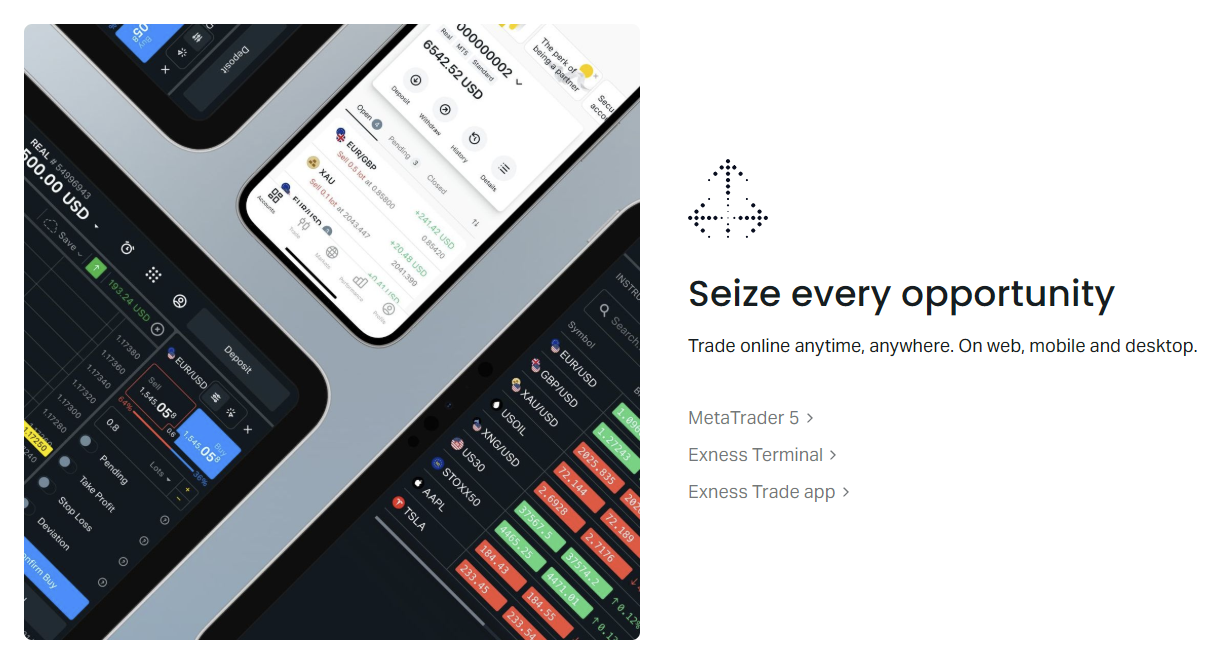
The Exness Web Terminal runs in any modern browser without installation. It includes TradingView charts, 50+ indicators, drawing tools, and one-click trading. For USDCAD, the integrated economic calendar and FXStreet news feed appear directly on the chart, which helps track Canadian and US data releases without switching windows. The web terminal syncs with your MT4/MT5 accounts, so positions opened in one appear in the other.
Mobile apps for iOS and Android provide full trading functionality including chart analysis, order management, and account operations. Push notifications for price alerts and margin calls work reliably. The mobile charting includes the same indicator set as the desktop platforms, though screen space limits multi-timeframe analysis.
Account Types and Their Impact on USDCAD Costs
Choosing the right account type for USDCAD depends on your trading frequency, position size, and whether you use automated systems. Exness offers five main account categories, each with different spread and commission structures.
- Standard: No commission, spreads from ~1.0 pips, minimum deposit $10, suitable for beginners and swing traders holding positions days to weeks
- Standard Cent: Same conditions as Standard but denominated in cents, allowing 0.01 lot = 1,000 cents ($10) instead of $1,000, ideal for learning with real money at minimal risk
- Pro: No commission, spreads from ~0.3 pips, minimum deposit $200, designed for active traders who want raw-like spreads without commission calculations
- Raw Spread: Commission $3.5 per side per lot, spreads from 0.0 pips, minimum deposit $200, best for scalpers and high-frequency strategies where spread certainty matters
- Zero: Commission $3.5 per side per lot, spreads from 0.0 pips with priority execution, minimum deposit $200, optimized for algorithmic trading and EAs requiring fastest fill rates
For USDCAD specifically, the Pro account often hits a sweet spot. The typical 0.3-0.7 pip spread costs $3-7 per standard lot round-turn, comparable to Raw Spread's $7 commission but without the separate fee structure. If you trade 3-5 lots monthly, Pro usually costs less. Above 10 lots, Raw Spread or Zero become cheaper.
Scroll horizontally to see all columns
| Monthly Volume (lots) | Standard (1.2 pip avg) | Pro (0.5 pip avg) | Raw Spread (0.1 pip + $7 commission) |
|---|---|---|---|
| 2 lots | $24 | $10 | $14.40 |
| 5 lots | $60 | $25 | $35.50 |
| 10 lots | $120 | $50 | $71 |
| 20 lots | $240 | $100 | $142 |
These calculations assume 1 standard lot = $10 per pip. Cent accounts divide all costs by 100. Islamic (swap-free) versions exist for all account types with slightly wider spreads or fixed commissions replacing overnight swaps. The swap-free adjustment on USDCAD typically adds 0.2-0.4 pips to the spread or a flat $2-4 per lot per night.
USDCAD Market Drivers and Correlation Factors
USDCAD moves primarily on three drivers: interest rate differentials between the Fed and Bank of Canada, crude oil prices, and relative economic data. Canada exports roughly 3.5 million barrels of oil daily to the US, making the Canadian dollar sensitive to WTI crude benchmarks. When oil rises, CAD typically strengthens, pushing USDCAD lower. When oil falls, CAD weakens, pushing USDCAD higher.
The correlation isn't perfect. During 2020-2022, the oil-CAD link weakened as pandemic demand shocks and monetary policy divergence dominated. In 2023-2024, the correlation returned closer to its historical 0.7-0.8 range. Traders should monitor the rolling 30-day correlation coefficient rather than assuming a fixed relationship.
Oil price moves explain roughly 60-70% of CAD medium-term trends, but central policy divergence can override energy fundamentals for months at a time.
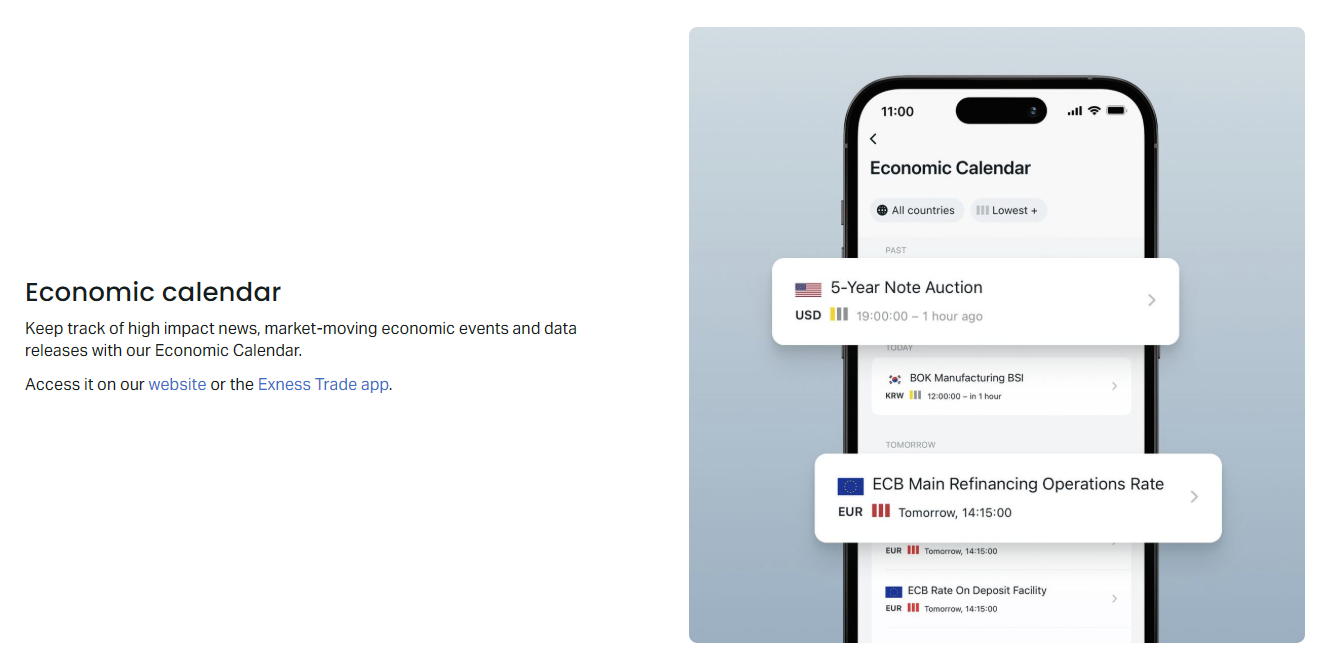
Key economic releases for USDCAD include: US CPI, non-farm payrolls, ISM manufacturing/services, Fed minutes and speeches; Canadian CPI, employment change, GDP, trade balance, BoC rate decisions and monetary policy report. The pair often ranges 30-50 pips ahead of major releases, then moves 80-150 pips in the first hour after. Exness's economic calendar flags these events with impact ratings and consensus forecasts.
Cross-asset correlations matter too. USDCAD often moves inversely to gold (XAUUSD) and positively with USDJPY during risk-off episodes. The US Dollar Index (DXY) drives the USD side, while commodity currencies like AUDUSD and NZDUSD share the resource-linked CAD behavior. Monitoring these relationships helps confirm or question USDCAD setups.
Trading Sessions and Liquidity Patterns
USDCAD liquidity follows the North American business day. The Tokyo session (00:00-09:00 UTC) sees thin volume, spreads 2-3x wider than peak hours, and erratic price action. The London open (08:00 UTC) brings some flow but CAD-specific liquidity remains low until Toronto opens at 13:00 UTC. The 13:00-17:00 UTC window — New York/Toronto overlap — handles 60-70% of daily USDCAD volume.
After 17:00 UTC, liquidity drains as New York desks close. The 17:00-21:00 UTC period often sees range-bound chop or late-day position squaring. Weekend gaps on Monday open are common after significant Friday news or geopolitical events affecting oil. Exness maintains pricing through weekends but with significantly wider spreads and reduced depth.
Technical Analysis Tools on Exness Platforms
All Exness platforms provide standard technical tools for USDCAD analysis. MT4/MT5 include trend indicators (moving averages, Ichimoku, ADX), oscillators (RSI, Stochastic, MACD, CCI), volume tools (On Balance Volume, Money Flow Index), and drawing tools (trendlines, Fibonacci, Andrew's Pitchfork). The Web Terminal adds TradingView's charting library with 100+ indicators and community scripts.
For USDCAD specifically, certain tools see heavier use. Fibonacci retracements on daily and 4-hour charts help identify pullback entries during trending moves driven by oil or rate expectations. Pivot points (standard, Fibonacci, Camarilla) work well on this pair because institutional order flow clusters around these levels during the NY session. The 200-day and 50-day moving averages on daily charts act as dynamic support/resistance watched by algorithmic funds.
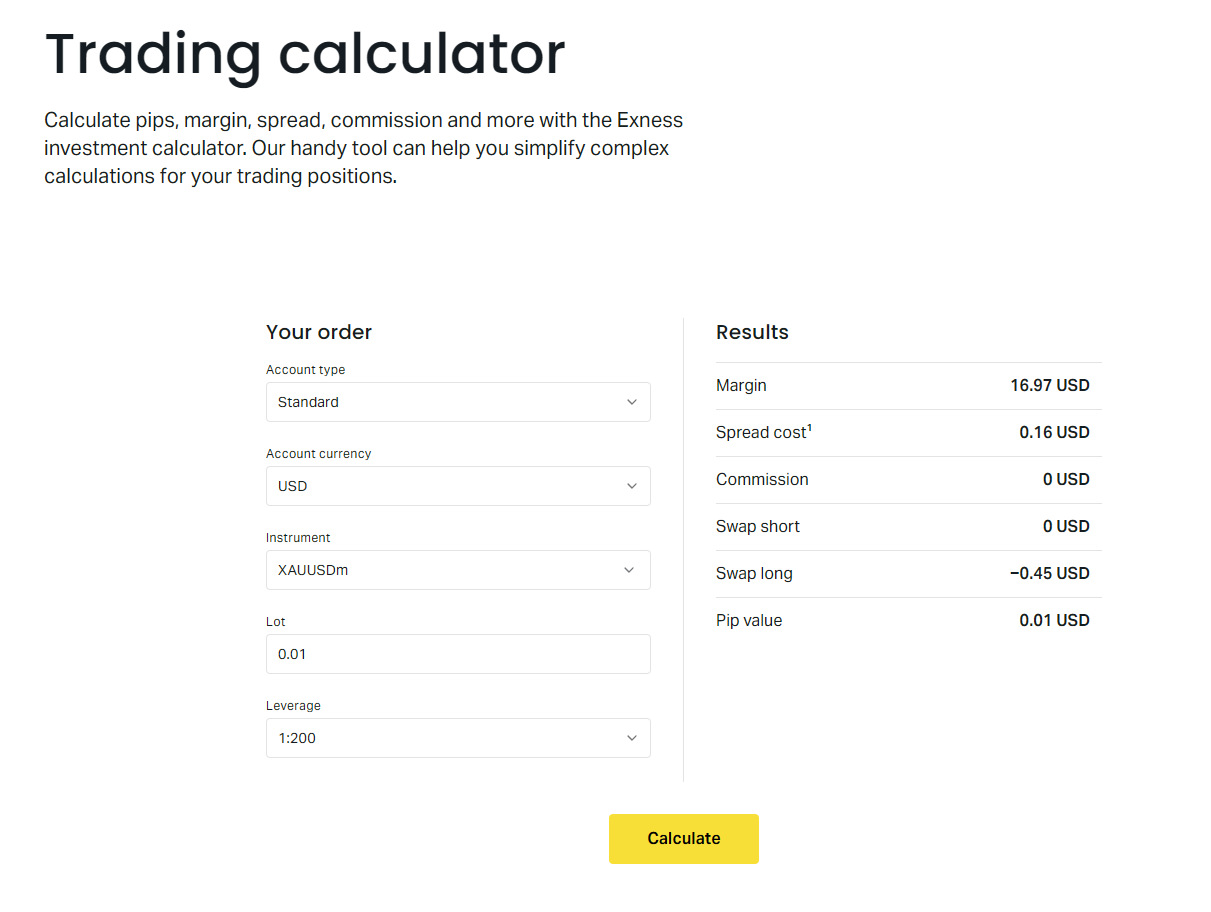
The Exness trading calculator integrates with all platforms and web terminal. It computes required margin, pip value in account currency, swap costs for long/short, and profit/loss at target levels. For USDCAD, pip value is $10 per standard lot, $1 per mini lot, $0.10 per micro lot when account currency is USD. The calculator adjusts automatically for non-USD base currencies.
Risk Management for USDCAD Positions
USDCAD's average daily range (ADR) over the past year sits around 80-100 pips. During high-volatility periods — oil shocks, central bank surprises — daily ranges can exceed 200 pips. Position sizing should account for this volatility. A common approach: risk 1-2% of account equity per trade, with stop loss placed beyond the recent swing high/low or key structural level, typically 20-40 pips for intraday, 60-100 pips for swing.
Exness offers negative balance protection across all regulated entities, meaning you cannot lose more than your account balance. Stop out level is 0% margin on most accounts (positions close automatically when equity hits zero), though some jurisdictions enforce 50% margin call / 20% stop out. The broker does not guarantee stop loss execution at the exact price during gaps or extreme volatility; slippage can occur.
- Set stop loss before entering, not after
- Use 1:2 or 1:3 risk-reward minimum for trend trades
- Reduce position size 50% during high-impact news windows
- Avoid holding large positions over weekends unless hedged
- Monitor oil correlation — if oil moves 3%+, expect CAD follow-through
Common USDCAD Trading Strategies on Exness
Three strategy categories work consistently on USDCAD given its drivers and Exness's conditions: trend following on oil correlation, range trading during low-volatility sessions, and news-based momentum trades around economic releases.
Oil Correlation Trend Following
When WTI crude trends clearly (higher highs/higher lows or lower highs/lower lows on 4-hour and daily charts), USDCAD tends to trend inversely. Enter on pullbacks to the 20-period EMA on 4-hour chart in the direction of the oil trend. Stop below recent swing low (long) or above swing high (short). Target 1:2 risk-reward or trail with 20 EMA. This works best 13:00-17:00 UTC when both oil and CAD liquidity peak.
Asian Session Range Fade
During 00:00-12:00 UTC, USDCAD often consolidates in a 20-40 pip range. Identify the Asian session high and low. Fade touches of these extremes with tight stops (5-8 pips beyond the extreme) targeting a return to the session midpoint or opposite extreme. Only take trades with 1:1.5 minimum risk-reward. Exit all positions by 12:00 UTC before London volume distorts the range. This strategy exploits low liquidity mean reversion but fails during oil news or geopolitical events.
News Straddle and Momentum
For high-impact releases (BoC rate decision, US CPI, NFP), place buy stop 10-15 pips above pre-news range high and sell stop 10-15 pips below range low, 2-3 minutes before release. Cancel the untriggered order immediately after the triggered order fills. Stop loss at the opposite side of the pre-news range. Target 1:2 or trail. Exness's fast execution and low slippage on Raw Spread/Zero accounts make this viable; on Standard accounts, spread widening often triggers both stops.
The best USDCAD trades on Exness combine a clear oil trend, clean technical structure on 4-hour charts, and entry during NY session liquidity. Everything else is noise.
Automated Trading and EAs for USDCAD
Exness supports expert advisors on MT4 and MT5 with no restrictions on strategy type, trading frequency, or holding time. The Zero account offers priority execution routing designed for EAs requiring minimal latency. VPS hosting is available free for clients meeting volume thresholds (typically 5 lots monthly) or for a monthly fee. The Exness VPS runs in Equinix NY4 data center, co-located with major liquidity providers, providing 1-2 ms latency to Exness trade servers.
For USDCAD EAs, the key considerations are spread sensitivity and session filtering. Strategies optimized for 0.5-1.0 pip spreads on backtests often fail on Standard accounts with 1.5+ pip effective costs. Raw Spread and Zero accounts provide the consistency needed for validated backtest-to-live correlation. Session filters should restrict trading to 12:00-18:00 UTC and disable new entries 15 minutes before/after high-impact news.
The Exness strategy tester in MT5 supports multi-currency backtesting, allowing USDCAD EAs to be tested against correlated pairs (USDJPY, AUDUSD, XAUUSD) simultaneously. This catches curve-fitting that single-pair backtests miss. MT4's tester is single-currency only but runs faster for simple strategies.
Deposit, Withdrawal, and Funding for USDCAD Traders
Exness processes deposits instantly for most methods: credit/debit cards, electronic wallets (Neteller, Skrill, WebMoney, Perfect Money), and local bank transfers in supported regions. Cryptocurrency deposits (USDT, USDC, BTC, ETH) credit within blockchain confirmation times. Minimum deposit is $10 for Standard/Standard Cent, $200 for Pro/Raw Spread/Zero. No deposit fees from Exness, though payment providers may charge.
Withdrawals process 24/7 including weekends for electronic methods. Card and bank withdrawals follow business hours. Exness charges no withdrawal fees. Minimum withdrawal matches minimum deposit by method. Verification (KYC) is required before first withdrawal — typically government ID and proof of address. The process completes within hours for most clients.
Regulatory Protection and Fund Safety
Exness operates through multiple regulated entities: Exness (SC) Ltd in Seychelles (FSA), Exness B.V. in Curaçao (CBCS), Exness (VG) Ltd in British Virgin Islands (FSC), and Exness ZA (Pty) Ltd in South Africa (FSCA). The entity serving you depends on your country of residence. European clients fall under CySEC regulation through Exness Europe Ltd (not currently active for new EU clients post-Brexit).
Client funds are segregated from operational funds at top-tier banks. Negative balance protection applies universally. The Investor Compensation Fund (ICF) covers eligible clients up to €20,000 under CySEC, though most non-EU entities rely on the broker's own capital adequacy rather than external compensation schemes. Exness publishes audited financial statements quarterly, showing capital ratios well above regulatory minimums.
For USDCAD traders, the practical implication is that your trading conditions — spreads, leverage, execution — remain consistent regardless of entity. The main differences appear in maximum leverage caps (1:2000 globally, 1:30 for EU retail under ESMA), available payment methods, and dispute resolution channels.
Practical Tips for Starting USDCAD on Exness
If you're new to USDCAD or Exness, start with a demo account. Exness demo accounts mirror live conditions exactly — same spreads, execution, swaps, and platform features. They don't expire. Use the demo to test your platform setup, verify spread costs during different sessions, and practice your strategy without risk.
- Open Standard Cent demo first — lets you trade real position sizes (0.01 lot = $0.10/pip) with $100 virtual balance
- Test your strategy across at least 50 trades before going live
- Compare Standard vs Raw Spread demo accounts to feel the cost difference
- Set up price alerts for key USDCAD levels and oil correlation breaks
- Add the economic calendar widget to your chart workspace
- Configure one-click trading with preset lot sizes for your risk model
When switching to live, start with the smallest position size your account type allows (0.01 lots Standard/Pro, 0.01 lots Raw Spread/Zero). Trade live for 20-30 trades at minimum size before scaling. The psychological difference between demo and real money appears even at $0.10/pip. Exness's instant withdrawal means you can pull profits daily if that helps discipline.
Most traders blow up not from bad strategy but from sizing too large too soon. Exness's cent accounts and micro lots exist for a reason — use them.
Comparing Exness USDCAD to Other Brokers
Exness competes on USDCAD primarily through spread compression, execution speed, and withdrawal reliability. Compared to typical market-maker brokers offering 1.5-2.5 pip fixed spreads on USDCAD, Exness's floating 0.3-1.2 pip range (account dependent) saves $5-15 per standard lot round-turn. Compared to raw-spread ECN brokers charging $6-10 commission per lot, Exness's $7 commission is mid-range but with better withdrawal track record.
Scroll horizontally to see all columns
| Feature | Exness Raw Spread | Typical ECN Broker | Typical Market Maker |
|---|---|---|---|
| Typical Spread | 0.0-0.2 pips | 0.1-0.3 pips | 1.5-2.5 pips fixed |
| Commission/Lot | $7 round-turn | $6-10 round-turn | Included in spread |
| Min Deposit | $200 | $100-500 | $10-100 |
| Withdrawal Speed | Instant (e-wallet) | 1-3 business days | 1-5 business days |
| Max Leverage | 1:2000 | 1:500 | 1:30-1:500 |
The leverage difference matters for margin efficiency but increases risk proportionally. Exness's 1:2000 maximum allows $50 margin for a standard lot of USDCAD versus $333 at 1:30. This frees capital for other positions or buffer but means a 50-pip move against you wipes 10% of a $5,000 account at max leverage. Most professional traders cap effective leverage at 1:10 to 1:20 regardless of maximum available.
Final Assessment of Exness USDCAD Trading
Exness delivers competitive USDCAD trading conditions across the board: tight spreads, multiple account structures matching different volume profiles, reliable execution during news, and platforms that support both discretionary and automated approaches. The broker's strength lies in consistency — spreads don't mysteriously widen outside news, withdrawals process without delay tactics, and the platform ecosystem works as advertised. For USDCAD specifically, the combination of NY-session liquidity access, oil correlation tools integrated into the web terminal, and cent accounts for risk-controlled scaling makes Exness a practical choice. The main limitation remains the lack of fixed-spread accounts for traders who need absolute cost certainty during volatile periods, and the 1:2000 leverage ceiling which, while high, encourages over-leveraging if not self-regulated. Traders who respect position sizing, trade during optimal sessions, and match account type to volume will find Exness USDCAD conditions among the most cost-effective available.
Frequently Asked Questions
What is the minimum deposit to trade USDCAD on Exness?
$10 for Standard and Standard Cent accounts, $200 for Pro, Raw Spread, and Zero accounts.
Does Exness charge swap fees on USDCAD overnight positions?
Yes, swap rates apply and differ for long vs short positions based on the USD/CAD interest rate differential. Islamic accounts are swap-free with adjusted spreads or commissions.
Which Exness account type is cheapest for high-volume USDCAD scalping?
Raw Spread or Zero accounts with $3.5 per side commission typically cost less than Standard accounts above 5-8 lots monthly volume.
Can I use expert advisors for USDCAD on Exness?
Yes, EAs are fully supported on MT4 and MT5 with no strategy restrictions. Zero account offers priority execution for algorithmic trading.
What are the best hours to trade USDCAD on Exness?
13:00-17:00 UTC (New York/Toronto overlap) offers tightest spreads and deepest liquidity. Avoid 00:00-12:00 UTC for most strategies.
Does Exness offer negative balance protection for USDCAD trading?
Yes, negative balance protection applies across all Exness regulated entities for all instruments including USDCAD.
How fast are Exness withdrawals for USDCAD profits?
Electronic wallet withdrawals process instantly 24/7. Card and bank withdrawals follow business hours. Exness charges no withdrawal fees.