

Forex Trading Education
Exness Lot Size: Complete Guide to Position Sizing and Costs
Position sizing, pip values, and cost calculations for Exness traders

Senior Forex Trader & Market Analyst
Daniel Chen is an experienced forex trader and financial market analyst with over 15 years of experience in currency trading. He specializes in technical analysis, risk management, and developing practical trading strategies to help traders make informed decisions.
Understanding lot size is fundamental to trading on Exness. Every position you open, every risk calculation you make, and every profit or loss you realize depends on the volume you choose. This guide covers how lot sizes work on Exness, what they cost, and how to size positions for your account and strategy.
Contents
- 1. What Is a Lot Size on Exness
- 2. Standard Lot vs Mini Lot vs Micro Lot
- 3. How Lot Size Affects Pip Value
- 4. Exness Lot Size Calculator: How to Use It
- 5. Lot Size Limits by Account Type
- 6. Trading Costs: Spreads and Commissions per Lot
- 7. Exness 1 Lot Charges Across Instruments
- 8. Exness 0.01 Lot Price for Micro Trading
- 9. Margin Requirements and Leverage Impact
- 10. Risk Management with Proper Position Sizing
- 11. Common Lot Size Mistakes to Avoid
- 12. Lot Size Considerations for Different Strategies
- 13. Using the Exness Mobile App for Lot Sizing
- 14. Final Assessment of Exness Lot Size Options
Exness offers flexible lot sizing across its account types. Standard and Standard Cent accounts allow micro lots from 0.01. Professional accounts — Raw Spread, Zero, and Pro — also start at 0.01 lot but with different cost structures. The maximum lot size per position reaches 200 lots on most instruments, though some exotic pairs and CFDs have lower caps.
A standard lot represents 100,000 units of the base currency. A mini lot is 10,000 units (0.10). A micro lot is 1,000 units (0.01). On cent accounts, the numbers look different — 1 lot equals 1,000 units of base currency, and the account balance displays in cents — but the risk mechanics remain the same. Knowing which denomination applies to your account prevents costly sizing errors.
What Is a Lot Size on Exness
Lot size defines the volume of a trade. On Exness, as with most MetaTrader brokers, volume is expressed in lots. One standard lot on a forex pair like EURUSD means you are buying or selling 100,000 euros. The quote currency (USD in this case) determines the pip value and margin requirement. For metals, energies, and indices, the contract specification defines what one lot represents — for example, 100 troy ounces for gold (XAUUSD) or 1,000 barrels for US crude oil (USOIL).
Exness displays lot sizes with two decimal places by default (0.01, 0.10, 1.00). The platform supports three decimal places for finer granularity (0.001) on some account types, though 0.01 remains the practical minimum for live trading. This precision matters when you scale positions to match a specific risk percentage. A trader with a $500 account risking 1% per trade ($5) on a 20-pip stop loss needs exactly 0.025 lots — impossible if the broker only allows 0.01 increments. Exness allows 0.01, 0.02, 0.03, and so on, giving you enough resolution for most account sizes.
The contract specifications page in your Personal Area or the Market Watch window in MetaTrader shows the exact lot definition for each symbol. Always check this before trading a new instrument. Assumptions about lot size — especially for indices, crypto, and shares — lead to positions that are far larger or smaller than intended.
Standard Lot vs Mini Lot vs Micro Lot
The three standard lot denominations serve different account sizes and risk tolerances. A standard lot (1.00) moves $10 per pip on EURUSD. A mini lot (0.10) moves $1 per pip. A micro lot (0.01) moves $0.10 per pip. These values assume a USD-denominated account and a quote currency of USD. Pairs like EURGBP or AUDJPY have different pip values because the quote currency is not USD, requiring a conversion step.
Standard accounts on Exness use the conventional definitions above. Standard Cent accounts are different: 1 lot = 1,000 units of base currency, and your balance shows in cents. A $100 deposit appears as 10,000 cents. Trading 1 lot on a cent account equals 0.01 lots on a standard account. The pip value on EURUSD for 1 cent lot is $0.001 (0.1 cents). This lets traders with very small deposits practice real position sizing without risking meaningful capital.
- Standard lot (1.00): 100,000 units base currency, ~$10/pip on EURUSD
- Mini lot (0.10): 10,000 units base currency, ~$1/pip on EURUSD
- Micro lot (0.01): 1,000 units base currency, ~$0.10/pip on EURUSD
- Cent account lot (1.00): 1,000 units base currency, ~$0.001/pip on EURUSD
Professional accounts (Raw Spread, Zero, Pro) use the same lot definitions as Standard accounts. The difference lies in spreads, commissions, and margin requirements — not in what a lot represents. A 1.00 lot on Raw Spread EURUSD still controls 100,000 euros. The cost to open and hold that position is lower, but the pip value and margin calculation follow the same formula.
How Lot Size Affects Pip Value
Pip value scales linearly with lot size. Double the lots, double the pip value. This relationship is the foundation of position sizing. For a USD-denominated account trading a pair where USD is the quote currency (EURUSD, GBPUSD, AUDUSD, NZDUSD), the formula is simple: pip value = lot size × 10. So 0.01 lot = $0.10 per pip, 0.10 lot = $1 per pip, 1.00 lot = $10 per pip.
When USD is the base currency (USDJPY, USDCHF, USDCAD), the pip value in USD changes with the exchange rate. For USDJPY, a pip is 0.01 JPY. The USD value of that pip is (0.01 / current USDJPY rate) × lot size × 100,000. At 150.00, one pip on 1 lot = (0.01 / 150) × 100,000 = $6.67. At 100.00, the same pip = $10. This means your risk per pip fluctuates with the rate, which matters for precise risk management on JPY pairs.
Cross pairs (EURGBP, EURJPY, GBPJPY, AUDNZD) require converting the pip value from the quote currency to your account currency. For EURGBP on a USD account, a pip is 0.0001 GBP. Convert GBP to USD at the current GBPUSD rate. The formula: pip value = lot size × 100,000 × 0.0001 × GBPUSD rate. At GBPUSD 1.2500, 1 lot EURGBP pip value = $12.50. Exness trading calculator handles these conversions automatically, but understanding the mechanics helps you verify the numbers.
Scroll horizontally to see all columns
| Pair Type | Example | Pip Value (1 Lot) | Pip Value (0.01 Lot) |
|---|---|---|---|
| USD Quote | EURUSD, GBPUSD | $10.00 | $0.10 |
| USD Base | USDJPY, USDCHF | Variable (~$6-10) | Variable (~$0.06-0.10) |
| Cross Pair | EURGBP, EURJPY | Variable (~$8-13) | Variable (~$0.08-0.13) |
Exness Lot Size Calculator: How to Use It
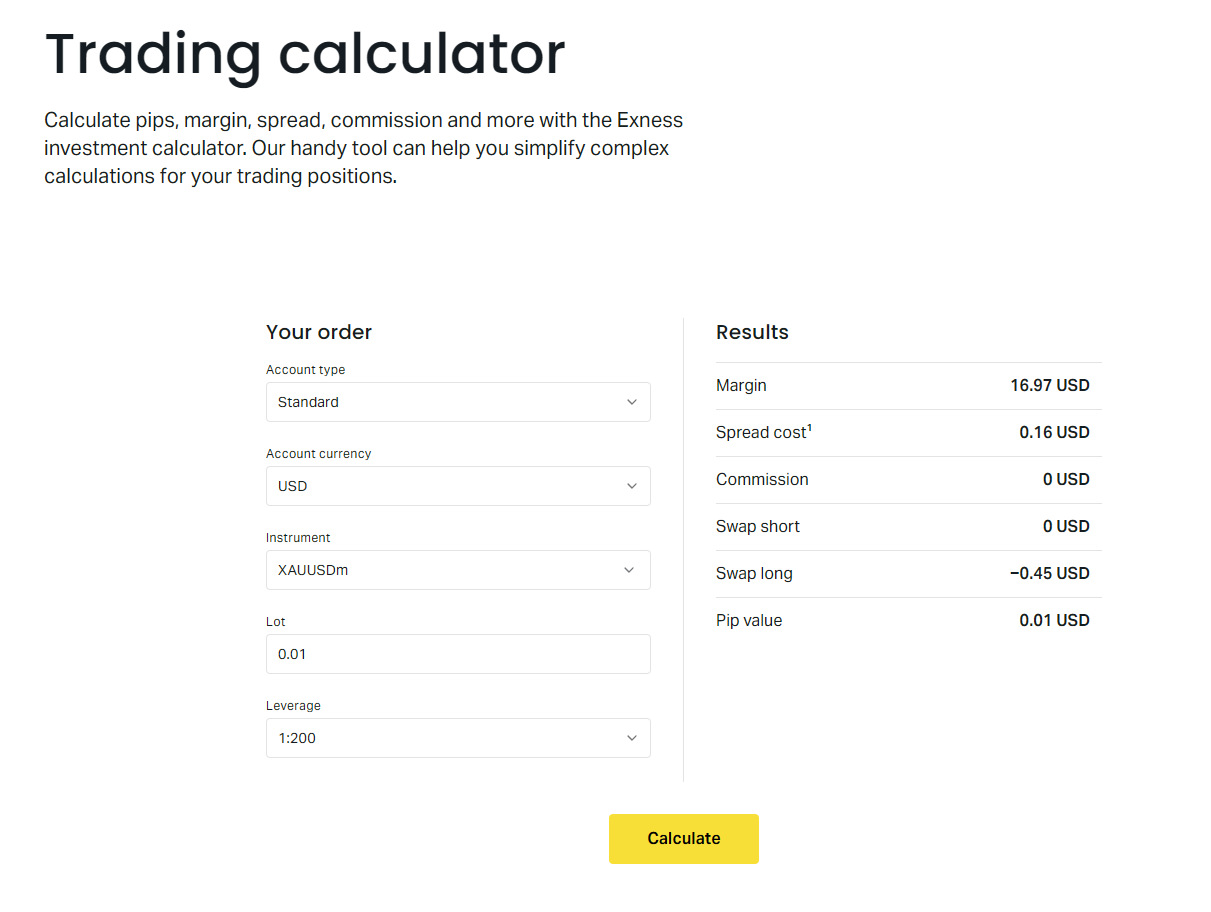
The Exness trading calculator is available in the Personal Area and on the website. It calculates margin, pip value, swap, and commission for any position size across all instruments. You select the account type, instrument, lot size, leverage, and account currency. The tool returns the required margin, pip value in your account currency, swap long and short, and commission if applicable. This is the fastest way to answer "what does 0.5 lots on XAUUSD cost in margin?" or "how much is a pip on 2 lots of US30?"
To use the calculator for position sizing, work backward from your risk tolerance. Decide your stop loss in pips and maximum risk in dollars. Divide risk by (stop loss pips × pip value per lot) to get the lot size. Example: $100 risk, 25-pip stop, EURUSD at $10/pip per lot. Lot size = 100 / (25 × 10) = 0.40 lots. Enter 0.40 into the calculator to confirm margin and pip value. This workflow prevents the common mistake of picking a lot size first and discovering the risk is too large.
The calculator also shows swap charges for holding positions overnight. Swap varies by instrument, direction (long/short), and account type. On Raw Spread and Zero accounts, swap-free conditions apply to certain instruments for eligible clients (Islamic accounts). Standard and Pro accounts charge swap on all positions held past 23:59 server time. Check the calculator before holding a trade through the weekend — triple swap applies Wednesday to Thursday for forex and metals.
Lot Size Limits by Account Type
Exness sets minimum and maximum lot sizes per account type and instrument. The minimum is 0.01 lots (0.001 on some professional accounts for certain symbols). The maximum per position is typically 200 lots for major forex pairs, 100 lots for minors and exotics, 50 lots for metals, 20 lots for energies, and 10-20 lots for indices and stocks. These limits are per ticket — you can open multiple positions to exceed the per-ticket cap, but total exposure limits still apply.
Standard and Standard Cent accounts share the same lot limits. The difference is the nominal value: 1 lot on Standard = 100,000 units; 1 lot on Cent = 1,000 units. A cent account trader hitting 200 lots controls 200,000 units — equivalent to 2 standard lots. This means cent accounts effectively have much lower maximum exposure, which aligns with their purpose as low-capital learning accounts.
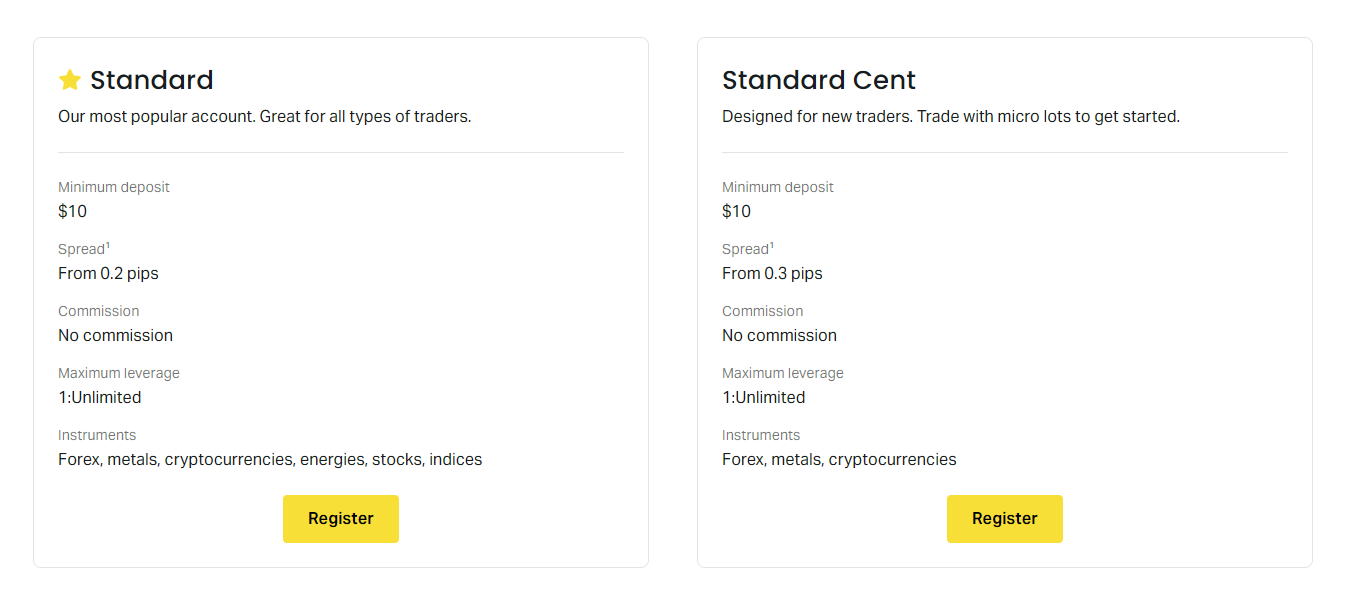
Professional accounts (Raw Spread, Zero, Pro) offer higher maximum leverage (up to 1:2000 vs 1:2000 on Standard, though both can reach unlimited leverage after equity thresholds). The lot size limits are identical, but the margin requirement per lot is lower at higher leverage. This means you can open larger positions with the same equity. Raw Spread and Zero accounts charge commission per lot — $3.50 per side per lot on Raw Spread, $0.00 to $3.50 on Zero depending on instrument — which affects the total cost of large positions.
Scroll horizontally to see all columns
| Instrument Class | Max Lots per Ticket | Typical Min Lot |
|---|---|---|
| Major Forex | 200 | 0.01 |
| Minor/Exotic Forex | 100 | 0.01 |
| Metals (Gold, Silver) | 50 | 0.01 |
| Energies (Oil, Gas) | 20 | 0.01 |
| Indices | 10-20 | 0.01 |
| Stocks/Crypto | 10-50 | 0.01 |
Trading Costs: Spreads and Commissions per Lot
The cost of trading one lot varies by account type and instrument. Standard and Standard Cent accounts are spread-only — no commission. The spread on EURUSD averages 0.3-0.5 pips on Standard, 0.3-0.5 pips on Standard Cent (same raw spread, but pip value is 100x smaller). At 0.5 pips spread, 1 lot EURUSD costs $5 to enter (0.5 × $10). On a cent account, 1 lot costs $0.05 (0.5 × $0.10).
Raw Spread account charges $3.50 per side per lot ($7 round trip) plus the raw spread. EURUSD raw spread averages 0.0-0.1 pips. Total cost per lot ≈ $7 + (0.05 × $10) = $7.50. Zero account charges $0 commission on forex and metals but with slightly wider spreads than Raw Spread. Pro account is spread-only like Standard but with tighter spreads (EURUSD from 0.1 pips) and higher minimum deposit.
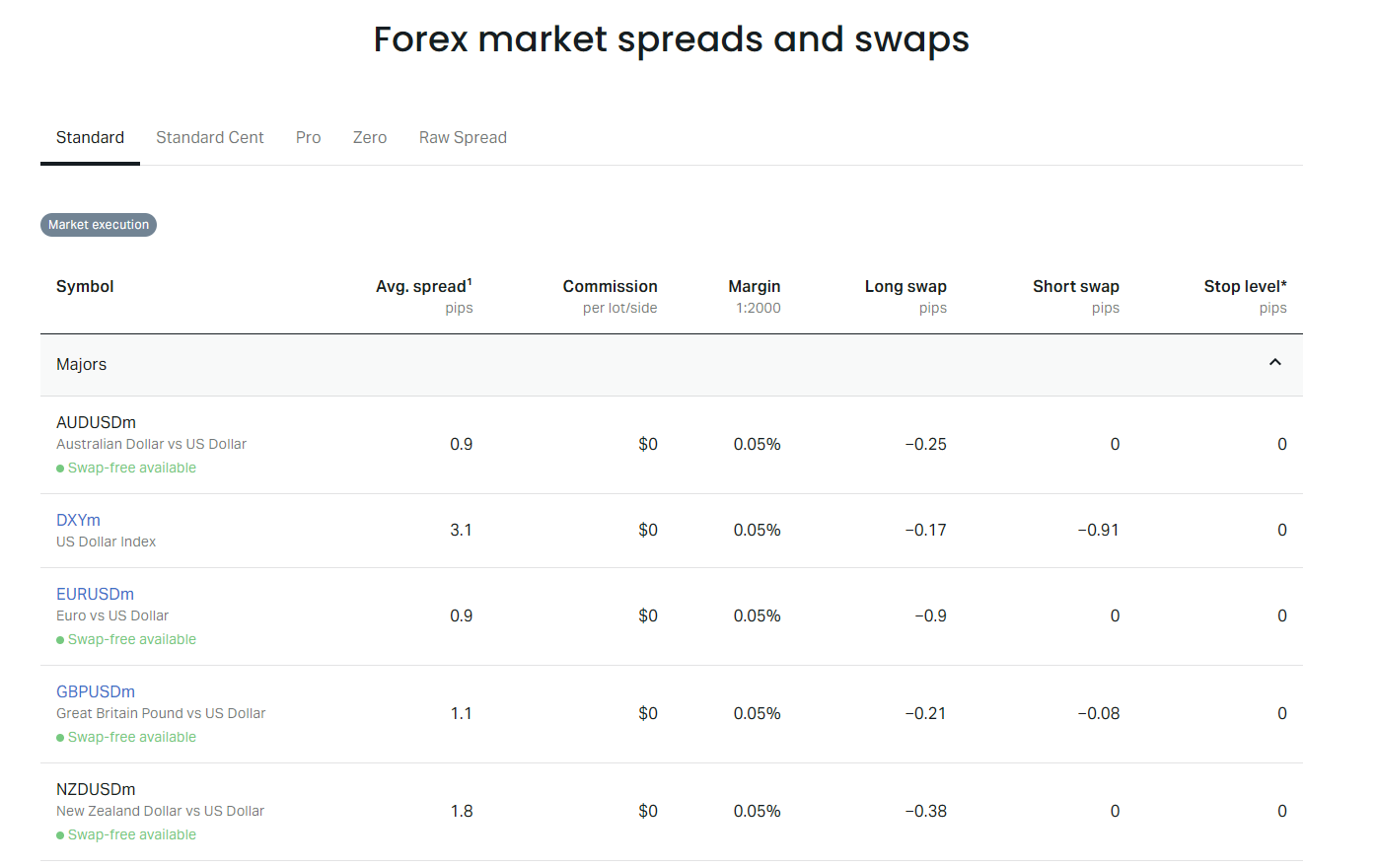
For high-frequency strategies or scalping, the commission model matters. A scalper doing 50 round trips per day on 1 lot EURUSD pays $350/day in commissions on Raw Spread ($7 × 50). On Pro account with 0.2 pip spread, the cost is $100/day (0.2 × $10 × 50). On Standard with 0.5 pip spread, $250/day. The break-even depends on your volume and spread sensitivity. Exness publishes average spreads per account type — use those with your expected trade frequency to model costs.
Exness 1 Lot Charges Across Instruments
The charge for 1 lot differs by instrument because spreads, contract sizes, and commission structures vary. On forex majors, 1 lot = 100,000 base units. On gold (XAUUSD), 1 lot = 100 troy ounces. On US crude (USOIL), 1 lot = 1,000 barrels. On US30 (Dow Jones), 1 lot = 1 contract × index price. The spread in pips or points translates to different dollar amounts per lot.
Example costs for 1 lot round trip on Standard account (spread only): EURUSD at 0.5 pips = $5. GBPUSD at 0.8 pips = $8. XAUUSD at 15 pips (0.15 USD per ounce) = $15. USOIL at 4 points = $4. US30 at 2.5 points = $2.50. These are approximate averages; spreads widen during news, rollover, and low liquidity. Always check current spread in Market Watch before entering.
On Raw Spread account, add $7 commission per lot round trip to the raw spread cost. EURUSD raw spread 0.05 pips = $0.50 + $7 = $7.50 total. XAUUSD raw spread 5 pips = $5 + $7 = $12. USOIL raw spread 2 points = $2 + $7 = $9. The commission is fixed per lot, so the percentage impact is higher on instruments with tight raw spreads. For gold, the spread dominates. For major forex, commission dominates.
Scroll horizontally to see all columns
| Instrument | Typical Spread | Cost per Lot |
|---|---|---|
| EURUSD | 0.5 pips | $5.00 |
| GBPUSD | 0.8 pips | $8.00 |
| XAUUSD (Gold) | 15 pips | $15.00 |
| USOIL (WTI) | 4 points | $4.00 |
| US30 (Dow) | 2.5 points | $2.50 |
| BTCUSD | 150 pips | $15.00 |
Exness 0.01 Lot Price for Micro Trading
Trading 0.01 lots (micro lot) is the entry point for small accounts. On a Standard USD account, 0.01 lot EURUSD has a pip value of $0.10. A 20-pip move changes your equity by $2. The spread cost at 0.5 pips is $0.05. Margin requirement at 1:2000 leverage is $0.50 (100,000 × 0.01 / 2000). At 1:500 leverage, margin is $2. At 1:100, margin is $10. This shows why leverage matters for micro accounts — it determines how many concurrent micro lots you can hold.
On a Standard Cent account, 0.01 lots is the minimum but represents only 10 units of base currency (since 1 cent lot = 1,000 units). The pip value on EURUSD is $0.001. A 20-pip move = $0.02. Spread cost = $0.0005. Margin at 1:2000 = $0.005. This extreme granularity lets you test strategies with real market conditions while risking pennies. The psychological experience differs from demo because real execution, slippage, and swap apply.
For a $100 Standard account, 0.01 lot per trade with a 20-pip stop risks $2 (2% of equity). That aligns with standard risk management. You could increase to 0.05 lots ($10 risk, 10%) but that leaves little room for drawdown. Most traders with accounts under $500 stay at 0.01-0.03 lots per position. The Exness calculator confirms the exact margin and pip value for your leverage and account currency.
Margin Requirements and Leverage Impact
Margin is the collateral required to open a position. Exness calculates margin as (contract size × lot size × current price) / leverage. For 1 lot EURUSD at 1.0800 with 1:500 leverage: (100,000 × 1 × 1.0800) / 500 = $216. At 1:2000: $54. At 1:100: $1,080. Higher leverage frees equity for more positions or larger stops, but it does not change the pip value or risk — it only changes the margin buffer before stop out.
Exness offers dynamic leverage: up to 1:2000 for equity under $2,000, then tiered reductions as equity grows. Above $2,000 equity, max leverage drops to 1:2000 (still). Actually, Exness provides unlimited leverage (effectively 1:21 billion) for accounts with equity over $1,000 that have traded 10 lots lifetime and 5 lots in the last 90 days. This means margin approaches zero for qualified traders. The practical limit becomes your risk tolerance, not margin.
Stop out level on Exness is 0% for most account types — positions close when margin level hits zero. Margin call is at 60% (notification only). This gives you full use of equity but requires discipline. A 1 lot EURUSD position at 1:500 leverage with $216 margin can lose $216 before stop out (about 20 pips). At 1:2000 with $54 margin, only 5 pips. The leverage choice directly determines your staying power for a given lot size.
Risk Management with Proper Position Sizing
Position sizing is the only risk control that works before a trade is open. The standard formula: lot size = (account equity × risk percentage) / (stop loss pips × pip value per lot). For a $1,000 account risking 2% ($20) with a 25-pip stop on EURUSD ($10/pip per lot): lot size = 20 / (25 × 10) = 0.08 lots. Round down to 0.07 or 0.08 depending on your precision preference.
This formula assumes the stop loss is fixed in pips. If you use structure-based stops (support/resistance, ATR multiples), the pip distance varies per trade. Recalculate lot size for each trade. Many traders skip this and use fixed lot sizes (e.g., always 0.10 lots). Fixed lots work only if your stop distance is consistent. Variable stops with fixed lots produce variable risk — sometimes 1%, sometimes 5% — which destroys account consistency.
Exness allows partial position closing. You can open 0.10 lots, close 0.04 at a target, move stop to breakeven on the remaining 0.06. This scales out of winners while protecting the initial risk. The lot size you enter initially should reflect the full position risk, not the scaled portion. Plan the scale-out levels before entry so the initial lot size matches total intended risk.
- Calculate lot size per trade using fixed fractional risk (1-2% per trade)
- Use the Exness calculator to verify margin and pip value
- Adjust for swap if holding overnight — it reduces effective risk capacity
- Track actual risk vs planned risk in a trading journal
- Reduce lot size during drawdowns, increase only after recovery
Common Lot Size Mistakes to Avoid
The most expensive mistake is confusing cent and standard lot values. A trader moves from cent to standard account, sees "1 lot" in the order window, and clicks buy — not realizing 1 standard lot = 100× the volume of 1 cent lot. The margin requirement jumps from $5 to $500 (at 1:2000). The pip value jumps from $0.001 to $10. A 10-pip move that used to be $0.01 becomes $100. Always verify the account type in the terminal title bar before placing orders.
Another mistake: ignoring the quote currency conversion on cross pairs. A trader sizes 0.50 lots EURGBP thinking pip value is $5 (like EURUSD). At GBPUSD 1.25, actual pip value is $6.25. A 30-pip stop risks $187.50 instead of $150 — 25% more risk than planned. The Exness calculator shows the correct pip value in your account currency. Use it for every new pair until you memorize the conversion.
Overleveraging via maximum position count is subtle. Exness allows many concurrent positions. A trader opens 10 positions of 0.10 lots each on correlated pairs (EURUSD, GBPUSD, AUDUSD, NZDUSD). Total exposure = 1.00 lot equivalent. A broad USD move hits all positions simultaneously. The margin may support it, but the risk is 10× the per-trade risk. Treat correlated positions as a single aggregate position for risk purposes.
Lot size is not a preference — it is a risk decision. Every lot you add multiplies both profit potential and loss exposure by the same factor.
Lot Size Considerations for Different Strategies
Scalpers use small stops (5-10 pips) and larger lots to capture small moves. A 5-pip stop on 1 lot EURUSD risks $50. To keep risk at 1% on a $5,000 account, max lot = 1.00. Scalpers often trade 0.50-2.00 lots per entry. The commission on Raw Spread ($7/lot round trip) becomes significant — 20 trades/day × 1 lot × $7 = $140/day in commissions. Pro account with tighter spreads but no commission often wins for high-frequency scalping.
Swing traders use wider stops (50-200 pips) and smaller lots. A 100-pip stop on 0.10 lots EURUSD risks $100. On a $10,000 account, that's 1% risk. Swing traders hold days to weeks, so swap accumulates. Check the calculator for swap long/short before entering. A negative swap of -$0.50 per lot per night on 0.10 lots = -$0.05/night. Over 30 days = -$1.50 — small but not zero. Positive swap can offset some cost.
Grid and martingale strategies add positions as price moves against them. Total lot size grows exponentially. Exness allows this (no hedging restrictions), but margin requirements grow with each added lot. A grid starting at 0.01 lots and doubling every 20 pips reaches 1.28 lots after 7 additions (0.01+0.02+0.04+0.08+0.16+0.32+0.64). Margin at 1:500 for 1.28 lots EURUSD ≈ $276. The account must withstand the drawdown to the final grid level. Most grid traders blow up because they size the first lot too large relative to equity.
Using the Exness Mobile App for Lot Sizing
The Exness Trade app includes a built-in calculator. Tap the calculator icon, select instrument, account type, lot size, and leverage. It shows margin, pip value, and swap. The app also lets you set default lot size per instrument in trading settings. This speeds up order entry — you tap buy/sell and the preset lot fills automatically. Set conservative defaults (0.01 or 0.02) to avoid accidental large orders.
On MetaTrader 4/5 mobile, the order window shows volume in lots. You can type 0.01, 0.02, etc. The platform does not show pip value or margin in the order window — you must check the calculator or terminal separately. MT5 shows margin in the trade tab after opening. For precise sizing on mobile, use the Exness app calculator first, then enter the lot size in MT4/MT5.
The Exness Web Terminal also has the calculator integrated. Since it runs in browser, you can keep the calculator open in one tab and the trading interface in another. This is useful for multi-monitor setups or when you need to check multiple instruments quickly before a news event.
Final Assessment of Exness Lot Size Options
Exness provides the lot size flexibility most traders need. Micro lots (0.01) are available on all account types. Maximum per-ticket limits (200 lots forex, 50 gold) accommodate institutional-scale positions. The three-decimal precision (0.001) on professional accounts allows fine-tuning for large accounts. Cent accounts offer a true micro-environment for learning with real execution.
The cost structure favors different styles on different accounts. Scalpers benefit from Raw Spread or Zero commissions. Swing traders on Standard or Pro avoid commission drag. High-volume traders qualify for unlimited leverage, removing margin as a constraint. The trading calculator is accurate and accessible across web, mobile, and desktop. It handles cross-currency pip conversions, swap, and commission automatically.
The main gaps are educational, not functional. Exness does not enforce position sizing rules — you can open 50 lots on a $500 account with unlimited leverage. The platform assumes you understand margin, pip value, and correlation risk. Traders who skip the calculator and guess lot sizes tend to overlever. The tools are there. Using them consistently is the trader's responsibility.
Frequently Asked Questions
What is the minimum lot size on Exness?
The minimum lot size on Exness is 0.01 lots (micro lot) for all account types. Some professional accounts allow 0.001 lots on certain instruments.
How much is 1 lot on Exness Standard account?
1 lot on a Standard account equals 100,000 units of the base currency. On EURUSD, 1 lot has a pip value of approximately $10.
What is the difference between Standard and Cent account lot sizes?
On a Standard account, 1 lot = 100,000 units. On a Cent account, 1 lot = 1,000 units. Cent account balances display in cents, so 1 cent lot pip value is 100x smaller than a standard micro lot.
How do I calculate the correct lot size for my risk?
Use the formula: lot size = (account equity × risk %) / (stop loss pips × pip value per lot). The Exness trading calculator automates this and shows margin requirements.
Does Exness charge commission per lot?
Raw Spread account charges $3.50 per side per lot ($7 round trip). Zero account charges $0 commission on forex and metals. Standard and Pro accounts are spread-only with no commission.
What is the maximum lot size per trade on Exness?
Maximum lots per position: 200 for major forex, 100 for minor/exotic pairs, 50 for metals, 20 for energies, 10-20 for indices and stocks. You can open multiple positions to increase total exposure.
How does leverage affect lot size on Exness?
Leverage determines margin required per lot, not pip value or risk. Higher leverage frees equity for more positions but does not change the dollar profit or loss per pip.