

Forex Broker Guides
Exness Deposit Methods: Complete Guide to Funding Your Account
Compare payment options, bonuses, and step-by-step deposit instructions for Exness traders.

Senior Forex Trader & Market Analyst
Daniel Chen is an experienced forex trader and financial market analyst with over 15 years of experience in currency trading. He specializes in technical analysis, risk management, and developing practical trading strategies to help traders make informed decisions.
Funding a trading account should be straightforward, but the details matter. Exness offers a wide range of deposit methods that vary by region, currency, and account type. Some options process instantly while others take a few business days. Fees, minimums, and bonus eligibility also differ across payment channels. This guide covers every method Exness currently supports, what each one costs, how long it takes, and which ones qualify for promotional offers.
Contents
- 1. Electronic Wallets and Instant Payment Systems
- 2. Bank Cards: Visa, Mastercard, and Regional Schemes
- 3. Bank Wire Transfers and Local Bank Deposits
- 4. Cryptocurrency Deposits
- 5. Deposit Bonuses and Promotional Offers
- 6. How to Make Your First Deposit Step by Step
- 7. Currency Conversion and Account Base Currency
- 8. Deposit Limits and Verification Tiers
- 9. Common Deposit Issues and How to Resolve Them
- 10. Internal Transfers Between Exness Accounts
- 11. Regional Payment Methods Worth Knowing
- 12. Deposit Fees: What Exness Charges vs. What Processors Charge
- 13. Security Practices for Safe Deposits
- 14. Deposit History and Reporting
- 15. Final Assessment of Exness Deposit Methods
The broker does not charge deposit fees on most methods, though third-party processors sometimes apply their own charges. Minimum deposit amounts start at $1 for many electronic options, but bank wires and certain local systems require higher thresholds. Processing speed is a key differentiator — cards and e-wallets typically credit funds within minutes, while bank transfers can take one to three business days depending on the originating bank and intermediary institutions.
Regional availability plays a major role. Traders in Southeast Asia, Africa, Latin America, and the Middle East often have access to local payment gateways that are not available to European or North American clients. These local methods frequently offer zero fees and instant crediting, making them the preferred choice where supported. The Exness Personal Area automatically displays only the methods available for your verified country of residence.
Electronic Wallets and Instant Payment Systems
E-wallets remain the fastest and most popular way to fund an Exness account. Skrill, Neteller, WebMoney, Perfect Money, and Sticpay process deposits instantly with no broker-side fees. Minimum deposits are typically $1 to $10 depending on the wallet. These methods also support withdrawals back to the same wallet, creating a closed loop that simplifies account management. Some regions offer additional local e-wallets such as GCash in the Philippines, M-Pesa in Kenya, or Paytm in India.
- Skrill — instant, $1 minimum, no Exness fee
- Neteller — instant, $1 minimum, no Exness fee
- WebMoney — instant, $1 minimum, no Exness fee
- Perfect Money — instant, $1 minimum, no Exness fee
- Sticpay — instant, $1 minimum, no Exness fee
- Local e-wallets — vary by country, often instant
One practical consideration: e-wallet deposits must originate from an account registered in the same name as your Exness profile. Third-party deposits are rejected for anti-money laundering compliance. If your wallet email differs from your Exness registration email, the transaction may still succeed but could trigger a manual review that delays crediting by several hours.
Bank Cards: Visa, Mastercard, and Regional Schemes
Credit and debit cards are universally supported and process instantly in most cases. Exness accepts Visa, Mastercard, and Maestro globally, plus regional schemes like UnionPay (China), JCB (Japan), and local debit networks in select markets. The minimum card deposit is $10. No Exness fee applies, but your card issuer may treat the transaction as a cash advance, which can incur interest from day one and a cash-advance fee of 2–5%.
Card withdrawals are limited to the total amount deposited via that card within the last 90 days. Profits must be withdrawn to a bank account or e-wallet. This rule is standard across regulated brokers and stems from card-network anti-fraud policies. The card must be in your name; corporate or third-party cards are not accepted.
The deposit screen in the Personal Area shows all available methods for your region with real-time minimums and estimated processing times. You can save card details for faster repeat deposits, though Exness does not store the full PAN — only a tokenized reference compliant with PCI DSS standards.
Bank Wire Transfers and Local Bank Deposits
International bank wires (SWIFT) are available for all account currencies. Minimum deposit is typically $500, though some regions set it at $1,000. Processing takes one to three business days. Exness does not charge a fee, but correspondent banks often deduct $15–$30 in transit fees. The amount credited to your trading account will be net of these deductions. Always instruct your bank to send the full amount with "OUR" fee instruction to minimize surprises.
Local bank transfers are a different product entirely. Exness partners with domestic payment processors in over 40 countries to offer near-instant bank deposits with low or zero fees. In Nigeria, for example, you can deposit via local bank transfer or USSD with instant crediting and a ₦1,000 minimum. In Brazil, PIX transfers credit within seconds. In Vietnam, local bank transfers via NAPAS process in minutes. These methods appear in the Personal Area only when your verified address matches the supported country.
Scroll horizontally to see all columns
| Method | Minimum | Speed | Exness Fee | Typical Third-Party Cost |
|---|---|---|---|---|
| SWIFT Wire | $500 | 1–3 business days | None | $15–30 correspondent fees |
| Local Bank Transfer | Varies (~$10 equiv.) | Instant to 1 hour | None | Usually zero |
| PIX (Brazil) | BRL 50 | Seconds | None | Zero |
| NAPAS (Vietnam) | VND 200,000 | Minutes | None | Zero |
Wire transfers require the sender name to match the Exness account holder exactly. Deposits from joint accounts are accepted if you are one of the named holders. Deposits from corporate accounts require additional documentation — a certificate of incorporation, board resolution authorizing the deposit, and identification of beneficial owners. Without these, the funds will be returned to source, which can take two to four weeks.
Cryptocurrency Deposits
Exness accepts Bitcoin (BTC), Tether (USDT ERC-20 and TRC-20), Ethereum (ETH), USD Coin (USDC), and several other major cryptocurrencies. Crypto deposits credit after the required network confirmations — typically 1 for USDT TRC-20, 3 for USDT ERC-20, and 3 for BTC. There is no maximum deposit limit. Minimums are low: 0.0001 BTC, 10 USDT, 0.01 ETH. Exness charges no fee, but you pay the network miner fee from your wallet.
Crypto withdrawals follow the same network rules. The minimum withdrawal amounts mirror deposit minimums. Processing is automated and usually completes within 30 minutes once the blockchain confirms. Note that crypto deposits do not qualify for most deposit bonus promotions — the terms typically specify "fiat payment methods only."
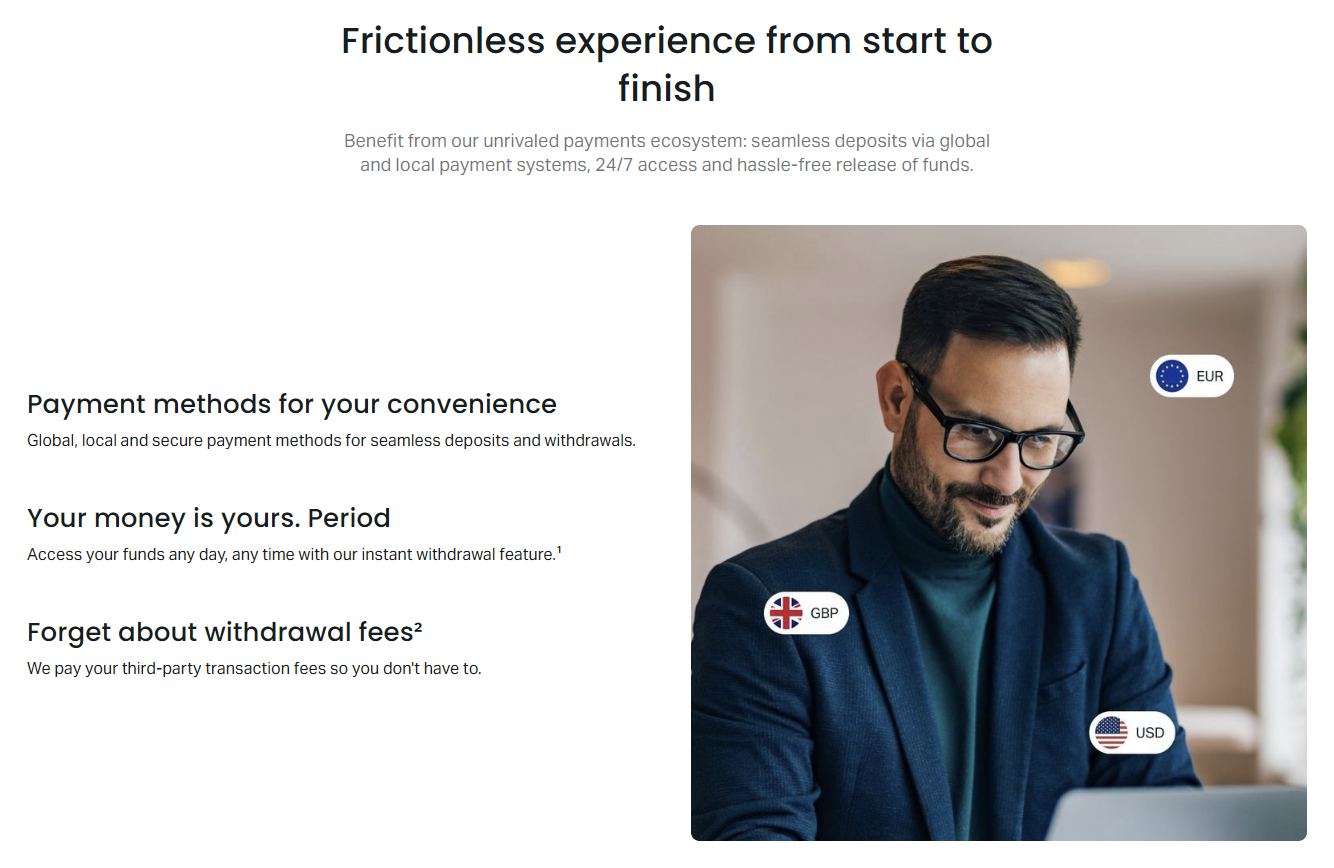
The payments dashboard lets you filter by country, currency, and method type. It also displays any active promotional offers tied to specific deposit channels. This is the most reliable way to check current availability since the list changes as Exness adds new local processors or discontinues underused ones.
Deposit Bonuses and Promotional Offers
Exness runs deposit bonus campaigns periodically, but they are not permanent features. The most common structure is a percentage match on the first deposit — for example, a 50% bonus up to $500 — credited as withdrawable equity after meeting a trading volume requirement. The volume target is usually expressed in lots: trade X lots to unlock the bonus for withdrawal. Unlocked bonus funds become part of your free margin and can be withdrawn at any time.
Bonus terms vary by campaign. Some require a minimum deposit of $50 or $100 to activate. Others restrict eligible payment methods — bank wires and crypto are frequently excluded. The bonus amount itself cannot be withdrawn until the volume condition is met, but profits generated from trading with the bonus are withdrawable immediately. If you request a withdrawal before completing the volume, the bonus is forfeited proportionally.
- Check the Promotions page in Personal Area for current offers
- Read the full terms — volume requirements differ by campaign
- Bonus eligibility often excludes internal transfers and crypto
- Only one active bonus per client at a time
- Bonus expires if volume target not met within the campaign period
How to Make Your First Deposit Step by Step
The deposit process is identical across methods once you reach the payment gateway. Log into your Personal Area, click "Deposit," select your preferred method, enter the amount, and confirm. You will be redirected to the processor's page (card form, e-wallet login, or bank instructions). Complete the payment there. The funds appear in your trading account once the processor notifies Exness — instantly for cards and e-wallets, after confirmations for crypto, and after settlement for bank transfers.
- Verify your account (KYC) before depositing — unverified accounts have strict limits
- Choose a method available in your country of residence
- Ensure the payment source matches your Exness registration name
- Enter an amount at or above the method minimum
- Save the transaction ID or receipt for reference
If a deposit does not appear within the expected timeframe, check the transaction status in the Personal Area "History" tab. Pending status means Exness is waiting for processor confirmation. Failed status means the processor declined the transaction — common reasons include insufficient funds, 3D Secure failure, or bank fraud blocks. Contact Exness support with the transaction ID if the status remains pending beyond the published maximum processing time.
Currency Conversion and Account Base Currency
Your Exness trading account has a base currency (USD, EUR, GBP, CHF, JPY, PLN, ZAR, and others). Deposits in a different currency are converted at the Exness internal rate, which includes a small spread over the mid-market rate — typically 0.5% to 1.5% depending on the currency pair. The conversion happens automatically when the funds reach Exness. You see the converted amount in your account balance; the original deposit currency and amount are shown in the transaction history.
To avoid conversion costs, deposit in your account base currency whenever possible. If you hold a multi-currency e-wallet (Skrill, Neteller, Sticpay), set the wallet currency to match your trading account. For bank wires, instruct your bank to send in the account base currency. Some local bank transfer methods only support the local currency, in which case conversion is unavoidable but the rate is still competitive compared to retail bank spreads.
Scroll horizontally to see all columns
| Base Currency | Common Deposit Currencies | Est. Conversion Spread |
|---|---|---|
| USD | USD, EUR, GBP, BTC, USDT | 0.5–1.0% |
| EUR | EUR, USD, GBP, CHF | 0.5–1.0% |
| GBP | GBP, EUR, USD | 0.5–1.2% |
| ZAR | ZAR, USD, EUR | 1.0–1.5% |
| NGN (via local transfer) | NGN only | N/A — local currency |
Exness also offers a currency converter tool in the Personal Area that shows the exact rate before you confirm a cross-currency deposit. Use it to compare the cost of depositing in your local currency versus converting first via your bank or e-wallet. Sometimes your bank's rate is better; sometimes Exness is better. The difference is usually a few dollars per thousand.
Deposit Limits and Verification Tiers
Unverified accounts (no KYC completed) face a lifetime deposit limit of $2,000 equivalent across all methods. Once you submit identity and address documents and they are approved — usually within a few hours — the limit is removed entirely. There is no maximum deposit for verified accounts. However, individual payment methods have their own per-transaction and daily limits set by the processor. For example, a single card deposit may be capped at $10,000, while a Skrill transaction might allow $50,000.
Professional clients (those who qualify under MiFID II or equivalent regimes) have the same deposit limits as retail clients. The distinction affects leverage and margin requirements, not funding. Corporate accounts require additional verification — certificate of incorporation, register of directors, and beneficial owner declarations — before any deposits are accepted.
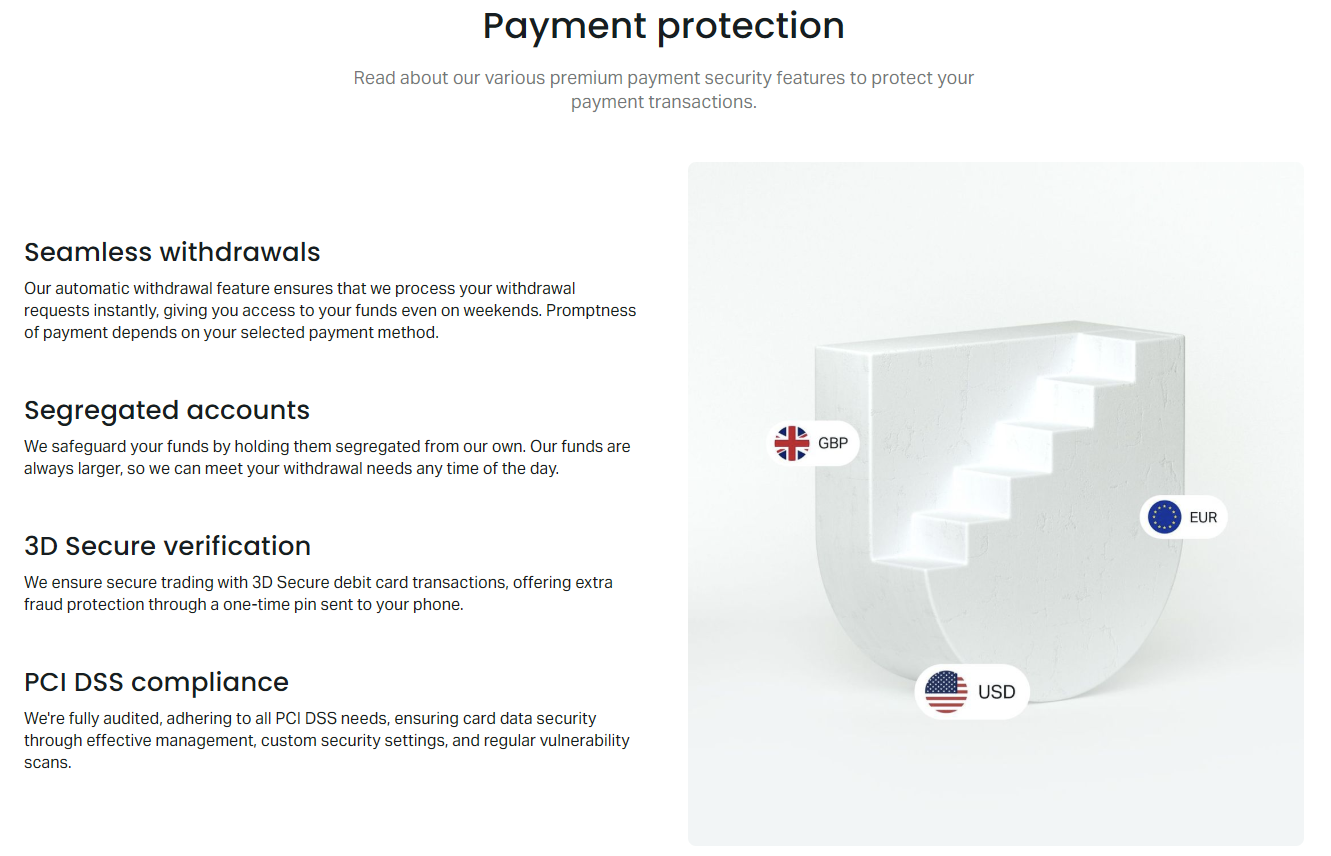
Client funds are held in segregated accounts at top-tier banks, separate from Exness operational capital. This segregation means that even in the unlikely event of broker insolvency, your deposits are not available to creditors. Exness also participates in investor compensation schemes where applicable (e.g., FSCS in the UK up to £85,000, ICF in Cyprus up to €20,000). The protection applies per client, per entity — not per account.
Common Deposit Issues and How to Resolve Them
Most deposit problems fall into a few categories. Card declines are the most frequent — usually due to bank fraud rules, insufficient funds, or 3D Secure failure. The fix is to contact your bank, confirm the transaction is legitimate, and retry. E-wallet failures often stem from mismatched names or unverified wallet accounts. Bank wire delays are typically caused by incomplete beneficiary details (missing SWIFT/BIC, intermediary bank, or purpose of payment). Crypto deposits that show fewer confirmations than required will remain pending until the network catches up.
- Card declined: call bank, authorize forex/MCC 6211, retry
- E-wallet pending: verify wallet KYC, ensure name match
- Wire not arrived: confirm sender used correct beneficiary details
- Crypto stuck: check blockchain explorer for confirmations
- Wrong amount credited: contact support with transaction ID
Exness support operates 24/7 via live chat, email, and phone in multiple languages. For deposit issues, live chat is fastest — agents can see the transaction status in real time and often resolve card or e-wallet problems within minutes. Bank wire inquiries may require escalation to the payments team, which can add a few hours. Always have your transaction ID, deposit method, amount, and timestamp ready when contacting support.
Internal Transfers Between Exness Accounts
If you hold multiple Exness accounts (for example, a Standard and a Raw Spread account), you can move funds between them instantly with no fee using the internal transfer feature in the Personal Area. The transfer is immediate and does not count as a deposit or withdrawal for bonus or volume purposes. Both accounts must be under the same Personal Area (same email login). You cannot transfer between different clients' accounts — that would be a withdrawal followed by a deposit, subject to normal processing times and potential fees.
Internal transfers are useful for allocating capital across strategies or account types without triggering withdrawal processing. They also preserve any active bonus progress on the source account — the bonus stays with the account it was earned on. If you close an account with an active bonus, the bonus is forfeited. Transfer the funds first, then close the empty account if needed.
Internal transfers are the only way to move money between your own Exness accounts without leaving the ecosystem. Treat them as bookkeeping, not funding.
Regional Payment Methods Worth Knowing
Exness invests heavily in local payment integrations because they reduce friction for traders in emerging markets. In Thailand, TrueMoney and PromptPay enable instant baht deposits with zero fees. In Indonesia, virtual accounts from major banks (BCA, Mandiri, BRI) and e-wallets like Dana, OVO, and ShopeePay are supported. In South Africa, Ozow and instant EFT process in minutes. In Mexico, SPEI transfers credit instantly. In Colombia, PSE bank transfers are the standard. Each method appears automatically when your verified address is in that country.
Scroll horizontally to see all columns
| Country | Method | Currency | Speed | Min Deposit |
|---|---|---|---|---|
| Thailand | PromptPay / TrueMoney | THB | Instant | THB 300 |
| Indonesia | Virtual Account / Dana | IDR | Instant | IDR 100,000 |
| South Africa | Ozow / Instant EFT | ZAR | Minutes | ZAR 150 |
| Mexico | SPEI | MXN | Instant | MXN 200 |
| Colombia | PSE | COP | Minutes | COP 50,000 |
| Nigeria | Local Bank / USSD | NGN | Instant | NGN 1,000 |
| Vietnam | NAPAS / MoMo / ZaloPay | VND | Minutes | VND 200,000 |
| Philippines | GCash / PayMaya / Bank | PHP | Instant | PHP 500 |
These local methods are often the cheapest and fastest option for residents. They bypass SWIFT entirely, eliminating correspondent fees and multi-day delays. The trade-off is that they only work in one direction — deposits. Withdrawals to the same local method are sometimes supported but not guaranteed. Check the withdrawal tab in the Personal Area to see which of your deposit methods also accept payouts.
Deposit Fees: What Exness Charges vs. What Processors Charge
Exness itself charges zero deposit fees on every method. This is a firm policy and a competitive differentiator. However, third-party processors — card networks, e-wallet operators, banks, crypto miners — impose their own fees. Card issuers may charge cash-advance fees (2–5%) and foreign-transaction fees (1–3%). E-wallets may charge upload fees (Skrill 1–2.5% for card top-up, Neteller 2.5%). Bank wires incur correspondent fees ($15–30). Crypto requires network miner fees (variable, $0.50–$5 for USDT, $2–$20 for BTC depending on congestion).
The total cost of a deposit is the sum of all these layers. A $1,000 deposit via credit card could cost $30–$80 in issuer fees plus a 1% conversion spread if your card currency differs from your account base currency. The same $1,000 via local bank transfer in your account currency might cost $0. The difference compounds over time for active traders who fund regularly.
Security Practices for Safe Deposits
Exness employs multiple security layers: 2FA (SMS, authenticator app, or email), device fingerprinting, withdrawal password (separate from login password), and anti-phishing codes in official emails. For deposits specifically, the main risk is phishing — fake Exness login pages that steal credentials and then initiate unauthorized deposits from linked cards or wallets. Always access the Personal Area by typing the URL directly or using the official mobile app. Never click deposit links in unsolicited emails or messages.
- Enable 2FA — authenticator app is more secure than SMS
- Set a withdrawal password different from your login password
- Bookmark the official Exness Personal Area URL
- Verify the anti-phishing code in emails from Exness
- Do not save card details on shared or public devices
If you suspect unauthorized access, change your password immediately, revoke all active sessions in the security settings, and contact support to freeze withdrawals. Exness can block outbound transactions while investigating. Deposits already processed cannot be reversed by Exness — you would need to dispute with the payment processor (chargeback for cards, wallet support for e-wallets). Chargebacks on trading accounts typically result in permanent account closure.
The fastest way to lose money on a deposit is falling for a phishing link. No bonus or urgency justifies skipping the URL check.
Deposit History and Reporting
Every deposit appears in the Personal Area transaction history with timestamp, method, amount in deposit currency, amount in account currency, conversion rate (if applicable), fees (if any), and status. You can filter by date range, method, and status. The history exports to CSV and PDF for tax or accounting purposes. Exness does not issue formal deposit certificates, but the PDF export with the broker's letterhead is generally accepted by tax authorities and auditors as proof of funding.
For corporate clients, the transaction history includes the sender entity name and reference field, which helps with reconciliation. If you need a stamped confirmation letter, contact support — they can issue one on company letterhead for verified corporate accounts. This service is free but may take one to two business days.
Frequently Asked Questions
What is the minimum deposit for Exness?
The absolute minimum is $1 for most e-wallets and crypto. Card deposits require $10. Bank wires start at $500. Local bank transfers vary by country but are typically equivalent to $10–$20.
Does Exness charge deposit fees?
No. Exness does not charge any deposit fees on any method. Third-party processors (banks, card networks, e-wallets, crypto networks) may apply their own fees.
How long does an Exness deposit take?
Cards and e-wallets: instant to a few minutes. Crypto: after network confirmations (typically 5–30 minutes). Local bank transfers: instant to 1 hour. SWIFT wires: 1–3 business days.
Can I deposit using someone else's card or wallet?
No. The payment source must be in the same name as the Exness account holder. Third-party deposits are rejected for AML compliance.
Do crypto deposits qualify for deposit bonuses?
Usually not. Most Exness deposit bonus campaigns explicitly exclude cryptocurrency deposits. Check the specific promotion terms.
What happens if I deposit before completing verification?
You can deposit up to $2,000 total on an unverified account. Withdrawals are blocked until KYC is approved. Complete verification first to avoid limits.
Can I change my account base currency after depositing?
No. Base currency is set at account creation and cannot be changed. Open a new account with the desired base currency if needed.
Why is my card deposit showing as pending?
Pending means Exness is waiting for the card processor to confirm the transaction. This usually resolves within minutes. If it exceeds 30 minutes, contact support with the transaction ID.
Final Assessment of Exness Deposit Methods
Exness deposit infrastructure is broad, fast, and largely free on the broker side. The standout feature is the depth of local payment integrations — traders in supported emerging markets get instant, zero-fee funding that rivals domestic fintech apps. For everyone else, cards and e-wallets provide reliable instant access with minimums as low as $1. Bank wires remain the only option for very large transfers but carry correspondent fees and delays. Crypto works well for those already holding digital assets, though bonus exclusion is a drawback. The main friction points are card cash-advance classification (bank-dependent) and the $2,000 unverified-account cap. Complete KYC first, pick a local method if available, and you will rarely think about deposits again.